Published October 25, 2026, 11:47 · by the Triops.me Editorial Team · Back to Articles
Beelzebufo: The Devil Frog With a Wolf's Bite
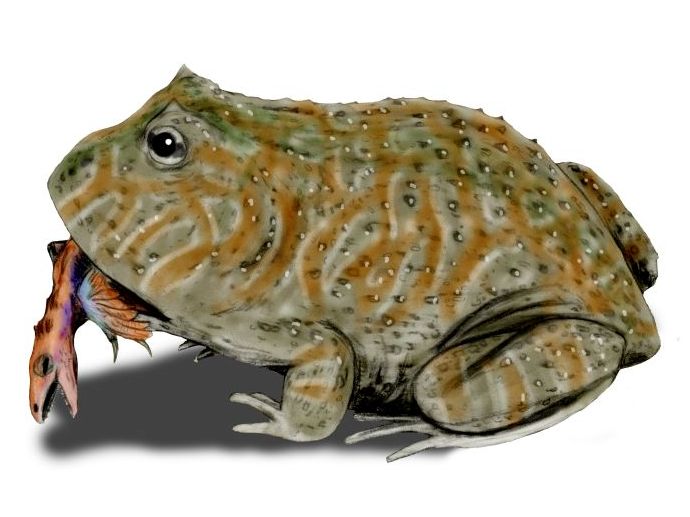
Most frogs are snacks. A heron takes one, a fish takes one, a grass snake takes one, and the frog's contribution to the food web is mostly protein for something larger. Roughly 70 million years ago, in the floodplains of what is now northwestern Madagascar, one frog refused that role. It was called Beelzebufo ampinga, and it sat in the leaf litter with a mouth wide enough to take animals the size of itself.
The name means devil toad, and the press immediately upgraded it to devil frog and even frog from hell. Behind the nicknames is a genuine oddity: an amphibian built like a bulldog, armoured with bony plates, with a bite that modelling puts in the same league as a wolf's. This is what the bones say about the largest frog we know of from the age of dinosaurs.
Bones From a Lost Island
The first fragments turned up in 1993, found by David Krause of Stony Brook University during fieldwork in the Maevarano Formation of Madagascar. The animal was not formally named until 2008, when Susan Evans, Marc Jones and Krause published it in the Proceedings of the National Academy of Sciences under the title "A giant frog with South American affinities from the Late Cretaceous of Madagascar".
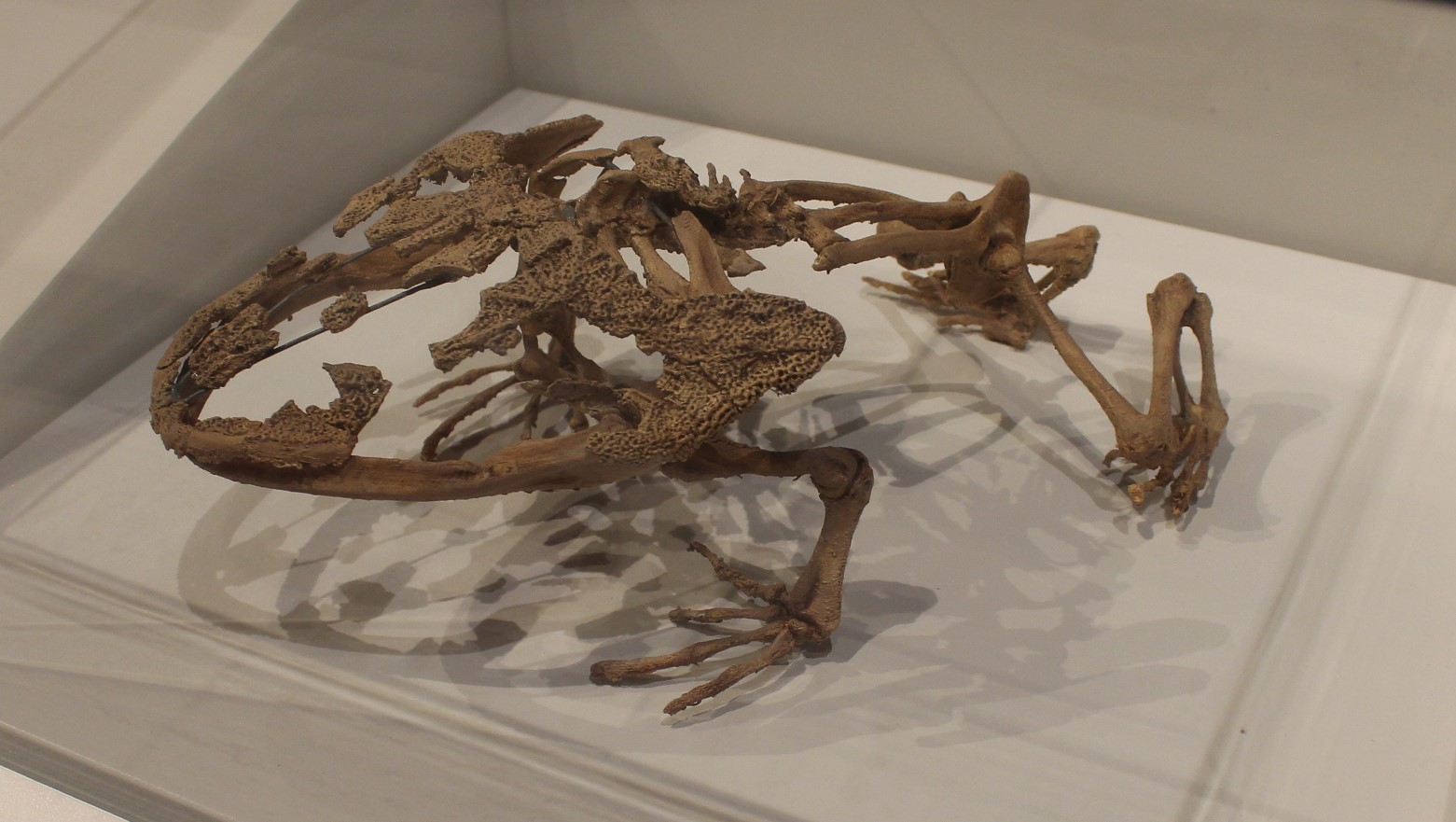
Between 1993 and 2011, roughly a hundred isolated bones were collected, plus some articulated skull material that finally let researchers rebuild most of the braincase and skull roof. Frog skeletons are famously flimsy, so most species are known from a handful of scraps, if at all. Beelzebufo had an advantage: it was hyperossified, its bones thickened, fused and knobbly. Armour is bad for agility and excellent for preservation.
How Big Was the Devil Frog?
Big, but not monster big. The original 2008 description suggested a snout to vent length of up to 42.5 cm, close to a foot and a half of frog. Later work, using better material, settled on a more conservative figure of at least 23.2 cm, roughly the size a modern African bullfrog reaches. That is a heavy, wide animal, the sort of frog that makes people step back in a pet shop.
The skull is where Beelzebufo really departs from the ordinary. It was enormous relative to the body, and the skull roof carries a rough, pitted surface that suggests bony scutes sat on top of the head. Even in the largest known specimens the skull sutures are still open, which means the biggest individuals had not finished growing when they died. A frog the size of a small dog is a reasonable floor, not a ceiling. As with many lineages, the story of size is really a story about growth, as explored in why prehistoric animals grew so big.
A Bite Measured Like a Wolf's
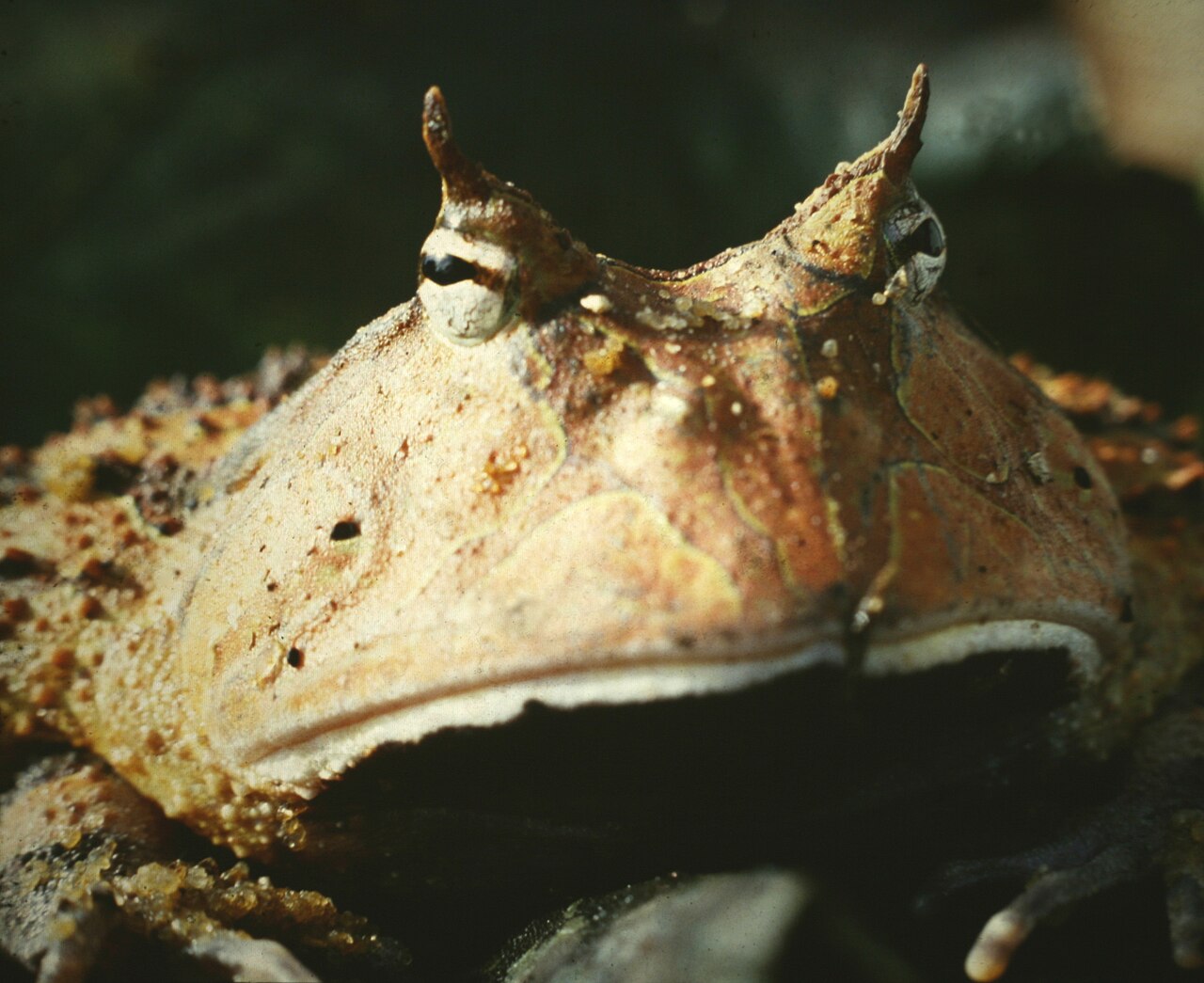
Frog bites are usually not worth mentioning, which is exactly why the 2017 study led by Kristopher Lappin and Marc Jones made headlines. The team built a custom bite force device, a transducer sandwiched between leather covered plates, and got the first direct bite force measurements ever published for a frog. Their test subjects were living South American horned frogs of the genus Ceratophrys, Pac-Man shaped ambush predators that seize prey as large as themselves.
The measurements went from about 30 newtons for a frog with a two inch wide head to close to 500 newtons at around five inches. Scaling that relationship up to the 15.4 cm skull width of a large Beelzebufo produced a projection of somewhere between 500 and 2,200 newtons, more than 200 kilograms of force, in the range of a wolf or a female tiger. As the researchers put it, at that force the frog was capable of subduing the small and juvenile dinosaurs that shared its habitat. It is a model built on living relatives rather than a measurement from a fossil, but even the low end is startling for an amphibian.
The Neighbours of the Maevarano
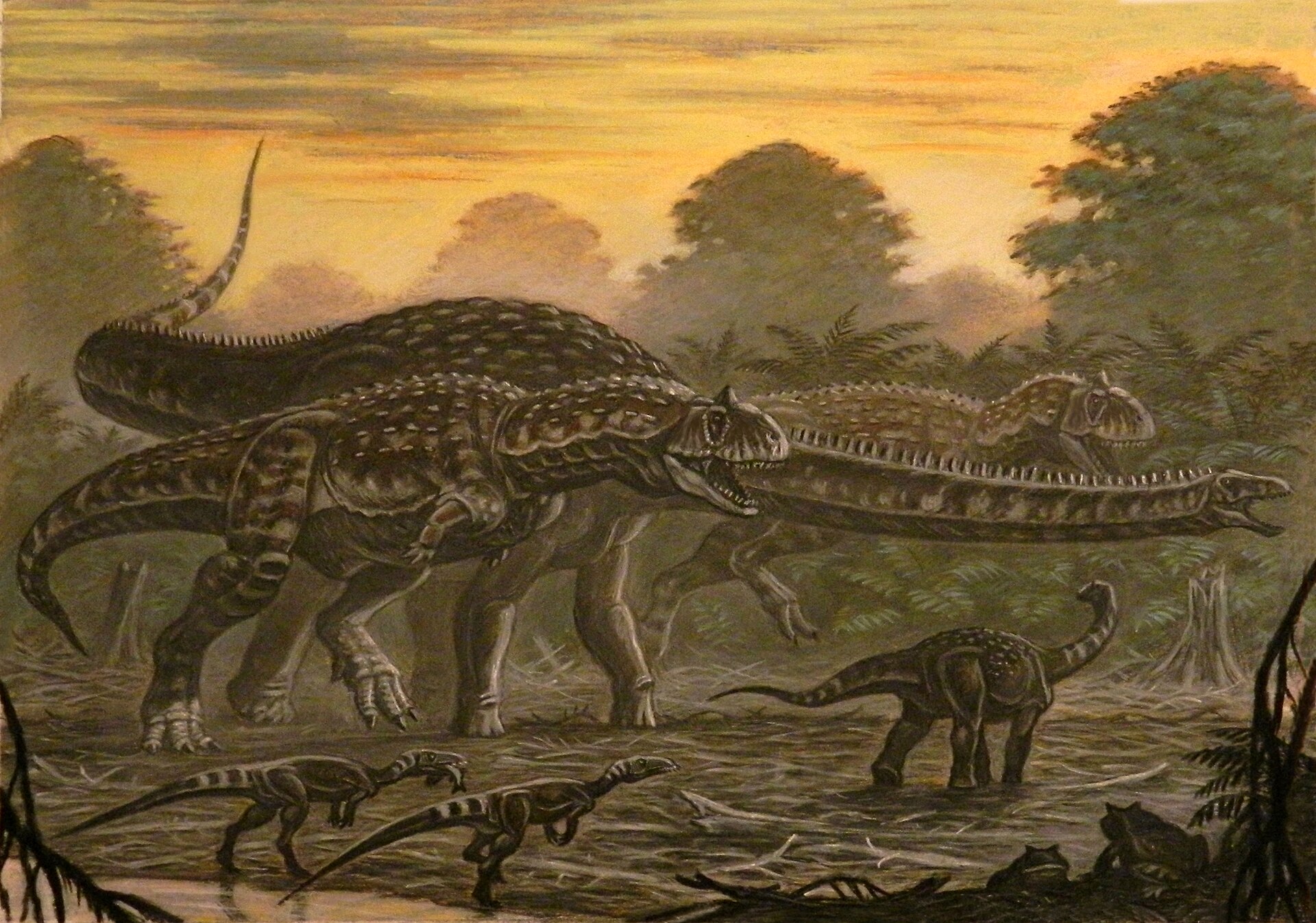
Madagascar in the late Cretaceous was an island continent on its way south, still riding with India, and its animals had evolved in isolation for tens of millions of years. The Maevarano Formation preserves a seasonal world of rivers, droughts and floods, and it has produced one of the finest Gondwanan fossil faunas anywhere.
Beelzebufo did not live alone. Majungasaurus, a stocky abelisaurid seven metres long, was the apex predator. Masiakasaurus, a small theropod with forward pointing knife teeth, hunted in the undergrowth. Rapetosaurus, a titanosaur, walked the plain on pillar legs, and the bird like Rahonavis patrolled the air. The small herbivorous crocodile Simosuchus, with its short pug nose and leaf shaped teeth, rooted around the floodplain as well.
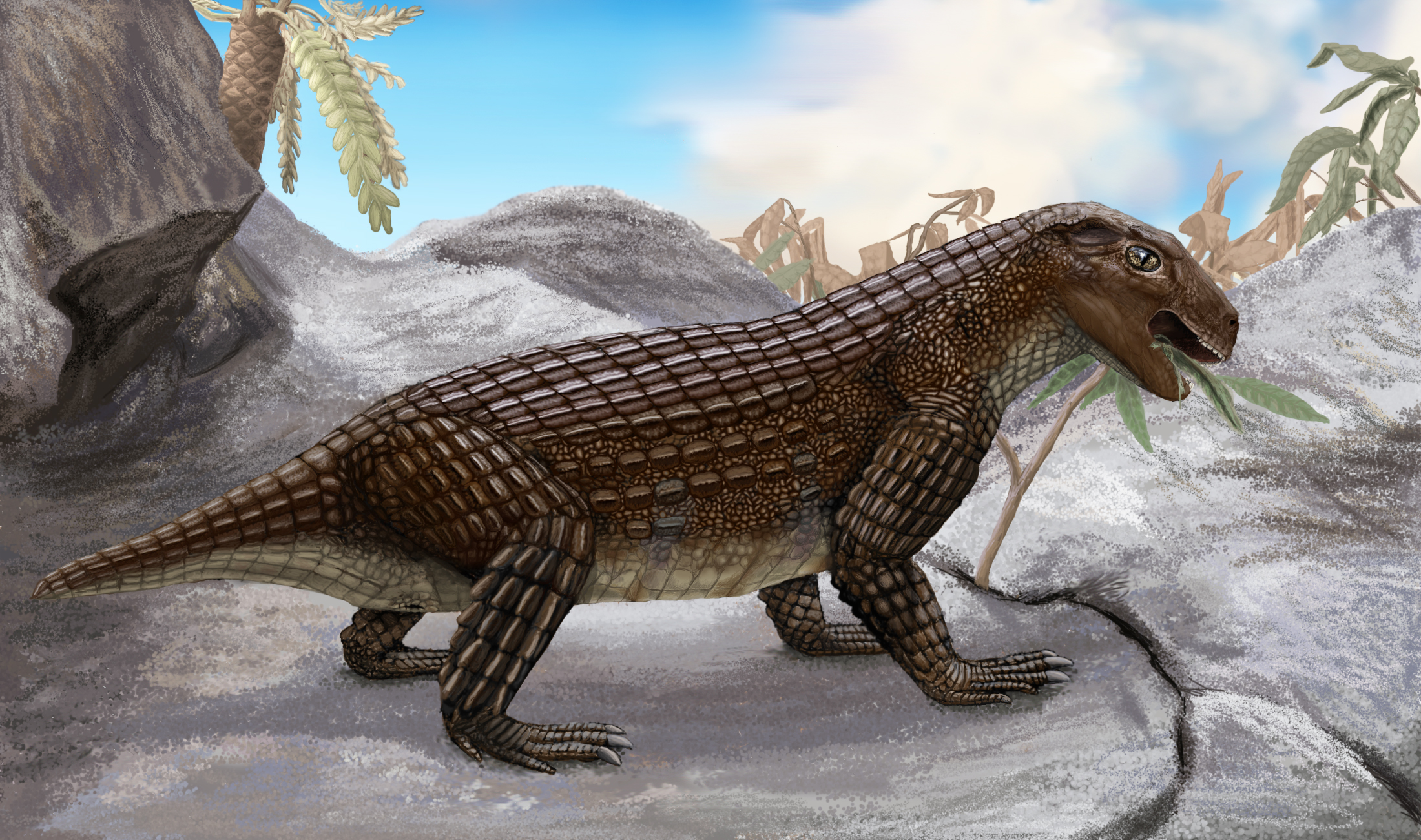
In that company the devil frog was neither king nor prey of least concern. An adult Majungasaurus would have eaten a frog without pausing, while a hatchling titanosaur or a juvenile crocodile was exactly the mouthful a sit-and-wait predator with a 15 centimetre wide gape was built for. Ambush feeding scales in both directions.
A South American Accent
The 2008 paper did not only describe a frog, it proposed a passenger. Phylogenetic analysis suggested Beelzebufo was close to the horned frogs of South America, a family whose living members today live on the other side of the Indian and African landmasses. If that relationship held, it implied a faunal link between Madagascar and South America during the Cretaceous, and the paper was explicit that convergence, the same body plan evolving twice, remained possible.
The family tree has been shuffled ever since. A 2018 analysis placed Beelzebufo among an older branch of modern frogs, distant from horned frogs. A 2022 study recovered it as the sister group to horned frogs, and a 2023 study moved it next to a tree frog relative. Its exact position inside the frog group Hyloidea is still open, which is a fair reminder that one spectacular fossil from an isolated island can shake up an entire family tree.
Tadpoles in a Vanishing Pool
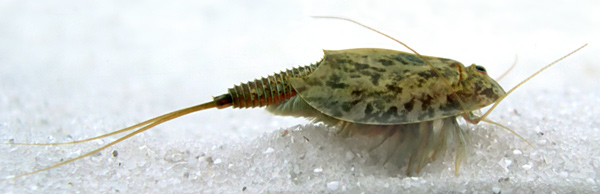
No one has found Beelzebufo eggs or tadpoles, so anything said about its young is an informed guess. But frogs are frogs, and frogs begin as tadpoles in water, which on a seasonal floodplain means water that will not stay. The larvae would have had to hatch, feed and metamorphose into air breathing adults before the pool cracked and baked, a deadline that kills off plenty of tadpoles every dry season.
That is the gamble the Triops animals simply do not have to take. The tadpole shrimp of this site, close relatives of the species that shared water bodies with dinosaurs, lay drought proof eggs that sink into the mud and wait, sometimes for years, until the rains wake them up. One lineage races the sun, the other outlasts it. Compare the two strategies in Triops in the age of dinosaurs and how Triops eggs survive drying. The same seasonal water that produced a devil frog also produced the most patient animal alive today.
What the Devil Frog Leaves Us
Beelzebufo matters less for its record breaking status than for what it breaks. It breaks the assumption that amphibians are always the small thing in someone else's ecosystem, an assumption that earlier chapters like the giant temnospondyls already put under pressure. It breaks a neat picture of island continents as evolutionary backwaters, and it arrives with a family tree argument that is still unresolved nearly two decades after publication.
The animal itself never knew any of that. It sat in the litter of a Madagascar floodplain, waited for something to move, and closed a mouth that could hold a hatchling dinosaur. On a planet where most frogs are snacks, that was the whole strategy.