Published 2026-10-20 · by the Triops.me Editorial Team · Back to Articles
Chalicotheres: The Hoofed Animals That Grew Claws
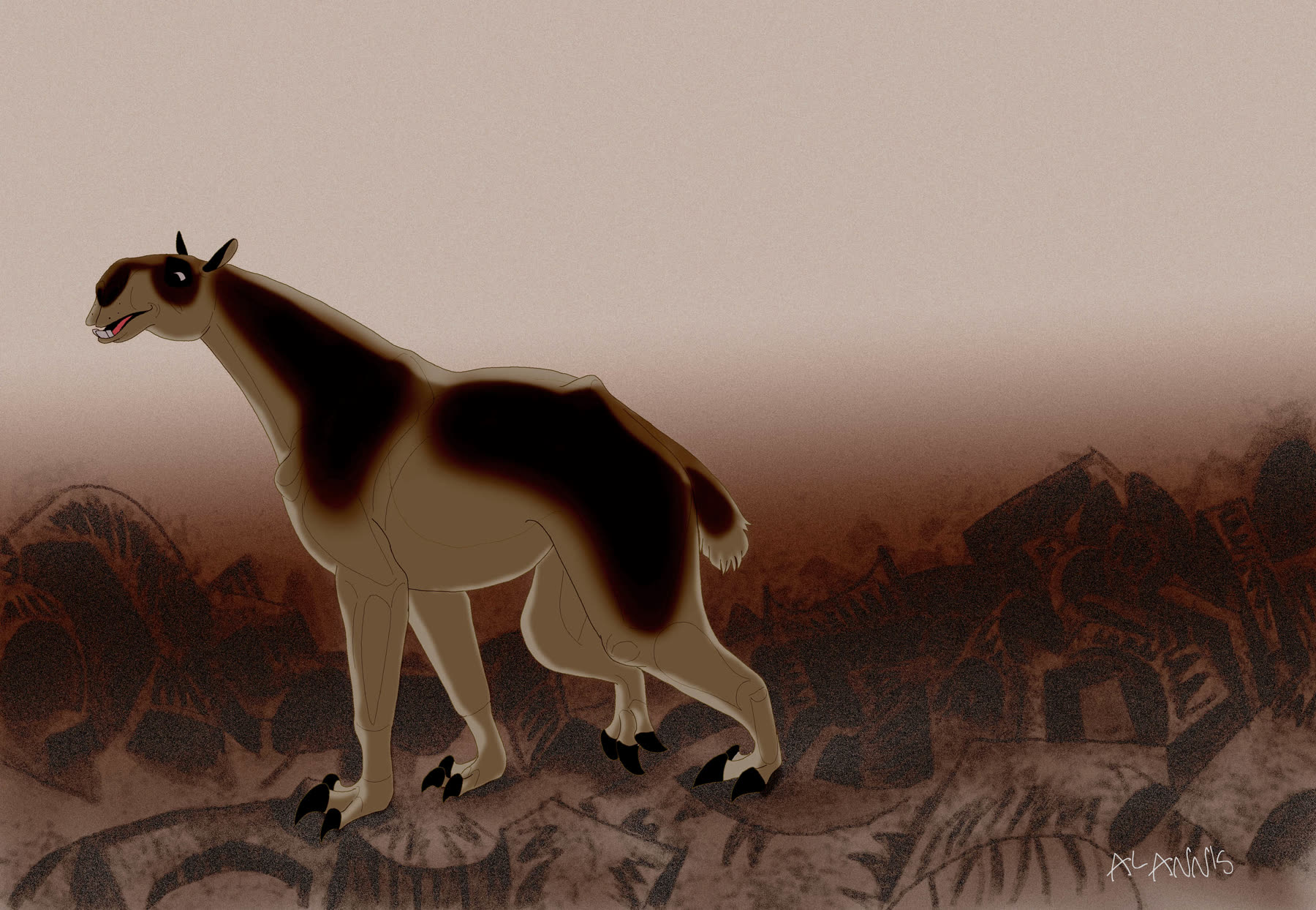
Picture a horse. Now give it the arms of a gorilla, a back that slopes down from the shoulders to the hips, and three curved claws on each hand where the hooves should be. That animal is not a fantasy hybrid. It is a chalicothere, a family of plant-eating mammals that browsed through the forests of North America, Europe, Asia and Africa for more than 30 million years.
Chalicotheres were odd-toed ungulates, members of the same order that today holds horses, rhinoceroses and tapirs. Every living member of that order walks on hooves. The chalicothere threw that blueprint away and grew claws again, and the reversal makes it the strangest relative a horse ever had.
A name that means gravel beast
The family name comes from the Ancient Greek khalix, meaning gravel, and therion, meaning beast: the gravel beast. The name refers to the teeth, whose bumpy, pebble-like chewing surfaces look nothing like the grinding ridges of a horse. The type genus, Chalicotherium, was named in 1833 by the German naturalist Johann Jakob Kaup from teeth dug up near the village of Eppelsheim, a site that has supplied mammal fossils since the early 1800s.
Claws and hooves are both built from keratin, the material of fingernails, and keratin almost never reaches the fossil record. Paleontologists read the difference in the bones at the tips of the fingers and toes. Those bones in chalicothere hands and feet are shaped to carry heavy, curved claws, and the picture they paint is hard to argue with: this animal did not stand on flat hooves.
The animal that fooled Cuvier
The chalicothere took a long time to assemble. The first remains, isolated claw bones found near Eppelsheim, reached Georges Cuvier, the most formidable anatomist of his generation. In 1822 he decided they belonged to a gigantic pangolin. In 1837 Edouard Lartet christened a French form Macrotherium from the Sansan deposit and reached the same verdict: another giant pangolin. Skull fragments from the same site were later filed with an extinct even-toed ungulate.
Only in 1890, when Henri Filhol described a complete skeleton from Sansan, did the teeth and the claws finally end up in the same animal. For most of the nineteenth century the chalicothere existed in the literature as three separate creatures, none of them correct.
Two body plans under one roof
Chalicotheres split into two subfamilies. The Chalicotheriinae, including Chalicotherium, Anisodon and the Chinese Hesperotherium, stretched their front legs far beyond their hind legs and built a gorilla-like frame. The Schizotheriinae, including Moropus, Ancylotherium and the dome-headed Tylocephalonyx, kept more conventional ungulate proportions, closer to an okapi or a small rhinoceros. Both lines share the claws and the browsing teeth.
Together the family ran from the Oligocene, about 34 million years ago, into the early Pleistocene, roughly a million years ago. That is a run of 33 million years, more than ten times the span of the human genus, and it ended only a geological heartbeat before the present.
Moropus, the slow foot
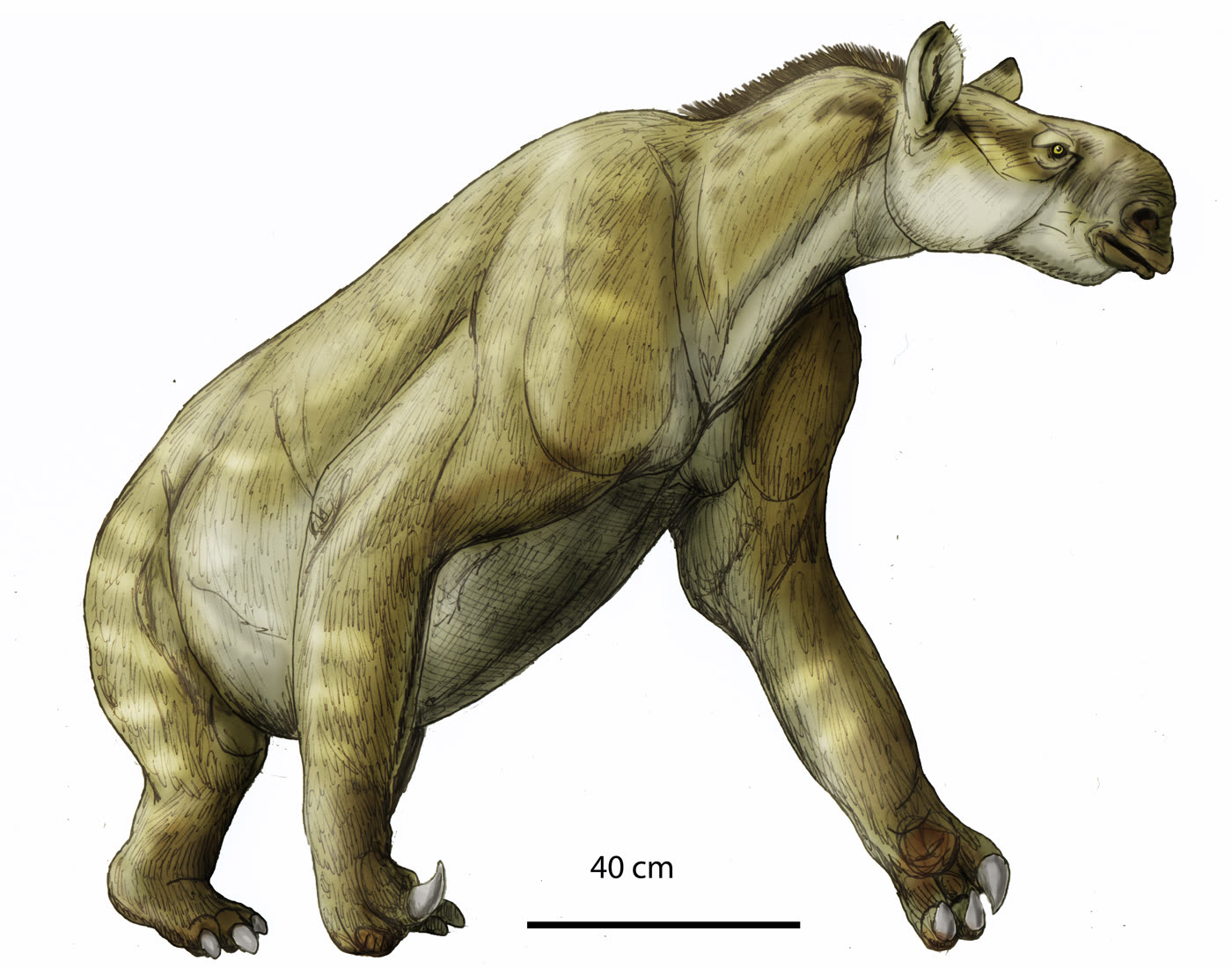
The best-known chalicothere is Moropus, a name meaning slow foot, which the American paleontologist Othniel Charles Marsh gave it in 1877. Marsh first lumped the animal with the toothless edentates, a group of mammals it had nothing to do with, and even erected a separate family to hold it. Foot bones and teeth soon put it back among the odd-toed ungulates.
Moropus lived in North America between roughly 20.4 and 13.6 million years ago and has the best fossil record in the family, with complete skeletons out of the John Day Fossil Beds of Oregon and the Agate Springs quarries of Nebraska. The largest specimens stood about 2.4 metres at the shoulder and one has been estimated at 1,179 kilograms, so we are talking about an animal the bulk of a big rhinoceros with the sloping outline of an okapi.
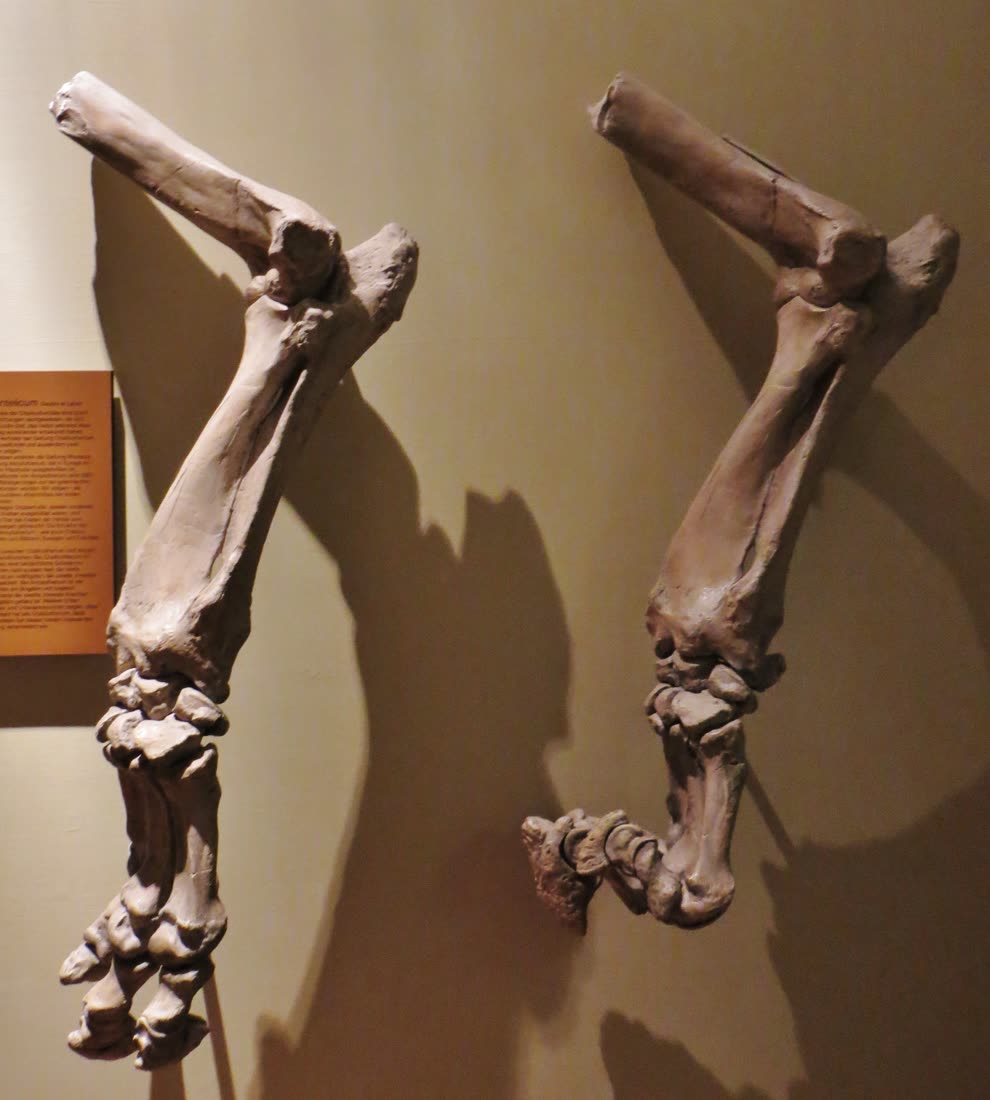
Its skull hints at how it ate. The nasal bones sit pulled back, which usually signals a flexible upper lip, and a wide gap between the front teeth and the cheek teeth left room for a long, mobile tongue. The chewing teeth resemble those of browsing ruminants. Lip and tongue together would have worked like a reacher grabber, hauling twigs into the mouth while the claws hooked into bark.
What the claws were for
Microscopic scratches on chalicothere teeth point to leaves, bark and fruit rather than grass. The claws did the rest of the work, hooking branches down into reach and possibly digging up roots and tubers. The long-armed chalicothereiines are often compared with gorillas, and some researchers reconstruct them as knuckle-walkers that rested on folded claws while moving between feeding sites, though trackway evidence for that gait is still thin.

The evolution itself is the remarkable part. Growing claws from a lineage that already carried hooves is a reversal, an animal reshaping a tool it had inherited into something else entirely. Pangolins and anteaters arrived at long claws from very different starting points. The chalicothere is the odd-toed ungulate that walked the same road backwards.
The last of the gravel beasts
Chalicotheres disappeared from North America about 9 million years ago, while Chalicotherium itself stayed common across Europe, Asia and Africa. The family survived into the Pliocene, and the Chinese genus Hesperotherium has been reported from early Pleistocene sediments close to a million years ago, making it the last gravel beast on Earth.
The ending fits the climate. As the world cooled and dried through the late Pliocene, continuous forest broke up into open woodland and grassland. Browsers tied to closed, wooded habitat lost ground, while grazing horses and rhinoceroses, on hooves built for hard open country, took it. In China the last chalicotheres shared their shrinking forests with early humans of the genus Homo, and then the record stops.
Nothing alive looks like a chalicothere today. The odd-toed ungulates that made it through are horses, tapirs and rhinoceroses, three survivors of a stranger and more crowded club. For a sense of what the wider group produced, start with the Siberian unicorn, wander over to the largest land mammal that ever lived, and meet the hell pigs that shared Miocene North America with Moropus.