Published 2026-09-21 · by the Triops.me Editorial Team · Back to Articles
Deinocheirus: The Terrible Hands That Hid a Stranger Giant
Some dinosaurs gave up their secrets slowly. Deinocheirus gave them up in the most dramatic way possible: for nearly half a century, the entire scientific world knew this animal from nothing but a pair of arms. No skull, no legs, no tail, no ribs. Just two colossal forelimbs and eight huge claws, lying in the sand of the Gobi Desert, waiting for someone to explain them.
The wait produced one of the strangest reveals in paleontology, and it turned one of the most feared names in old dinosaur books into one of the weirdest giants that ever walked the Earth.
Arms in the Sand, 1965
The story begins in July 1965, during a Polish-Mongolian expedition to the Nemegt Formation of southern Mongolia, one of the richest dinosaur hunting grounds on the planet. At a site called Altan Ula, the team, led by the celebrated paleontologist Zofia Kielan-Jaworowska, uncovered a pair of enormous forelimbs, each about 2.4 meters long, ending in three slender, strongly curved claws around 20 centimeters long.
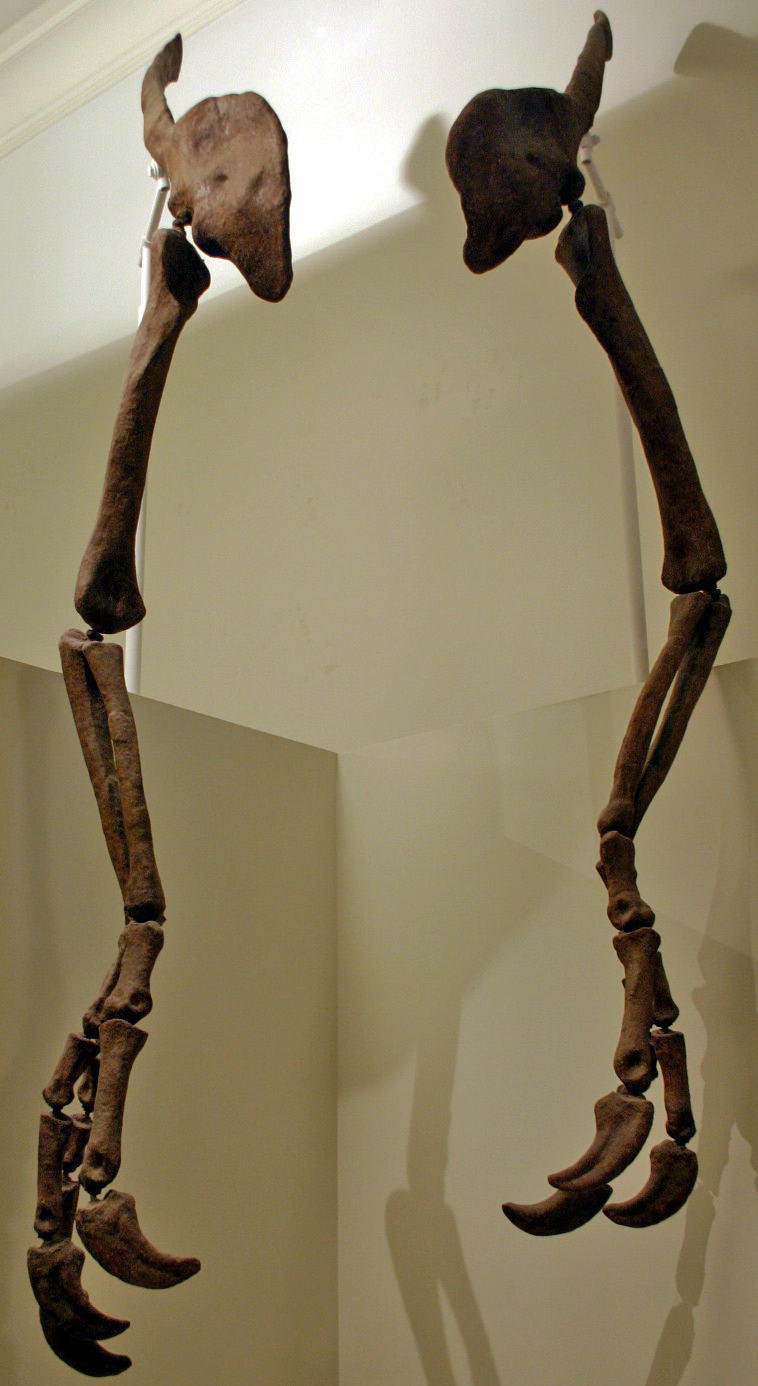
When the arms were described in 1970 by Halszka Osmólska and Ewa Roniewicz, they received a name to match their menace: Deinocheirus mirificus, roughly "terrible hand, the wondrous one". Whatever owned these hands had been big. Really big. And it had vanished, leaving only its most intimidating parts behind, like a criminal that deliberately burned everything except the gloves.
Forty Years of Guessing
For decades, those arms starred in museums and textbooks, and scientists argued endlessly about the body attached to them. The claws looked like a predator's tools, so early restorations imagined a gigantic carnivorous theropod, a shadowy super predator that ambushed dinosaurs ten times its own arm span. Other researchers pointed out similarities to therizinosaurs, the clawed plant eaters, and made Deinocheirus a gentle giant with a pot belly. A third camp saw hints of the ostrich dinosaurs, the ornithomimids, small fast omnivores with toothless beaks and small heads.
Artists had a wonderful time. Restorations showed everything from a monstrous killer to an enormous fuzzy ostrich. Every new book could, quite honestly, draw the body however it liked, because nobody had a single vertebra of evidence beyond the shoulders.
The truth turned out to be far stranger than any of the guesses.
The Poachers, the Collector, and the Skull
In 2009, a Korean-Mongolian expedition found more Deinocheirus bones at Altan Ula, including parts that finally settled the family question: this was indeed a member of the ornithomimids, the ostrich dinosaurs. But the fullest picture came from two further specimens, one of which had been damaged and partly looted by fossil poachers. Its skull had been smuggled out of Mongolia and sold into a private collection in Europe. After years of detective work, researchers identified it, and it was returned to Mongolia in 2014.
That same year, a landmark study finally assembled the whole animal from three specimens, and paleontologists got their first honest look at what "terrible hand" actually meant.
A Giant Nobody Predicted
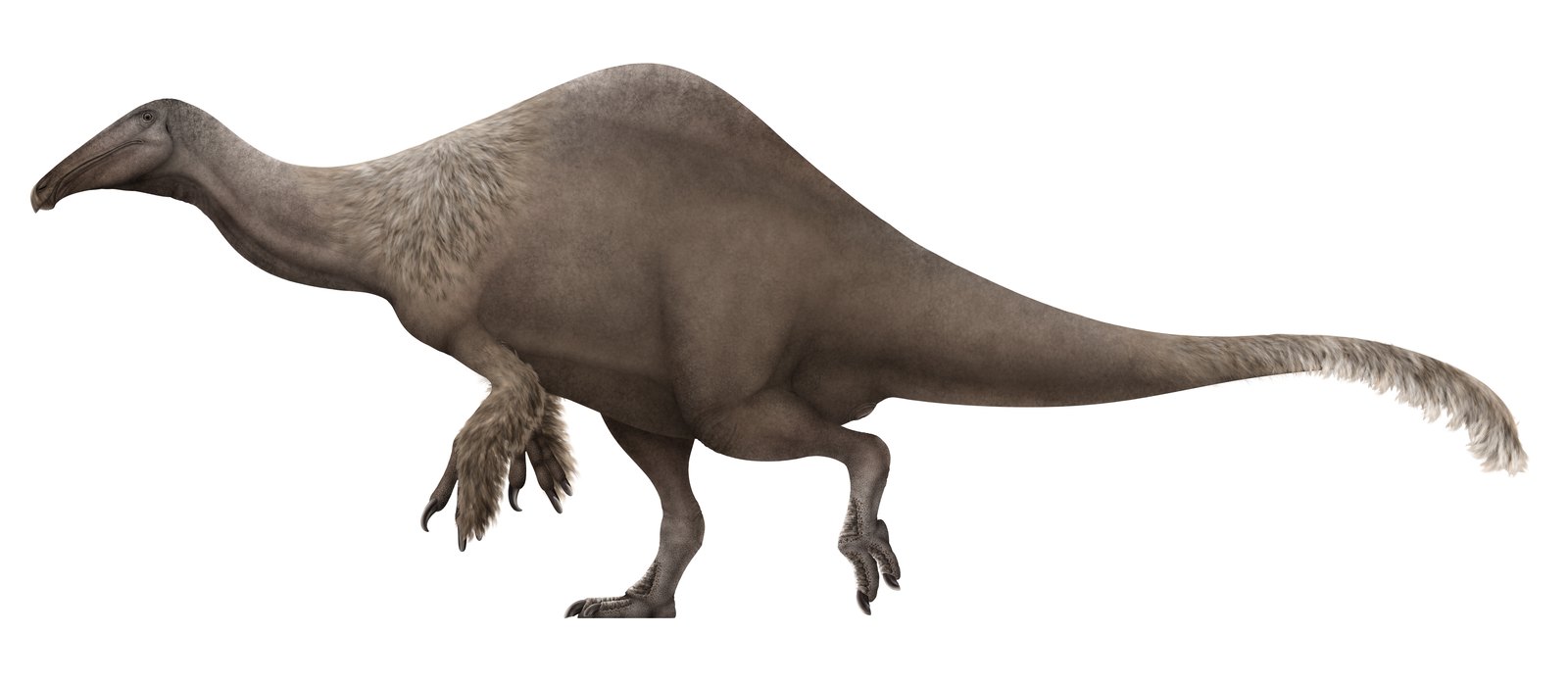
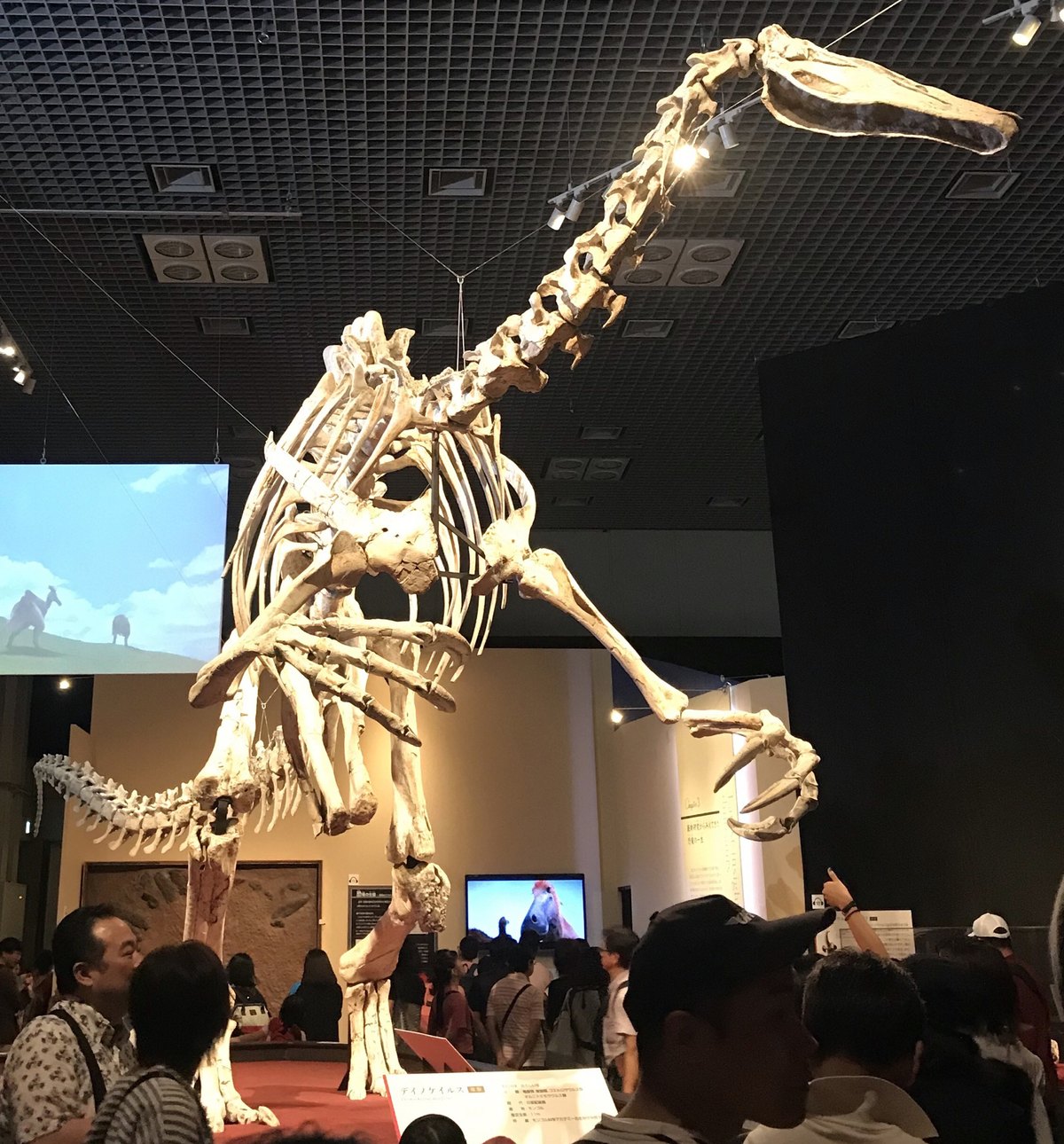
Deinocheirus mirificus was about 11 meters long and weighed roughly six tonnes, making it not just the largest known ornithomimosaur but one of the biggest theropods of all time, in the company of the great tyrannosaurs. Yet it looked nothing like them. It had a small, blunt head on a long neck, capped with a broad, duck-like bill. Its lower jaw was deep and rounded, built like a shovel. Tall spines on its back vertebrae propped up a hump or sail, a feature otherwise associated with Spinosaurus.
Inside one specimen's stomach area, paleontologists found fish remains and hundreds of gastroliths, swallowed stones that helped grind food, much like those of modern birds. That is a dinner menu, not a mystery: Deinocheirus was slurping fish and soft plants from the bottoms of rivers and lakes in its Late Cretaceous floodplain, about 70 million years ago.
And those terrible hands? The claws were huge but surprisingly blunt, better suited to hooking and pulling vegetation, or perhaps digging into soft sediment, than to slicing flesh. They may still have made a fearsome defensive weapon, because Deinocheirus shared its world with Tarbosaurus, Mongolia's cousin of Tyrannosaurus rex, and one specimen carries bite marks to prove somebody sampled it.
Why Deinocheirus Matters
Deinocheirus is a reminder that a famous name can hide a stranger truth than any speculation. The old reconstructions were wrong in the most charming way: they imagined a normal dinosaur scaled up, while the real animal was a slow, hump-backed, duck-billed, six-tonne omnivore that looks like evolution assembled it from spare parts. Paleontologists have literally described it as one of the weirdest dinosaurs ever found.
It also shows how modern paleontology works. A mystery sustained for two generations was cracked by new fieldwork, by comparing dozens of bones across three specimens, and by tracking a smuggled skull across borders until it came home. The mounted skeleton in Ulaanbaatar now stands complete, arms and all, no longer a puzzle but a portrait.
Life, as usual, had already solved the problem 70 million years earlier. It just declined to hand in the answer until we learned to ask properly.
Curious about other giants from the same era? Meet the long-necked Elasmosaurus, the saber-fanged Gorgonopsids of an earlier age, or the tiny survivors like Triops that outlived every dinosaur on this page.