Published 2026-10-06 · by the Triops.me Editorial Team · Back to Articles
Diplocaulus: The Boomerang-Headed Amphibian of the Permian Swamps
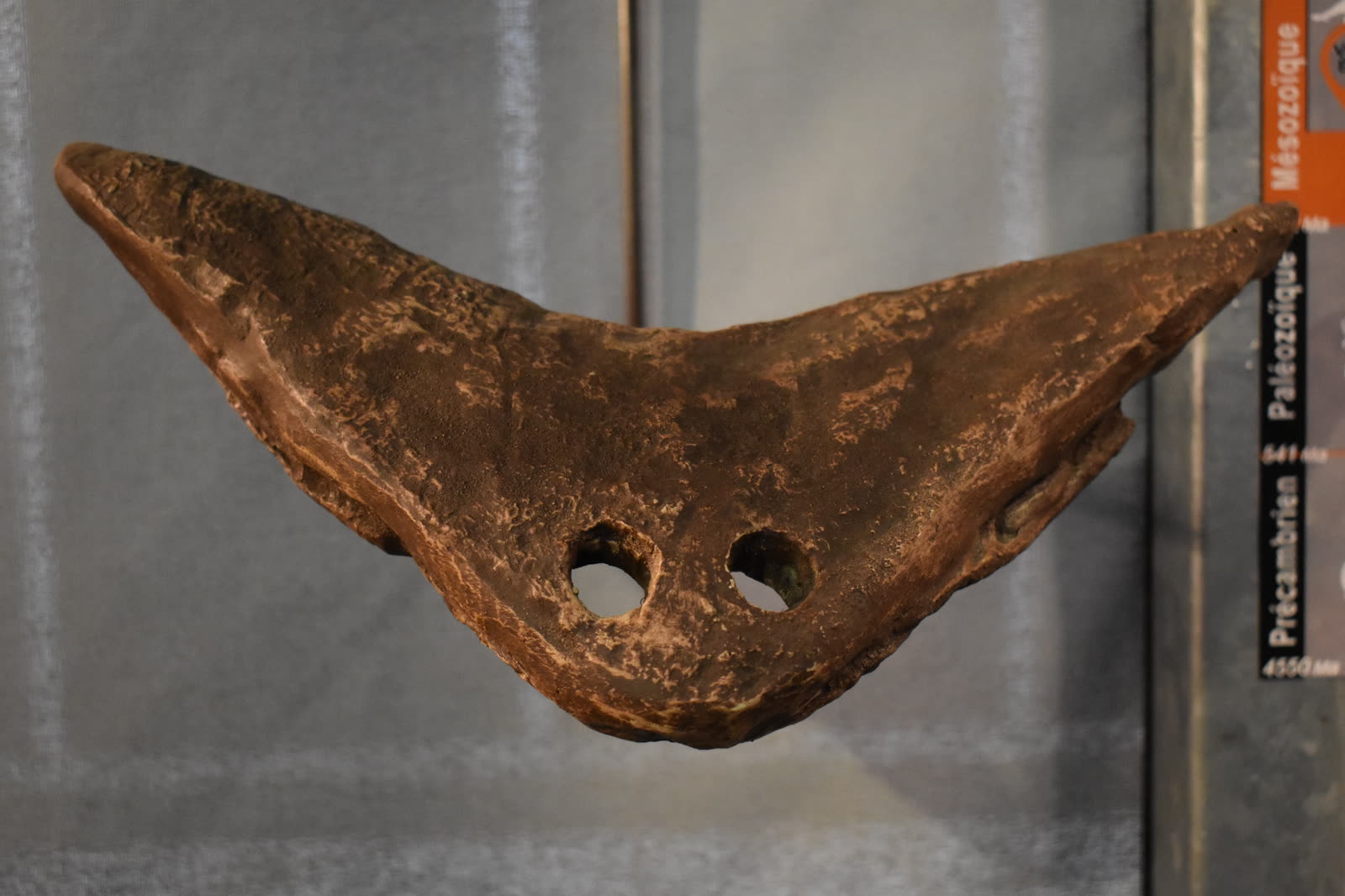
Very few animals in the fossil record can be identified from a single silhouette. Diplocaulus is one of them. Its skull is a flat, bony boomerang, wider than the animal is tall, with two long horns sweeping backwards from the rear corners. Once you have seen that shape, you will never mistake it for anything else.
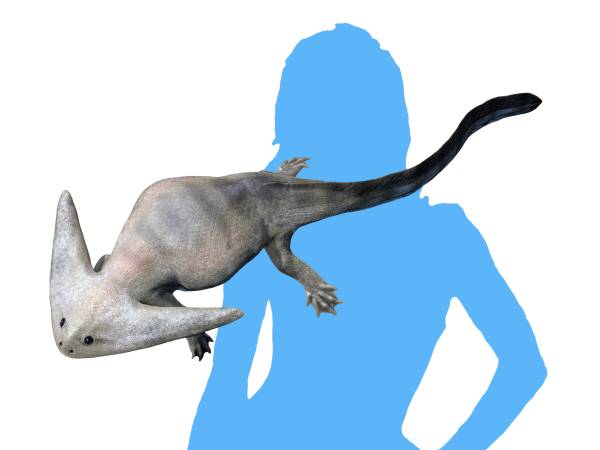
This was an amphibian of the Permian swamps, up to a metre long, built like a stout salamander and almost certainly aquatic for its whole life. It paddled through the slow rivers and floodplains of what is now Texas and Oklahoma while the first synapsids, the ancestors of mammals, hunted along the banks. Palaeontologists have been arguing about its strange head for more than a hundred years, and the debate is still not finished.
A lepospondyl, not a temnospondyl
Diplocaulus belongs to an odd, often overlooked branch of early tetrapods called the lepospondyls, and within that group to the order Nectridea, the "swimming" amphibians. It is by far the largest and best known of them all. That matters, because the giant Carboniferous and Permian amphibians most people picture, like the eight-metre temnospondyls, were a completely separate lineage. Diplocaulus was smaller, flatter and built for a life spent resting on the bottom.
The name means "double stalk", a reference to those two horn-like projections. Edward Drinker Cope named the genus in 1877 from a handful of vertebrae found near Danville, Illinois. Only later, when well-preserved skulls started turning up in the red beds of Texas and Oklahoma, did the true shape of the animal become clear. The commonest species, D. magnicornis, is known from hundreds of specimens, which is why so much of what we know rests on this one genus. Its range stretches from the Late Carboniferous to the Late Permian, roughly 307 to 257 million years ago, and reaches from North America to Morocco.
The anatomy of a boomerang head
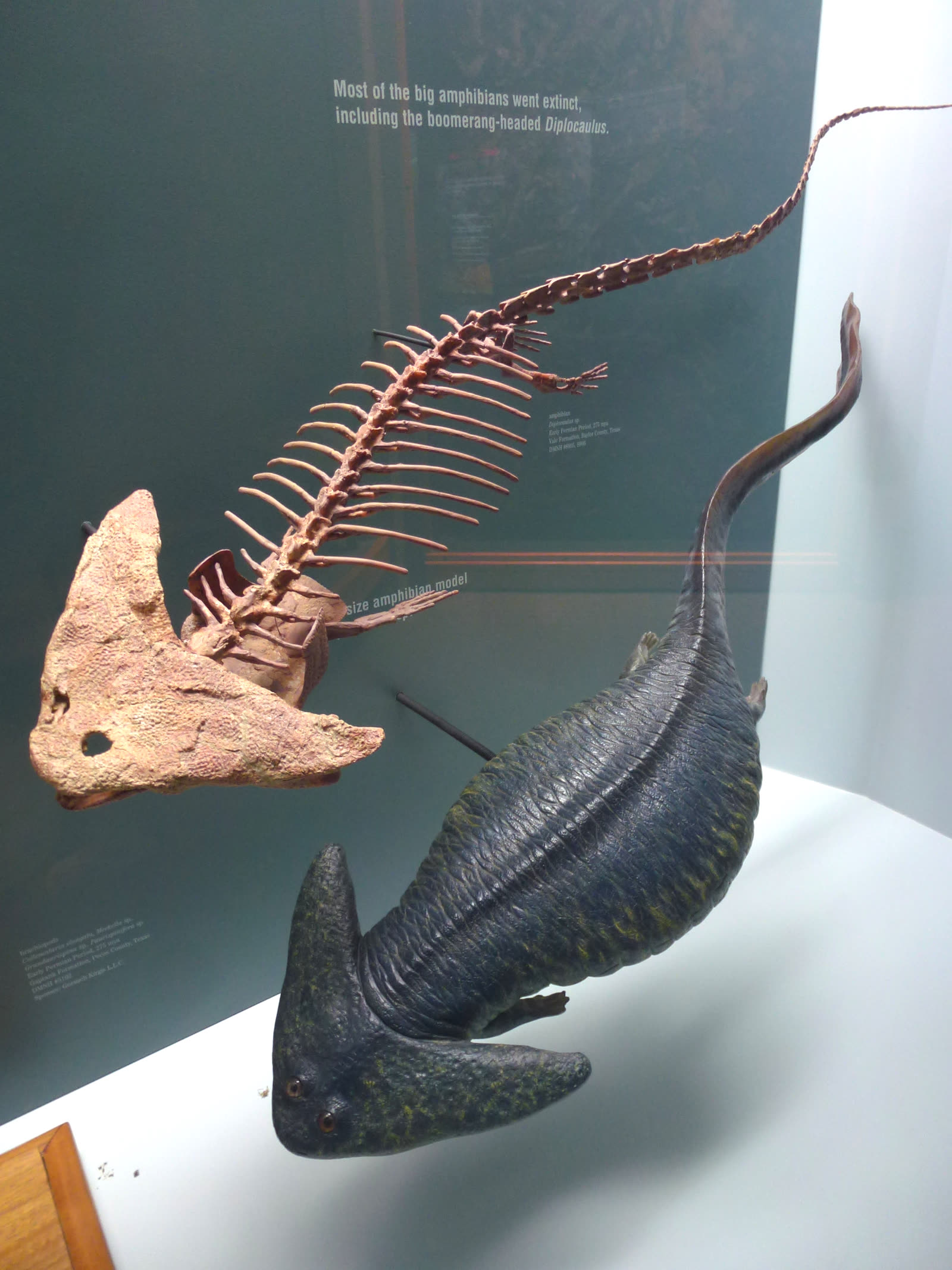
The body behind the famous head was unremarkable and effective: a stocky torso, four short legs and a long, laterally compressed tail. Studies of its vertebrae suggest that swimming was driven mainly by eel-like, side-to-side beats of that tail, so Diplocaulus was a cruiser rather than a sprinter, gliding just above the sediment. The eye sockets sit high and far apart on the flat skull, giving it a wide field of view across the water above.
The horns themselves are built from ordinary skull bones taken to an extreme. The front edge of each horn is an elongated, blade-like squamosal, the rear edge is formed by the postparietals, and the main bone of the tip was debated for decades. Early workers called it a tabular, a small bone at the back of the skull in other early tetrapods; others insisted it was a supratemporal that had shifted backwards. Comparison with close relatives such as Urocordylus, which still has both bones, settled the argument in favour of the tabular, which is why palaeontologists now speak of "tabular horns".
Growth changed the head too. Everett Olson's classic 1951 study of Diplocaulus growth and variation showed that juveniles and adults differ in skull proportions, with skull length and width increasing together as the animal matured. Even today, small differences in horn shape are enough for researchers to describe new species, from the short-snouted D. brevirostris of the Arroyo Formation to D. recurvatus, whose horn tips are distinctly crooked.
So what were the horns actually for?
This is the question everyone asks, and paleontology has supplied a full cabinet of answers. S. W. Williston suggested in 1909 that the horns shielded external gills, an idea shot down two years later for lack of evidence. Herman Douthitt thought they were a counterweight for a heavy skull. Robert Bakker proposed in 1986 that animals swung their heads sideways to jab rivals, while Everett Olson suggested the horns carried skin flaps for stingray-like gliding, or worked as a spade for digging into mud.
The most practical explanation may also be the simplest: defence. A predator such as Eryops would have had real trouble swallowing an animal whose head was three or four times wider than its body. And then there is the elegant one. In 1980, palaeontologist Arthur Cruickshank and fluid dynamicist B. W. Skews built a full-size Diplocaulus head from balsa wood and modelling clay and put it in a wind tunnel. The horns generated real lift, even with the head level with the flow, rising steadily with the angle of attack until the flow stalled at 22 degrees. At about 1.5 degrees below horizontal, lift was at its lowest, which may have been the animal's resting attitude. Opening the mouth barely changed the numbers, so it could strike at prey mid-rise. On this reading the head was a hydrofoil, letting Diplocaulus lift off the bottom and surge up the water column with almost no effort.
Life and death in the Permian red beds
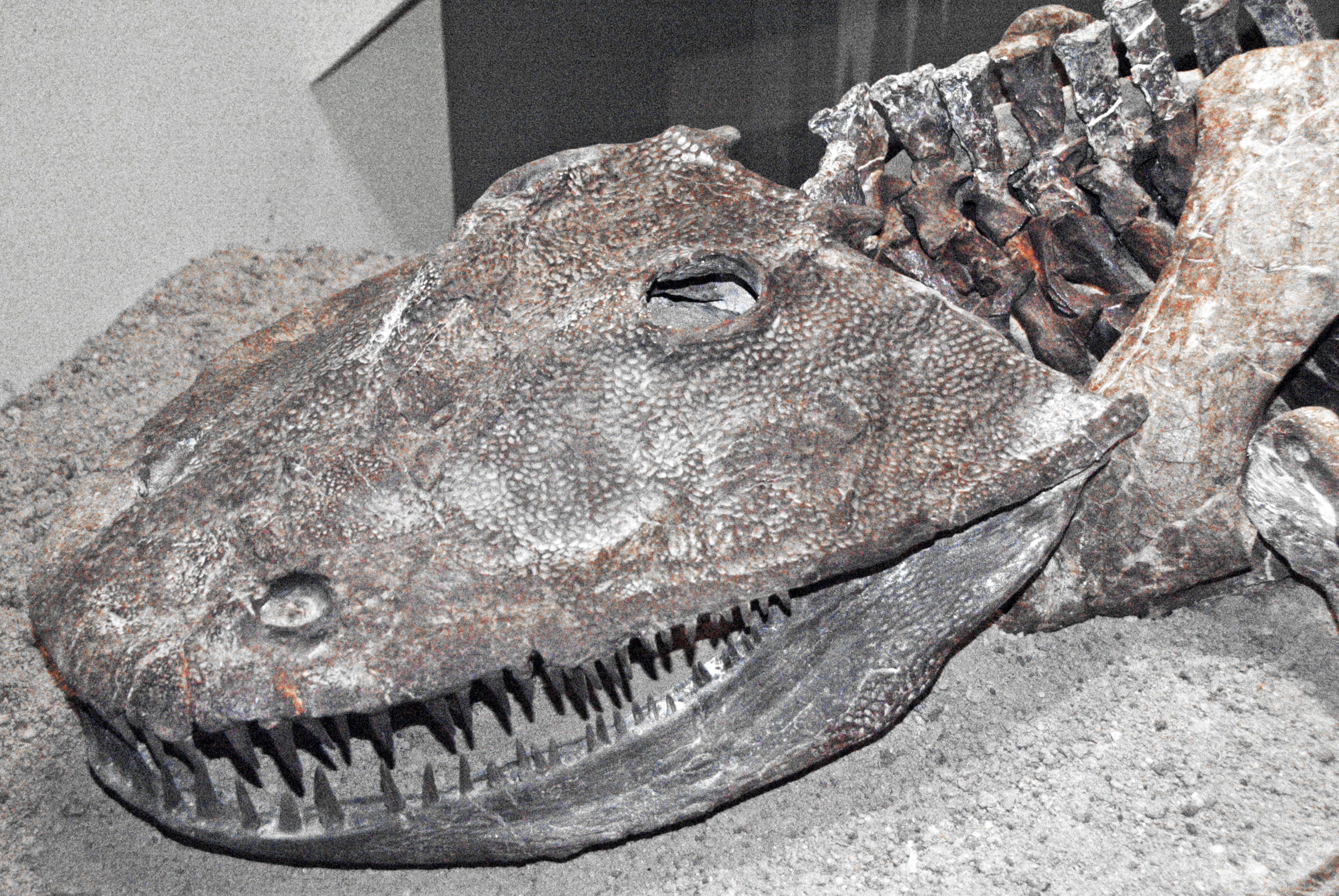
The world of Diplocaulus was a mosaic of lowland rivers, deltas and seasonally dry floodplains. The genus was widespread and locally abundant, sharing the water with lungfish, small reptiles and large amphibians, and it seems to have been a bottom-dwelling predator of small invertebrates and other small animals, snatching them from the water as it rose.
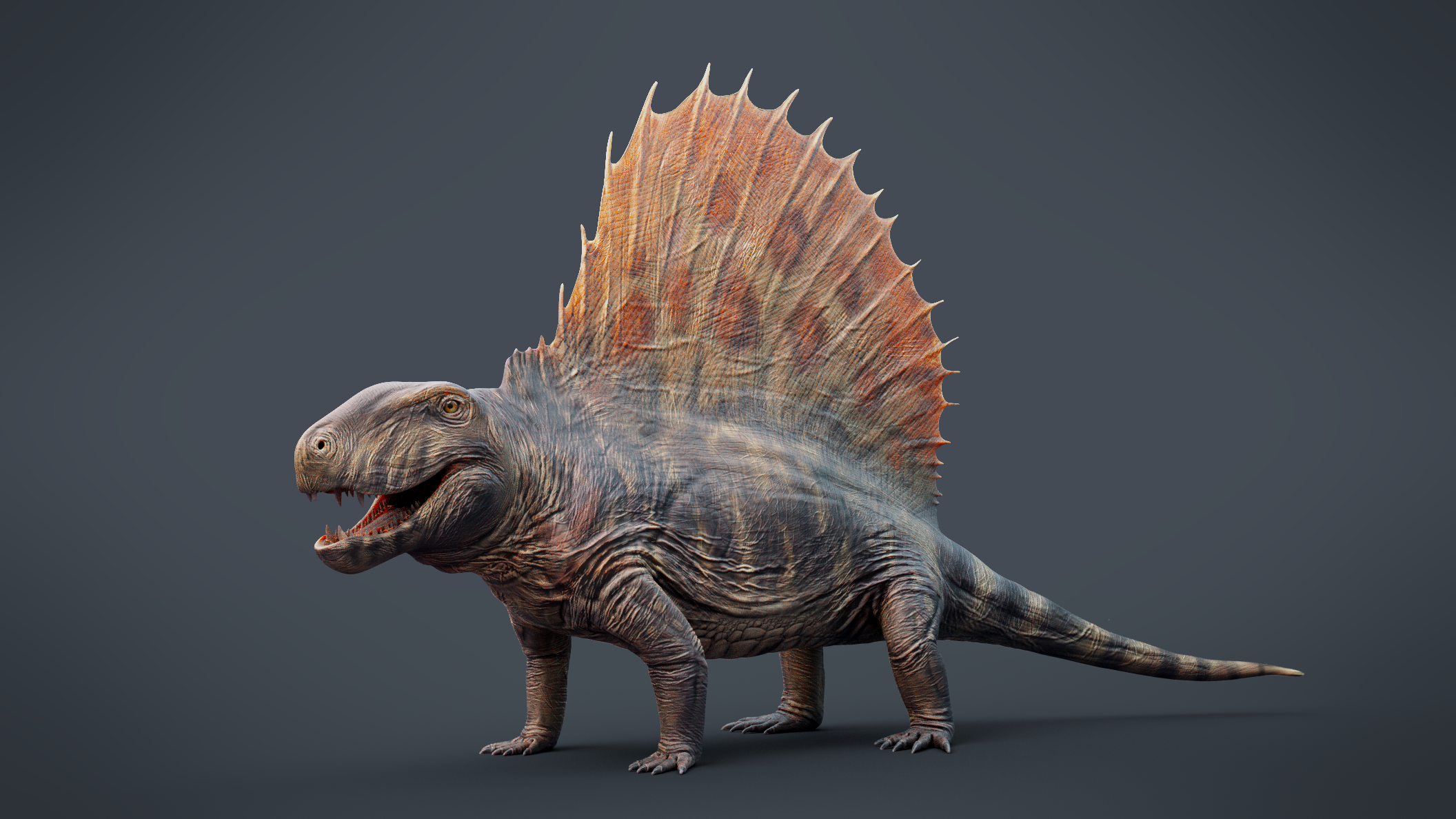
Its predators left a rare and vivid piece of evidence. In a Permian burrow in Texas, researchers found eight animals stacked together to wait out a drought: several juvenile Diplocaulus and a juvenile Eryops, curled up in the same hole. The burrow had been dug open by a Dimetrodon looking for a meal. One of the amphibians had been killed with a bite through the skull and brain, an injury its wide horns could not prevent. Even a hydrofoil skull has its limits.
The last of the lepospondyls
Diplocaulus did not survive the end of the Permian. Along with the sail-backed synapsids, the large amphibians and most other life on Earth, it disappeared in the mass extinction about 252 million years ago, an event covered in more detail here. Moroccan remains of a related diplocaulid represent the youngest known lepospondyl of all, so the whole group faded out with the Paleozoic.
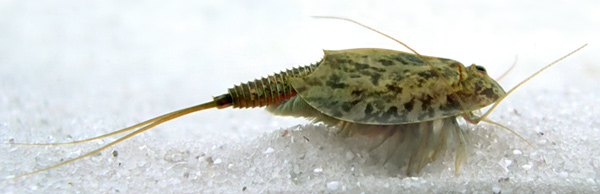
What came afterwards is the part our readers know best. When the dust settled in the Early Triassic, the temporary freshwater pools that opened up belonged to branchiopod crustaceans with dormant eggs, and one of those lines, Triops, is still with us today. The boomerang-headed amphibian is gone; the survivor is a shrimp-shaped animal the size of a thumb that you can raise in a tank at home. You can read more about that lineage in what are Triops and in Triops in the age of dinosaurs.
That is the real lesson of Diplocaulus. Evolution does not only produce winners. It produces spectacular, purposeful oddities that work magnificently for a hundred million years and then vanish, leaving behind nothing but a flat bony boomerang in the red rock, waiting for someone to wonder what it was for.