Published 2026-10-09 · by the Triops.me Editorial Team · Back to Articles
The End-Triassic Extinction: The Eruption That Cleared the Stage for Dinosaurs
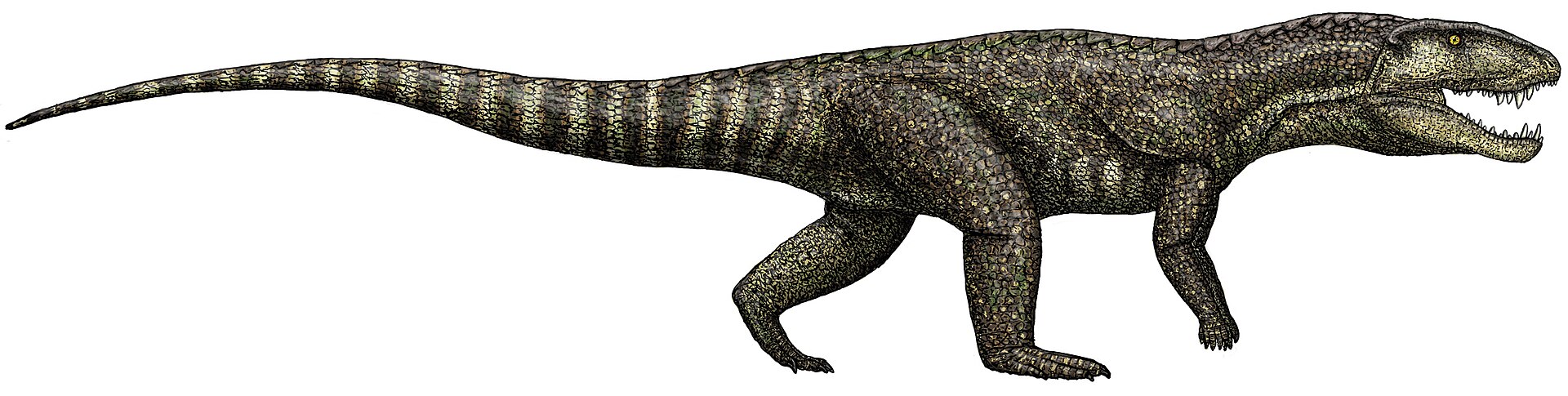
About five metres long and built like a crocodile stood on legs, Postosuchus was the animal you did not want to meet at the water's edge. For millions of years, archosaurs like it ran the river valleys of the Triassic world: armoured plant eaters called aetosaurs, snout-snouted fish catchers called phytosaurs, and a long parade of other reptiles that answered to no one. Dinosaurs existed back then, but they were bit players, small and rarely common, living in the margins of a world that was not theirs.
Then, somewhere around 201 million years ago, most of that cast was wiped off the stage in one of the five great extinctions of the fossil record. The end-Triassic extinction closed the Triassic period and opened the Jurassic, and it did so in a geological eyeblink. By the most common estimates, something like three-quarters of all species disappeared, including nearly every large animal on land and in the sea. What crawled out of the other side was a strange, scrawny lineup: small meat-eating dinosaurs, crocodilians, turtles, lizards, mammals, and a pond dweller with three eyes that still lives in ditches today. This is the crisis that made the Age of Dinosaurs possible.
A crisis hiding in plain sight
Unlike the crater left by the asteroid that ended the Cretaceous, the end-Triassic left no obvious smoking gun at the boundary itself, which is why it took geologists a long time to see it clearly. The clues are chemical. Around the world, sediments crossing from Triassic into Jurassic record a sudden, sharp drop in the ratio of carbon isotopes, a swing of several parts per thousand that says vast amounts of light carbon were dumped into the air and ocean at once. Boundary clays in Europe, North America and Morocco carry spikes of mercury, the fingerprint of enormous volcanic outgassing. The official line marking the boundary runs through a section of rock at Kuhjoch in the Austrian Alps, and the beautifully layered lake sediments of the Newark Supergroup in eastern North America preserve the event with such fine detail that researchers have counted the individual seasonal layers.
The Central Atlantic Magmatic Province
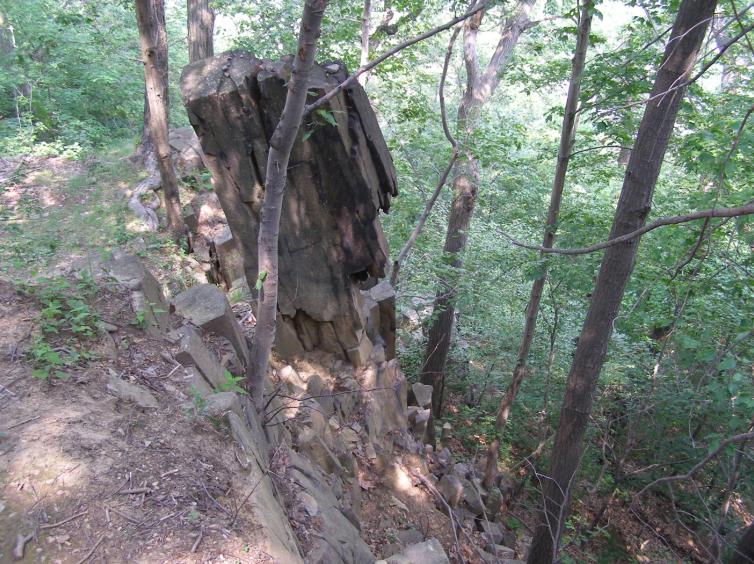
The culprit, as far as the evidence currently points, was not an impact but a rupture. At the time, all of the continents were still welded into the supercontinent Pangaea, and it was beginning to tear apart along the seam where North America would eventually separate from Africa. As the crust stretched and thinned, magma poured out on a scale that is hard to picture: lava fields spread across what is now eastern North America, Morocco, Guinea and Brazil, plus thick intrusive sheets of rock forced sideways into the crust. One of those intrusions is the Palisades Sill, the dark cliff line along the Hudson River in New Jersey, emplaced as a sill during these very eruptions. Together these rocks form the Central Atlantic Magmatic Province, one of the largest volcanic provinces ever documented. Work on the Newark basin lakes and matching sections in Morocco suggests the eruptions came in four main pulses, each lasting only thousands of years, with the whole sequence unfolding in well under a million years.
It was the gases that did the damage rather than the lava. Burping out carbon dioxide and sulphur dioxide over a geologically short stretch of time, the eruptions pushed the climate several degrees warmer, acidified the surface ocean, and choked parts of the deep sea with oxygen-poor water. The carbon isotope excursion is the receipt for that carbon pulse, and the mercury spikes are the receipt for the eruptions that delivered it. Unlike the instant heat of an asteroid strike, this was a stress that lasted tens of thousands of years, long enough for the same fragile traits that keep species alive in stable times to become liabilities.
Who lost their world
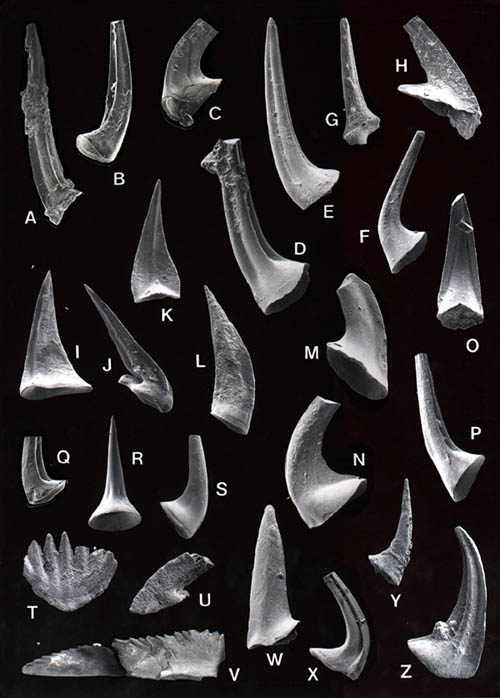
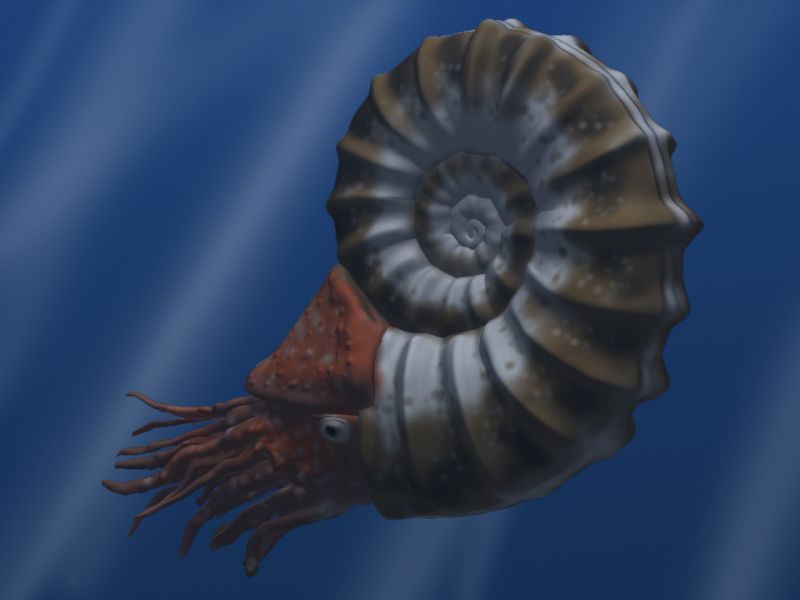
On land, the losses were concentrated in the big and the specialised. The rauisuchians, the top predators, went entirely, and Postosuchus with them, along with the armoured aetosaurs and the crocodile-shaped phytosaurs. Most of the large freshwater amphibians, the temnospondyls, disappeared too. In the oceans, whole ammonoid families vanished even though some ammonites squeezed through, and the conodonts, the eel-like animals whose tooth elements are used to date the rocks themselves, did not survive the crisis at all. Marine reptiles took a beating: the shell-crushing placodonts, the long-necked nothosaurs and the giant shastasaurid ichthyosaurs were all gone, and reef-building communities collapsed once more.
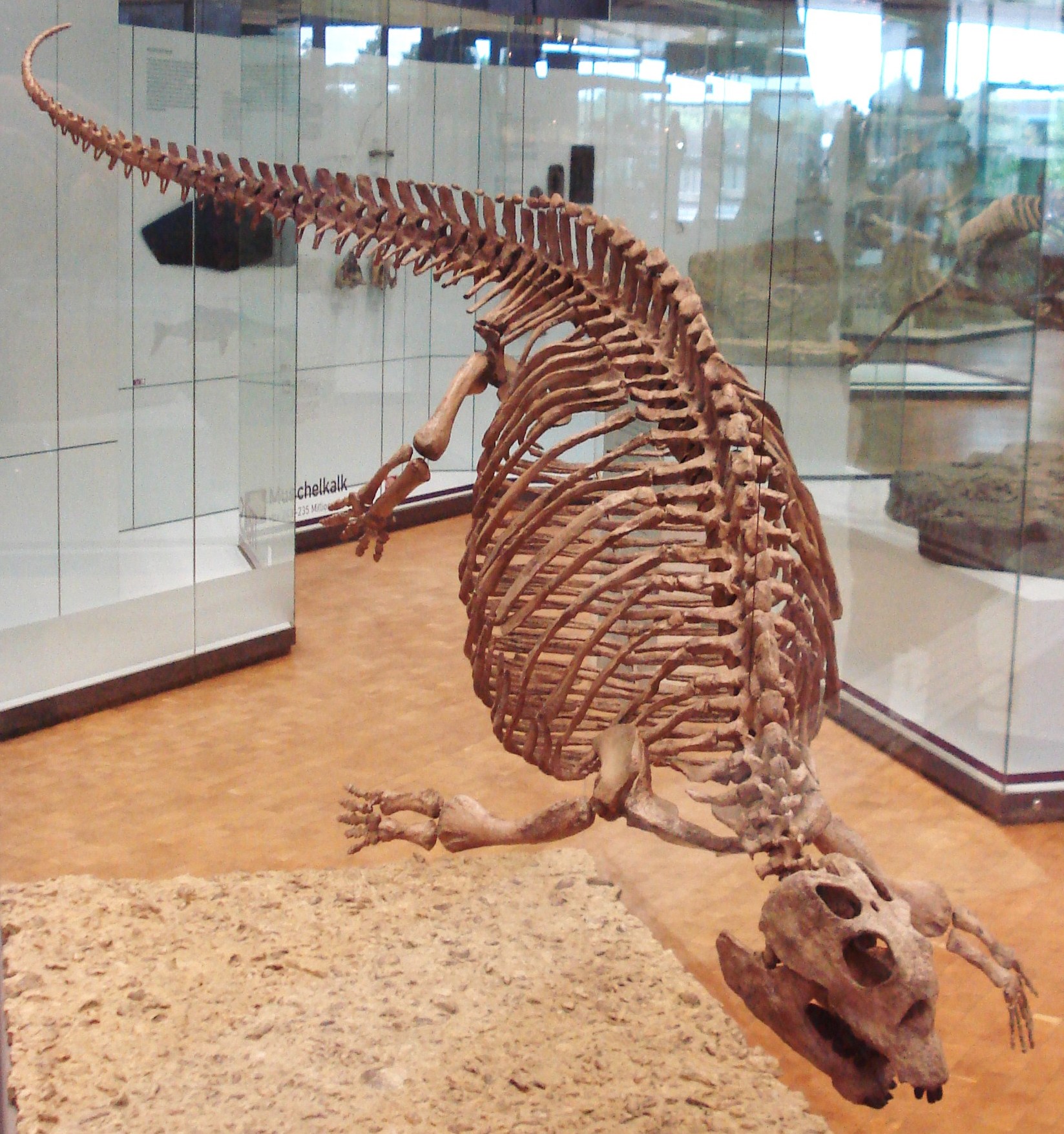
Notice what the victims had in common. They were the incumbents, the groups that had dominated their ecosystems for tens of millions of years. Extinctions are rarely democratic; they take out the specialised and the large while leaving behind generalists that can eat almost anything and go dormant when conditions turn.
Who inherited the Earth
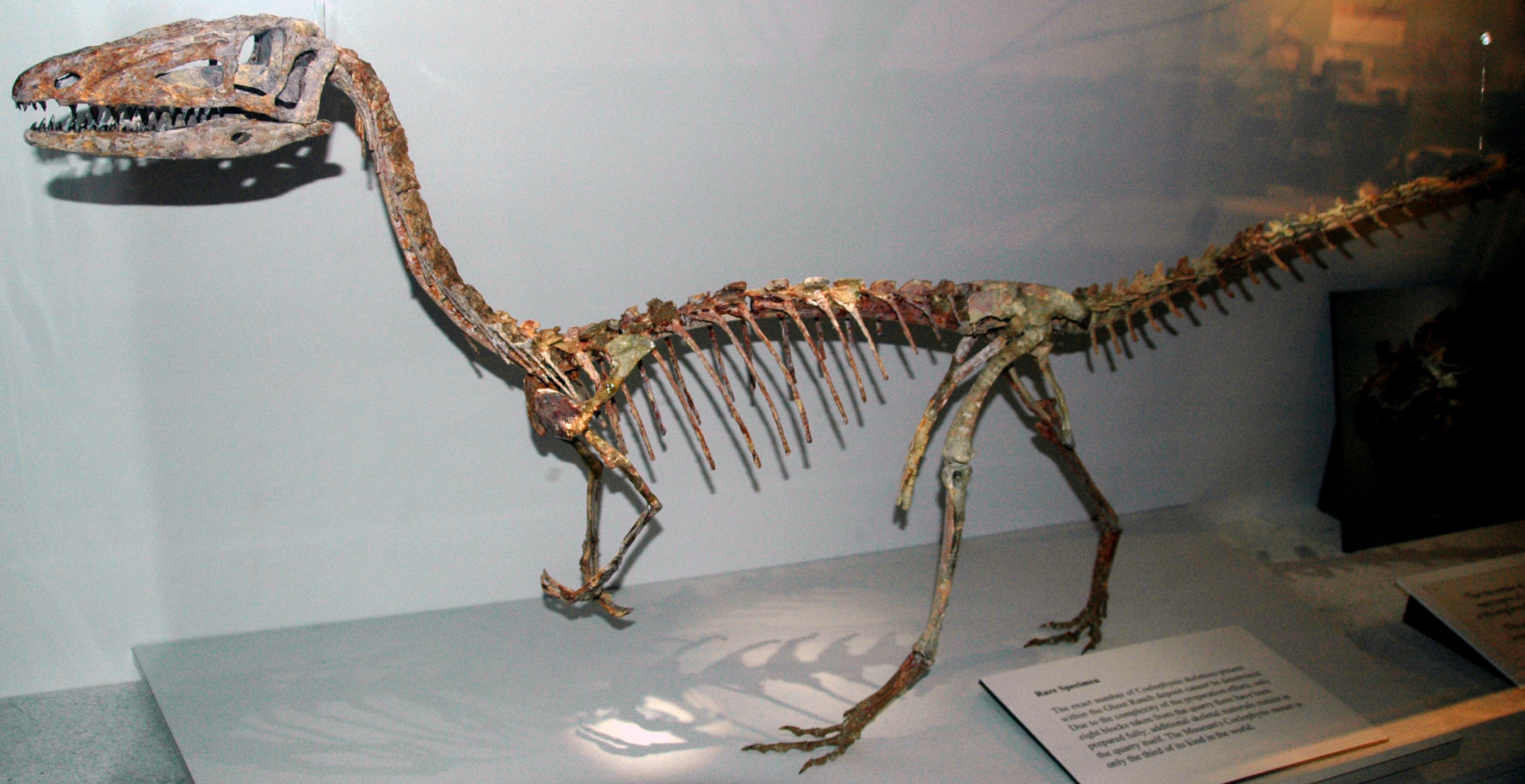
Dinosaurs are the famous winners, and the irony is that they did not win by being big. The Triassic survivors were modest animals like Coelophysis, a three-metre hunter that weighed about as much as a sheepdog, plus the small crocodylomorphs, turtles and mammals that had been living underfoot the whole time. With the rauisuchians gone, these leftovers found an empty menu. During the Early and Middle Jurassic, dinosaur lineages diversified and grew, and by around 150 million years ago their descendants were the long-necked giants and plated tanks that define the period in every museum hall. Nothing about that outcome was guaranteed at the boundary itself; it was the ordinary consequence of outliving the competition.
The survivor in the ditch
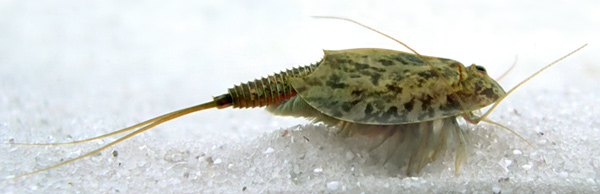
Then there is the animal this site is named after. Triops crossed this extinction too, along with the Permian one before it. Fossils of Triops-like tadpole shrimp from Triassic rocks, around 220 million years old, look startlingly like the animals you can still buy as eggs today, and the notostracan lineage clearly rode out the boundary without changing much. That makes sense once you look at how they live. Triops breed in temporary pools that dry up completely, so their eggs simply sit in the mud as dormant cysts through drought, heat and cold, waiting for the next rain. They depend on no stable ecosystem, no particular food chain and no balanced ocean. A crisis that destabilised the whole planet for tens of thousands of years was, for a puddle of dormant eggs, mostly an ordinary Tuesday. See how Triops and the dinosaurs shared the Triassic.
Recovery took time. Marine communities stayed depauperate for millions of years, reef ecosystems in particular took a long, slow rebuild, and dinosaur dominance was a process measured in tens of millions of years rather than a single afternoon. The end-Triassic matters because it shows extinction working the way it usually does: not through a single dramatic blast, but through a sustained environmental shove that removes the incumbents and hands the future to whoever is small, flexible and already waiting in the wings. It sits in the same story as the Permian-Triassic catastrophe that came before it and the Cretaceous-Paleogene impact that ended the dinosaurs, part of a series of resets our earlier oceans also endured. The planet keeps reshuffling, and the survivors are rarely the ones you would bet on.