Published 2026-09-23 · by the Triops.me Editorial Team · Back to Articles
Entelodonts: The Hell Pigs of the Age of Mammals
Picture a creature with the bulk of a bison, the head of an enormous warthog and a bite built for snapping bones like breadsticks. Now picture it chasing a rhinoceros across an open plain, forty million years ago. That creature existed. Palaeontologists call it an entelodont, and early researchers, half jokingly, gave it the nickname that stuck: the hell pig.
The name is misleading in more ways than one. Entelodonts were terrifying, but they were not pigs, and some of them looked more like monsters from a nightmare than anything on a farm. They dominated the landscapes of North America, Europe and Asia for roughly thirty million years, from the late Eocene into the early Miocene, and their fossils record some of the most violent behaviour ever preserved in stone.
Not Pigs at All
Entelodonts are artiodactyls, the order of even-toed hoofed mammals, so the pig comparison is not completely random. But detailed anatomical studies show they were never true swine. Instead they perched somewhere near the base of the branch that leads to hippos and whales, which makes their story a strange cousin to the animals described in when whales walked. Their name, coined by Richard Owen in the 1840s, means "perfect teeth", a nod to a mouth that contained a complete, fearsome set rather than any single specialised tool.
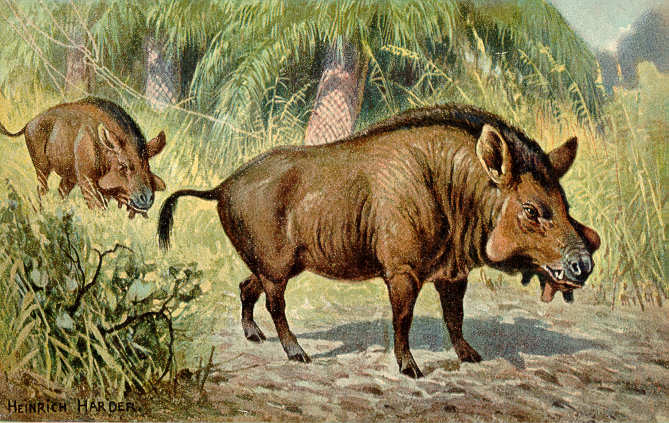
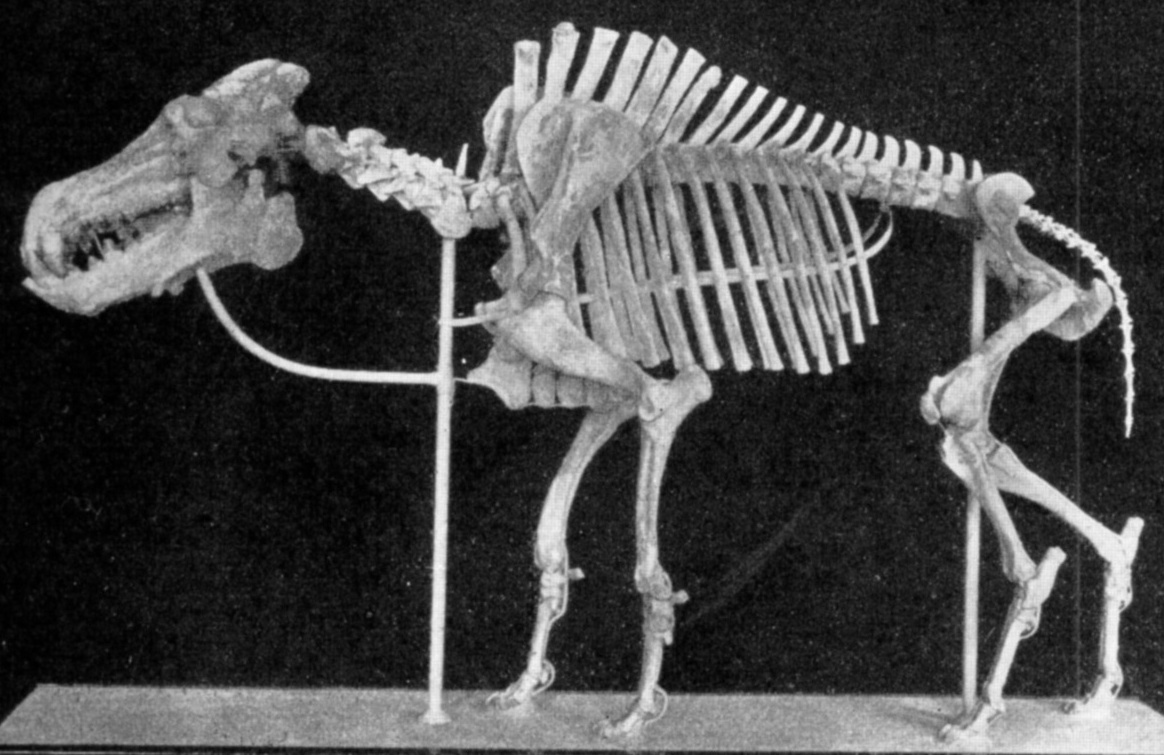
The first well-known species, Entelodon, lived in Europe during the Eocene and was roughly cow-sized. Later relatives grew far bigger. Archaeotherium prowled the Oligocene plains of North America, while Daeodon, a Miocene giant once known as Dinohyus, reached around two metres at the shoulder and may have weighed close to a tonne. In Asia, Paraentelodon rivalled it. These were the largest land mammals of their day, part of a wider trend you can read about in why prehistoric animals grew so big.
Built for Bone
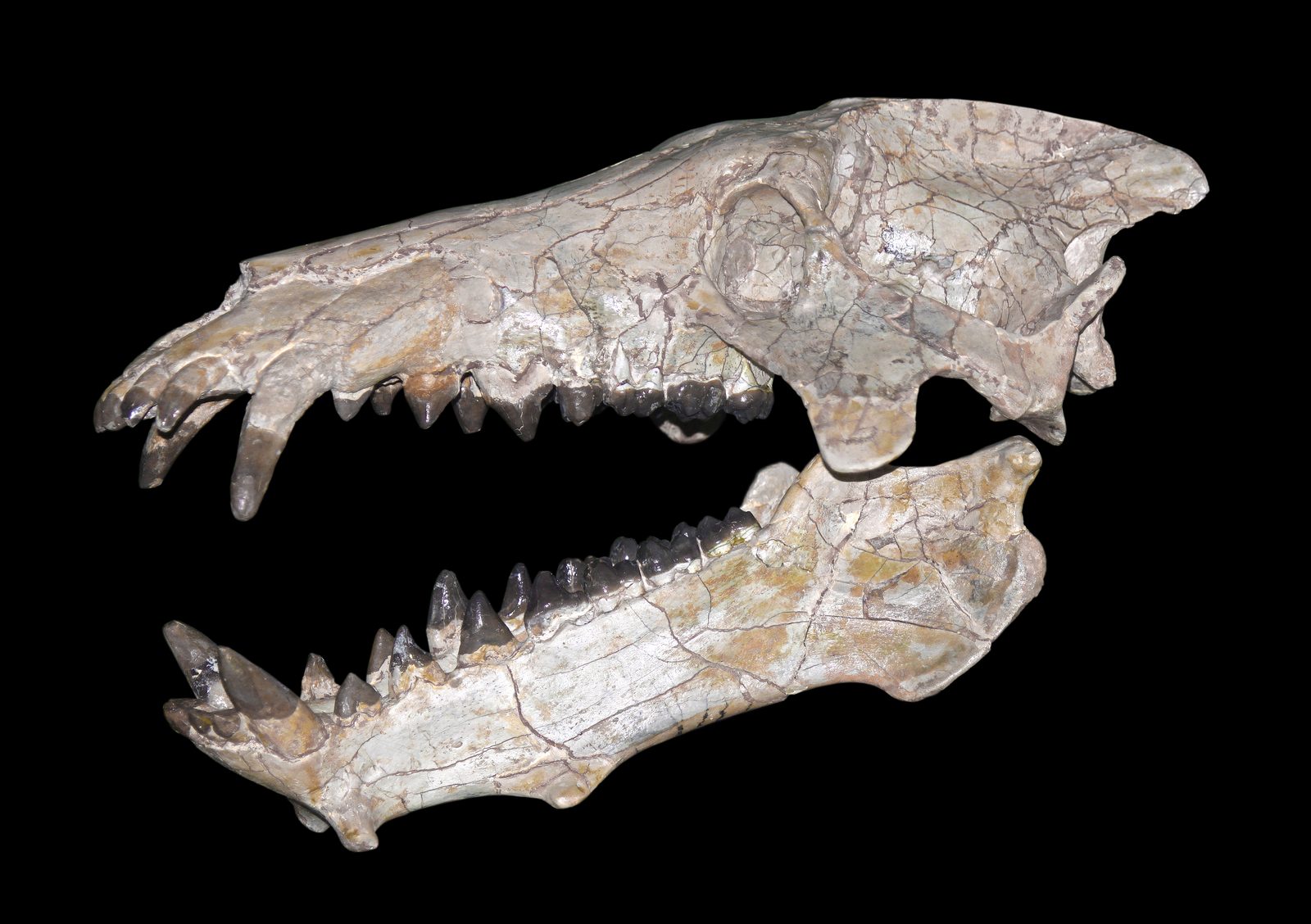
Everything about an entelodont skull announces trouble. It was long, deep and heavy, in the biggest species stretching well over half a metre. Small eyes sat high on the head, and the brain was tiny, with enormous olfactory bulbs. Entelodonts clearly navigated their world by smell rather than sight, sniffing out carcasses over long distances.
The teeth tell the diet. Sharp canines for gripping, crushing molars for grinding, and every tooth type in between. But the strangest features are the bony flanges that bulged from the cheeks and jaw. Slender, knobbly and curved, they made the face look wider than it should be. Nobody knows their exact purpose. They may have protected the face during fights over carcasses, anchored powerful jaw muscles, or served as status signals between rivals, the way antlers do in deer.
A Fossil Record of Violence
Entelodonts did not just look aggressive. Their fossils prove it. Bones of Archaeotherium discovered in Wyoming bore distinctive puncture marks that matched its own jaws exactly, evidence that these animals bit each other, probably in ferocious disputes over food and rank. The injuries were numerous and often on the face and skull, consistent with face-to-face combat.
Even stranger, some fossil sites preserve piles of disarticulated prey bones stacked together. The pattern suggests entelodonts carried chunks of carcass back to a central spot, the way a modern predator caches food. One site contained the crushed remains of several early camels mixed with entelodont bite marks, essentially a thirty-million-year-old larder. Combined with tooth marks on the bones of other animals, the evidence paints a picture of an omnivore and scavenger that supplemented carrion and plants with active hunting when the chance appeared.
The most famous entelodont graveyard is Agate Fossil Beds in Nebraska. There, dozens of Daeodon individuals died together around the carcasses of other Miocene giants, and their gnawed bones record the competitive frenzy that surrounded every meal.
The End of the Hell Pigs
For thirty million years entelodonts had no real competition. Then, in the early Miocene, the landscape changed. Grasslands spread, forests shrank, and a new wave of predators arrived from Asia, including the bear dogs such as Amphicyon, which were faster, smarter and hunted in packs. Entelodonts had small brains and poor eyesight, and their scavenging lifestyle offered few defences against dedicated pursuit predators. By around sixteen million years ago they were gone, leaving no descendants.
Their disappearance did not end bone eating, of course. Hyenas and other later carnivores evolved similar bone-crushing equipment independently, a nice example of how evolution keeps recycling the same successful ideas. The hell pig niche was simply taken over by better engineers.
Entelodonts deserve their reputation. They were among the most imposing mammals ever to walk the Earth, and their fossils capture behaviour, not just anatomy, something palaeontology rarely achieves. A snap of jaws preserved in a rival's skull is as close to a photograph as the deep past ever gets.
If this glimpse into the age of mammals hooked you, explore more in our creature gallery, or read how other giants met their end in Argentavis, the heaviest flying bird that ever lived.