Published August 16, 2026, 15:56 by the Triops.me Editorial Team · Back to Articles
Giant Isopods: The Deep Sea's Armored Living Fossils
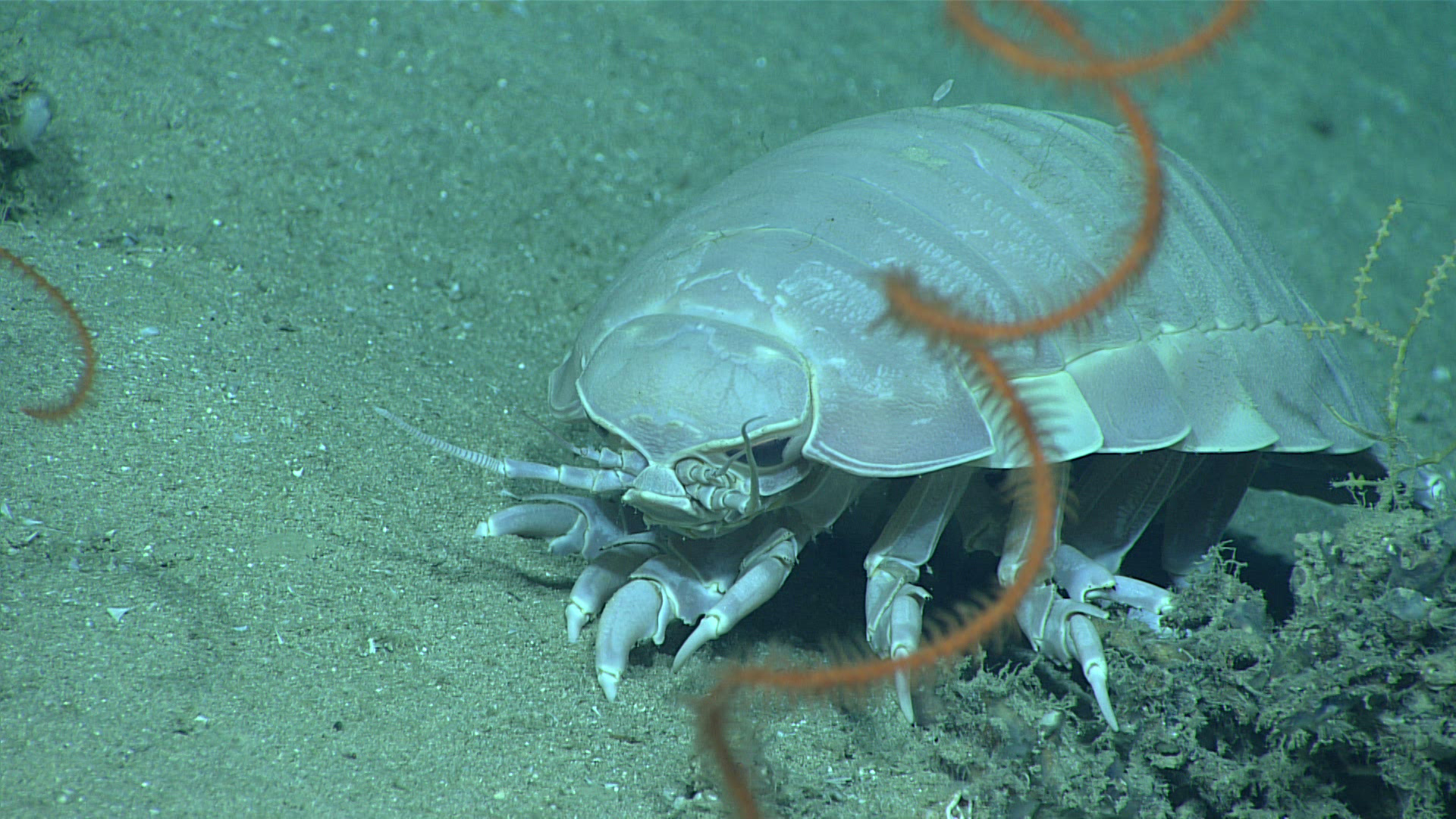
When most people think of living fossil crustaceans, Triops immediately comes to mind. But there is another ancient lineage that shares many of the same remarkable traits: the giant isopods of the genus Bathynomus. These deep-sea armored scavengers have been haunting the ocean floor for over 160 million years, surviving every major extinction event since the Jurassic period. They are, in every sense, the deep-sea cousins of our favorite prehistoric shrimp.
First described by French zoologist Alphonse Milne-Edwards in 1879, giant isopods were a sensation when they emerged from the depths of the Gulf of Mexico. At a time when scientists still debated whether the deep ocean was completely lifeless, the discovery of a football-sized crustacean with compound eyes and segmented armor proved that even the most hostile environments on Earth could harbor extraordinary life. The first specimen was a juvenile male, and females would not be recovered for another twelve years.
What Exactly Is a Giant Isopod?
Despite their alien appearance, giant isopods are closely related to the humble woodlouse, the pill bug you might find under a log in your garden. Both belong to the order Isopoda, and both share the same fundamental body plan: a dorsoventrally flattened body protected by overlapping segments of calcareous exoskeleton. Both can curl into a tight ball, exposing only their tough dorsal shell to would-be predators. The difference is scale. While a common woodlouse measures roughly two centimeters, Bathynomus giganteus typically reaches 19 to 36 centimeters in length. The largest confirmed specimen was approximately 50 centimeters, or about the size of a large dinner plate.
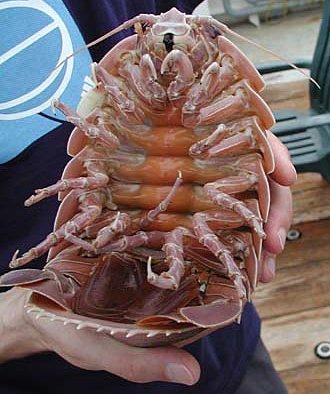
The genus Bathynomus contains two broad size categories. The "giant" species mature between 8 and 15 centimeters, while the "supergiant" species, including B. giganteus, grow between 17 and 50 centimeters. This makes them the largest isopods in the world, an example of a phenomenon known as deep-sea gigantism, where invertebrates in cold, high-pressure environments grow far larger than their shallow-water relatives.
Eyes Built for Darkness
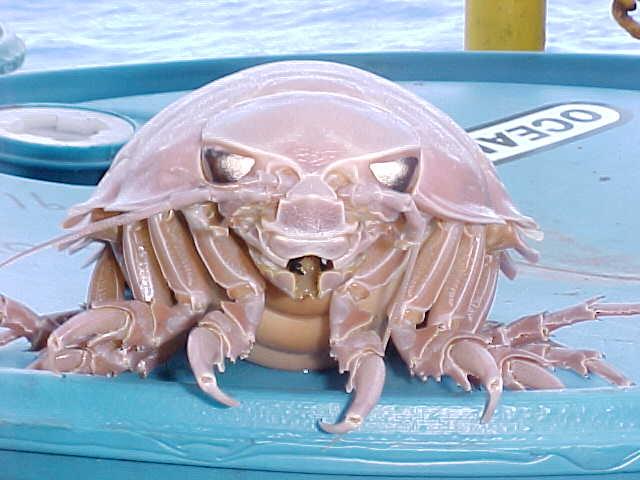
One of the most striking features of giant isopods is their enormous compound eyes. Each eye contains nearly 4,000 individual facets called ommatidia, arranged in a distinctive split pattern with a gap between the upper and lower halves. These eyes are among the most complex in the deep sea, giving giant isopods surprisingly sharp vision in the near-total darkness of their habitat. In an environment where light is scarce and fleeting, having such powerful visual organs gives them a significant advantage in locating the rare scraps of food that sink from the surface.
Their body is typically a pale lilac or pinkish color, a pigmentation that is almost invisible in the blue-black darkness of the deep ocean. Seven pairs of thoracic legs line their underside, with the first pair modified into maxillipeds, specialized feeding appendages that manipulate and carry food to their four sets of jaws. The abdomen bears five pairs of flat, leaf-like pleopods that serve as both swimming appendages and respiratory gills.
A Life of Scarcity and Survival
The deep ocean is one of the most food-poor environments on Earth. Giant isopods have evolved extraordinary adaptations to survive in this world of feast and famine. They are primarily scavengers, feeding on dead whales, fish, and squid that sink from the waters above. When a significant food source is encountered, they gorge themselves to the point of immobility, storing massive energy reserves in their midgut gland and fat body. Lipids, particularly triacylglycerols, make up 88 percent of the total lipids in their fat body.
When food is not available, giant isopods can shut down. They possess an enlarged stomach and the ability to drastically lower their metabolism. In captivity, individuals have survived over five years without a single meal. Their digestive system relies heavily on Chlamydiae bacteria, which help break down food and are essential for lipid storage. A study of 1,651 specimens found that fish made up the bulk of their diet, followed by cephalopods and small crustaceans such as shrimp and squat lobsters. They may also prey on slow-moving animals like sea cucumbers, sponges, and nematodes.
A Connection to Triops
While Triops and giant isopods belong to different crustacean orders, they share a striking common thread: both are living fossils whose body plans have remained largely unchanged for over 160 million years. Triops carapaces have been found in Triassic sediment dating back more than 200 million years, and fossils closely resembling modern Bathynomus appear in Miocene deposits from Japan and Spain, approximately 15 to 20 million years ago, with the broader lineage stretching back to the Jurassic.
Both groups have survived five major mass extinctions. Both have evolved remarkable survival strategies: Triops through their desiccation-resistant eggs that can wait decades for the right conditions, and giant isopods through their ability to endure years of starvation in the perpetual darkness of the abyss. Both occupy the role of resilient generalists, capable of exploiting whatever resources their extreme environments provide.
Range, Habitat, and Diversity
Giant isopods inhabit the Atlantic, Pacific, and Indian oceans, typically at depths between 170 and 2,140 meters. The greatest species diversity, with five known species, is found off eastern Australia. The deepest record belongs to B. kensleyi, found at 2,500 meters below the surface. Over 80 percent of B. giganteus individuals are found at depths between 365 and 730 meters, in waters that hover between 3 and 13 degrees Celsius.
Interestingly, giant isopods from Australia, Mexico, and India are nearly identical in appearance despite being separated by thousands of kilometers of ocean. This remarkable consistency across vast distances is thought to result from the extremely low light levels of their habitat, which reduces the selective pressure for visual divergence. The deep sea is a leveling force, and its darkness erases the subtle differences that would drive speciation in shallower waters.
Reproduction and Lifespan
Female giant isopods carry their eggs in a brood pouch, or marsupium, formed by overlapping plates on their underside. The young emerge as miniature adults, known as mancas, fully formed except for the last pair of legs. There is no larval stage, a trait shared with Triops, where the young hatch as tiny versions of the adults and immediately begin foraging. This direct development is an advantage in environments where planktonic larvae would face almost certain death.
Only two egg-bearing females have ever been documented, suggesting that mothers may dig into the ocean floor and cease foraging while incubating their eggs. The estimated lifespan of B. giganteus is about 7.7 years for females and 6 years for males, though some researchers suspect individuals may live significantly longer in the wild.
Threats from the Surface
Despite their remoteness, giant isopods face real threats from human activity. They are frequently caught as bycatch in commercial fishing operations targeting deep-sea species like monkfish. During just 14 industrial fishing cruises in 2001, an estimated 55,475 giant isopods were caught as bycatch. Once hauled to the surface, their post-release mortality rate is estimated at 50 to 100 percent, as the stress of rapid decompression and temperature change overwhelms their physiology.
Plastic pollution has also reached the deep. Analysis of stomach contents from giant isopods in the Gulf of Mexico revealed large quantities of plastic debris, a grim reminder that even the most remote habitats on Earth are not immune to human impact. In Vietnam, giant isopods are actively sought as a delicacy, adding harvesting pressure to the already mounting threats from bycatch.
Living Fossils of the Abyss
Giant isopods embody the same story that makes Triops so captivating: the extraordinary persistence of ancient body plans in extreme environments. While Triops conquered the temporary pools and desert ephemerals of the surface world, Bathynomus conquered the lightless plains of the deep ocean. Both lineages have outlasted dinosaurs, ice ages, and asteroid impacts, proving that survival does not require perfection. It requires resilience, adaptability, and the patience to wait out whatever the planet throws at you.
The next time you see a woodlouse curl into a ball under a garden stone, take a moment to appreciate that you are looking at the same basic blueprint that has been refining itself for hundreds of millions of years, both on land and in the crushing darkness of the abyss.