Published 2026-09-13 · by the Triops.me Editorial Team · Back to Articles
Glyptodon: The Car-Sized Armadillo of the Ice Age
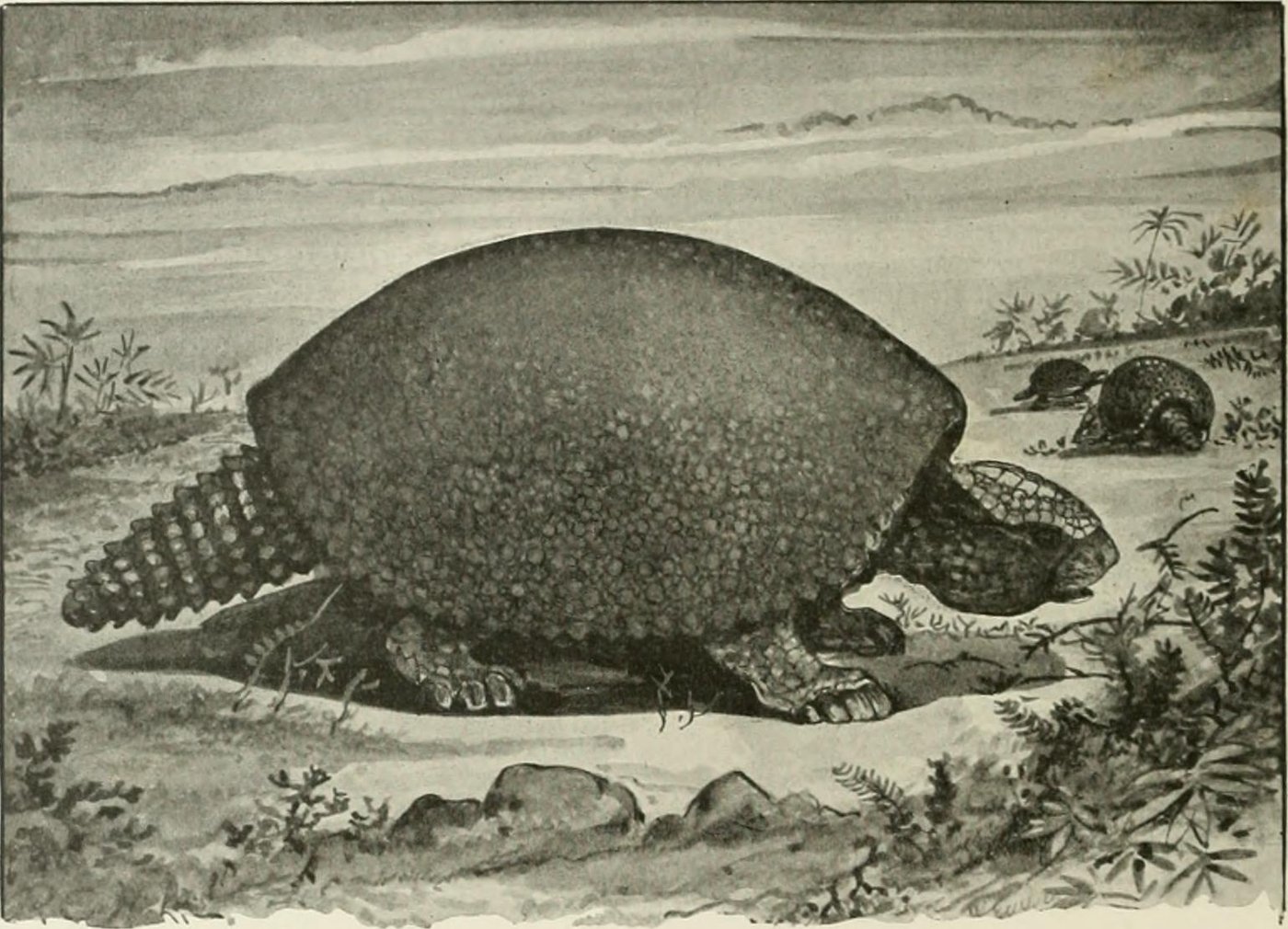
When the first Spanish colonists rode across the Pampean plains of Argentina, they kept finding enormous shells half buried in the riverbanks. Curved, thick as a dinner plate, and clearly made of bone, they looked like the shells of giant turtles. But there was a problem: they were far too large for any turtle, and they had no place for a head or legs to retract into. The gauchos told a simpler story. These were the houses of an ancient race of giants, and some of the shells still held their former owners inside.
The shells belonged to glyptodonts, and the most famous of them, Glyptodon, was no turtle at all. It was an armadillo. Not a giant armadillo in the loose sense, like today's six-foot Priodontes of the Amazon, but a cousin so distant and so heavily modified that it deserves its own place among the strangest mammals that ever walked the Earth. Picture a Volkswagen Beetle with a tail: that is roughly Glyptodon clavipes, the type species, which reached about 3.3 meters long and weighed close to two tonnes.
A Shell Built Like a Suit of Armor
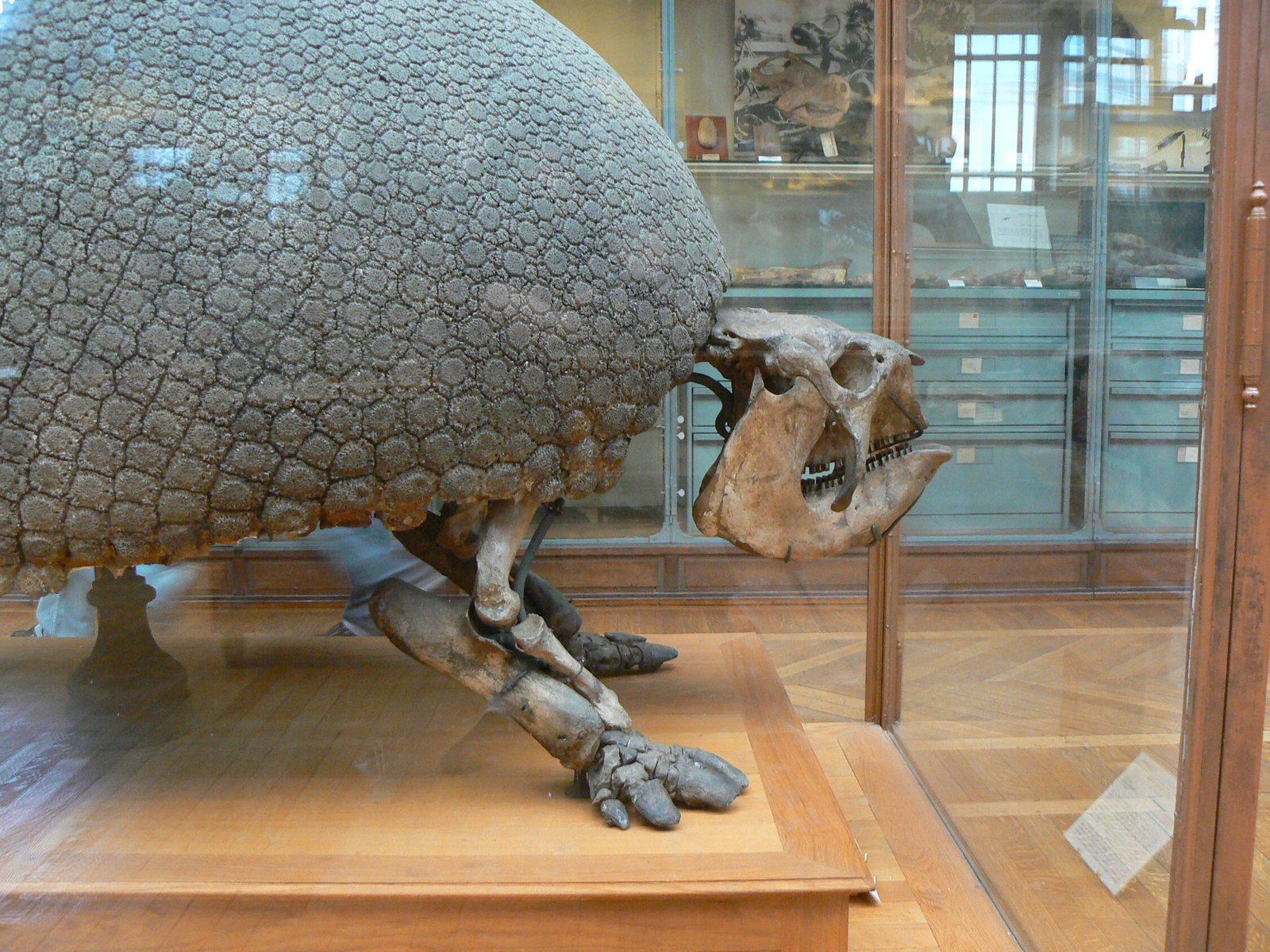
An armadillo's armor is made of ossified skin: thousands of small bony plates called osteoderms, each grown in the dermis and covered by horn. In a modern armadillo these bands stay separate, so the animal can roll or flex. Glyptodon went down a different road. Its osteoderms fused together into a single rigid dome, a carapace so solid that early scientists confused individual pieces with turtle shells. The dome did not touch the ground. Beneath it, the animal's vertebrae were fused to the shell's underside, suspending the body inside its armor like the chassis of a car hung on its frame.
This rigidity had consequences. Glyptodon could not curl into a ball the way a three-banded armadillo does. It could not even walk very fast; its limb bones are short, stout, and dense, built for carrying two tonnes of shell rather than for running. Instead of fleeing, glyptodonts relied on a fortress strategy. The rim of the carapace flared outward, and the top of the head was covered by its own bony shield. In front of the pelvis, extra rings of plates protected the vulnerable gap between shell and tail. The whole animal reads like a lesson in defensive engineering, and it worked for millions of years.
The Tail That Broke the Rules
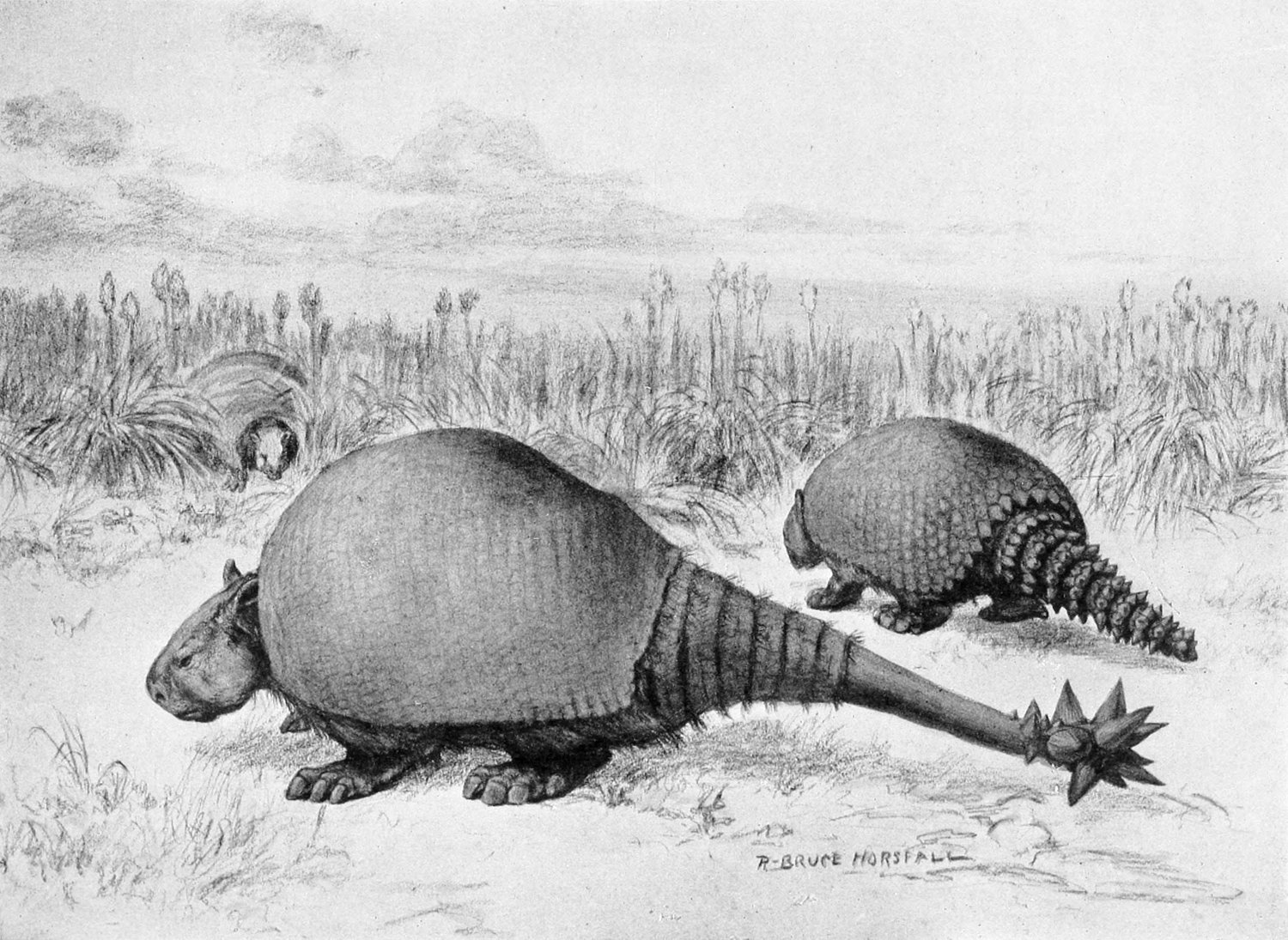
Glyptodon itself had a fairly plain, armored tail. But one of its relatives, Doedicurus, the largest glyptodont ever found at nearly four meters and well over a tonne, carried a weapon at the end of its own: a thickened, spiky club, up to a meter and a half long, hollowed at the tip into a cavity that may have been a fluid reservoir. These clubs look so much like those of ankylosaur dinosaurs that paleontologists use the same word for both. Where ankylosaurs swung their tails tens of millions of years earlier, Doedicurus swung its own during the Pleistocene, possibly against rivals of its own kind rather than predators. Broken shells and heavily built tail vertebrae in related glyptodonts hint at real fights, a private arms race playing out under the Ice Age sky.
A Grazing Life on the Pampas
Strip away the armor and Glyptodon was a placid herbivore. Its teeth are simple, ever-growing columns, the kind of dentition that belongs to an animal grinding tough grass all day. Combined with the high-crowned skull and the position of the eyes, low and sideways, the picture is of a dedicated grazer, nose near the ground, working through the Pampas grasslands exactly as a capybara or a cow does today. Glyptodon and its relatives filled a grazing role that South America's native hoofed mammals had partly abandoned, and they shared that landscape with giants: the ground sloth Megatherium, the elephant-like gomphotheres, the heavy camelid Macrauchenia, and the predators that hunted them all.
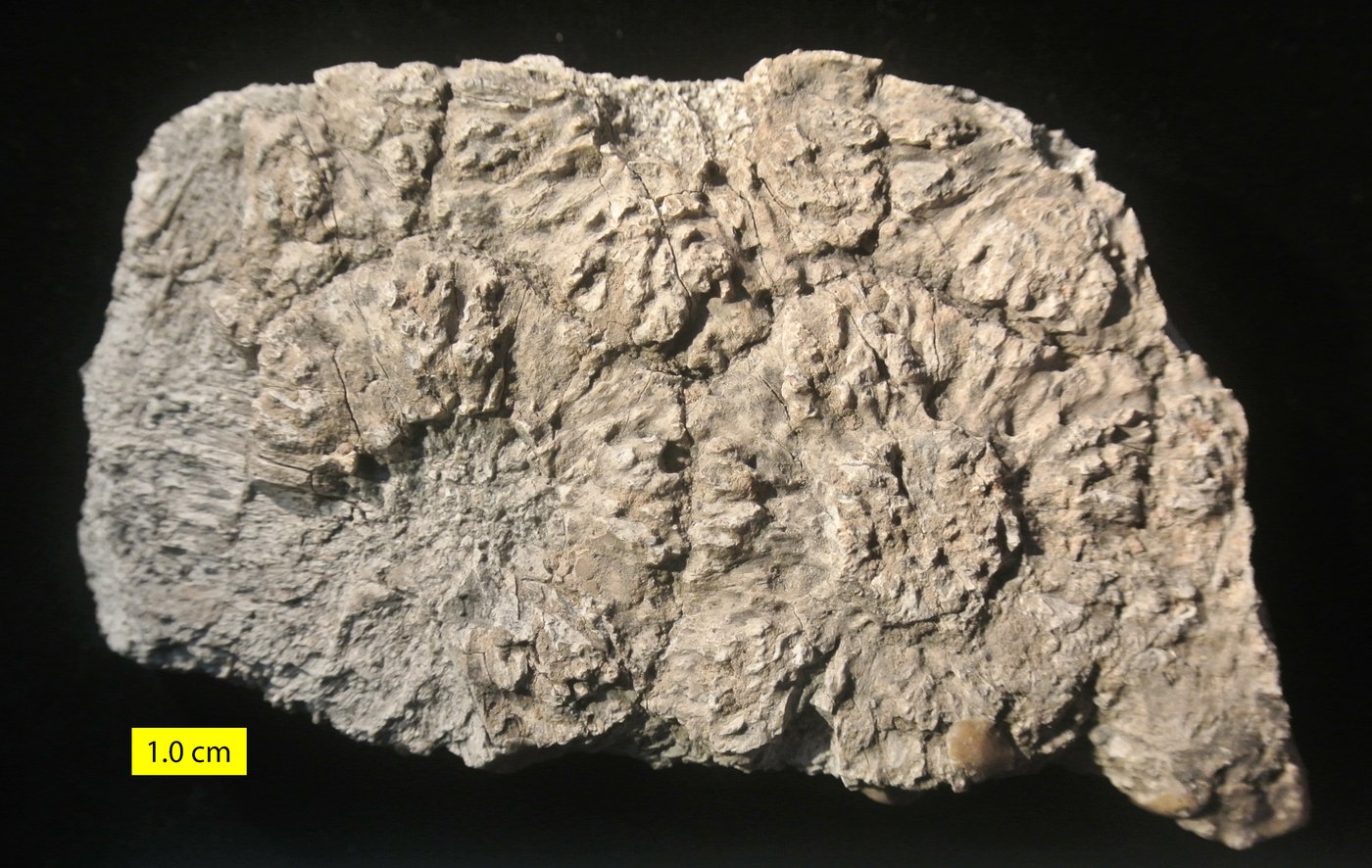
Each osteoderm in that carapace tells its own small story. In cross-section they show a honeycomb of bone, and in the fossil fragments you can often trace the growth lines, season by season, the way tree rings record years. Because the plates grew with the animal, a glyptodont never had to shed or replace its armor. It was born armored, and it died in the same shell, only larger.
Meeting Humans, and the End
Glyptodon lived through the great Pleistocene swings of climate that killed off many other lineages, and it was still thriving when the first humans reached South America, probably around 15,000 years ago. Archaeological sites show that people knew these animals well. Shell bones appear in hearths and living floors, and at some sites, like the famous Pay Paso site in Uruguay, there is evidence that people used glyptodont scutes, and possibly whole tail-sheath segments, as raw material. A tail club sheath is a ready-made cutting tool, and a carapace is a ready-made shelter; some researchers have even suggested early humans camped under upturned shells.
The combination proved fatal. Within a few thousand years of human arrival, every species of glyptodont was gone, along with most of the megafauna they shared the grasslands with. Climate change at the end of the last ice age may have weakened their populations, but the timing and the evidence point to humans as a decisive factor. An animal that had survived millions of years of predation by sabertoothed cats and giant flightless birds could not outlast a species that could wait beside a waterhole with a spear.
Why Glyptodon Still Matters
Glyptodonts are a reminder of how strange mammal evolution can get when it is given a continent to itself. South America spent tens of millions of years as an island continent, and its fauna responded with experiments that look almost reptilian: armored fortresses, bone-shattering clubs, giant sloths. Glyptodon is one of the clearest examples of convergent evolution in the fossil record, an animal that solved the defense problem the way a turtle or an ankylosaur did, but with mammal hardware, using plates of modified skin instead of a true shell.
There is also a lesson about survival strategies here, one that readers of this site will recognize. Triops survives by being fast: hatching in days, breeding in weeks, and abandoning a drying pool before it kills them. Glyptodon took the opposite bet. It invested everything in a body that was almost impossible to kill in a single encounter, and that strategy, too, ran for millions of years. What neither strategy could prepare for was a world where the rules changed faster than either animal could adapt. The armored giant's greatest strength became a liability when a new predator with weapons, and ideas, arrived on the Pampas.
The gaucho legends about the giant shells eventually gave way to science. In 1839 Richard Owen, the biologist who coined the word "dinosaur", formally described Glyptodon from Darwin's collections, and the animal has anchored South American paleontology ever since. Its closest living relatives, the armadillos, are much smaller and much more flexible, a successful bet in their own right. But for a stretch of the Pleistocene, the most formidable animal on the grasslands of the south was an armadillo the size of a car, carrying a shell you could live in.