Published 2026-09-09 · by the Triops.me Editorial Team · Back to Articles
Graptolites: The Pencil Marks That Time the Ocean
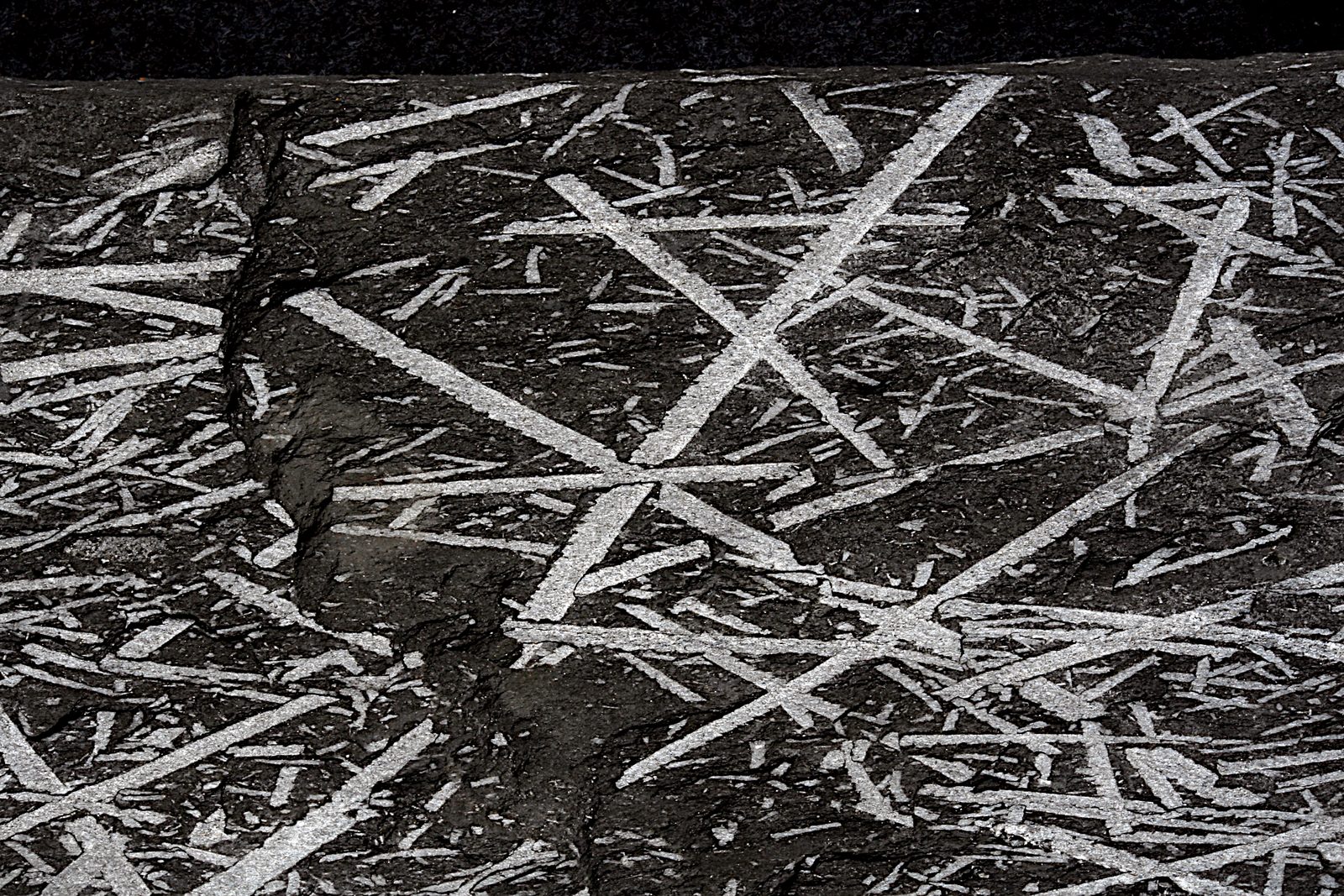
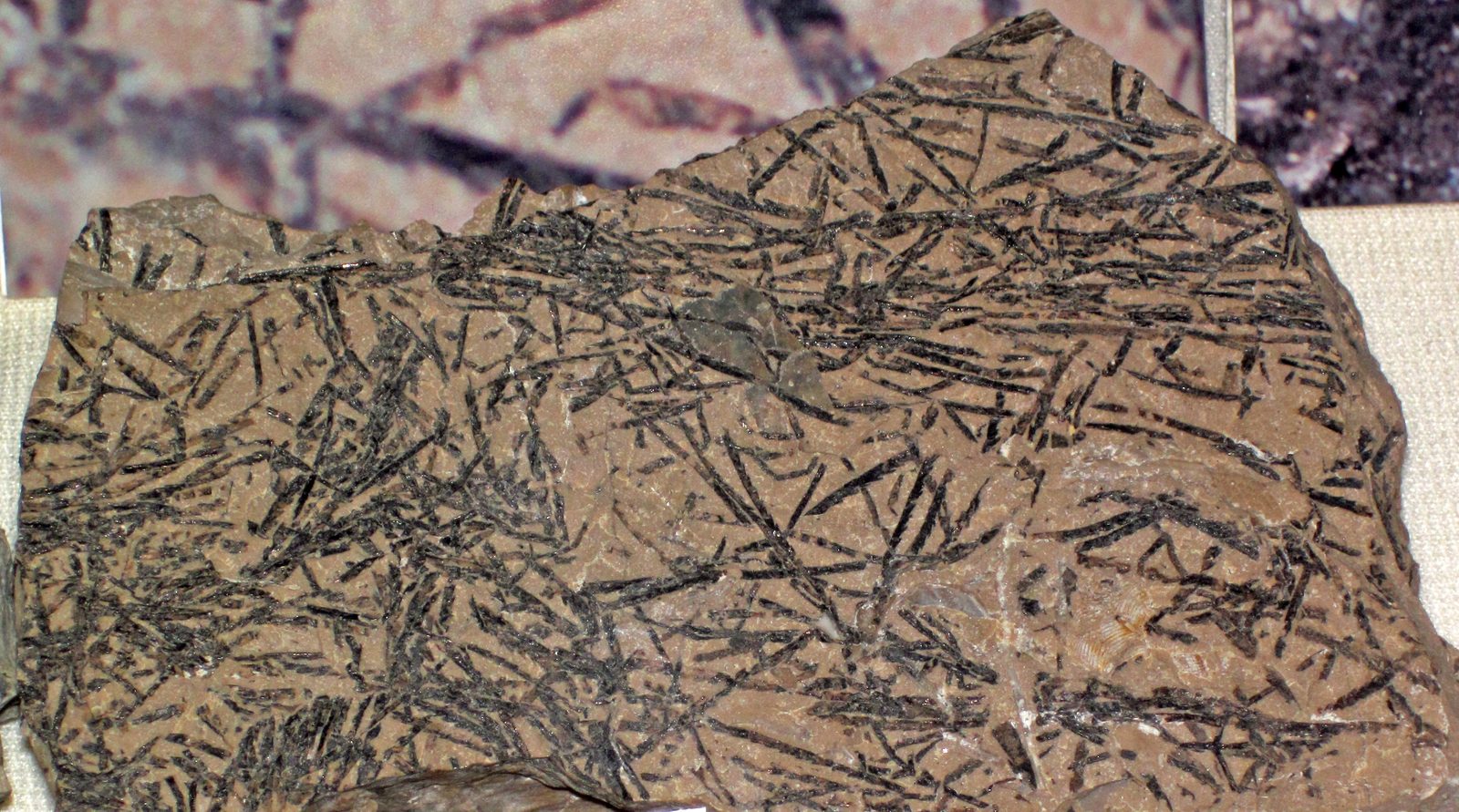
Split open a slab of dark Ordovician or Silurian shale and you might find something that looks like a pencil line scribbled across the rock, or a row of tiny saw teeth frozen in stone. Victorian geologists called these marks "graptolites," from the Greek for "written on stone," and for decades nobody could agree on what had made them. They looked a little like plants, a little like corals, a little like nothing alive today. It took more than a century of argument before science settled the question, and the answer turned out to be stranger than any of the early guesses.
Graptolites were animals: colonial hemichordates, built as branching chains of tiny connected filter feeders that floated through the open ocean in vast numbers. They dominated the plankton of the Paleozoic seas for roughly 200 million years, they evolved so fast that their fossils now set the official clock for entire chapters of geologic time, and against every expectation, their closest living relative is still with us, quietly building tubes on the seafloor today. Like Triops, they are a reminder that a lineage's survival has less to do with size or strength than with being in the right place when the world resets.
What exactly is a graptolite?
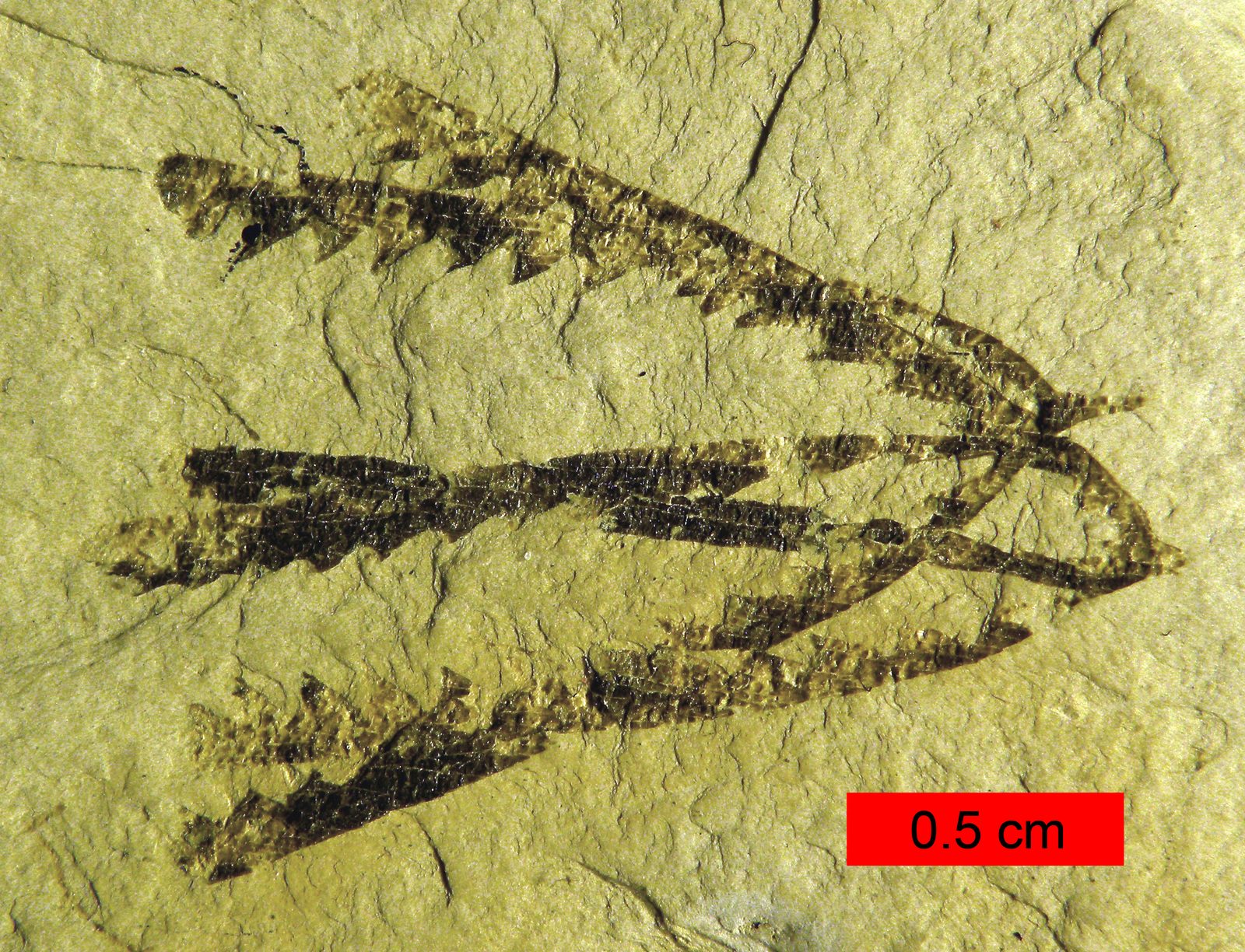
A single graptolite animal was nearly invisible, smaller than a grain of rice. The remarkable part was the architecture around it. Each colony, called a tubarium, is a nitrogen-rich housing secreted by the animals, built from half-tubes called thecae stacked along a stem. Every theca held one zooid, and all the zooids in a colony were connected by a shared thread of tissue, so the whole assembly functioned as a single feeding organism. Water was pulled past the rows of tentacled zooids, food was strained out, and the colony drifted wherever the currents took it. What a fossil collector finds is almost never the animal itself but this housing, pressed flat and carbonized into shiny black film on the rock.
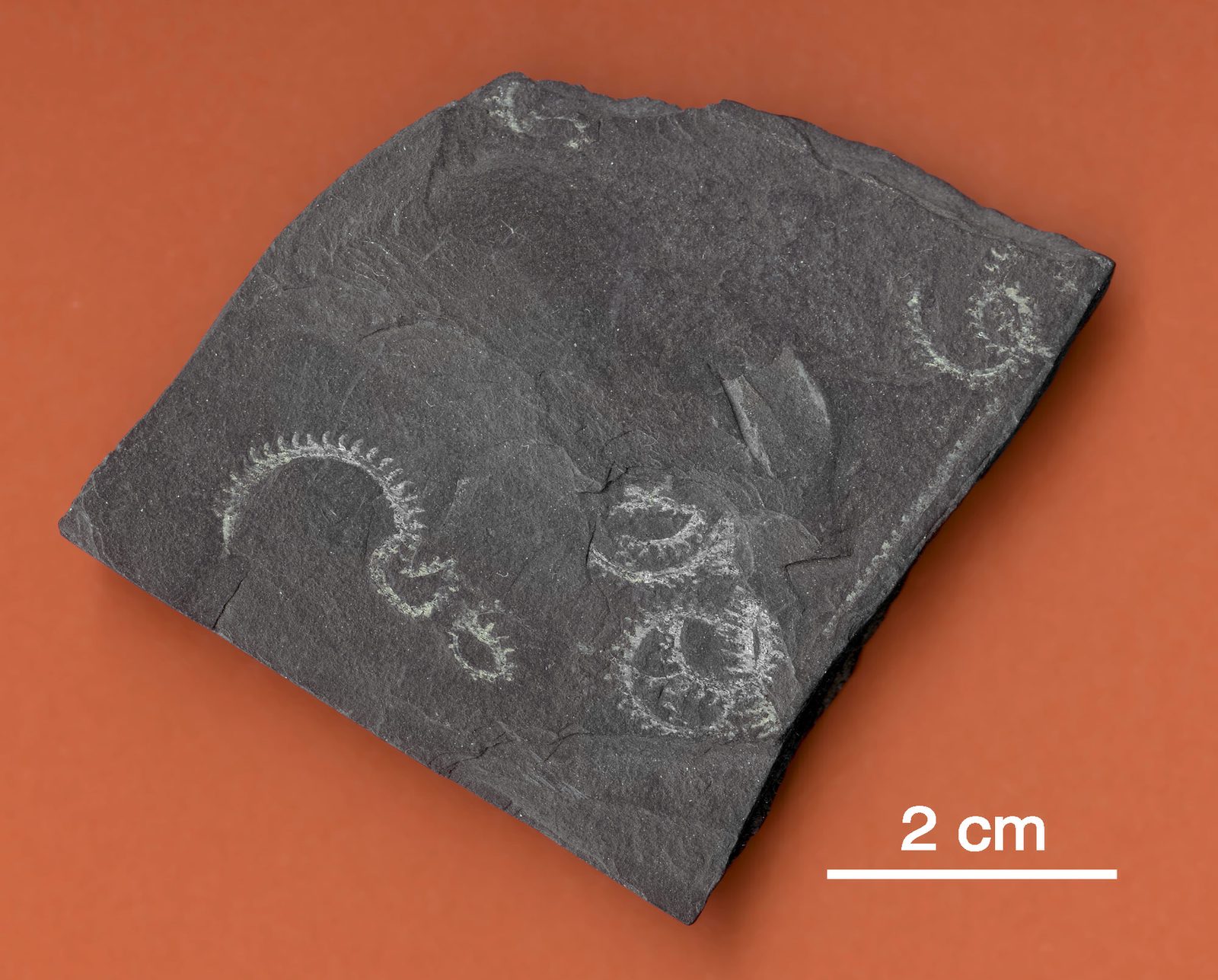
Early forms grew as bushy, many-branched colonies attached to the seafloor, much like a tiny stiff coral or moss animal. Over the Ordovician, the floating graptolites stripped that design down to something better suited for open water: fewer branches, lighter weight, sometimes a single elegant strand. By the Silurian, genera such as Monograptus hung as one saw-blade line in the current, while relatives like Oktavites spiralis coiled into loose spirals. Each of these shapes is a snapshot of an engineering lineage testing designs in real time, and because the designs changed quickly, each species lasted only a few million years before something new replaced it.
Living on the drift
Being plankton has an obvious drawback: you cannot swim away from trouble. Graptolites solved it the way drifters always have, by being numerous, widespread, and quick to adapt. Currents carried them across entire ocean basins, so the same species could be found in shales from what is now Australia, Scandinavia, Texas, and Scotland. When conditions changed, populations died back or shifted, and new species emerged to fill the water. This combination of worldwide distribution and rapid turnover is precisely what made them so valuable to geologists later on.
After death, the light hollow colonies sank slowly into the anoxic mud of deep seabeds where scavengers and bacteria were scarce, which is why graptolite fossils so often appear as crisp black films on black shale. Nothing about that lifestyle demanded speed, armor, or size. It demanded only abundance and fast evolution, two things graptolites delivered for the better part of 200 million years.
The clock of the early Paleozoic
Because graptolite species appeared and vanished so quickly, and because the same species shows up everywhere, geologists use them to correlate rock layers across continents. A shale bed in Wales and a shale bed in Nevada containing the same graptolite species were almost certainly deposited at the same moment in history. The official boundaries of the Ordovician and much of the Silurian period are literally defined by graptolite first appearances. When the base of a stage is fixed at the first occurrence of one named species, that species is doing the same work that a marked ruler does for a carpenter.
The most consequential of these time markers is Metabolograptus extraordinarius, whose first appearance defines the Hirnantian stage, the final and worst slice of the Ordovician. Its rise coincides with the end-Ordovician mass extinction, a double blow of glaciation and sea-level collapse that killed around 85 percent of species. Graptolites were hit brutally hard, and yet the lineage recovered each time, reorganized its colony designs, and kept going. Reading their record is like watching an ecosystem's pulse, with every downturn and recovery printed in the shale.
The near-miss with oblivion
Graptolites survived the end-Ordovician catastrophe, but their diversity never fully returned. The Devonian brought repeated crises that kept eroding the planktonic groups, and by the middle of that period the drifting graptolites were gone, some 330 million years before the present. For a long time the whole group was written off as a complete dead end, an experiment the ocean had retired.
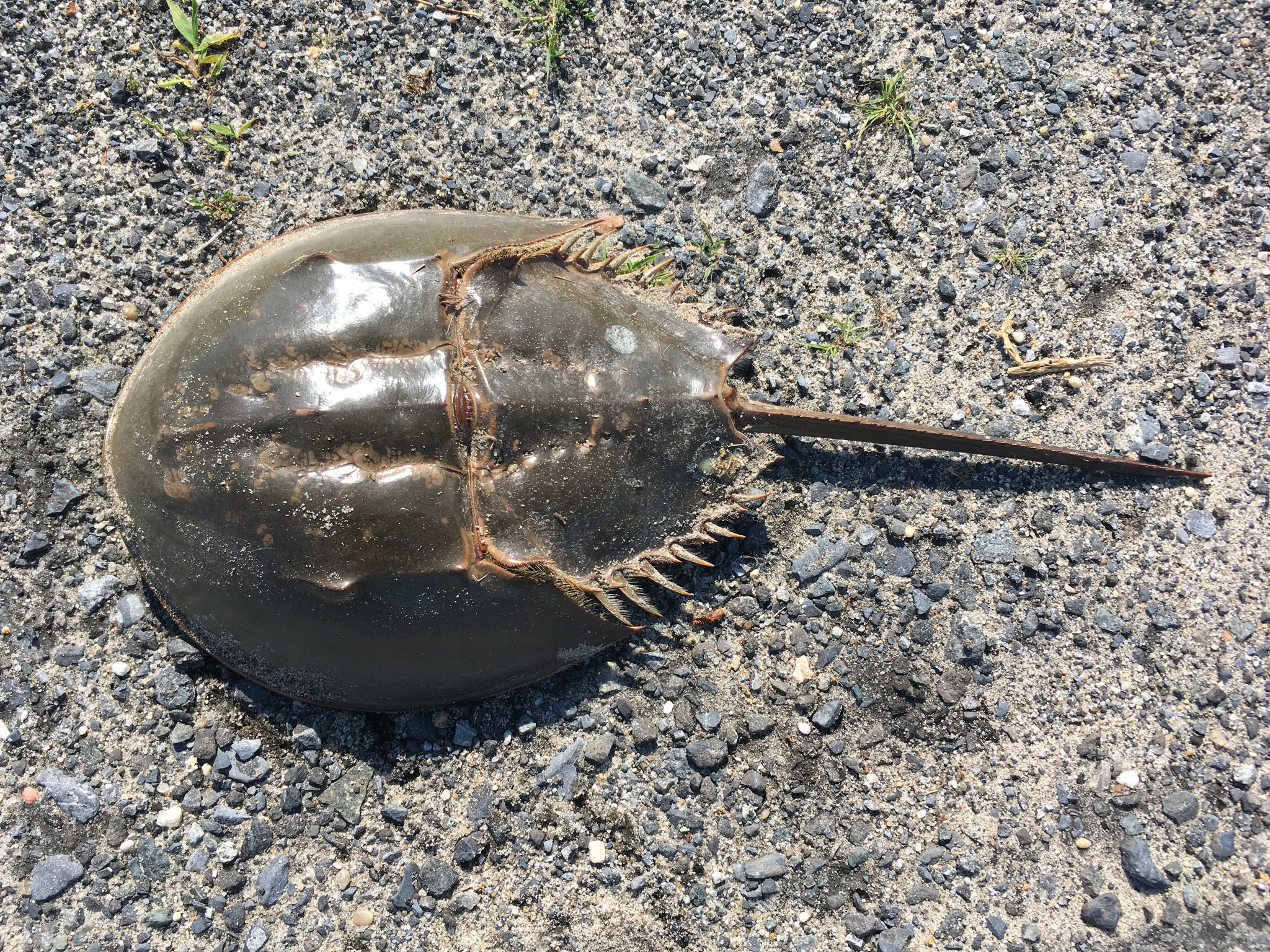
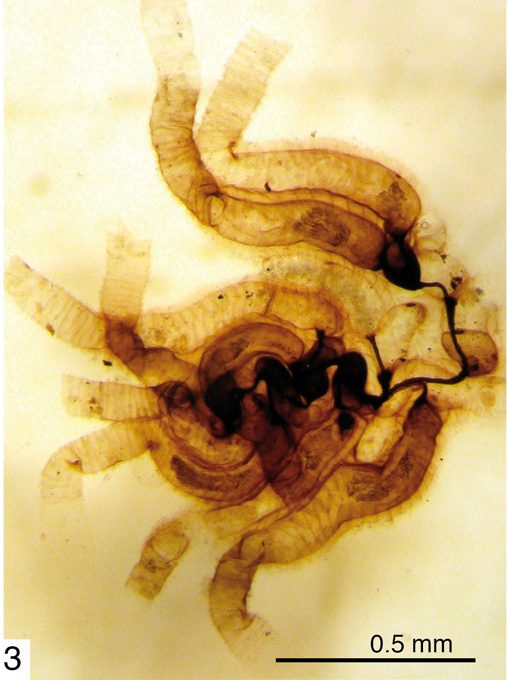
The surprise came from the seafloor. In the 1990s, evidence from ultrastructure and later DNA settled a question that had been open since the 1800s: graptolites are hemichordates, close relatives of acorn worms, and their living genus is Rhabdopleura, a tiny benthic animal that builds the same kind of thecal tubes as its fossil cousins. It is a walking, filter-feeding holdover from a 480-million-year-old lineage. The planktonic empire died, but the conservative, bottom-dwelling branch quietly persisted, much as horseshoe crabs outlasted the more flamboyant trilobites and lungfish outlasted most of their ancient freshwater peers.
What graptolites tell us about survival
The site's regular readers know the pattern by now: being a "living fossil" is less about winning every round than about losing survivably. Triops endure by banking drought-proof eggs and letting the adults of each generation die. Graptolites endured, for a while, by being everywhere at once and reinventing themselves fast, and their living relative endures by staying small, staying on the seafloor, and wanting almost nothing from a changing world.
There is also a lesson in how they were figured out. Graptolites baffled geologists for over a century, their affinities debated between plants, corals, and entirely phantom groups, until patient work on tiny details of tube construction settled the matter. A fossil does not come with a label. It comes with a shape, a layer of rock, and a set of questions, and the answers can take generations of investigators to assemble. That slow accumulation of understanding, from pencil marks on shale to a defined branch of the tree of life, is its own kind of survival story, one that continues every time a collector splits a slab of black shale and finds a written line from a vanished ocean.