Published August 16, 2026 by the Triops.me Editorial Team · Back to Articles
Helicoprion: The Spiral-Saw Fish of the Permian Seas
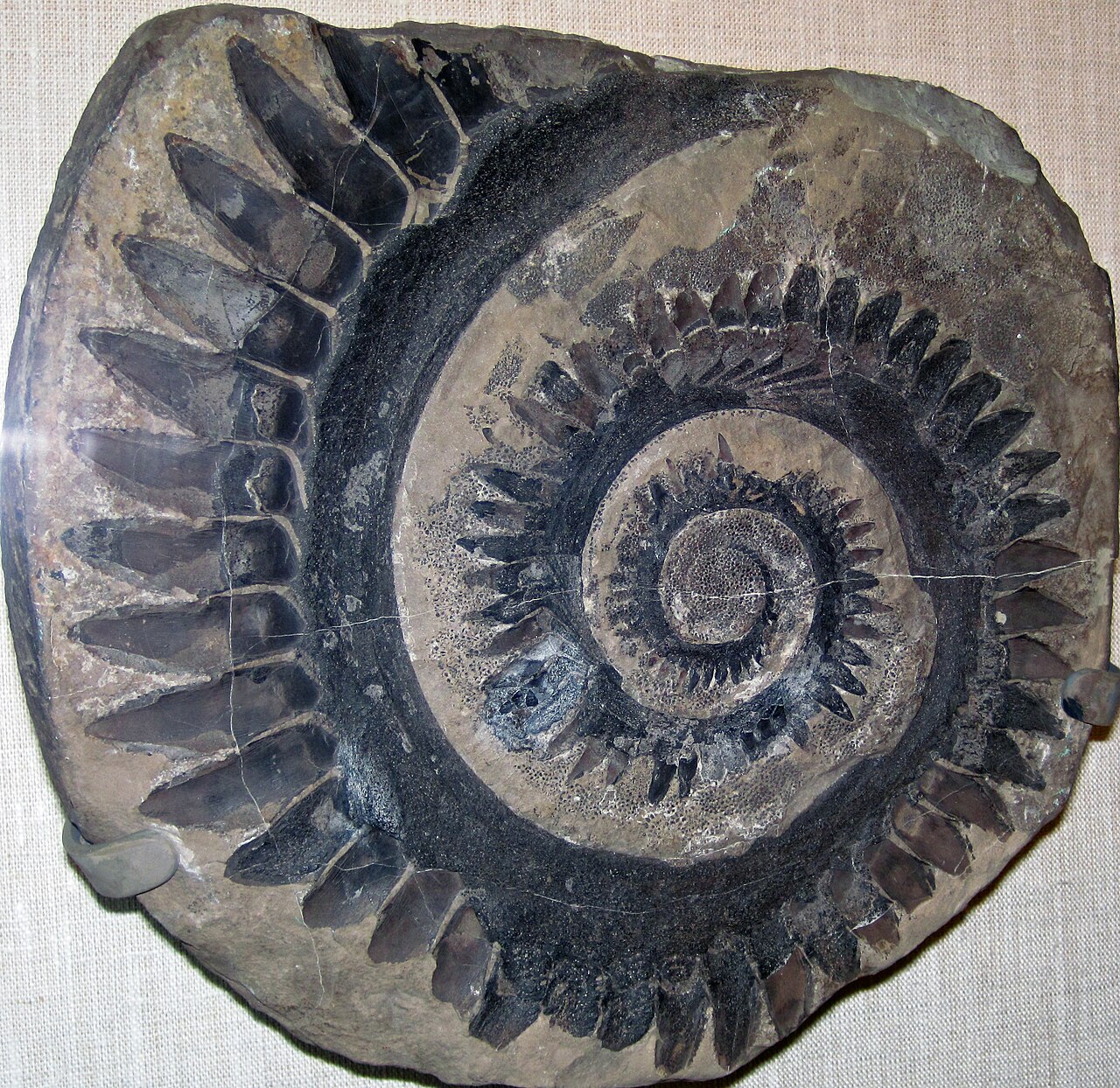
Imagine a fish that swallowed a circular saw. That is essentially what paleontologists have been staring at for over a century, trying to figure out how it actually worked. Helicoprion, whose name literally means "spiral saw" in Greek, is one of the most enigmatic predators to ever patrol Earth's oceans. This cartilaginous fish lived during the Early to Middle Permian period, roughly 290 to 270 million years ago, and left behind some of the strangest fossils in the entire vertebrate record.
Unlike most prehistoric creatures that we reconstruct from skulls, skeletons, or tooth impressions, almost everything we know about Helicoprion comes from one peculiar structure: the tooth whorl. This is a fused, spiral-shaped cluster of teeth embedded in a logarithmic coil, looking like something between a bandsaw blade and a nautilus shell. The whorl could reach over half a meter in diameter, with individual teeth growing progressively larger toward the outer edge of the spiral.
A Discovery That Confused Everyone
The first known Helicoprion fossil was found in Western Australia by a gold prospector named Mr. Davis, whose first name remains unknown to history. The partial tooth whorl, preserving 15 teeth, eventually made its way to the British paleontologist Henry Woodward, who in 1886 described it as a new species of Edestus, another strange tooth-whorled fish. It was not until 1899 that Russian geologist Alexander Karpinsky, working with more complete specimens found near Krasnoufimsk in the Ural Mountains, recognized that these fossils were distinct enough to warrant their own genus. He named it Helicoprion bessonowi, honoring the man who discovered the Russian specimens.
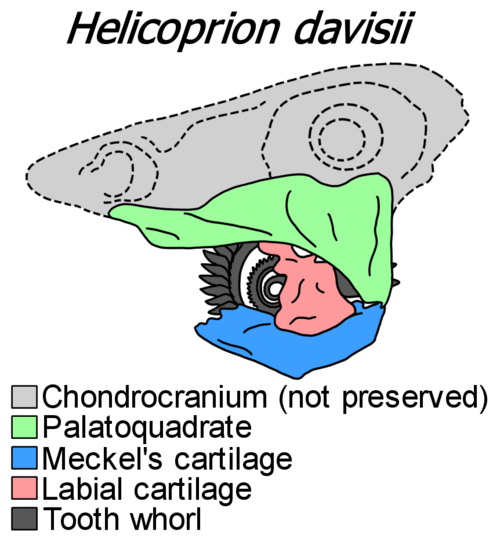
For decades, the big question was: where did this thing go? Scientists placed the tooth whorl everywhere from the dorsal fin to the tail, from the upper jaw to the snout. Some even suggested it coiled inside the animal's body like a digestive spring. It was not until CT scans of a remarkable specimen nicknamed "Idaho 4" (IMNH 37899), discovered in a mine near Montpelier, Idaho in 1950, that the mystery was solved. The scans, published in 2013 by Leif Tapanila and colleagues, revealed that the tooth whorl sat squarely in the lower jaw, supported by cartilaginous structures including the palatoquadrate and Meckel's cartilage.
How the Spiral Saw Worked
The jaw mechanism of Helicoprion was unlike anything in modern fish. The tooth whorl occupied the front of the lower jaw, with the spiral coiling inward toward the throat. As the animal fed, new teeth grew at the center of the spiral while older teeth were pushed outward. The teeth were triangular, laterally compressed, and often serrated, reaching heights of over 10 centimeters at the outermost positions. The upper jaw, meanwhile, was covered in small, rounded pavement teeth that scraped against the whorl like a grinding plate.
Recent research suggests this apparatus was specialized for processing soft-bodied prey, particularly cephalopods. Helicoprion likely used the whorl to grasp ammonoids and nautiloids, then employed the shearing action of the serrated teeth to extract the soft body from the shell. One study even proposed a "shell-peeling" function, where the spiral motion of the whorl would peel open a coiled cephalopod shell like opening a can of tuna.
A Gigantic Predator
Helicoprion was not a small animal. Based on the proportional size of tooth whorls relative to its close relatives, individuals with whorls 35 to 40 centimeters in diameter likely reached 5 to 8 meters in total length. The largest known whorl, specimen IMNH 49382, measured 56 centimeters across, suggesting an animal 7 meters or longer. Some estimates place the biggest individuals at 9.7 to 12 meters, putting Helicoprion in the size range of a modern great white shark, or even larger.
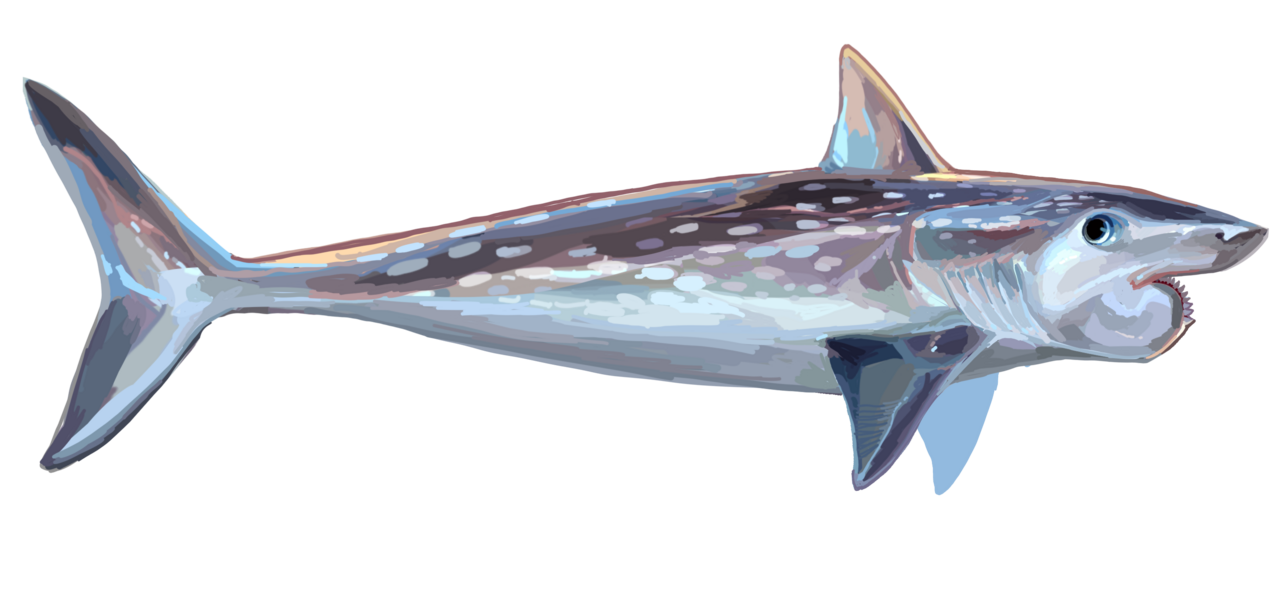
Despite its fearsome dentition, Helicoprion was not actually a shark. It belonged to the order Eugeneodontiformes, an extinct group of cartilaginous fish within the clade Holocephali. Today, Holocephali is represented only by chimaeras, also known as ratfish or ghost sharks, which are small, deep-sea scavengers with blunt tooth plates. The gap between a 12-meter Permian apex predator and a 60-centimeter deep-sea fish is staggering, but they share a common cartilaginous ancestor. Helicoprion would have looked more like a tuna or a mackerel shark than anything resembling a modern chimaera, with a streamlined, torpedo-shaped body and a tall, forked tail fin.
A Global Fossil Record
Fossils of Helicoprion have been found worldwide, from Idaho and Texas to Russia, Svalbard, Norway, Bolivia, China, and Japan. This cosmopolitan distribution confirms it was pelagic, roaming open oceans rather than coastal waters. The highest concentrations come from the Phosphoria Formation in Idaho and from the Ural Mountains region of Russia, both covered by deep inland seas during the Permian. Only three valid species are recognized today: H. bessonowi from Russia, H. davisii from Australia and North America, and H. ergassaminon from Idaho, distinguished by subtle differences in tooth crown shape and spacing that appear only after the 85th tooth of the spiral.
End of the Spiral
Helicoprion vanished from the fossil record by the middle Permian, around 270 million years ago, well before the catastrophic Permian-Triassic extinction event that would wipe out 90% of marine species 20 million years later. Why it disappeared remains unclear. The oceans of the middle Permian were undergoing significant changes, with shifts in sea level and marine ecosystems that may have disrupted the food chains Helicoprion depended on.
What remains is one of paleontology's most iconic puzzles. The tooth whorl of Helicoprion is immediately recognizable and unlike anything in the living world. It reminds us that evolution, left to its own devices for hundreds of millions of years, produces solutions that no engineer would dare to propose. The spiral saw of the Permian seas is proof that nature's imagination runs deeper than ours.