Published 2026-09-02 · by the Triops.me Editorial Team · Back to Articles
The Last Jawless Fish: Lampreys and Hagfish, Survivors From Before the First Bite
Before sharks, before bony fish, before jaws existed at all, the seas belonged to a different kind of fish. These animals had no biting mouths, no paired fins in many cases, and armored heads covered in plates of bone. They are called the agnathans, the jawless fish, and for tens of millions of years they were the most successful vertebrates on Earth. Almost all of them are gone now. Only two lineages remain, and both are strange enough to feel like visitors from another world.
One of them attaches itself to other fish with a round, tooth-lined sucker and slowly rasps their flesh away. The other, when threatened, turns its own body inside out with slime, producing enough of the stuff to clog the gills of an attacking shark in seconds. These are the lampreys and the hagfish, and they are the closest thing we have to living time capsules from the earliest chapter of vertebrate history.
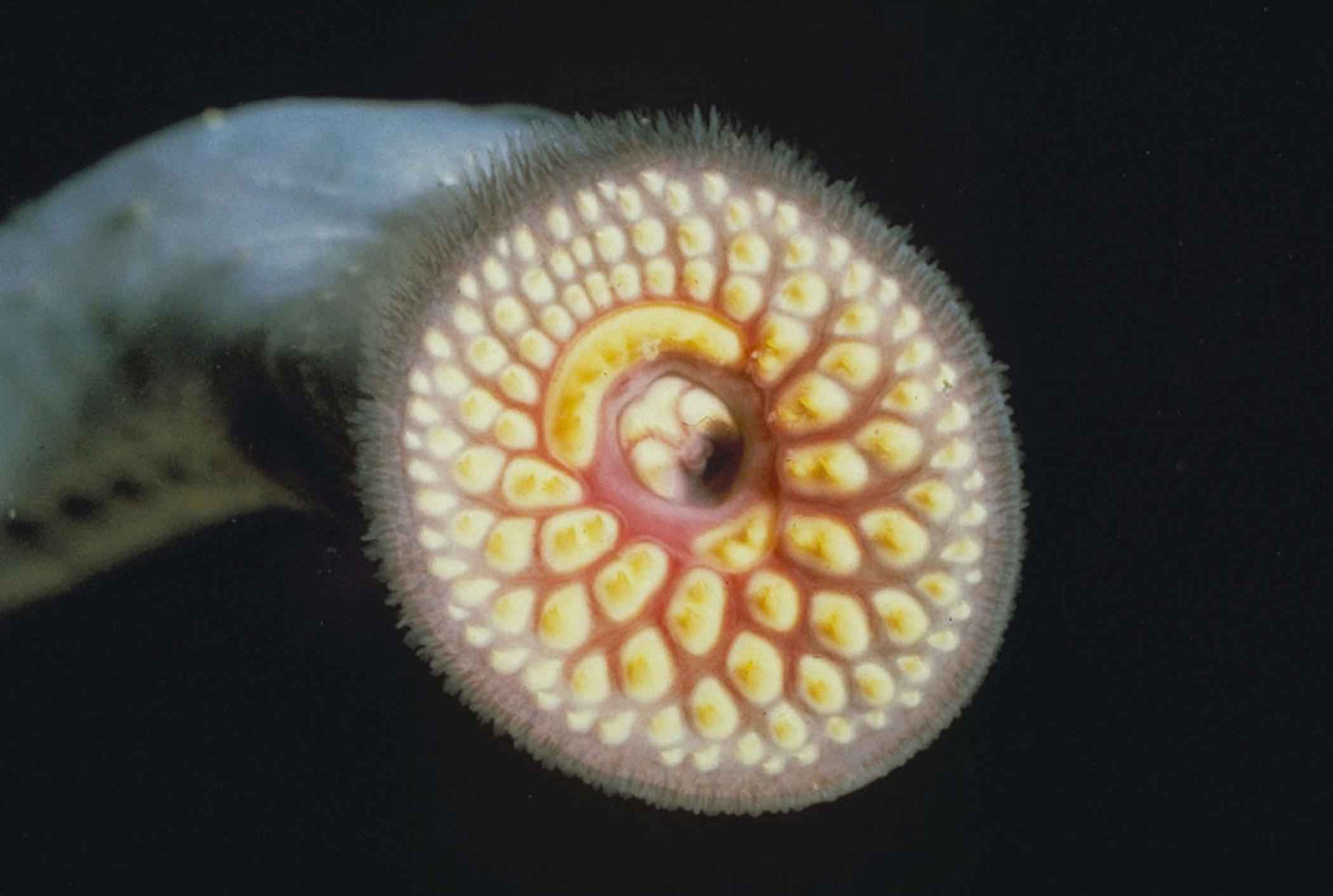
Lampreys are the more recognizable of the two. A sea lamprey looks superficially like an eel, but the resemblance ends at the tail. In place of a jaw, it carries a circular oral disc, a fleshy ring studded with rings of curved, yellowish teeth made of keratin, the same material as your fingernails. In the center sits a piston-like tongue, also armed with teeth. The lamprey presses this disc against the flank of a trout or salmon, scrapes through the skin, and feeds on blood and body fluids. An anticoagulant in its saliva keeps the wound flowing. A single lamprey can kill fish many times its own weight over a season, not through violence but through persistence.
It is a feeding method with a very long pedigree. Fossils of lamprey-like animals appear in the late Devonian, over 360 million years ago, and fossil impressions of soft-bodied lampreys have been found in rocks from the Carboniferous and Cretaceous periods. Remarkably, a juvenile lamprey from the Cretaceous of China, described in 2006, shows a feeding apparatus almost identical to that of modern species. The sucker and its teeth have stayed essentially unchanged for over 100 million years.
Hagfish are stranger still. They live on the ocean floor, mostly in cold, deep water, and they feed mainly on dead and dying animals, burrowing into whale carcasses and devouring them from the inside. They have no true eyes, only light-sensitive patches beneath the skin, and no jaws either. Instead, a hagfish grips its food with two rows of tooth-like structures on a cartilage plate that protracts and retracts to pull scraps off a carcass. To gain leverage while tearing flesh, a hagfish does something almost no other vertebrate can: it ties itself into a knot. The knot slides down its body and presses against the food, giving the animal purchase to rip away a piece of meat. Hagfish also use these knots to escape their own slime and to squeeze out of tight spaces.
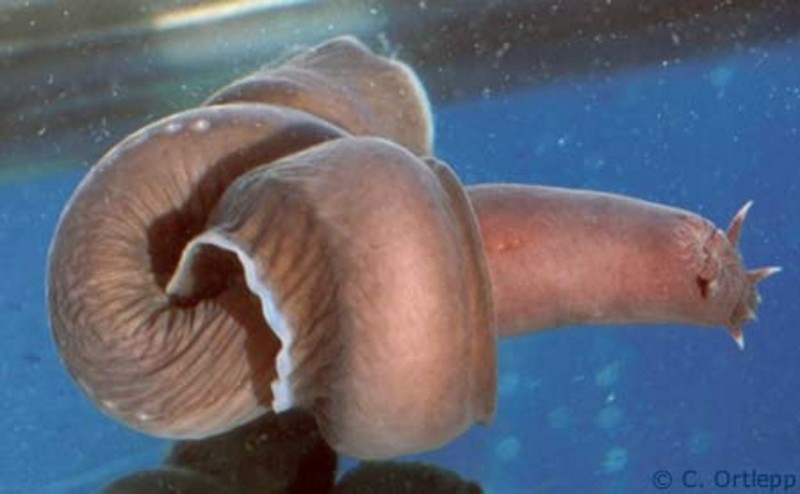
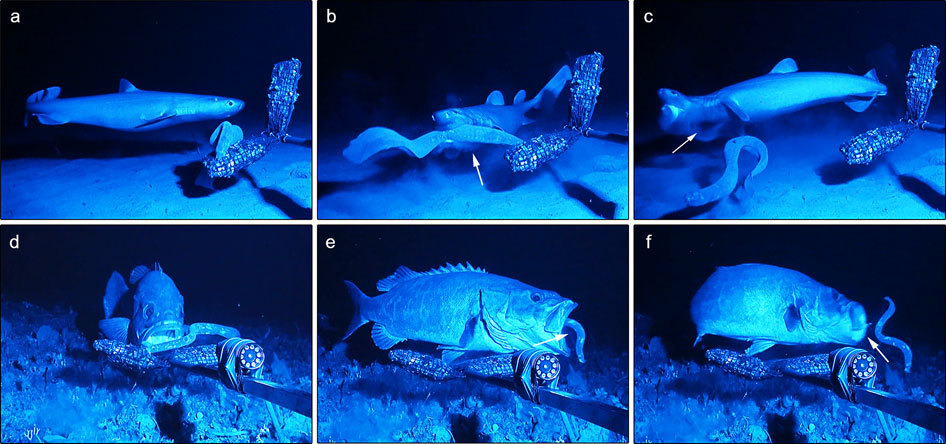
The slime is the hagfish's signature. A single animal can produce liters of it in seconds, from around 100 pairs of glands running along its flanks. Each gland discharges two ingredients at once: mucin threads and swollen protein packets. On contact with seawater they combine into a gel of extraordinary efficiency, roughly a tenth of a gram of dry material can gel several liters of water. Fish that bite a hagfish find their mouths and gills packed with choking mucus, and the predator usually lets go fast. There are recorded cases of sharks surfacing with dead hagfish in their throats, suffocated by the very defense their prey deployed. The slime can even repel a sea lamprey, one of the few animals bold enough to tackle a hagfish in the first place.
Both animals share a trait that links them back to the beginning of vertebrate history: neither has a backbone in the usual sense. Lampreys have a flexible rod of cartilage called a notochord supporting their body, along with a rudimentary cartilaginous skeleton. Hagfish have a notochord too, and barely anything else. They also lack true vertebrae, which puts them at the very base of the vertebrate family tree. Molecular clock studies place the hagfish lineage at somewhere between 400 and 550 million years ago, overlapping the period when the first unmistakable vertebrates were appearing in the fossil record.
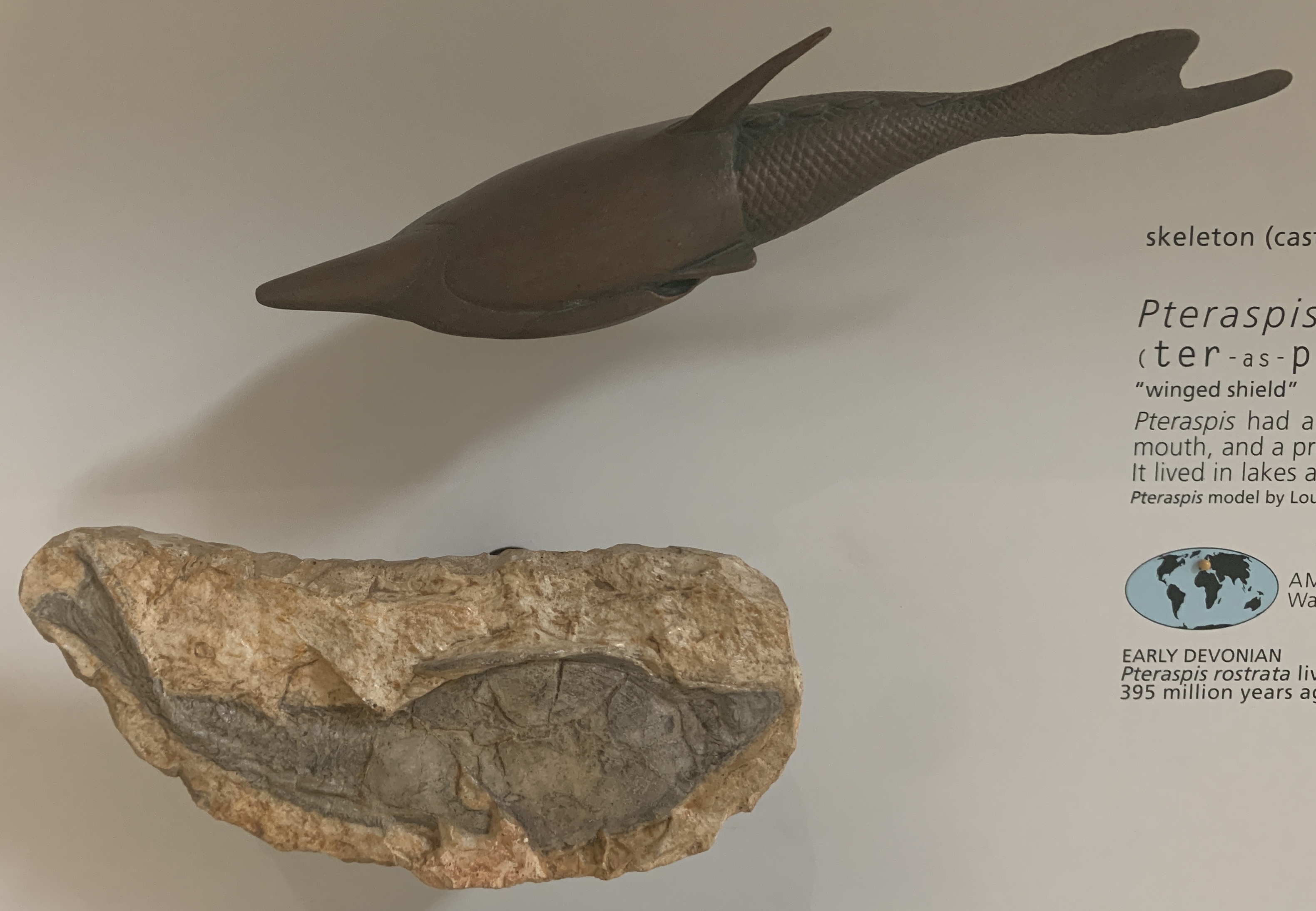
That early record is written in stone. In rocks from the late Cambrian and Ordovician periods, roughly 480 to 500 million years ago, paleontologists have found small fish with no jaws and no paired fins, their bodies covered in bony armor. Animals like Arandaspis and Astraspis had head shields of solid bone but mouths that could only suck or scrape. By the Silurian, jawless fish had diversified into dozens of lineages, including the ostracoderms, some of which carried elaborate spines and head ornaments. The Devonian brought the heterostracans, fish like Pteraspis, whose pointed bony head shield gave it a shape like a living dart.
Then, roughly 420 million years ago, everything changed. Jaws evolved, most likely from the gill arches that had previously supported breathing. A jawed fish could grab prey, crush shells, and exploit food sources no jawless animal could touch. The arms race was over almost before it started. One by one the armored lineages vanished through the late Devonian and Carboniferous, and by around 300 million years ago the jawless fish that had ruled the seas for 200 million years were reduced to a handful of lineages, and eventually to just two.
What is remarkable is that the two survivors did not just persist, they thrived in niches that jaws could not touch. Hagfish dominate the deep-sea scavenging economy, one of the most stable food sources on the planet. Lampreys, in both parasitic and non-parasitic species, occupy rivers and coastal seas across every continent except Africa. Their larvae, called ammocoetes, are filter feeders that bury in river sediment and strain microscopic food from the water, a lifestyle not so different from how the earliest chordates probably fed hundreds of millions of years ago.
It is a pattern Triops keepers will recognize. Triops have survived half a billion years not by outfighting newer animals, but by retreating into a niche no one else wants: temporary pools that dry up and reappear. The jawless fish did the same in the ocean. When jaws made open-water predation a losing game, they moved to the sea floor, to the sediment, to parasites and scavengers, the ecological margins where speed and biting teeth count for less. Survival through specialization, not competition, may be the single most repeated strategy in the history of life.
There is a lesson in their longevity too. Jawed fish came and went in waves. Dinosaurs rose and fell. Mammals diversified and spread. Through all of it, two lineages of soft-bodied, jawless, boneless survivors kept doing what their ancestors had done since before there were sharks. The next time you see a lamprey or a hagfish, you are not looking at a primitive failure. You are looking at one of evolution's longest running success stories, an animal whose entire body plan was already old when the first tree stood on land.