Published October 17, 2026, 21:12 by the Triops.me Editorial Team · Back to Articles
Marrella: The Most Common Creature of the Burgess Shale
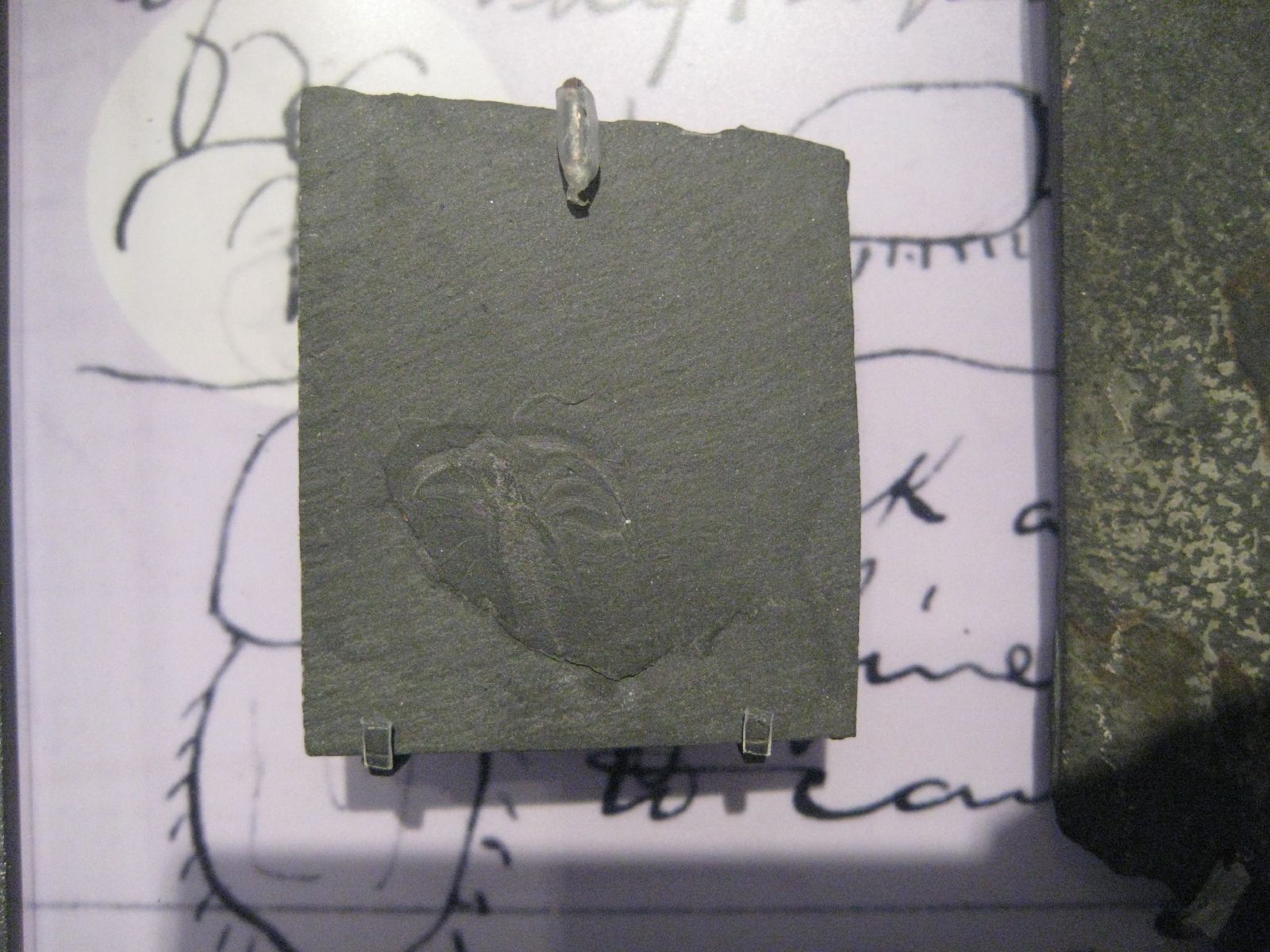
Ask anyone to name an animal from the Burgess Shale and the answer is usually Anomalocaris, Opabinia or Hallucigenia. The strange and the famous always win. Yet the single most abundant creature in that celebrated Canadian fossil deposit is none of those. It is a small, eyeless arthropod called Marrella splendens, and more than 25,000 of its fossils have been pulled out of the shale so far.
Marrella is not a side character in the story of the Cambrian explosion. It is the background crowd, the animal that was everywhere while the predators stalked above it. Because its shell was never mineralised, it would be invisible in ordinary rock, and it survives only because the Burgess Shale captures soft tissues with extraordinary fidelity. That combination of commonness and fragility makes Marrella one of the best windows we have onto a world that left almost nothing behind.
The first fossil in the quarry
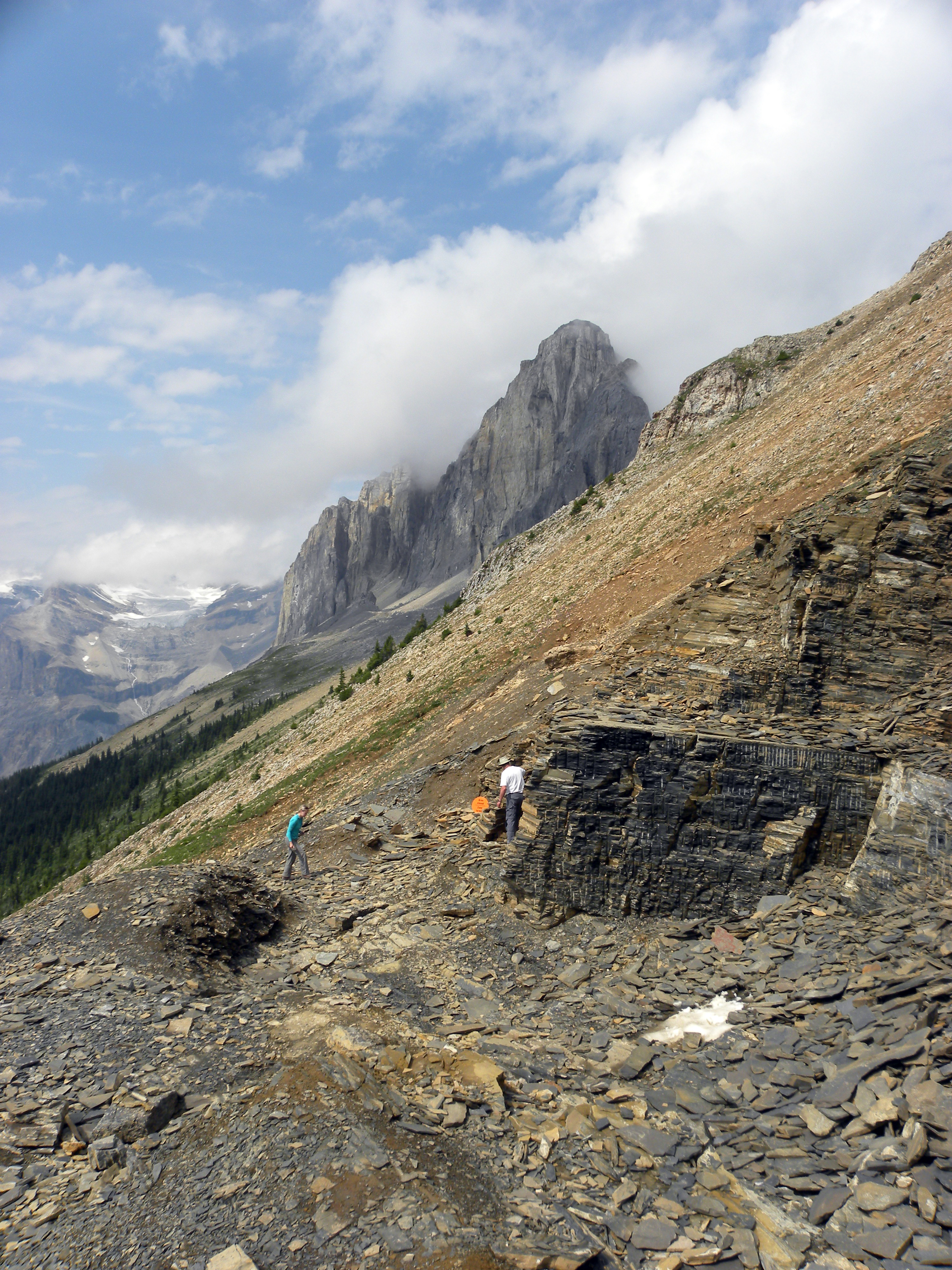
Charles Doolittle Walcott collected the first fossil from the Burgess Shale in 1909, and that fossil was a Marrella. He went on to open the quarry with hand drills and black powder and to haul the fossil-bearing shale down the mountain, and he named the animal in 1912 after Dr John Edward Marr, a Cambridge geologist.
Walcott could not quite place it either. He described it informally as a "lace crab", a name that captures the delicate spray of spines around its head, and then formally filed it with the trilobites as an oddity. Later handbooks followed him, shelving Marrella in a wastebasket group called Trilobitoidea. It took Harry Whittington's meticulous redescription in 1971 to break the spell. By working through the legs, the gills and the head appendages, Whittington concluded that Marrella was neither a trilobite, nor a chelicerate, nor a crustacean. It belonged to nothing that had been named yet.
Built like nothing alive today
Adults were modest in size. Known specimens run from 2.4 to 24.5 millimetres long, so a large one was about the length of a thumbnail. What it lacked in scale it made up for in hardware. The head shield carried two pairs of long, backward-curving spines, the rear pair keeled and finely serrated, and underneath sat a pair of sweeping antennae built from around 30 segments and projecting forward at a shallow angle. Behind the antennae was a pair of short, stout, paddle-like appendages fringed with bristles.
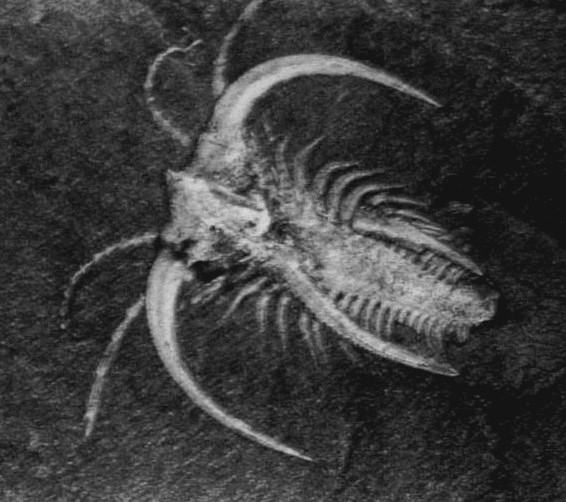
The trunk held at least 17 segments, rising past 26 in the largest animals, and every segment wore a two-branched limb. The lower branch was a jointed walking leg ending in tiny claws, while the upper branch was a flat, filament-covered gill that handled respiration. The body ended not in a shield but in a button-sized tail piece called a telson. Most remarkably, there is no evidence of eyes anywhere on the animal: Marrella navigated a crowded seabed in what appears to have been complete darkness of the senses we would recognise, reading the world through antennae and bristles instead.
Why it is not a trilobite
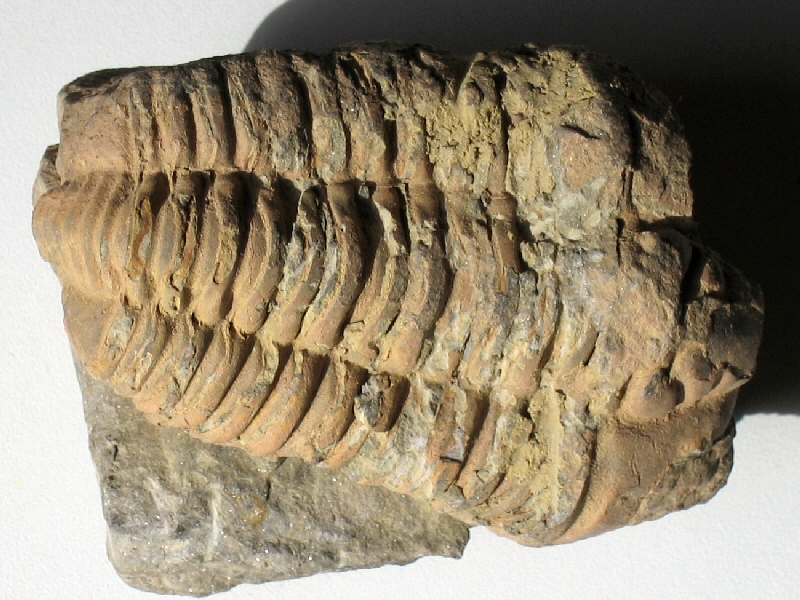
The confusion is forgivable, because at a glance both are segmented arthropods flattened in dark shale. A trilobite gives itself away with a broad semi-circular head crossed by axial furrows, a body divided lengthways into three lobes, and a fused tail shield. Marrella has none of these. Its head is small, its body tapers without a shield, and instead of a smooth outline it wears the spines that made Walcott think of lace.
Today Marrella sits in the order Marrellida of a group called Marrellomorpha, which ranges from the Cambrian to the Early Devonian. Marrellids are defined by head shields with two or three pairs of elongate spines, and their relatives include Furca, Mimetaster and Tomlinsonus. None of them left descendants. Because marrellomorph cuticles were not mineralised, they are known almost entirely from exceptional deposits, which means the group is probably far more common in the ancient record than the rock normally allows us to see.
A swimmer that fed near the bottom
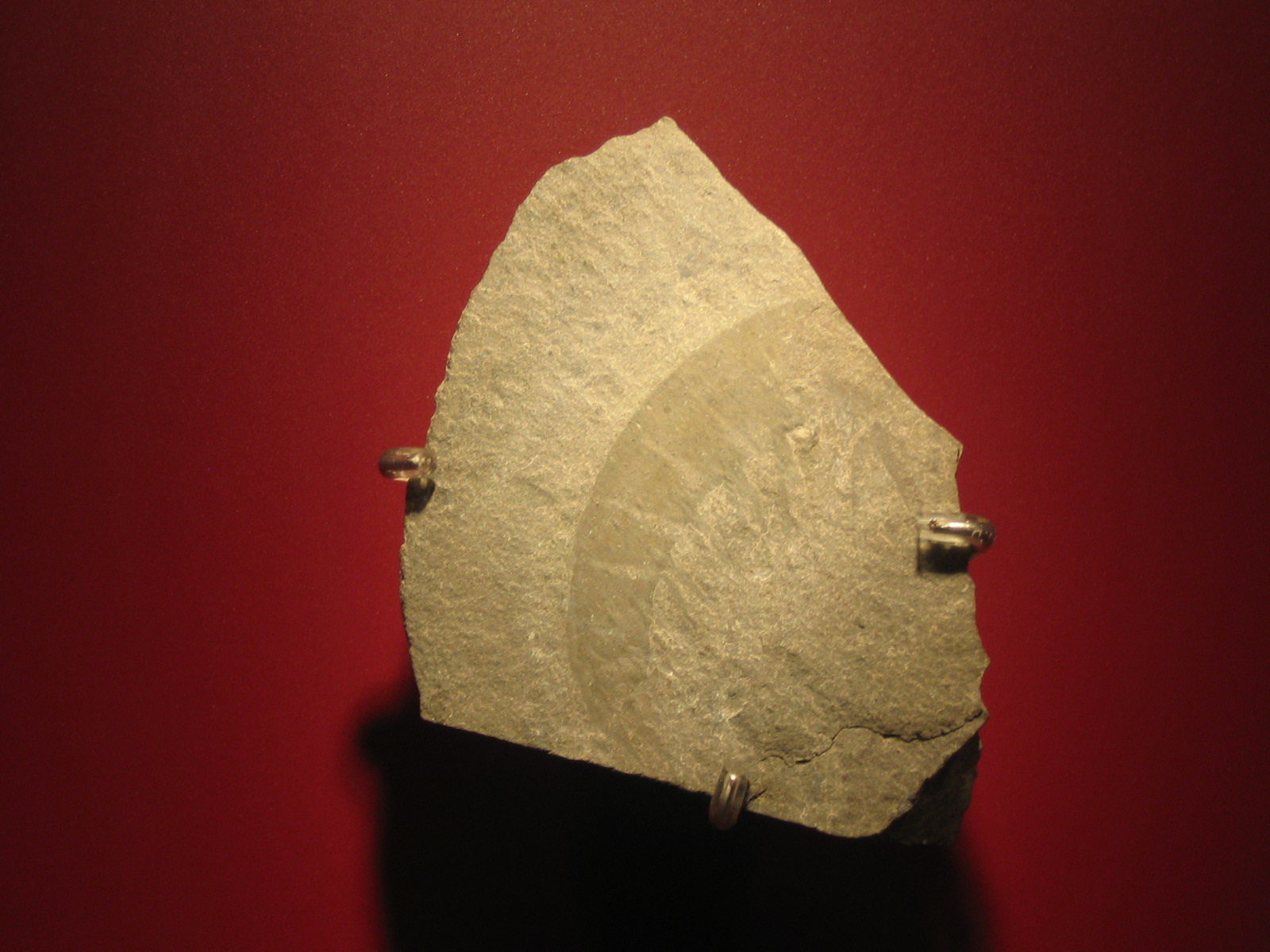
Reconstructions put Marrella just above the seabed, swimming with its paddles in a sort of backstroke while the long head spines acted as stabilisers, and quite possibly as a deterrent. A predator the size of Anomalocaris would have found a mouthful of spines an awkward proposition.
Its feeding strategy looks equally unusual. The rear limbs may have sifted food particles out of the water while the animal drifted and swam, passing the catch forward along the body to the mouth, a conveyor belt of bristles. Even the waste tells a story: dark stains at the rear of many specimens are thought to be faecal material or escaped blood, and one rare specimen was caught in the act of moulting, its exoskeleton split open at the front of the head shield. A 1998 study even proposed that fine ridges on the head spines formed a diffraction grating, which would have given the living animal an iridescent sheen, though that claim has been challenged by other researchers.
Why there are so many of them
The abundance is staggering. Most specimens come from a single thin horizon nicknamed the Marrella bed, and detailed counts of the Greater Phyllopod Bed record 5,028 individuals there, about 9.5 per cent of the whole community. In an ecosystem where a thin layer of mud can be read almost like a census, one animal in every ten being Marrella tells you what the Cambrian seabed actually looked like: not a parade of monsters, but a carpet of small, spiny grazers.
The single known moulting specimen raises an obvious follow-up question. An arthropod that sheds its shell twice leaves two fossils, one animal and one empty husk, so some fraction of those 25,000 specimens may be moulted armour rather than individuals that died there. Separating shed skins from carcasses is genuinely difficult in these deposits, and it means the true population was smaller than the raw count suggests, but either way Marrella dominated its neighbours by a wide margin.
A rare traveller
North America holds nearly everything known of the genus. A few dozen fragmentary specimens have turned up in Cambrian rocks of southern China, from formations that are slightly older than the Burgess Shale, but that is the entire known range outside British Columbia. For an animal that is common within its quarry, Marrella is geographically almost a local species, which is exactly what you would expect from a creature that never built a hard shell and could only be fossilised where conditions were perfect.
That is the lesson Marrella offers. The Burgess Shale is famous for its monsters, but the monster business was a minority occupation. Most of the animal life of the Cambrian seabed looked like this: a couple of centimetres of segmented body, no eyes, a spray of defensive spines, and an enormous population keeping itself to the mud. Modern arthropods such as Triops inherited a different lineage entirely, one that survived by waiting out bad times rather than by dominating their neighbours, and neither strategy is obviously the better one. Marrellomorphs vanished without a trace, branchiopods are still with us, and Triops reached the fossil record on the strength of a tough carapace and eggs that sit out droughts, not on the mercy of a single layer of perfect shale.
Further reading on this site: the Cambrian explosion, the Burgess Shale quarry, the dominance of trilobites, and the five-eyed oddity Opabinia.