Published 2026-10-30 · by the Triops.me Editorial Team · Back to Articles
Megalosaurus: The First Dinosaur Ever Named
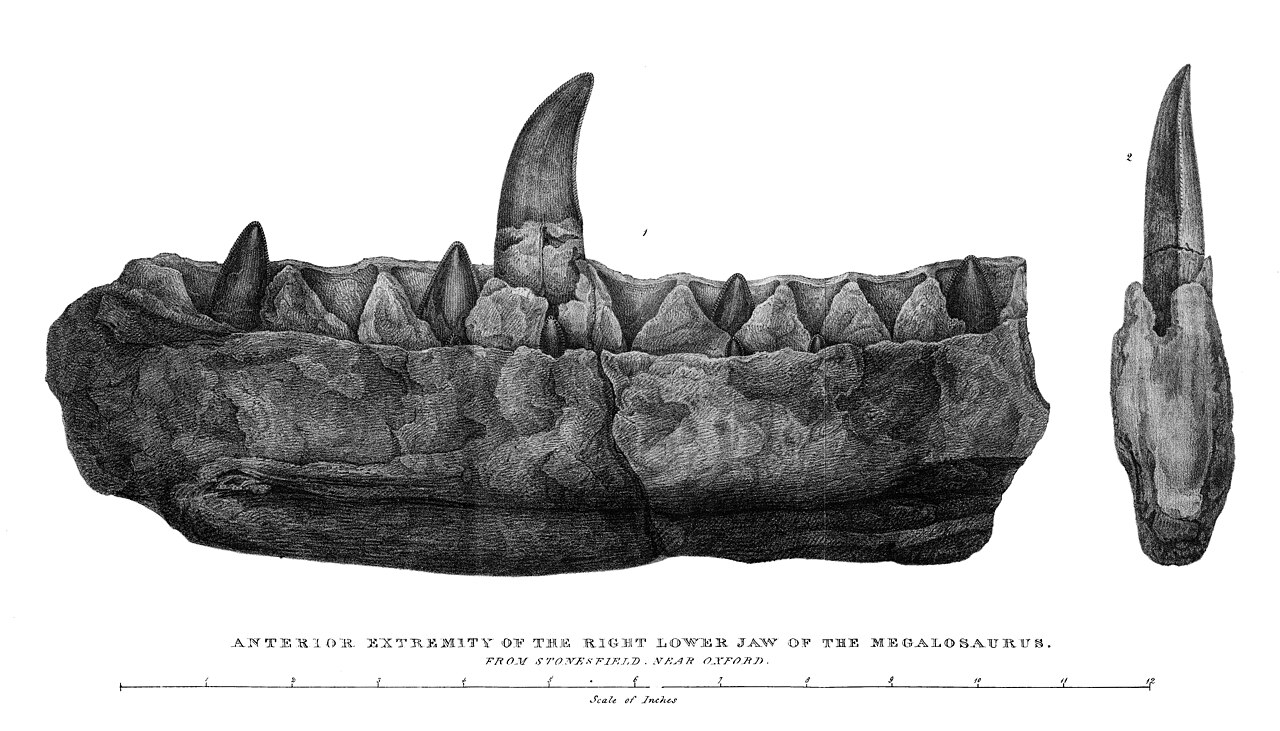
In 1824, an Oxford professor described a battered jaw bone with serrated teeth and gave its owner a scientific name: Megalosaurus, the great lizard. It was the first animal we would now call a dinosaur to be formally named, and the moment our modern picture of prehistory began.
What makes the story remarkable is how little anyone knew at the time. The name went on the animal nearly two decades before the word dinosaur even existed. Nobody knew what a dinosaur was, because nobody had ever defined one. Buckland was not describing a member of a famous extinct dynasty. He was inventing the category by accident.
A jaw and a pile of puzzle pieces
The bones came from the Stonesfield Slate, a set of limestone beds near the village of Stonesfield in Oxfordshire, laid down around 166 million years ago in the Middle Jurassic. Local quarrymen had been splitting the rock for roofing tiles for generations, and strange bones and teeth kept surfacing with the stone.
The trouble was that the fossils never arrived intact. The bones of the animal had been scattered, broken, and jumbled by ancient water before burial. What reached William Buckland, Oxford's first professor of geology, was a fragmentary lower jaw with several curved, serrated teeth, along with assorted limb bones, vertebrae, and hip pieces from nearby quarries.
From this handful of fragments, Buckland did something genuinely new. He carefully compared the jaw and teeth with living reptiles, worked out that the creature had been far larger than any land animal he knew of, and published a formal scientific description. His estimate of more than twelve meters long was actually an overreach, and he pictured it as a colossal four-legged lizard. He got the pose wrong, but he got the bigger point right: this was an animal, not a monster from myth, and it had lived and died in a world that existed long before humans.
The bone that appeared before the name
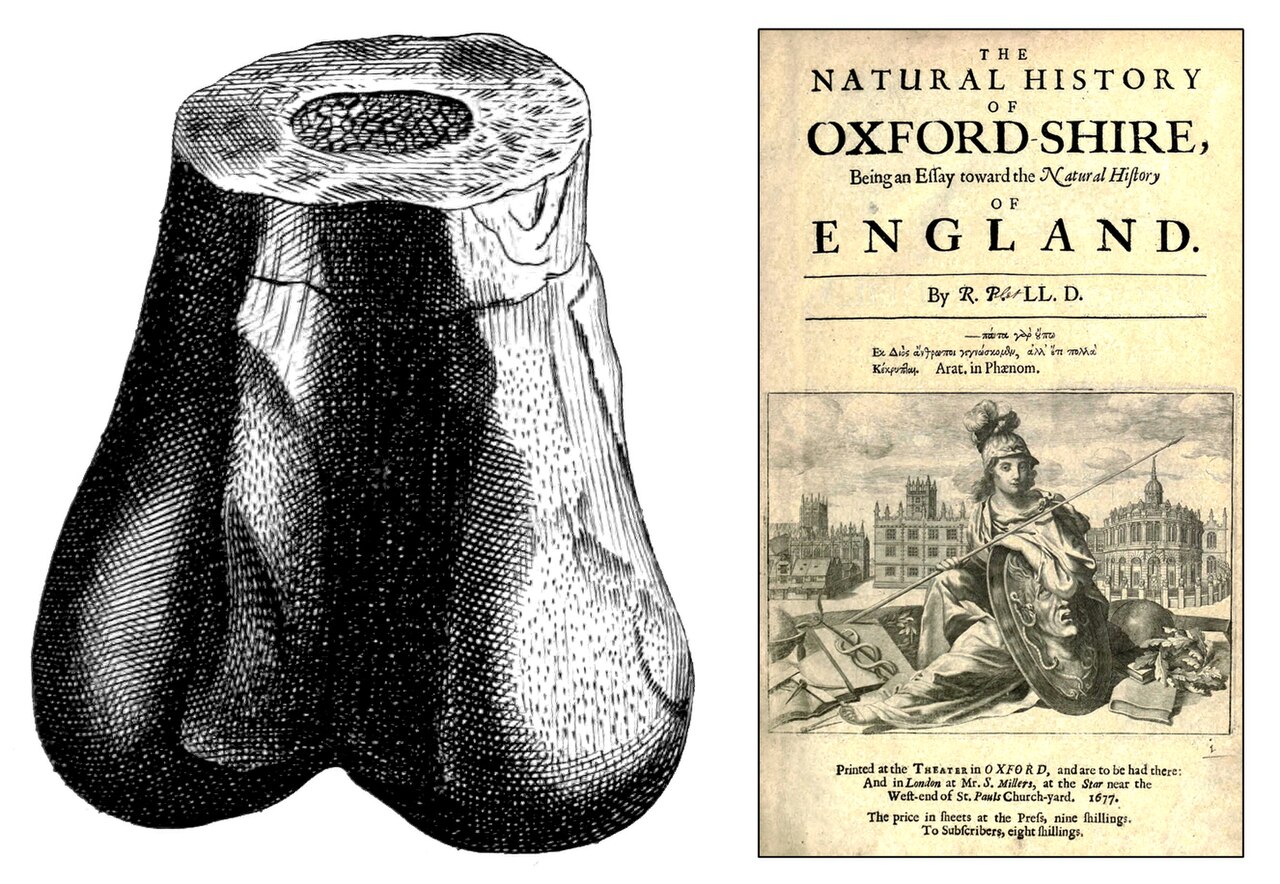
Megalosaurus bones had been puzzling people long before Buckland. In 1676, the naturalist Robert Plot illustrated the tip of an enormous fossil thighbone dug from an Oxfordshire quarry in his book on the county's natural history. Plot examined it honestly and admitted he could not place it. He speculated that it might have belonged to a giant from ancient legend, or perhaps to an elephant brought over by the Roman army. It was neither. Most paleontologists today accept that the fragment came from a Megalosaurus relative.
For our purposes, the story matters for a simple reason: the first dinosaur ever named had already been sitting in the fossil record, confusing naturalists, for nearly 150 years. Deep time does not announce itself. It leaks out in fragments.
The Crystal Palace mistake
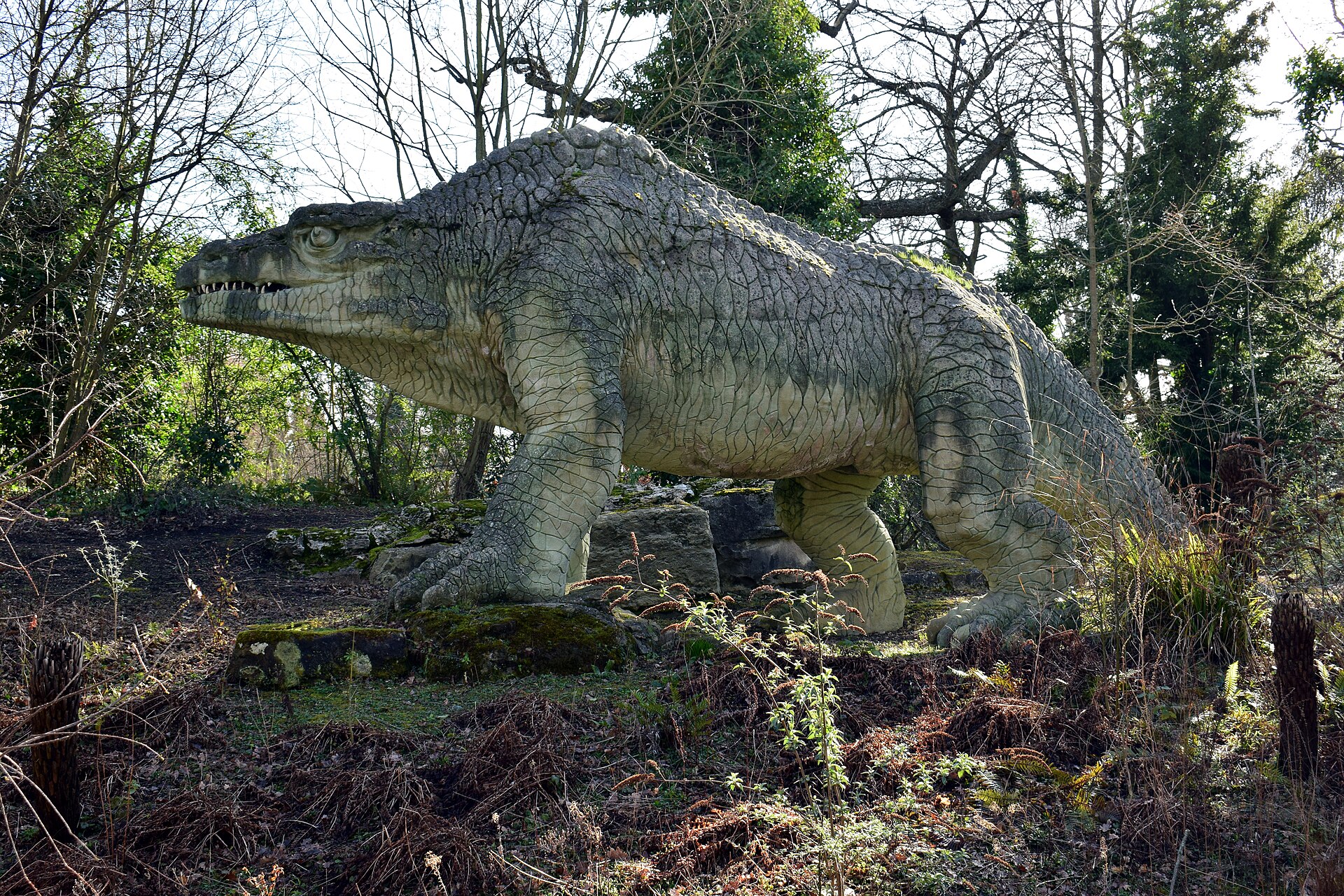
By the 1850s, Megalosaurus had become a celebrity. When the sculptor Benjamin Waterhouse Hawkins built his life-sized prehistoric animals for the Crystal Palace park in south London, unveiled in 1854, Megalosaurus got top billing alongside Iguanodon. The models followed the science of the day, which meant the great lizard was reconstructed as a hunched, four-legged beast with a ponderous lizard walk. The statue still stands in the park today, one of the oldest dinosaur sculptures on Earth, radiating confidence about anatomy that turned out to be badly wrong.
The era's enthusiasm was real, and slightly ridiculous. On New Year's Eve 1853, Hawkins hosted a dinner party for leading scientists inside one of his half-finished models, a toast to animals nobody had ever seen alive. And in 1852, Charles Dickens gave Megalosaurus a literary first: in the opening fog of Bleak House, he wrote that it would not be wonderful to meet "a Megalosaurus, forty feet long or so, waddling like an elephantine lizard up Holborn Hill." It is the first appearance of a dinosaur in a novel, written before most of his readers had ever heard the word.
What Megalosaurus actually was
Modern paleontology has rebuilt the animal completely. Megalosaurus was a bipedal meat eater, balanced over its hips with a long tail, roughly six to nine meters long and probably around a tonne in weight. Its head carried bladed, serrated teeth like steak knives, and it had muscular arms with clawed hands. It belongs to the megalosaurids, a family of Middle Jurassic predators that includes Duriavenator, Magnosaurus, Eustreptospondylus, and the mighty Torvosaurus. Its wider branch, Megalosauroidea, also contains the strange sail-backed Spinosaurus and the fish-eating Baryonyx, making them distant cousins.
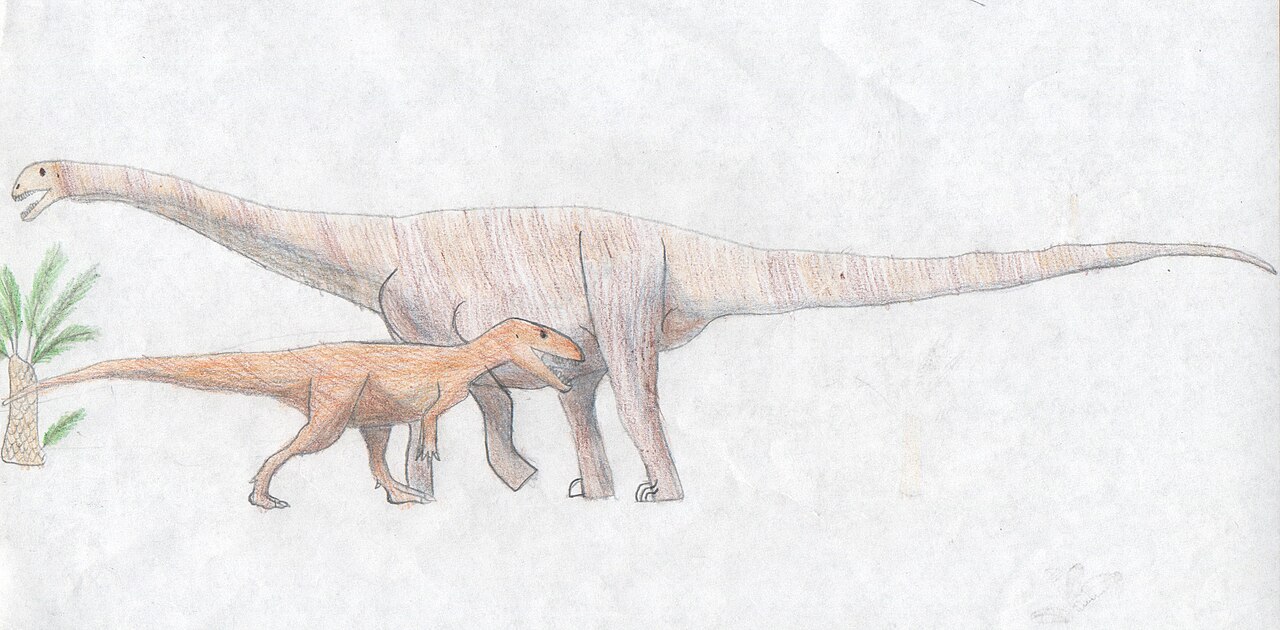
Its world was a warm, green floodplain in what is now southern England. Long-necked sauropods such as Cetiosaurus browsed the treetops, early stegosaurs trampled the fern prairies, and crocodilians patrolled the rivers. Megalosaurus was one of the biggest predators in this landscape, most likely ambushing young sauropods and other prey rather than engaging giants head on.
The wastebasket years
Because the original fossils were so incomplete, Megalosaurus became a convenience label. For more than a century, any large theropod fragment from Europe, Africa, or beyond that did not fit somewhere else tended to be declared a new species of Megalosaurus. At the peak of the confusion, dozens of species from across the globe carried the name, many based on teeth or single bones.
That era is over. Most of those species have been reclassified into their own genera, and today paleontologists recognize just one valid species, Megalosaurus bucklandii. Fittingly, the animal remains one of paleontology's famous incompletes. No complete skeleton has ever been found, and reconstructions still lean heavily on better-preserved relatives like Torvosaurus to fill the gaps.
Why a broken jaw still matters
Megalosaurus was not the biggest, the strangest, or the best preserved of the dinosaurs. Its importance is that it came first. Its formal naming in 1824 forced naturalists to accept that a world of enormous, extinct reptiles had existed ages before humanity, and it set the stage for Richard Owen, who studied Megalosaurus alongside Iguanodon and Hylaeosaurus before defining the group Dinosauria in 1842. Every dinosaur book ever written has its first line in that Oxfordshire jaw.
There is also a quiet lesson in it for anyone who loves Triops and other living fossils. Megalosaurus shows how slowly understanding accumulates: a bone in 1676, a name in 1824, a true shape a century later. Paleontology is patience applied to fragments, and the fragments keep arriving.
Further reading
If this story hooked you, dig into Iguanodon and its famous thumb spike, meet Allosaurus, the lion of the Jurassic, or follow the fossil history of Tyrannosaurus rex across a century of discoveries.