Published 2026-09-27 · by the Triops.me Editorial Team · Back to Articles
Oviraptor: The Dinosaur Named an Egg Thief
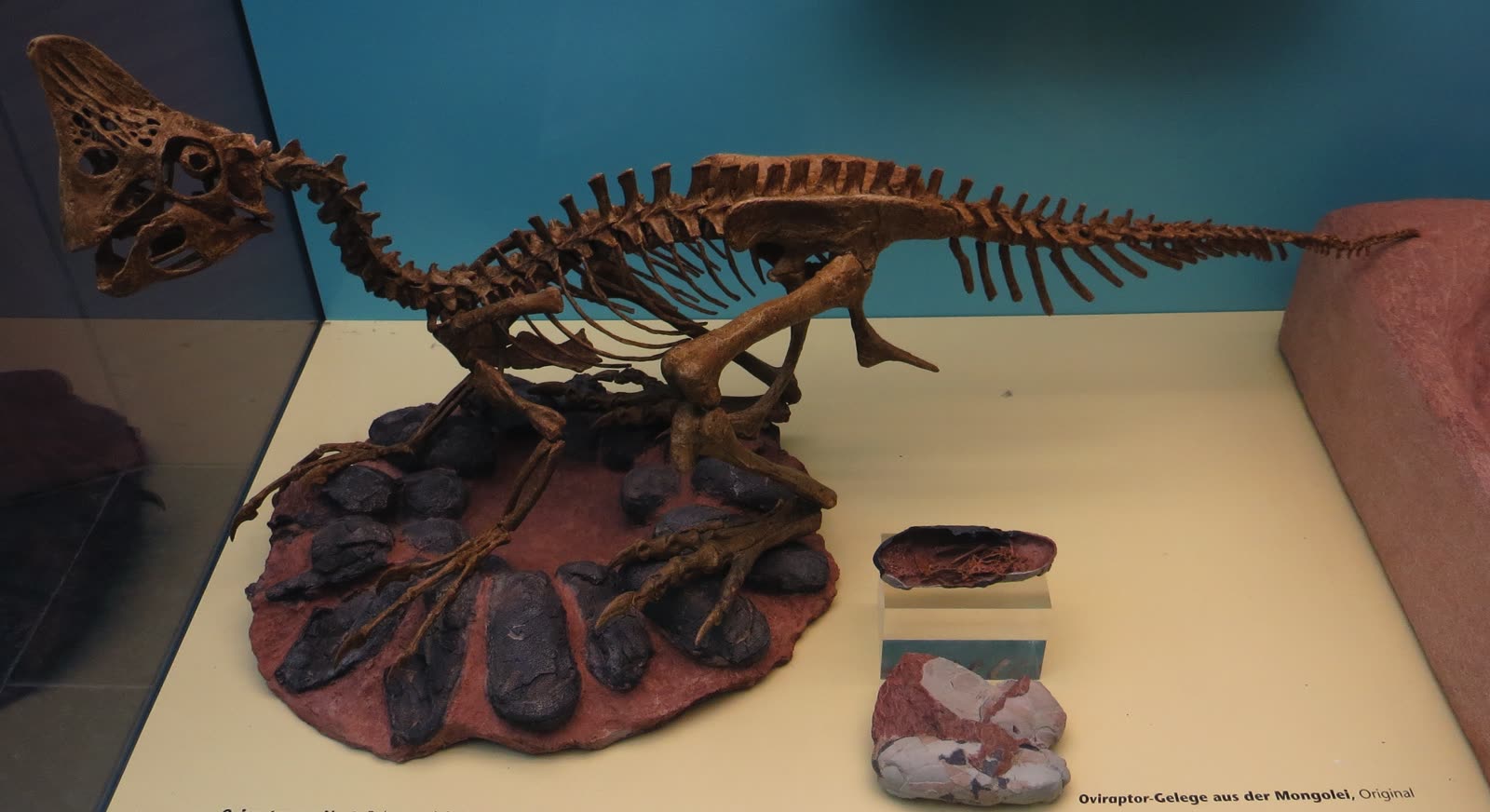
One animal died lying on a nest of about fifteen eggs, and for seventy years the world believed it was caught in the act of stealing them. The dinosaur got a name that means egg thief, a species name that means lover of ceratopsian eggs, and a reputation as a nest raider in every popular book that mentioned it. The evidence that exonerated it did not arrive until the 1990s, long after the name was already locked into the scientific literature.
That dinosaur is Oviraptor philoceratops, and its story is the best-known case of a fossil being judged before the trial was over.
A skull ten centimetres above a nest
In 1923, during the Third Central Asiatic Expedition led by Roy Chapman Andrews, field crews working in the reddish sandstones of the Djadokhta Formation at Bayn Dzak in Mongolia's Gobi Desert uncovered a partial skeleton lying directly over a clutch of eggs. The skull sat only about 10 centimetres of sediment above the eggs, catalogued separately as nest AMNH 6508. Because Protoceratops was the best-known nesting dinosaur from that formation, the eggs were assumed to belong to it.
Henry Fairfield Osborn described the material in 1924, in the same paper that named Velociraptor and Saurornithoides. He called the new theropod Oviraptor, Latin for egg seizer or egg thief, and the species philoceratops, fond of ceratopsian eggs. Osborn was careful enough to warn readers that the name might reflect an incorrect impression of the animal's habits. That caution was buried under the catchiness of the name itself.
What the animal actually was
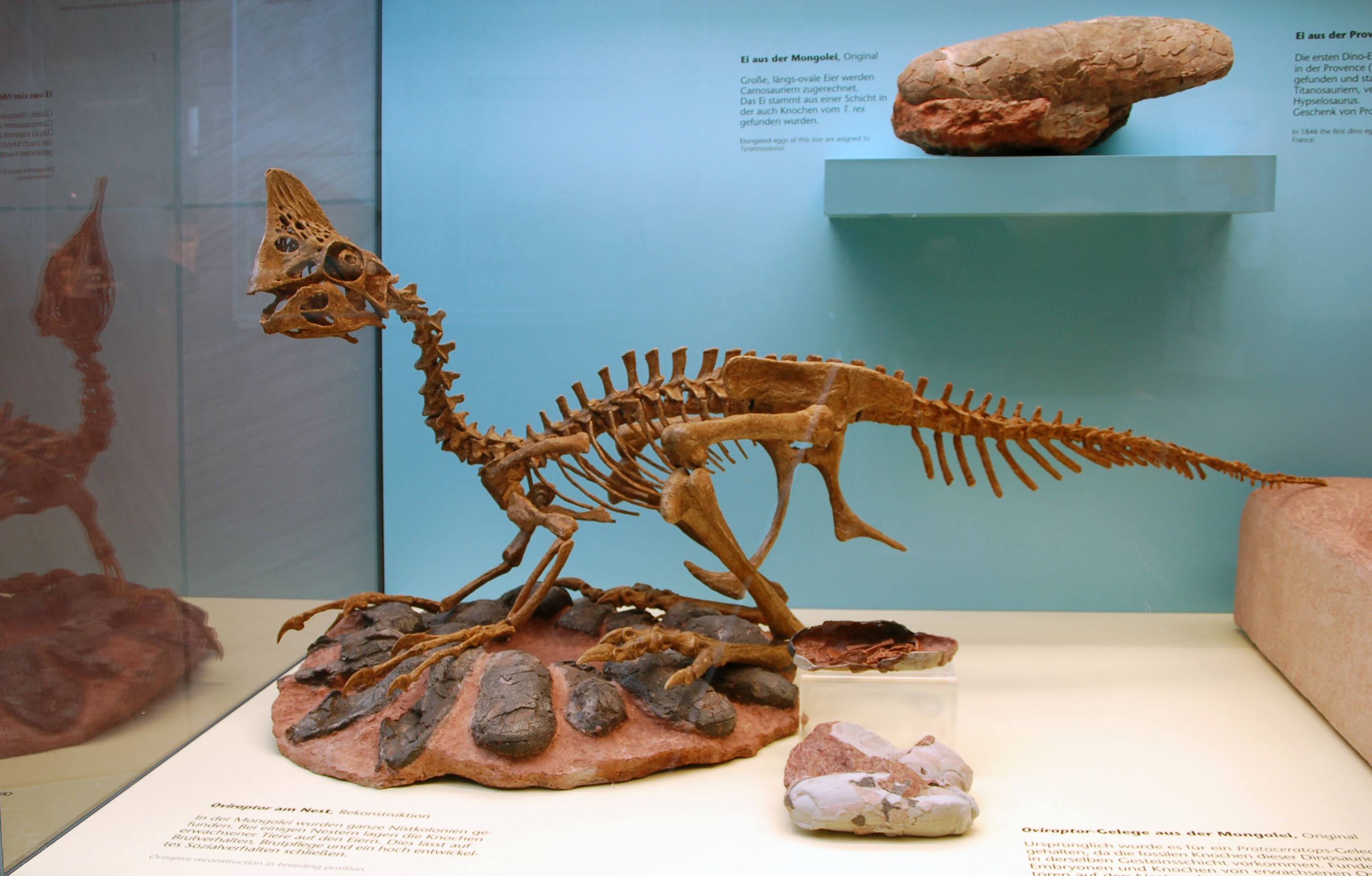
Those proportions matter because they place Oviraptor firmly among the maniraptorans, the group of dinosaurs closest to birds, in a family called Oviraptoridae that Rinchen Barsbold separated from the ostrich-mimic dinosaurs in 1976. Barsbold and later workers also realised that the specimen everybody had been drawing and mounting as Oviraptor for decades was actually a different oviraptorid, closer to Citipati. The real Oviraptor is known only from a crushed skull, some vertebrae, a furcula, one arm and hip fragments, plus a nestling bone found with the holotype and described in 2018.
So what was it eating?
Nobody has settled this. In 1977 Barsbold proposed that the heavy beak worked like a shell-crushing tool, good for clams from the same formation, and he read the high nostrils and strong tail as signs of a partly aquatic life. A re-examination in 1990 found shearing surfaces instead of crushing ones and suggested leaves. Then Norell and colleagues reported the crushed remains of a small lizard inside the holotype's body cavity, which makes at least some meat on the menu.
Later studies went in circles around the beak. A 2008 comparison found the lower jaws closest to those of parrots and the upper jaws closest to turtles, which fits an omnivore snapping up small prey and hard seeds alike. A 2010 review rejected shell-crushing altogether, noting that oviraptorids turn up in dry, desert-like sediments where clams are scarce, and argued that tough desert plants were the staple. In 2018 the crushing idea returned in a softer form: a parrot-like bite suited to nuts and seeds. The honest answer is that Oviraptor was probably an opportunist with a strong beak, eating whatever a Gobi oasis offered.
The exoneration
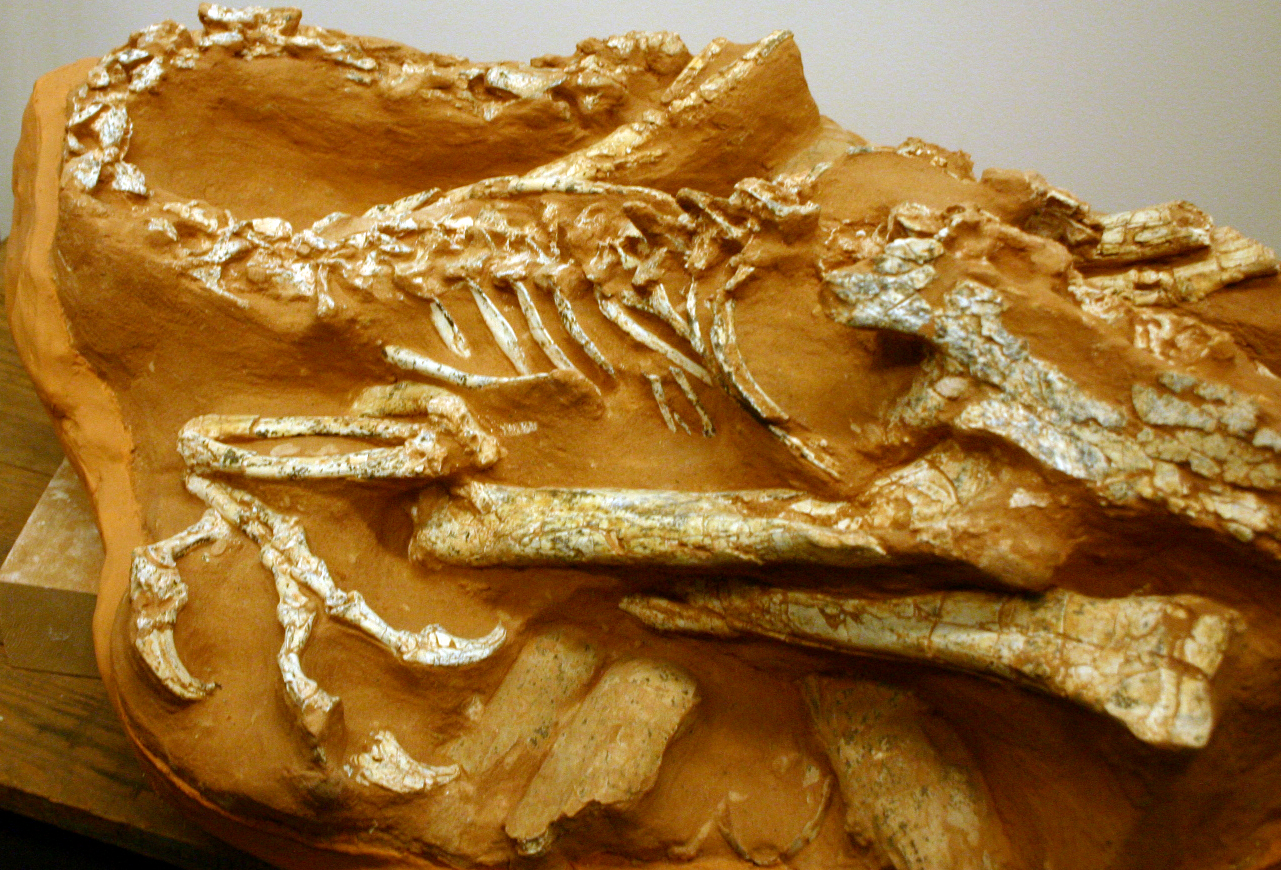
The same posture answered a bigger question about feathers. With the arms held out over the nest rim rather than folded tight against the body, the plumage worked as a shield against sun, wind and rain. One influential 2004 study argued that this protective job, not flight, was the original reason long wing and tail feathers evolved in the first place.
A nest built like nothing alive
Oviraptorid clutches were organised with unusual care. The eggs were laid in pairs, arranged in three or four elliptical rings around an empty centre where the parent sat, and the whole thing formed a gently inclined mound. The original Oviraptor nest preserves about fifteen eggs. Eggshells carried a protein-rich cuticle that stopped water loss, a useful adaptation in the caliche-rich desert sediments where these fossils are found. A female skeleton from China showed two oviducts but only one ripe egg per side, so these animals produced small numbers of large, well-protected eggs instead of flooding the nest with cheap ones. Modern studies of clutch sizes link that strategy to intensive parental care, closer to an ostrich than to a crocodile.
Why keep a slanderous name? In taxonomy, a scientific name stays with the first animal it was attached to, even if the story behind it turns out to be wrong. Once Oviraptor philoceratops was published in 1924, correcting the record meant renaming, and the rules make that deliberately difficult. The accusation outlived the evidence for it.
Waiting versus guarding
It is a useful contrast with the animals this site is named after. A Triops mother does not sit on anything. She seals her eggs into a dry mud puddle and leaves, and the embryos inside go dormant until rain returns, sometimes years later. Read more about that trick in how Triops eggs survive drought, and about the evolutionary origin of the shell itself in the shelled egg. Oviraptorids chose the opposite gamble: few eggs, built for one specific desert, guarded by a parent that died on duty in a sandstorm. Both strategies worked. The Triops version has outlasted five mass extinctions, and the guarding version produced the birds in your garden.
The lesson of Oviraptor is not really about dinosaur behaviour. It is about how a good name sticks. Seventy years after the accusation, schoolchildren still meet it first, and the correction takes a paragraph.