Published 2026-10-16 · by the Triops.me Editorial Team · Back to Articles
Did Pachycephalosaurus Really Head-Butt?
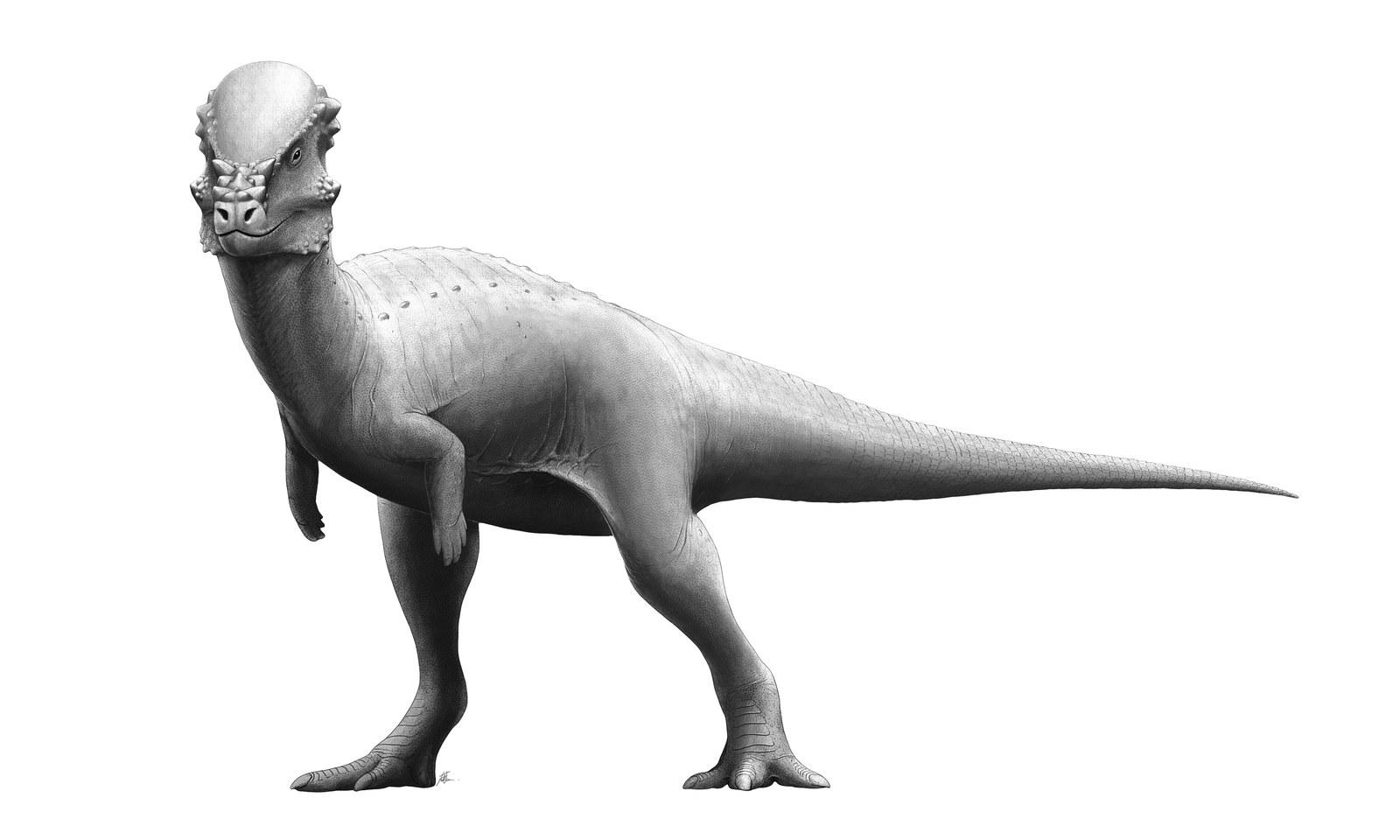
Open almost any dinosaur book written for children and you will find the same scene: two dome-headed dinosaurs charging at each other and slamming skull against skull. The image is repeated so often that it reads as established fact, the kind nobody bothers to check. With Pachycephalosaurus the evidence does exist. It simply does not point in one direction.
More than eighty years after the animal was named, researchers are still arguing about what that dome was for. The dispute has produced injury maps, bone thin sections, computer stress models and a naming mess that may have inflated the number of known species. It is a good case study in how slowly paleontology actually moves.
A walking battering ram
Pachycephalosaurus wyomingensis, thick-headed lizard from Wyoming, was described in 1943 by Barnum Brown and Erich Schlaikjer from fossils collected in the latest Cretaceous rocks of Montana. It belonged to the pachycephalosaurs, a family of two-legged ornithischians that all follow the same plan: a thickened skull roof surrounded by knobs and spikes.
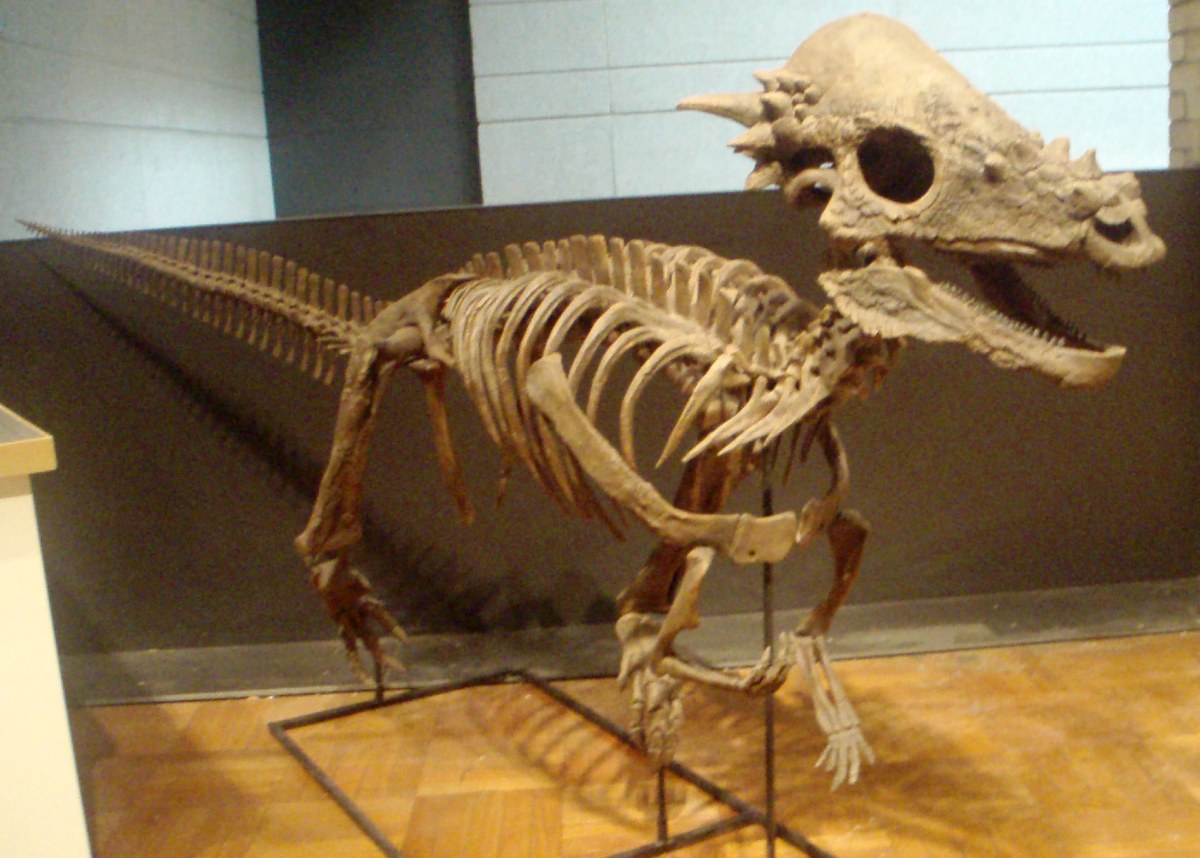
The animal lived from roughly 70 to 66 million years ago, in the final four million years of the Age of Dinosaurs, on the island continent of Laramidia. Fossils turn up in Montana, Wyoming, South Dakota and Alberta. Estimates put it at about 4.5 metres long and 370 to 450 kilograms, roughly the mass of a large brown bear.
Almost everything known about it comes from skull material, and the skull is remarkable. The dome is built from the frontoparietal bones of the skull roof, which fuse and thicken as the animal matures. In the thickest specimens it reaches 22 to 25 centimetres of solid bone, more roof than any other dinosaur grew. A row of bony knobs edged the back of the dome, and short spikes projected from the snout. Those spikes were blunt. Whatever they were for, they were not for piercing.
The diet is guessed at rather than known. Leaf-shaped teeth and a small head suggest a browser of soft vegetation, and no stomach contents have been found. For comparison, the great horned dinosaur ceratopsians of the same formations defended themselves with genuine weaponry, while Stegosaurus carried its display structures on the back rather than the head. The pachycephalosaur put everything on the skull roof, which is exactly why the head-butting idea took hold.
The case for impact
The strongest argument comes from damage. In 2013 Jeffrey Peterson, Conor Dischler and Nicholas Longrich surveyed cranial lesions across pachycephalosaur domes and found that about 22 per cent of them carried damage consistent with osteomyelitis, a bone infection that follows a penetrating blow to tissue over the skull. Crucially, the lesions cluster near the top of the dome, the contact point you would expect if rival skulls met there. The flat-skulled members of the group showed almost no such pathology, which fits either juveniles or females staying out of the contests.
Engineering work pointed the same way. Finite element models that trace stress through the dome as load is applied found that its internal architecture handles considerable impact force without collapsing. The bone is thick where the load concentrates and lighter elsewhere, which is how a structure is supposed to be built if it is going to be hit.
The case against
In 2004 Mark Goodwin and Jack Horner cut thin sections through pachycephalosaur domes and looked at the bone under a microscope. What they found resembled the horns of cattle and the antlers of deer: fast-growing, heavily vascularised tissue laid down in episodic bursts rather than the dense layered bone of a shock absorber. On top of that, none of the domes showed healed impact fractures. If animals were routinely cracking their skulls together, some of them must have missed, and healed cracks are hard to miss.
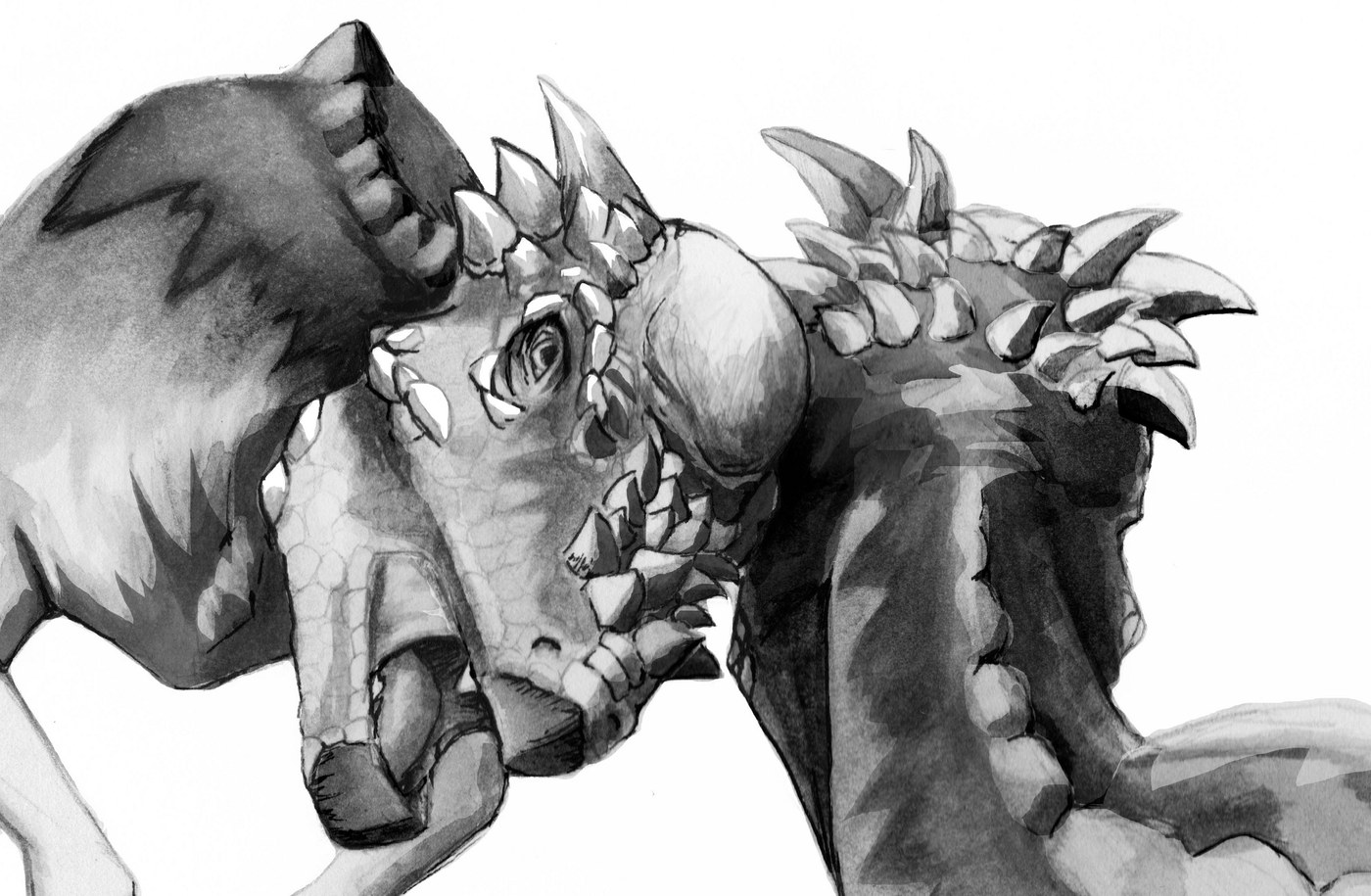
Anatomy added a second objection. The neck vertebrae carried the head in an S-shaped curve rather than a straight line, a poor arrangement for transmitting a ramming force, and the dome is rounded, so contact between two skulls would tend to glance off instead of landing square. Ken Carpenter proposed an alternative in 1997: flank-butting, where an animal swings its head sideways into the body of a rival, or a shoving match in which domes press and twist. Both behaviours use the same hardware and neither requires a straight-on charge.
Three names, one dinosaur
The argument is complicated by a taxonomic tangle. Two other domed dinosaurs from the same rocks, Dracorex hogwartsia and Stygimoloch spinifer, were shown by Horner and Goodwin in 2009 to be juvenile growth stages of Pachycephalosaurus. Their evidence comes from bone histology: dome and spike tissue is extremely variable during growth, juveniles start with flat skulls and long spikes, and the spikes are resorbed while the dome thickens toward adulthood. Later work extended the same logic to flat-skulled forms from Asia.
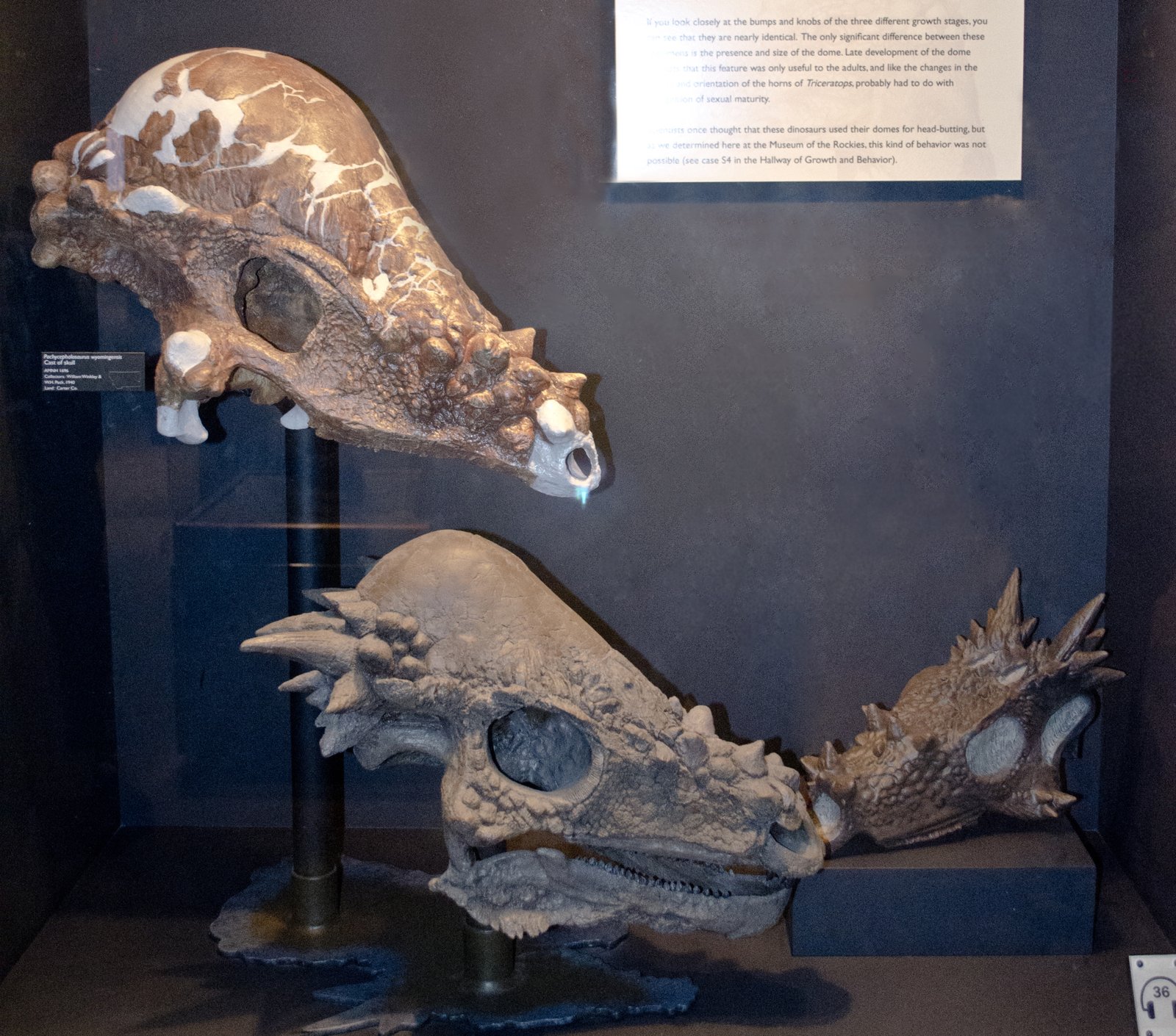
Not everyone accepts it. Fowler pointed out in 2017, and Evans and colleagues confirmed in 2021, that the few Stygimoloch specimens with reliable ages come from the very top of the Hell Creek Formation while Pachycephalosaurus comes from lower layers, so the two may have lived at slightly different times. A 2025 review by Wroblewski kept Stygimoloch as a separate genus. Dracorex is more widely treated as a juvenile stage. The stakes are real: if the flat-skulled forms are young animals, the pathology record is missing an entire age class, and the famous fight may only ever have involved adults.
What the newest find adds
In 2025 a paper in Nature described Zavacephale rinpoche from the Lower Cretaceous Khuren Dukh Formation of Mongolia, the oldest and most complete pachycephalosaur found anywhere. It already had a well-developed frontoparietal dome, which pushes the origin of the structure deep into the group's history, and it preserves the first hand bones and stomach stones ever recorded for these animals, hinting at a diet that needed grinding. A 2023 study describing two new small-bodied species from North America argues that the group was more diverse than the fossil record currently shows.
So where does that leave the children's book scene? The injuries say something struck these domes. The histology says the bone grew like a horn, not like armour. The biomechanics says the roof could take a blow while the neck was badly aligned to deliver one. A shove or a flank strike fits all three observations better than a high-speed charge, though nothing rules out short, deliberate contact at close quarters. A 2024 review in The Anatomical Record that surveyed head-butting across living and extinct animals makes the point plainly: this is an open question, and it will stay open until someone finds the healed crack that closes it. The animals themselves got no chance to settle it either, since the last Pachycephalosaurus died in the same extinction event covered in our article on the Cretaceous-Paleogene extinction.