Published October 16, 2026, 21:07 · by the Triops.me Editorial Team · Back to Articles
Parasaurolophus: The Trumpet Crest of the Cretaceous
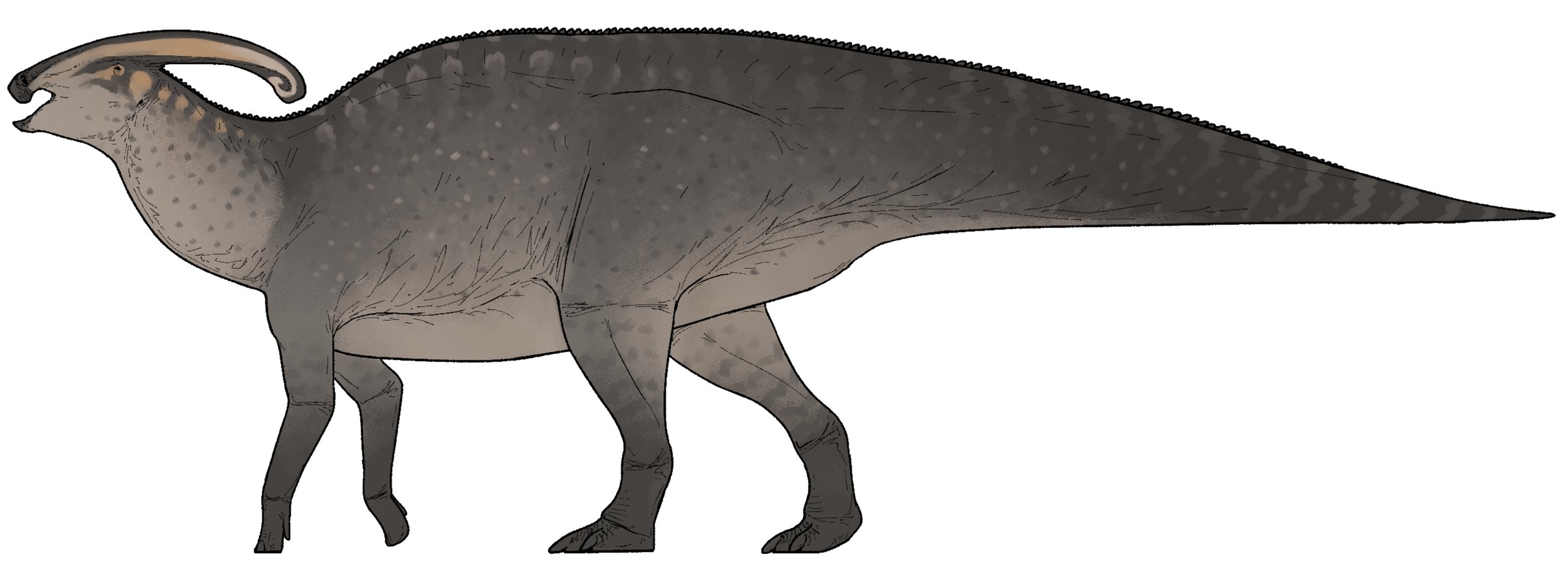
Between about 76 and 73 million years ago, the floodplains of what are now Alberta, New Mexico and Utah were grazed by a duck-billed dinosaur that reached 9.5 meters in length and passed five metric tons. It fed on four legs and could rise onto its hind legs to run, cropped plants with a broad beak, and ground them in dental batteries packed with hundreds of constantly replaced teeth. All of that is standard hadrosaur equipment. What set this animal apart grew straight out of the back of its skull: a hollow tube of bone, in some species more than a meter long, that no living animal has ever reproduced.
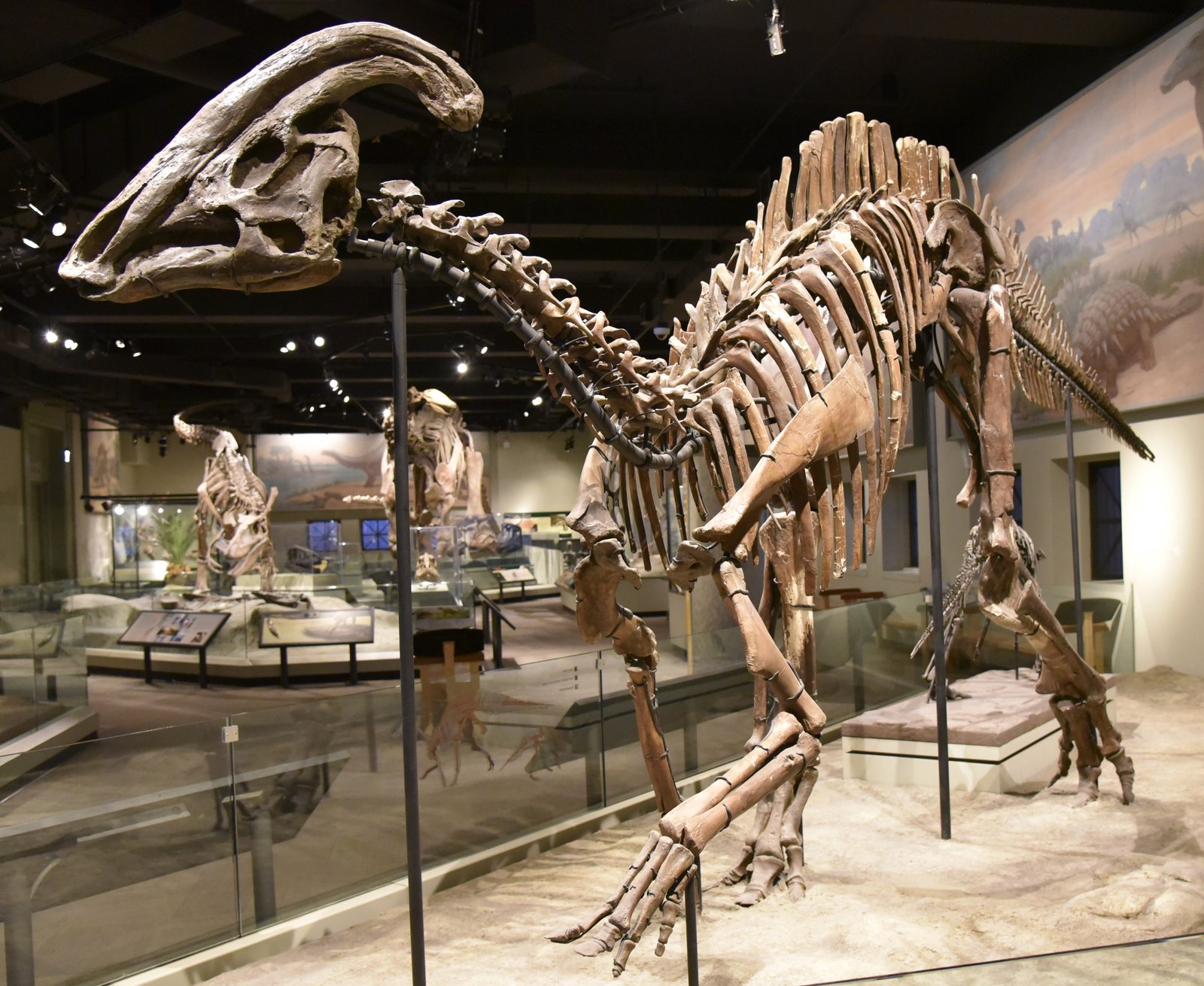
The crest was built from the premaxilla and nasal bones and swept up and backwards. Inside it, a pair of passages ran from each nostril to the far end of the crest, doubled back, and descended into the skull again. The skull of the type specimen measures about 1.6 meters from the beak to the crest tip. The name means near crested lizard, from the Greek para, saurus and lophos, and it was chosen because the paleontologist who first described it saw a resemblance to Saurolophus, a related duckbill wearing a much shorter solid crest.
A Genus Known From Half a Dozen Skulls
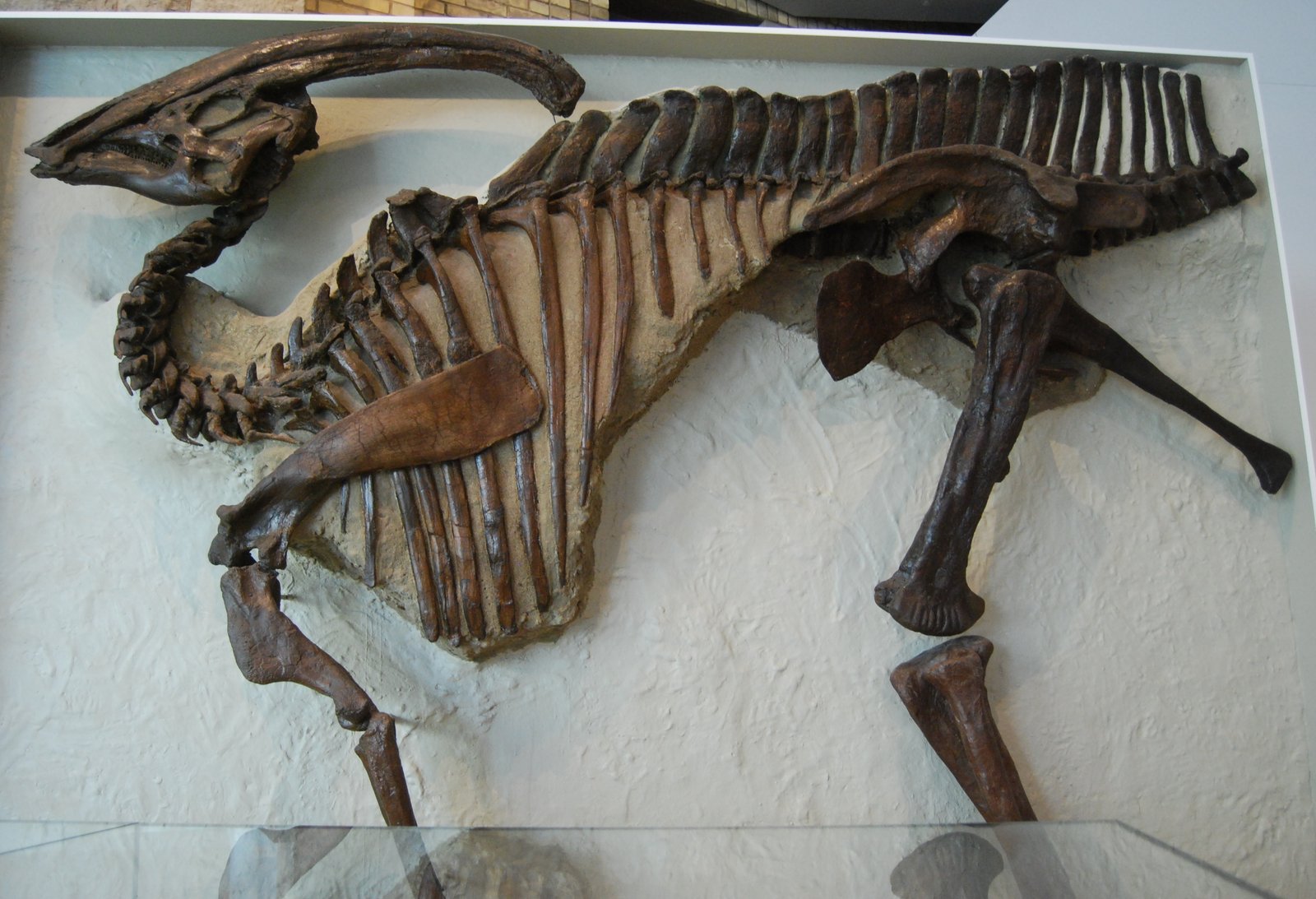
The first specimen, catalogued as ROM 768, was collected in 1920 by a University of Toronto field party working along Sand Creek near the Red Deer River in Alberta. William Parks described it in 1922 and named it Parasaurolophus walkeri after Sir Byron Edmund Walker, chairman of the board of trustees at the Royal Ontario Museum. A century later the genus is still known from only about six good skulls. In Alberta it counts as rare: besides the type, there is one other possible skull from the Dinosaur Park Formation and a few specimens without skulls that may belong to it.
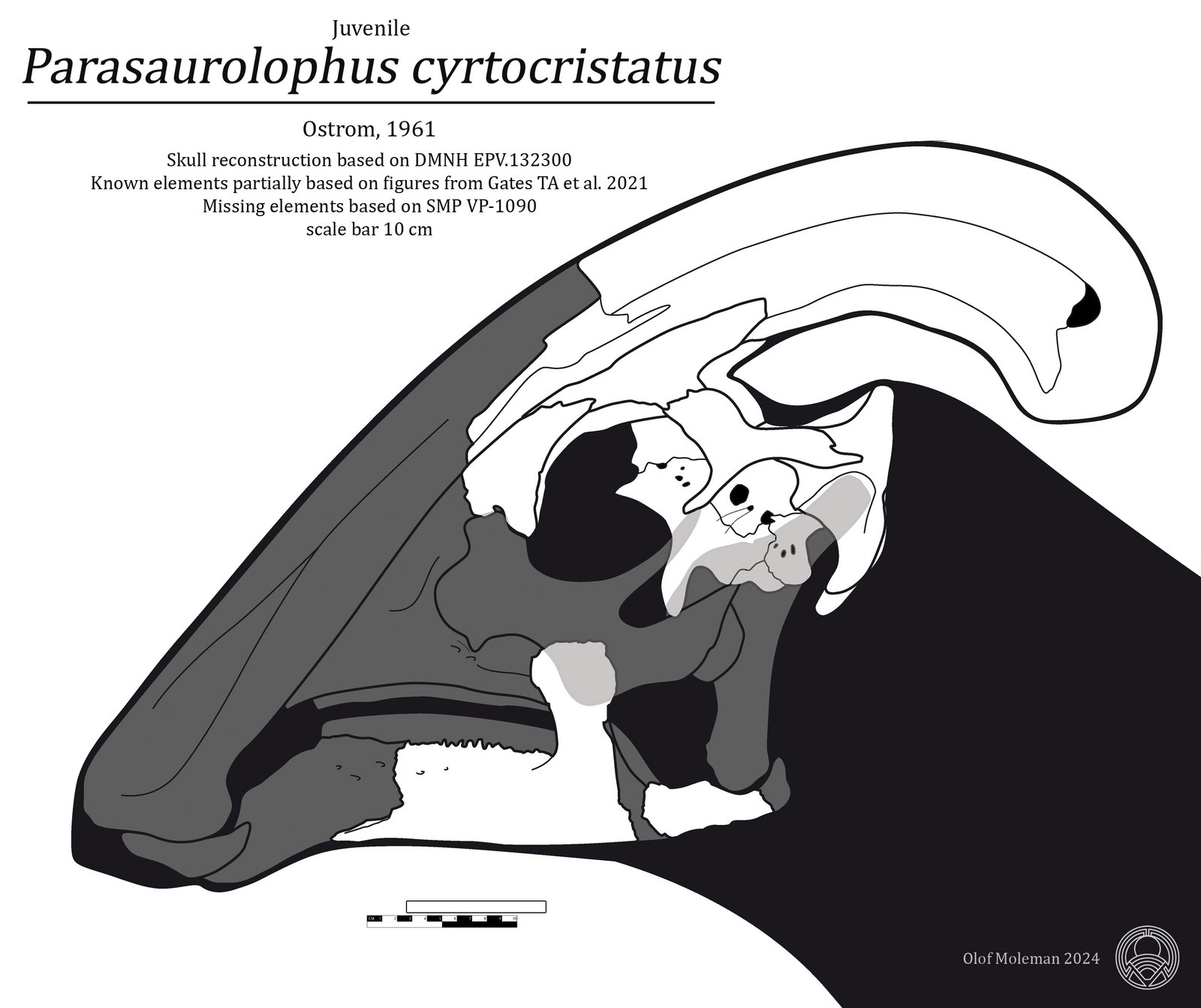
Three species are generally accepted. P. walkeri carries a long, gently curved crest with simple tubing. P. tubicen is the largest of the three and the most complicated, its passages branching, meeting and ending blindly; Carl Wiman named it in 1931 from a skull that Charles Sternberg had dug out of New Mexico's Kirtland Formation a decade earlier, and the epithet is Latin for trumpeter. The third, P. cyrtocristatus, is the smallest, with a short strongly rounded crest, described by John Ostrom in 1961 from New Mexico material with more later from Utah. The closest known relative is Charonosaurus from northeastern China, which sports a similar skull.
Snorkel, Smell Organ, or Weapon
For decades the crest attracted explanations that read like guesswork. Alfred Sherwood Romer proposed a snorkel. Martin Wilfarth argued that it anchored a movable proboscis used for breathing or gathering food. Charles Sternberg made it an airlock against water, and Ned Colbert turned it into a reserve tank for long stays underwater, an idea that survived in museum murals into the 1940s. Parks himself thought the crest was tied by ligaments to the neck vertebrae to help carry the head. Othenio Abel saw a weapon for contests between rivals, Halszka Osmolska gave it salt glands, and John Ostrom gave these dinosaurs an unusually sharp sense of smell.
None of it holds up. There is no opening at the tip of the crest for a snorkel, no muscle scar for a proboscis, and the air volume was trivial for an animal this size. The smell idea fails hardest: the olfactory nerves and sensory tissue sit mostly outside the section of nasal passage that grows into the crest, so the tube had almost nothing to do with scent. And other duckbills with solid crests, or no crests at all, got through life perfectly well without any of it.
A Note at 30 Hertz
What the crest really held was a wind instrument. Wiman noticed in 1931 that the inner structure resembled that of a swan and suggested the animal drove air through those elongated passages to make noise. David Weishampel worked the idea further in 1981 and estimated a range of 55 to 720 hertz, shifting between species with crest size and tube length. The ears back this up: hadrosaurs kept a slender stapes, a broad space for the eardrum, and an elongated chamber of the inner ear much like a crocodile's, all signs of sensitive hearing. Weishampel also argued that adults were tuned to higher pitches, the sort a chick produces, which fits parents answering their young across a valley.
In 1997 a team at Sandia National Laboratories built a digital acoustic model from a well-preserved P. tubicen skull. The main passage resonates near 30 hertz, a vibration felt in the chest more than heard with the ears, while the tangled sinus anatomy layers peaks and valleys over it. Notes that low travel far through forest and over water, which is where a herd spread across a floodplain needs them. A second line of evidence points the same way. Hadrosaur eye sockets were large and still held their scleral rings, so vision counted, and a crest of that size would have identified species and sex at a distance before the first sound arrived.
Cooling Fins and Skin Sails
Sound was probably only one of the crest's jobs. Its surface was broad and richly supplied with blood vessels, which led Wheeler to propose in 1978 that it shed heat from the brain, and Maryańska and Osmolska to suggest evaporative cooling through salt glands. Barnum Brown spotted fine striations behind the crest in 1912 and argued for a frill of skin stretched back to the neck, a detail that reached Charles R. Knight's murals and Disney's Fantasia before paleontologists lost their enthusiasm for it. Most modern restorations leave the frill off. The honest summary is that the crest did several things at once, and no single experiment has yet settled which job mattered most.
Growing Into the Instrument
A juvenile nicknamed Joe, collected in Utah's Kaiparowits Formation in 2009 and described in 2013, died at about a year old, 2.5 meters long, roughly a quarter of adult size. Its crest was not a tube yet but a low dome. Crest growth started earlier in this genus than in relatives such as Corythosaurus and accelerated as the animal approached sexual maturity, which may be why adults finish with such extravagant headgear while the young carry only a bump.
Life in a Crowded Floodplain
The Alberta population shared its ground with the horned dinosaurs Centrosaurus, Chasmosaurus and Styracosaurus, with fellow duckbills Gryposaurus and Corythosaurus, with armored ankylosaurs, and with two tyrannosaurids, Gorgosaurus and Daspletosaurus. The climate was warmer than Alberta today, frostless, with wet and dry seasons. Conifers formed the canopy, ferns and flowering plants filled the understory, and rivers braided across low relief toward a sea slowly advancing from the east. Against all those neighbors Parasaurolophus was uncommon, which has led to the suggestion that it lived upland and that its bones reached the river deposits only after death. In New Mexico it stayed in swamps near the shore of the Cretaceous interior seaway, with Bistahieversor and Teratophoneus hunting in the same wet lowlands.
The holotype carries a souvenir of one bad day. Its neck vertebrae show a V-shaped gap, with cracked and swollen neural spines directly in front of it. Parks read the damage as an injury, though for years it was also taken for a preparation flaw. In 2020 Bertozzi and colleagues compared the pattern with healed bone and concluded that the most plausible cause was an impact from a falling tree during a storm. The regrowth shows the animal lived on for at least a month or two after the blow, and the injuries did not kill it.
What the Trumpet Tells Us
Fame in the Cretaceous was not only about teeth. Tyrannosaurus rex dominates the popular imagination, yet it left us no way to test how it sounded, while this quieter herbivore has yielded a working acoustic model simply because its skull happened to be hollow in the right places. The ornithopod lineage it belongs to produced plenty of oddities, from Iguanodon's thumb spike to the crested helmets of Corythosaurus.
There is a smaller story in the same rocks. Those floodplains broke into pools that filled and dried with the seasons, and in those pools lived Triops, the same branchiopod body plan that still haunts rainwater puddles today. A five-ton animal calling at 30 hertz and a shrimp-sized creature waiting out the drought both made their living on the Cretaceous floodplain, one broadcasting across it, the other hiding inside it. Between them they show how much of that world can still be read from the rock.