Published 2026-10-07 · by the Triops.me Editorial Team · Back to Articles
Postosuchus: The Predator That Ruled Before the Dinosaurs
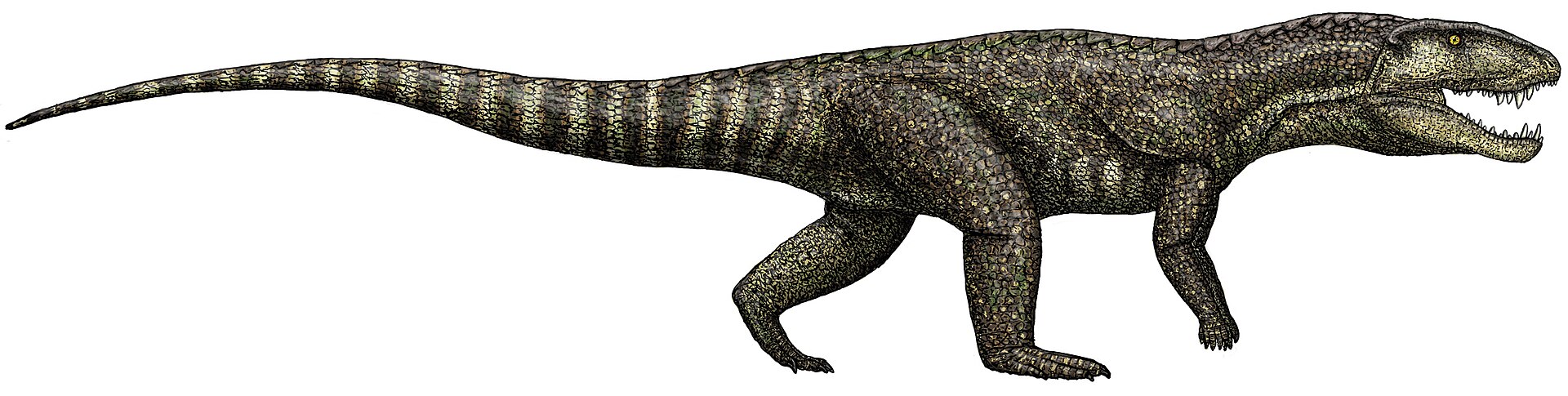
Dinosaur is the word almost everyone reaches for when they picture the distant past: giant, reptilian, in charge. In the Late Triassic, roughly 230 to 220 million years ago, that instinct would have gotten you killed. The largest carnivore stalking the rivers and floodplains of what is now the American Southwest was not a dinosaur, and not closely related to one. It was Postosuchus, a rauisuchid built like a crocodile, armoured like a lizard and standing on legs carried straight under its body.
For most of the Triassic, animals like this held the top job. The first dinosaurs were small and mid-ranking in a world run by the pseudosuchians, the lineage that also produced modern crocodiles. Postosuchus grew to five or six metres, carried a skull half a metre long and left its bones in four American states, giving us one of the best windows into an entire lost order of rulers.
A crocodile that never lived in the water
The family tree matters here. Archosaurs split in the Triassic into two great branches: the avemetatarsalians, which led to dinosaurs and birds, and the pseudosuchians, which led to crocodilians. Postosuchus sits firmly on the crocodile side, in the family Rauisuchidae, and rauisuchids turn out to be the closest kin of the crocodylomorphs, the group that contains every living crocodile, alligator and gharial. In phylogenetic terms, the Triassic world produced crocodiles that behaved like big-game hunters on land, long before any crocodile learned to wait in a river.
The name says exactly where it comes from: Postosuchus is Greek for "crocodile from Post", after the small town of Post in Garza County, Texas. In 1980 a Texas Tech University expedition found a fossil-rich site near the town, now called Post Quarry, where a dozen well-preserved specimens of a new rauisuchid were waiting in the Cooper Canyon Formation of the Dockum Group. Sankar Chatterjee described the genus in 1985 as P. kirkpatricki, naming the species after Jack Kirkpatrick and his wife, who helped with the fieldwork. A second species, P. alisonae, was described in 2008 from a brick quarry in Durham County, North Carolina, where two undergraduates had uncovered it in 1992; it honours Alison Chambers, who popularised paleontology in the state.
Built like a tank, armed like a raptor
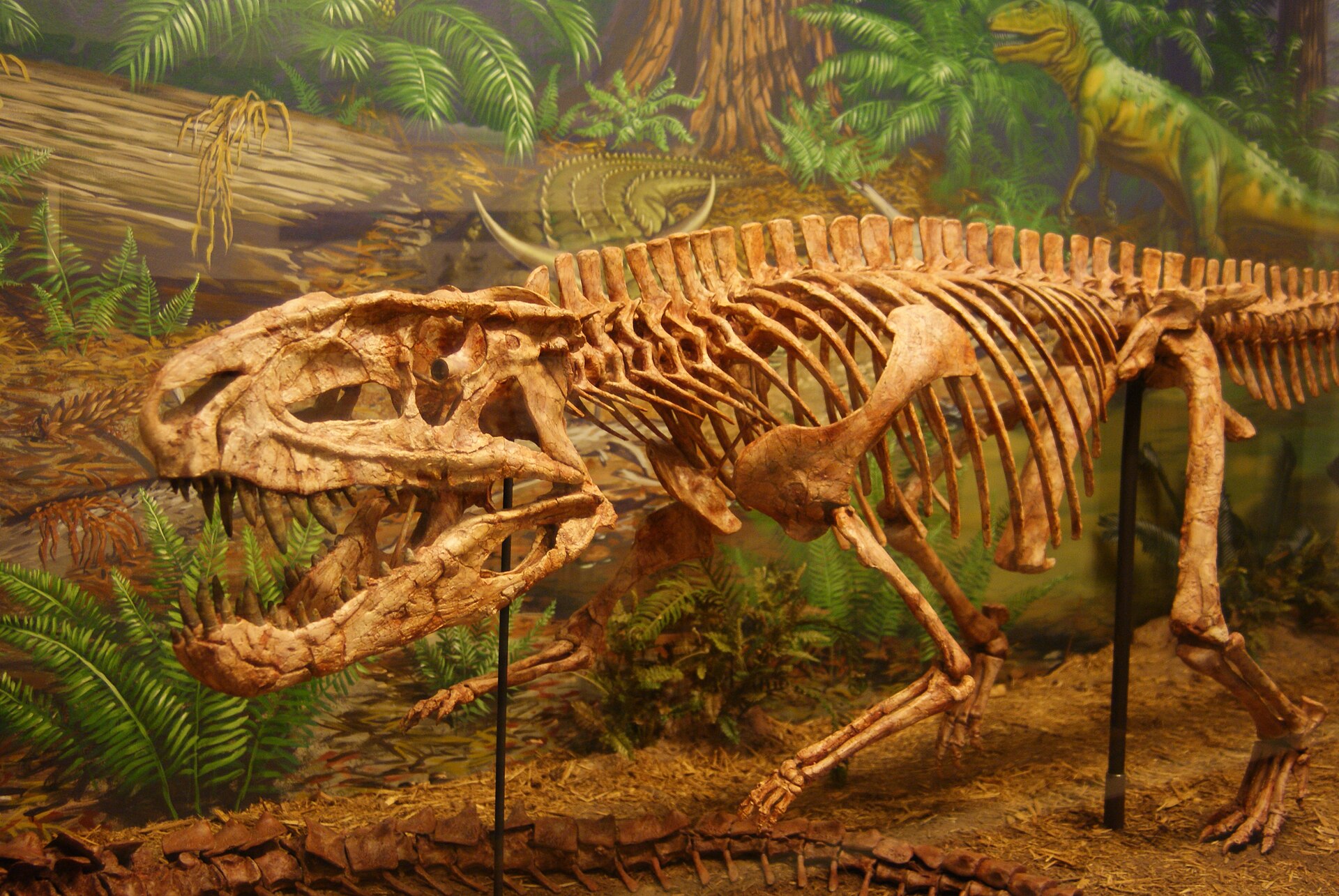
Start with the skull, because that is where the animal's job description is written. The holotype skull measures 55 cm long and 21 cm across and deep, narrow at the front and widening into a heavy block behind the eyes. Inside sat large, serrated teeth, some enlarged into hooked sabres, and the dentition was heterodont: each tooth a different size and shape, 17 in each upper jaw (four in the premaxilla, 13 in the maxilla) and more than 30 along each side of the lower jaw. A single complete tooth from North Carolina stands 7.2 cm tall. Tooth replacement also differed from a crocodile's, with the new tooth growing until the old one was resorbed rather than slotting into the empty socket.
The rest of the body was no less sturdy. Thick bony plates, osteoderms, armour the back, neck and possibly the tail. The limbs sat underneath the body in an upright stance, nothing like the sprawling pose of a modern monitor lizard, and the heel and ankle are built on the crocodile plan. The forelimbs reached only about 64 per cent of the length of the hindlimbs, with small five-fingered hands of which only the first digit carried a claw, while the feet were much larger and ended in a hook-shaped fifth metatarsal. Put it together: an animal taller at the hip than a big Komodo dragon, carrying a massive head on a neck of at least eight vertebrae.
Biped, quadruped, or both?
Those short arms have started an argument that has run for four decades. Chatterjee argued that Postosuchus walked in an erect stance and dropped onto its forelimbs only at slow speeds, a reading supported by the extreme difference in limb length, a feature usually seen in bipedal reptiles. Robert Long and Phillip Murry disagreed in 1995, judging the animal too heavily built to be anything but a quadruped. In 2013 Jonathan Weinbaum's detailed study of the postcranial skeleton made the strongest case yet for obligate bipedality, finding that the proportions of the digits, vertebrae and pelvis matched those of theropod dinosaurs.
Since then the answer has softened. A 2015 study found load-bearing adaptations in the hand, so the forelimbs really were used for support. A 2021 analysis of femur shape gave conflicting results, with larger specimens overlapping bipedal archosaurs and smaller ones overlapping quadrupeds. By 2022 the picture was a predominantly bipedal adult that could still prop itself up at low speeds, plus a genuine growth story: juveniles had proportionally longer arms and were facultative quadrupeds, losing that option as the arms shortened with age. The debate was less resolved than shown to be the wrong question for a single answer.
What was on the menu
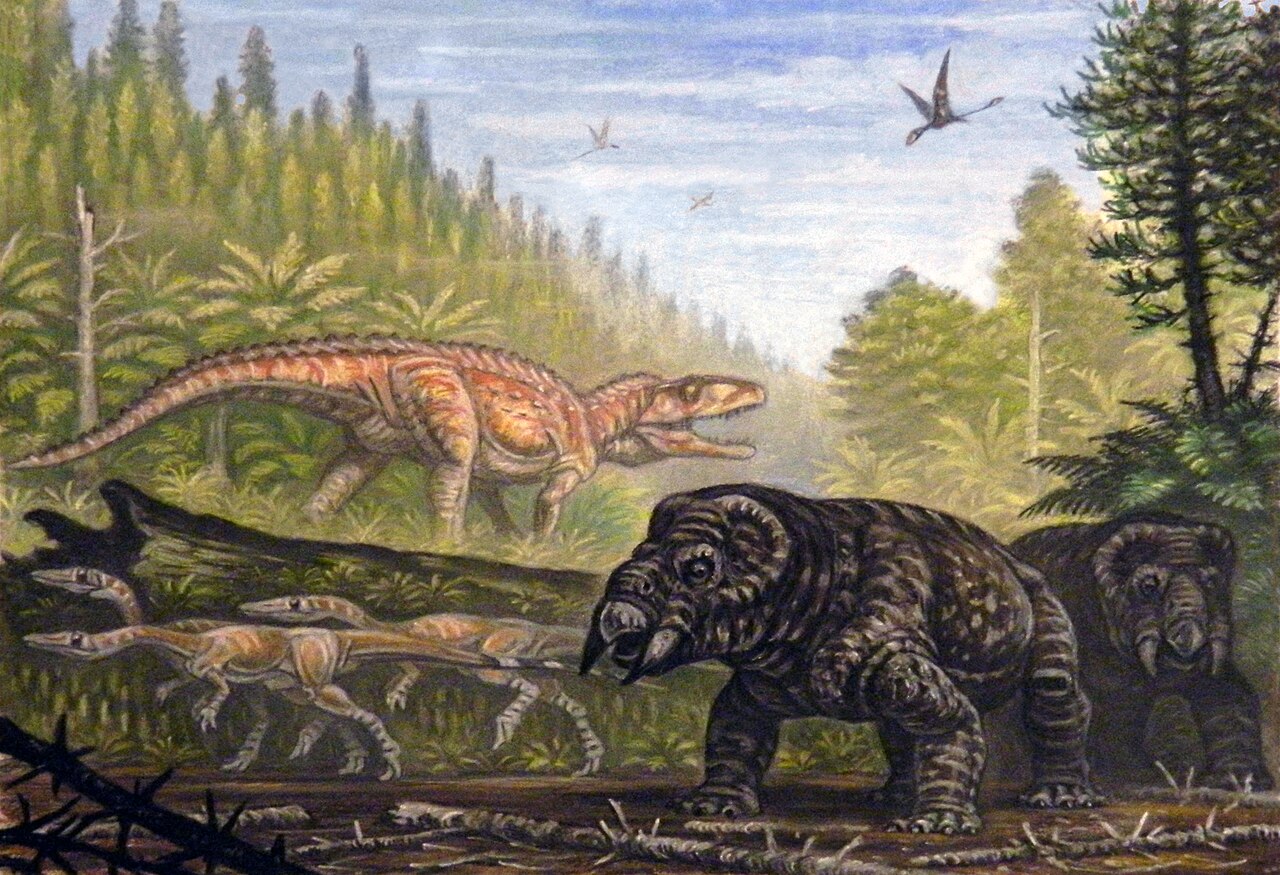
Its world was warm and humid, ferns and cycads under conifers such as Araucarioxylon. The Dockum lakes and rivers held shark-like Xenacanthus, lobe-finned Chinlea and lungfish such as Ceratodus. On the banks and in the floodplains lived the herbivores that made the prey list: the tusked dicynodont Placerias in herds, the armoured aetosaurs Desmatosuchus and Typothorax, the small biped Coelophysis and a scattering of early reptiles. The rivers themselves held the phytosaurs, Rutiodon, Leptosuchus and Nicrosaurus, crocodile-shaped ambush hunters that were not crocodiles either. Two completely separate groups had arrived at the same silhouette, one in the water and one on land.
The direct evidence of predation is unusually good. The North Carolina P. alisonae holotype preserved gut contents from at least four animals: part of an aetosaur, the snout, shoulder blade and upper arm of a traversodontid cynodont called Plinthogomphodon, two toe bones from a dicynodont and a possible amphibian bone. The same specimen was found lying on top of a smaller sphenosuchian, Dromicosuchus, whose skull and neck bore tooth marks. Whatever else it was, it ate widely and did not always finish cleanly.
A name built on borrowed bones
Behind the confident reconstruction sits a messier history, which shows how paleontology actually works. Early rauisuchian material from Texas and Arizona had been shuffled between phytosaurs, dinosaurs and new genera for decades. Some bones Chatterjee assigned to Postosuchus, including a set of "sacral" vertebrae, turned out to belong to Shuvosaurus, a bizarre toothless archosaur; the associated hand and foot bones were split off as Chatterjeea elegans before being synonymised with it again. An articulated skeleton from the famous Coelophysis Quarry at Ghost Ranch, New Mexico, long treated as Postosuchus, was recovered in a 2011 phylogenetic analysis as the most basal crocodylomorph known instead. The 2016 description of a second rauisuchid, Vivaron, from New Mexico made the point explicit: not every large Triassic predator from the southwest is Postosuchus.
None of that undoes the animal itself. A valid Postosuchus specimen sits in the Chinle Formation of Petrified Forest National Park, and new material keeps emerging. Chatterjee's original 1985 paper even carried the subtitle "and the origin of tyrannosaurs", an argument that tyrannosaurs rose from the crocodile line. That hypothesis did not survive testing, but the animal in it did.
The rulers who did not get a second act
The end of the Triassic, about 201 million years ago, closed the chapter. The rauisuchians, phytosaurs and aetosaurs vanished with much of the rest of the large Triassic fauna, in one of the big five mass extinctions. The crocodylomorphs, Postosuchus's own close relatives, came through and diversified into the niches that opened up, which is why we still share the planet with crocodiles, not rauisuchids. The small dinosaurs that had lived in their shadow grew into the giants of the Jurassic and Cretaceous.
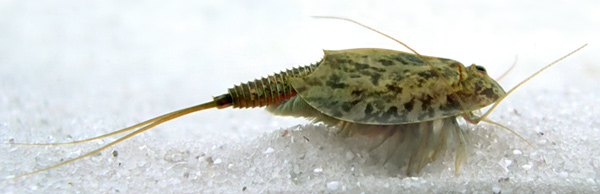
The pools, meanwhile, kept their own quiet record. The same Triassic rivers and drying ponds held branchiopod crustaceans whose eggs could desiccate and wait out a drought or a catastrophe, and one of those lines is the Triops this site is named for. It is a small irony of deep time: the armoured five-metre predator and the thumb-sized pool-dweller shared a landscape, and only one of them had a strategy that needed no luck at all. You can follow that side of the story in how Triops survived five mass extinctions and in Triops in the age of dinosaurs.
That is what makes Postosuchus worth the detour. It was not a failed dinosaur or a primitive stand-in. It was a finished, successful design that ran the world for tens of millions of years, and it lost its crown only because the rules changed underneath it. The fossil record is full of rulers like that, and every one of them assumed the arrangement was permanent.