Published October 21, 2026 · by the Triops.me Editorial Team · Back to Articles
Repenomamus: The Mammal That Ate Dinosaurs
The standard story of the Mesozoic is told in very simple terms. Dinosaurs grew enormous, and mammals stayed small, scurrying underfoot and eating insects while giants ruled the land. Then in January 2005 a paper in the journal Nature complicated that story with a single fossil from Liaoning province in northeastern China. The skeleton belonged to a small mammal, and inside its ribcage, where its last meal should be, lay the partially digested bones of a baby dinosaur.
The mammal was Repenomamus. The baby dinosaur was a Psittacosaurus. Neither animal was large, but together they prove that the boundary between mammal and dinosaur was never a one way street. This is the story of the badger sized predator that turned the usual script of the age of dinosaurs on its head.
Meet Repenomamus
The name Repenomamus is a Latin blend of reptile and mammal, which is exactly what palaeontologists thought they had found: a mammal that lived and hunted more like a reptilian predator than a field mouse. The genus was named in 2001, when Chinese researchers described the first species, Repenomamus robustus, from fossils in the Yixian Formation. A second and larger species, Repenomamus giganticus, followed in 2005.
The sizes are worth spelling out, because they break the rules of the era. Adults of R. robustus were about as big as a Virginia opossum: 41 centimetres of body behind the head, a skull 10.6 centimetres long, and an estimated weight of 4 to 6 kilograms. R. giganticus was roughly half as big again, with a 68 centimetre body, a 16 centimetre skull, a total length of more than one metre including the tail, and an estimated 12 to 14 kilograms. That places it among the largest mammals known from the entire Mesozoic, represented by fossils good enough to measure properly. Almost every mammal alive at the same time was the size of a shrew or a rat.
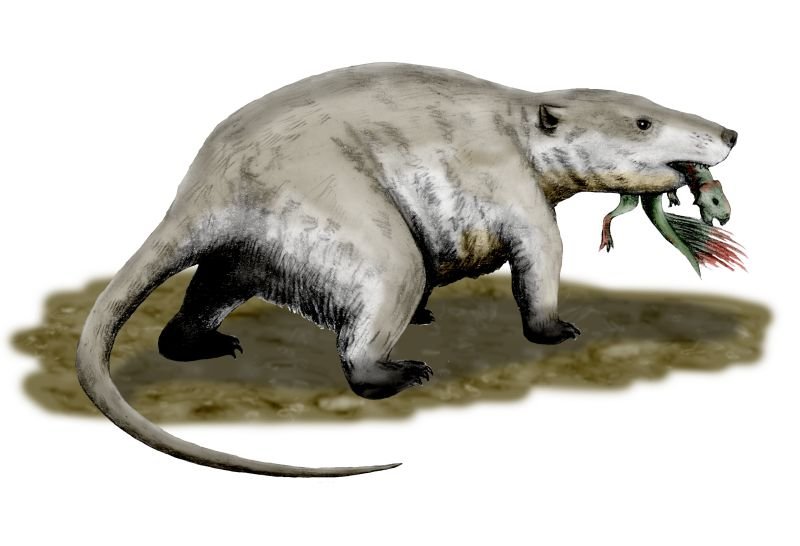
Repenomamus belonged to a group called the eutriconodonts, an early branch of mammaliaforms with no living representatives. They count as mammals in the ways that matter, but they kept features that predate the familiar mammal families, including a long heavy body carried on short sprawling limbs and flat, plantigrade feet. It was not built for a sprint. It was built for gripping things.
A Stage Shared with Feathered Dinosaurs
The rocks that hold these fossils are the Yixian Formation of Liaoning, dated to between 125 and 123.2 million years ago. Volcanic ash buried lakes and floodplains there with extraordinary care, preserving animals with their feathers, skin and stomach contents intact. The Yixian is one of the great fossil windows on earth, famous for the first feathered dinosaurs, and Repenomamus lived right in the middle of the cast.
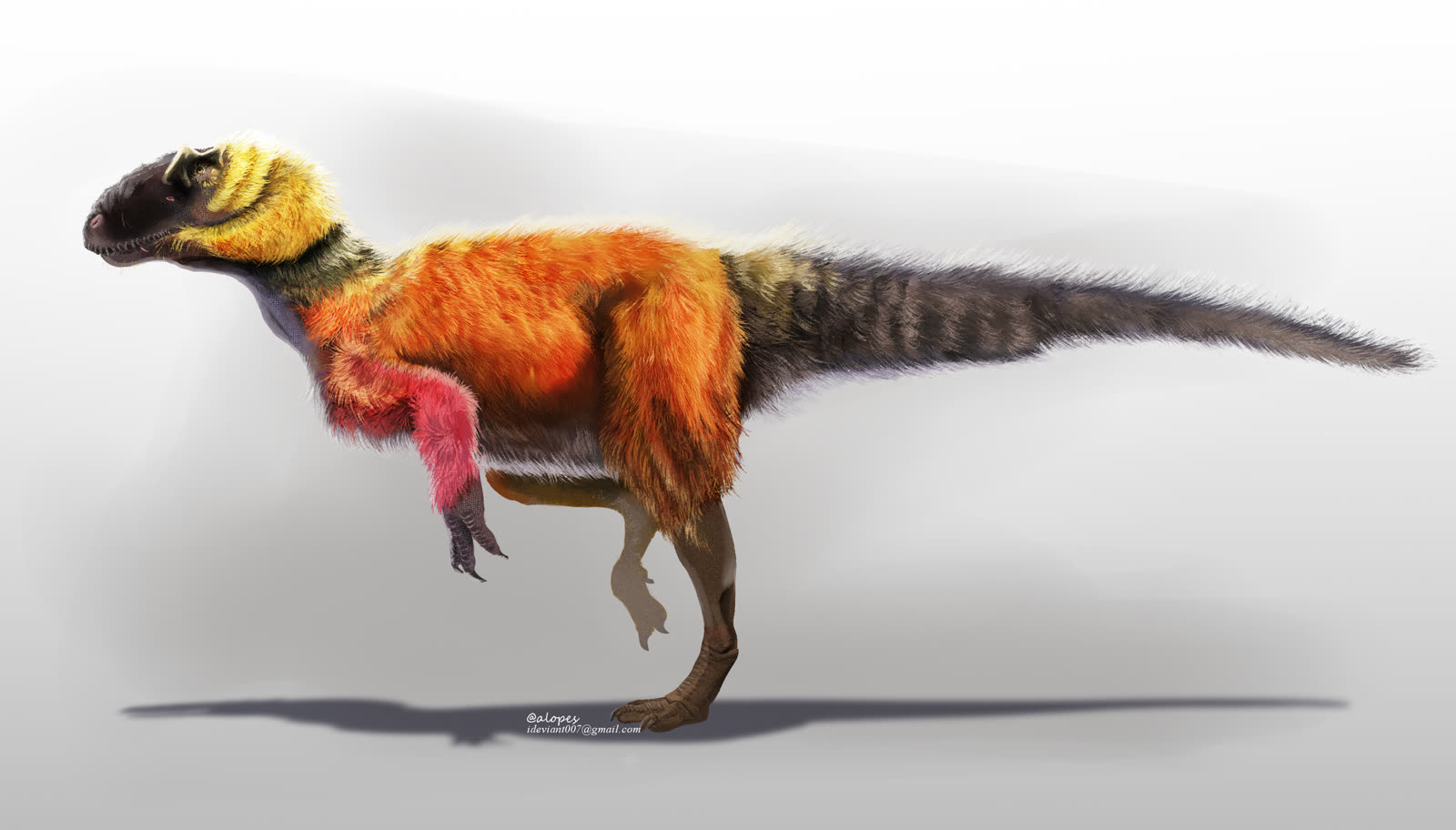
Its neighbours included Psittacosaurus, a parrot beaked herbivore that walked on two legs; Sinosauropteryx, the first dinosaur ever found with direct evidence of feathers; and Yutyrannus, a feathered tyrannosaur that reached nine metres in length. There were also small raptors such as Graciliraptor, and here is the detail that matters: Repenomamus giganticus outweighed small meat eating dinosaurs such as Graciliraptor, which shared its floodplains. In at least one corner of the Early Cretaceous food web, the mammal was not the smallest thing on the menu.
Dinner in the Ribs
The specimen that made the genus famous is catalogued as IVPP V13605 and sits in the Paleozoological Museum of China in Beijing. Inside the abdominal cavity of a R. robustus lies the fragmentary skeleton of a juvenile Psittacosaurus, the bones damaged in ways consistent with being bitten, swallowed and digested. It was the second direct proof that a Mesozoic mammal fed on other vertebrates. The first was an older report of a small marsupial relative called Deltatheridium attacking a little dinosaur named Archaeornithoides.
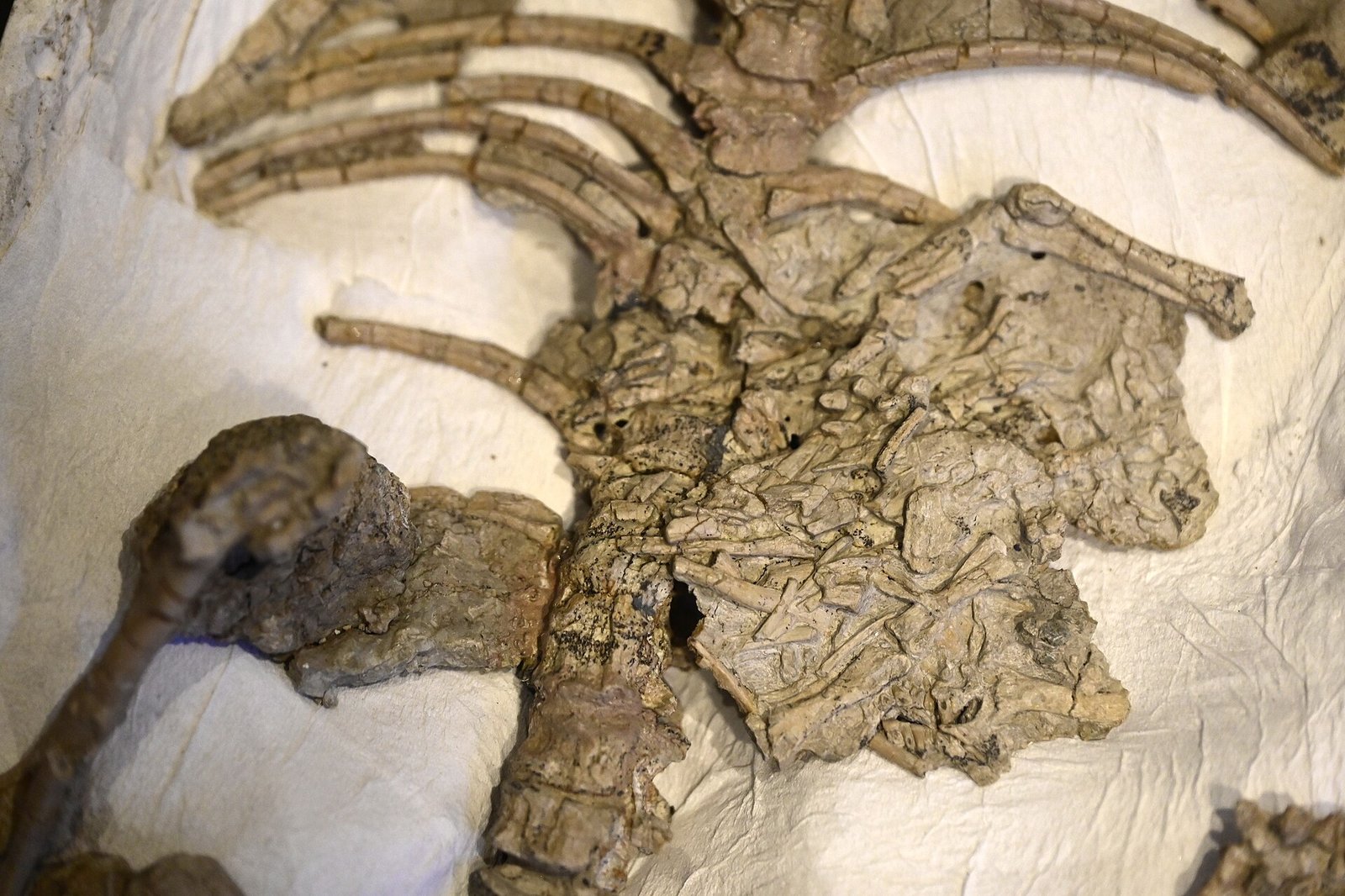
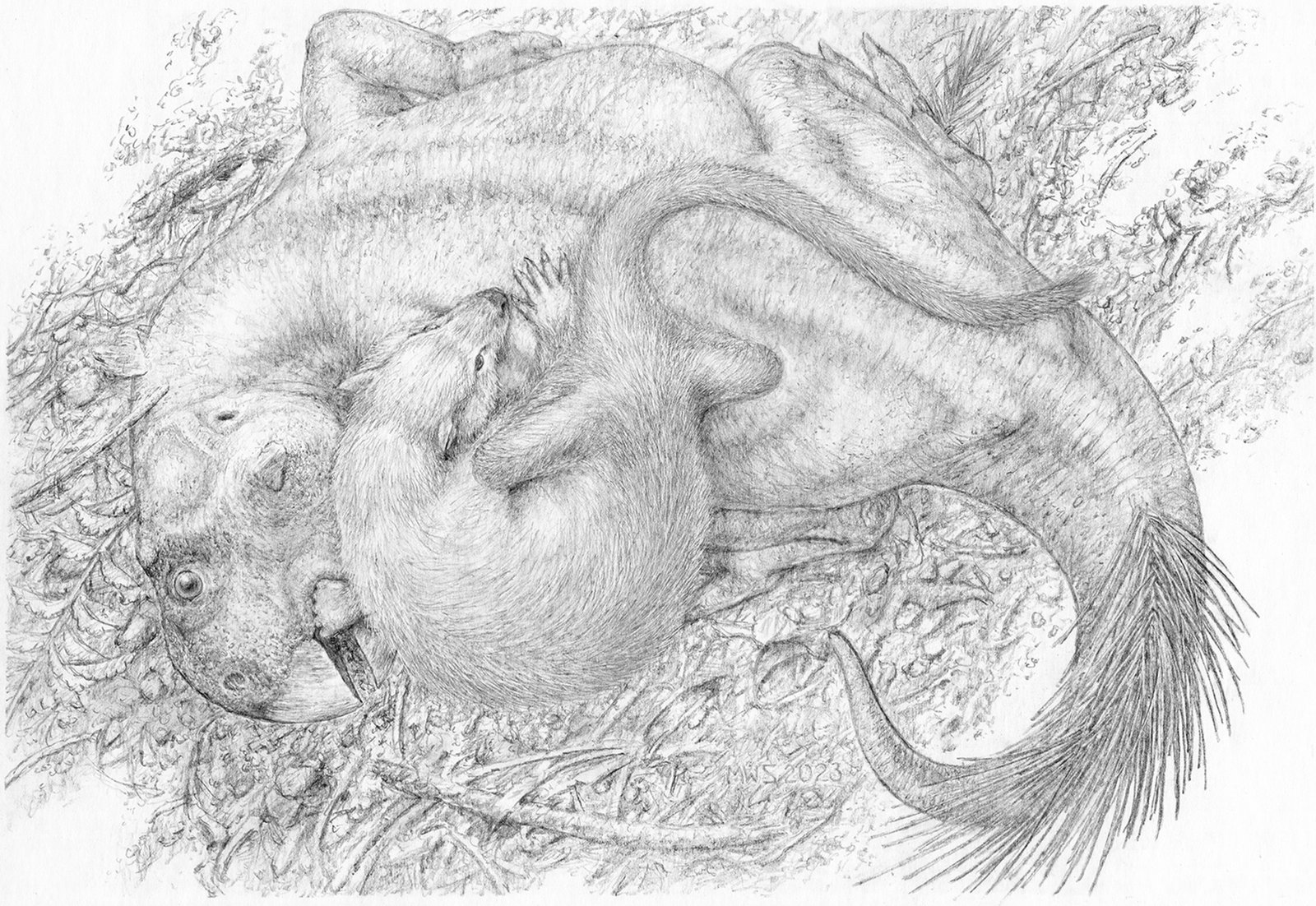
A full stomach does not prove hunting, of course. A scavenged carcass fills a stomach just as well, and for years that objection stayed on the table. It came off in 2023, when a second specimen surfaced: an R. robustus preserved intertwined with an adult Psittacosaurus lujiatunensis, its limbs wrapped around the dinosaur and its jaws clamped on as it bit. The researchers compared it to the famous Fighting Dinosaurs fossil of Mongolia and concluded that the mammal was most likely the instigator of the struggle, attacking an animal several times its own mass.
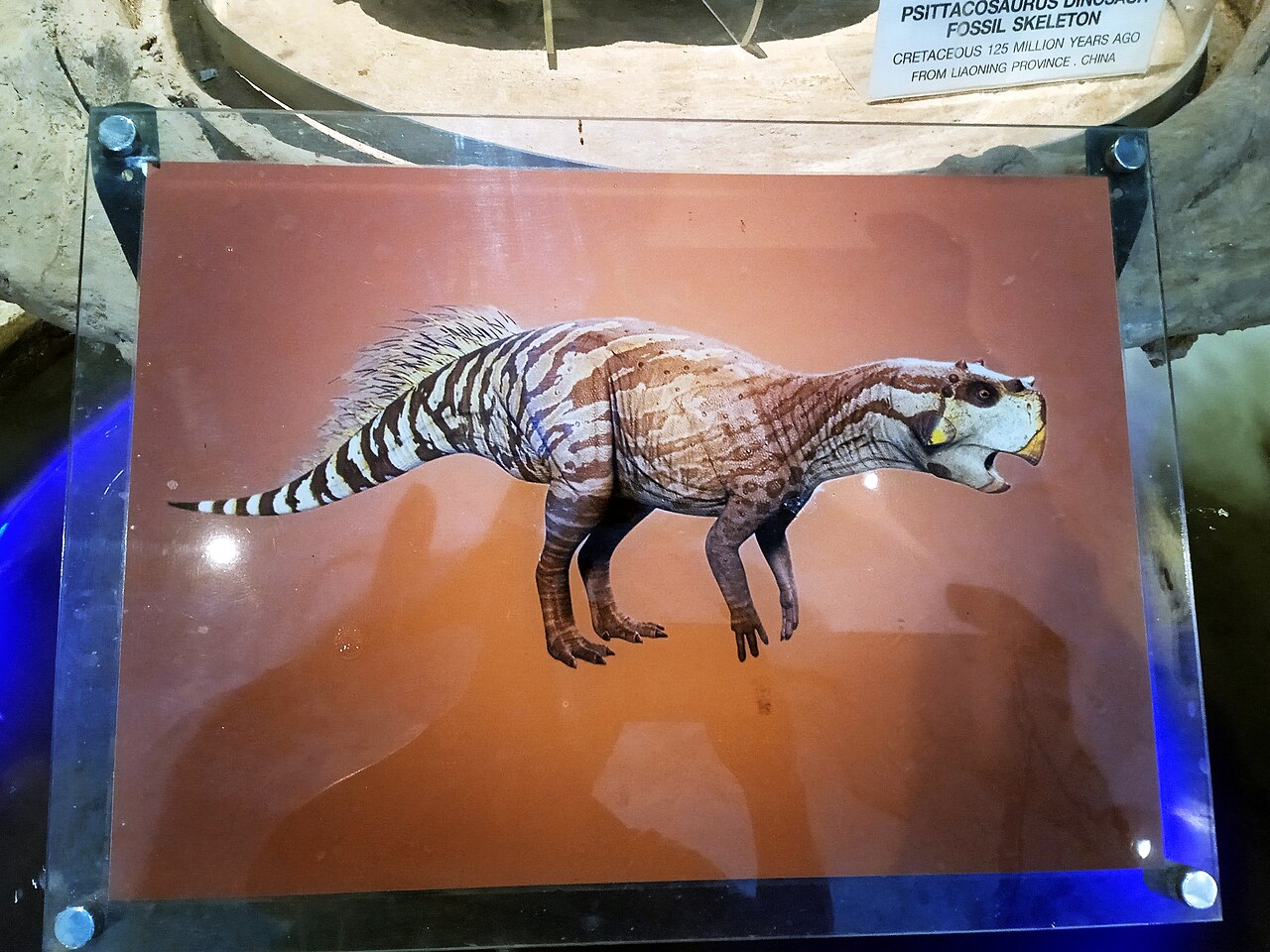
The meal itself was probably a juvenile, which keeps the arithmetic plausible. A badger sized predator can tackle a young Psittacosaurus without signing its own death warrant, then drag the remains off to eat in peace. Faced with an adult, the same mammal appears to have tried anyway, and the rocks caught it in the act.
Built for the Job
Everything about the skeleton says carnivore. The teeth and jaws are shaped for meat, the shoulders and legs were strong enough to pin prey while the mouth did the work, and the sprawling posture gave it a low centre of gravity for wrestling rather than chasing. Like most mammals outside the placental lineage it also carried epipubic bones in the pelvis, which means it either gave birth to very undeveloped young or laid eggs, in the style of a modern platypus.
Nor was it a lonely experiment. Relatives such as Gobiconodon, Jugulator and Triconodon were also large, toothy and apparently willing to take on prey bigger than themselves. The Mesozoic produced a small but real club of mammal hunters, and Repenomamus was its heavyweight.
What Repenomamus Changes
The old picture of mammals hiding in the dinosaur shadow is too tidy. Predatory mammals lived alongside dinosaurs, occasionally ate them, and were then knocked back to the starting line by the asteroid that ended the Cretaceous extinction. What followed is familiar: within twenty million years mammals had produced the first whales, and within a few million more they were the largest animals on land once more. The surprise is that the ambition was already there, 125 million years earlier, in a one metre carnivore in Liaoning.
Repenomamus was not an ancestor of modern mammals. It was a cousin on a branch that eventually died out, a reminder that evolution tested several versions of the mammal idea long before ours took over. The lineage that did reach us traces back through the cynodonts, small survivors of an older extinction, patient in exactly the way apex predators are not.
The Hunter and the Survivor
While Repenomamus was wrestling dinosaurs in Liaoning, triops were doing what triops had been doing since the Triassic: filling temporary pools after the rains, dropping eggs into the mud, and waiting out the drought in suspended animation. Two lineages sharing the same world, with opposite strategies. One was a specialist hunter that gambled everything on being the fiercest animal for its size. The other gambled on doing nothing at all for as long as necessary.
Both outlasted the dinosaurs. The mammals inherited the planet after the asteroid, while triops simply kept their ancient habit going through five mass extinctions and counting. The mammal won the dramatic victory. The shrimp won the long one.