Published August 31, 2026, 22:22 by the Triops.me Editorial Team · Back to Articles
Temnospondyls: Giant Amphibians That Ruled Before Dinosaurs
Long before dinosaurs strode across the Earth, a remarkable group of amphibians dominated freshwater ecosystems around the world. Called temnospondyls, these creatures ranged from small salamander-like forms to true giants exceeding nine meters in length. They survived not one but two of Earth's greatest mass extinctions and persisted for over 200 million years.
Despite their extraordinary success, temnospondyls remain largely unknown to the general public. Their story is one of resilience and adaptation, connecting the coal swamps of the Carboniferous to the icy rivers of the Cretaceous. Understanding temnospondyls also helps us appreciate the broader history of amphibian life on Earth, including the Triops and other branchiopods that shared their ancient pools.
Origins in the Coal Swamps
Temnospondyls first appeared during the early Carboniferous period, roughly 340 million years ago, when vast swamp forests covered much of Earth's landmass. The earliest forms were small, sprawling creatures that lived alongside the giant insects and early reptiles of the coal measures. They possessed the basic body plan that would define the group for its entire existence: a large, flattened skull, short limbs, and a powerful tail adapted for aquatic locomotion.
During the Carboniferous and early Permian, temnospondyls diversified rapidly. Some lineages remained small and aquatic, while others experimented with larger body sizes and semi-terrestrial lifestyles. The coal swamp environments provided abundant food and relatively low predator pressure, allowing temnospondyls to occupy niches from ambush predators in the shallows to active hunters in deeper waters.
The Permian Golden Age
The Permian period, spanning from about 299 to 252 million years ago, was the golden age of temnospondyl diversity. As Pangaea formed, temnospondyls radiated into an astonishing array of forms. Some, like the plagiosaurids, became flat-bodied bottom dwellers that could inflate themselves like living pancakes. Others, like the archegosaurids, developed crocodile-like snouts and became the dominant freshwater predators.
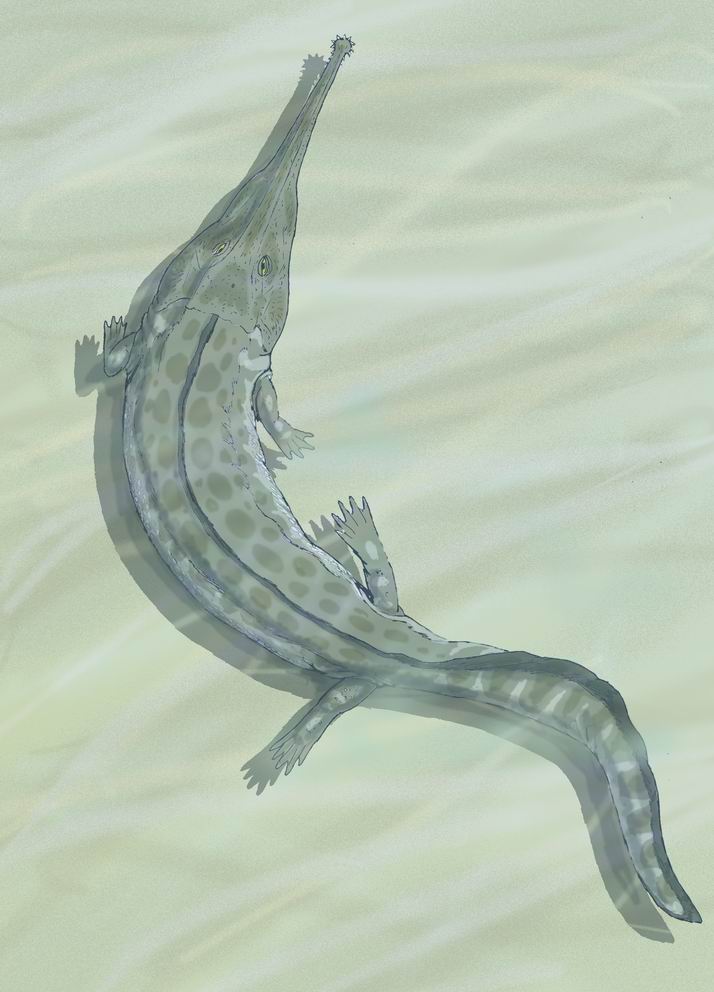
The largest of all temnospondyls lived during this era. Prionosuchus, discovered in what is now Brazil, is estimated to have reached lengths of up to nine meters, making it one of the largest amphibians ever to have existed. With its elongated snout filled with conical teeth, Prionosuchus resembled a giant gharial and likely patrolled the rivers and lakes of the Permian as an apex predator, a role that crocodilians would later inherit.
Surviving the Great Dying
The Permian-Triassic extinction event, approximately 252 million years ago, was the most devastating catastrophe in the history of life on Earth. Roughly 90% of all species perished, and the tropical freshwater ecosystems where temnospondyls thrived were completely devastated. Yet several temnospondyl lineages survived. Their ability to endure harsh conditions, enter dormancy during droughts, and recolonize rapidly gave them a crucial advantage in the aftermath.
The post-extinction world offered temnospondyls a brief window of opportunity. With many competitors eliminated, they once again diversified and became the dominant predators in freshwater systems across Pangaea. The Triassic period saw the emergence of some of the most impressive temnospondyls of all time, including the flat-headed Mastodonsaurus, which could reach four meters in length and lurked in the lakes and rivers of what is now Europe.
The Masters of Ambush
Most temnospondyls were ambush predators. Their flattened skulls allowed them to lie almost invisible on the muddy bottoms of lakes and rivers, with only their eyes and nostrils breaking the surface. When prey ventured close, a rapid upward snap of the jaws captured the victim. Many species also possessed sensory canals along the skull, similar to the lateral line system in modern fish, allowing them to detect prey pressure waves even in murky water or total darkness.
The Boomerang Head Mystery
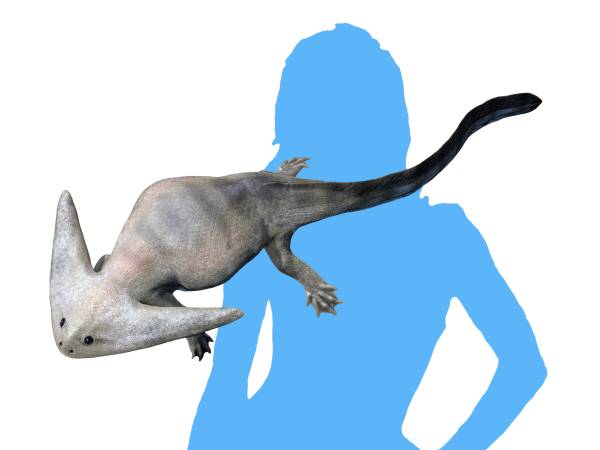
Perhaps the most visually striking temnospondyl was Diplocaulus, an animal whose skull bore dramatic lateral extensions giving it a boomerang-shaped appearance. Living during the Permian, Diplocaulus measured roughly one meter in length and was entirely aquatic. Scientists have long debated the function of those extraordinary skull flaps. Early hypotheses suggested they acted as hydrofoils, generating lift as the animal swam forward to snatch prey from below. More recent studies propose the wide head served as a stability device preventing the animal from being flipped by currents, or as a predator deterrent, making Diplocaulus too wide for many predators to swallow. The truth likely involves all three functions.
The Last Holdouts
As the Triassic gave way to the Jurassic, the rise of dinosaurs and modern crocodilians spelled the end for temnospondyls. Their ecological niches were progressively usurped by these faster reptilian predators. Most temnospondyl lineages disappeared during the Jurassic, their reign finally over after more than 150 million years.
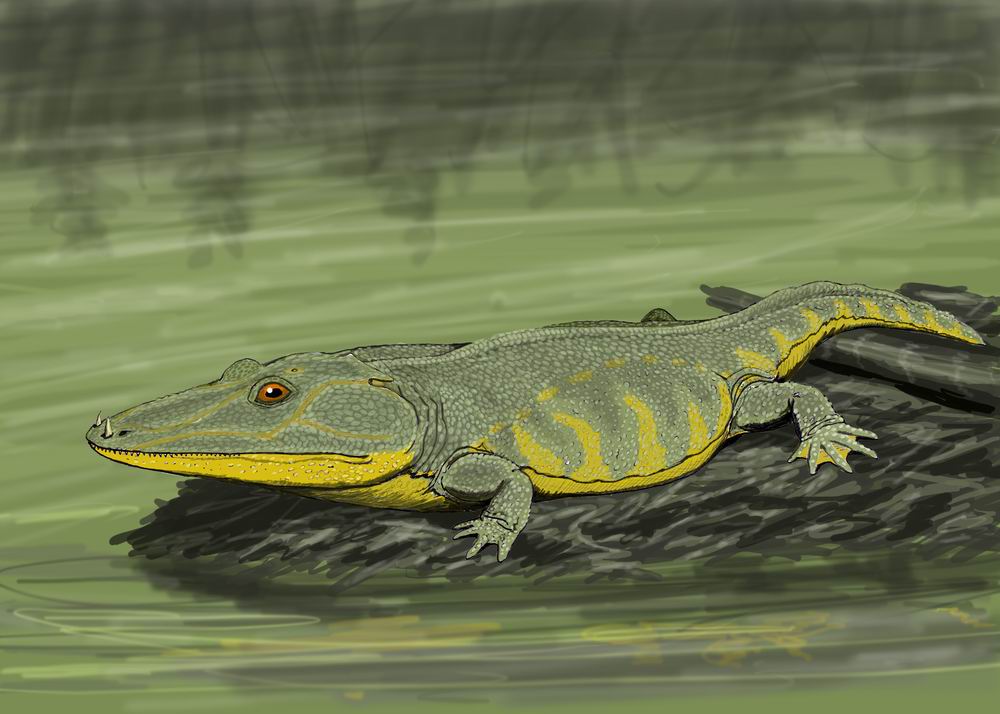
But a few remarkable lineages held on far longer than anyone once expected. In 1997, paleontologists described Koolasuchus, a temnospondyl from the early Cretaceous of Australia. At that time, Australia was still attached to Antarctica and experienced cool, seasonal climates that kept crocodilians at bay. In these chilly rivers, Koolasuchus continued to thrive as an ambush predator, representing the last survivor of a lineage that first appeared in the Carboniferous, some 280 million years earlier.
Legacy and Living Connections
The exact relationship between temnospondyls and modern amphibians remains one of the more contentious topics in vertebrate paleontology. Some researchers propose that frogs, salamanders, and caecilians evolved from within the temnospondyl radiation, from small forms like Doleserpeton and Amphibamus that show features shared with modern amphibians. Others argue for a completely separate origin. Either way, temnospondyls remain central to understanding how amphibian life diversified over deep time.
There is also a deeper connection worth considering. Triops, the tadpole shrimp that has persisted since the Triassic, shared its ancient pools with temnospondyls. Both groups survived the Permian extinction and both are celebrated today as living links to the deep past. While temnospondyls eventually fell to reptilian predators, Triops endured in ephemeral desert pools, outlasting even the dinosaurs. Fossils of temnospondyls have been found on every continent, from Permian beds in South Africa to Cretaceous deposits in Australia. They were the original freshwater giants, and their story deserves to be remembered alongside the more famous inhabitants of prehistoric Earth.