Published 2026-09-28 · by the Triops.me Editorial Team · Back to Articles
Therizinosaurus: The Scythe Lizard with Meter-Long Claws
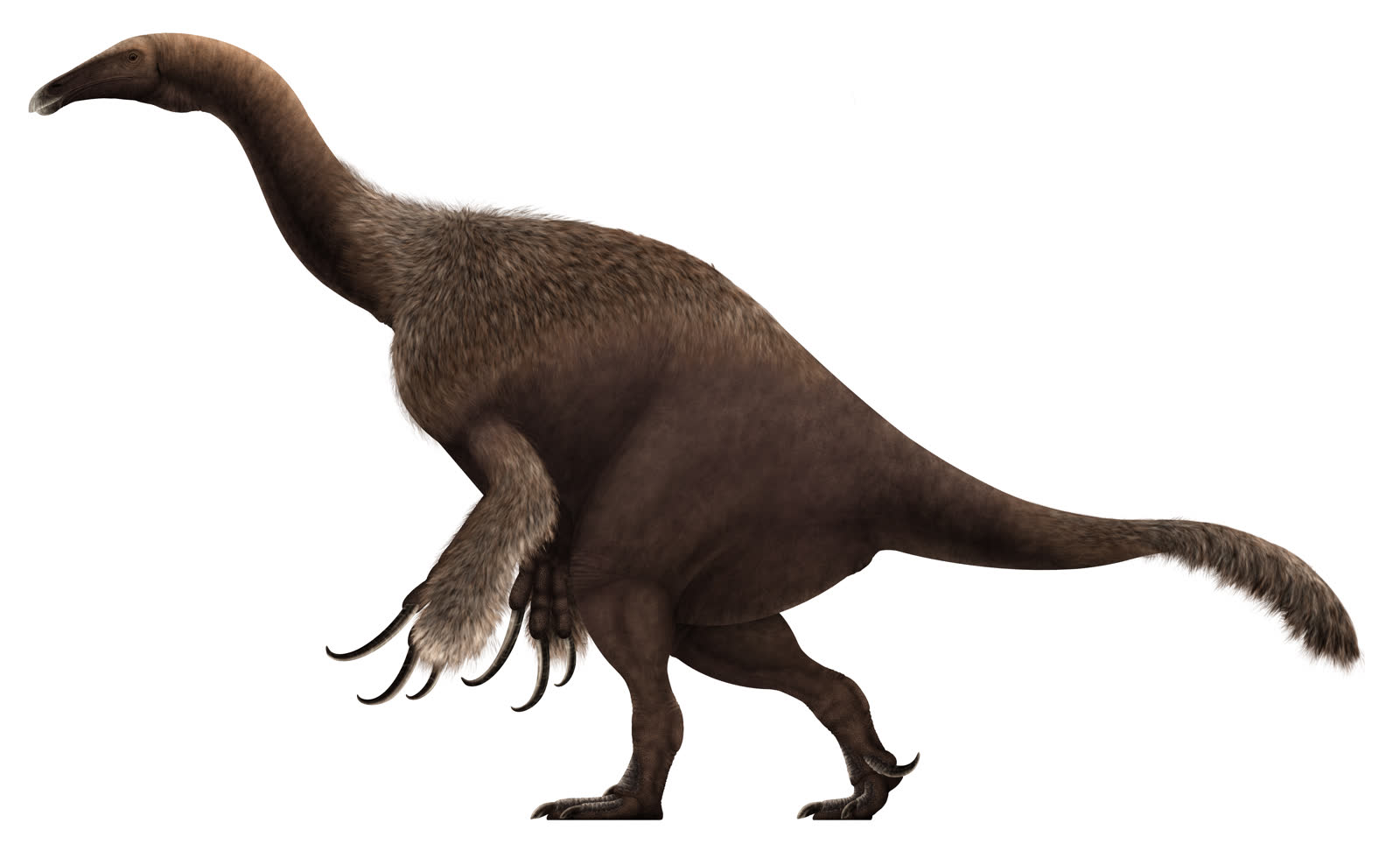
Most famous dinosaurs are famous for their teeth. Therizinosaurus is famous for its hands. Each hand ended in three scythe-shaped claws that reached about a metre in length, the largest claws ever carried by any animal, living or extinct. On an animal that stood taller than a giraffe at the shoulder, the claws hung from arms longer than your entire body.
The name gives the game away: Therizinosaurus means "scythe lizard", from the Greek for reaping and the Latin for lizard. It lived in the floodplains of Late Cretaceous Mongolia, roughly 70 million years ago, sharing its world with the tyrannosaur Tarbosaurus. And for the first sixteen years after its discovery, paleontologists had no idea what it actually was.
A Turtle Made of Claws
In 1954, Soviet paleontologist Evgeny Maleev described three enormous claws dug out of the Nemegt Formation in western Mongolia. He also had a few ribs and what looked like a breastplate. With no skull, no legs and no body to go on, he reached for the nearest fit: a giant turtle. The species name he chose, Therizinosaurus cheloniformis, literally means "turtle-formed scythe lizard".
That left science with a strange ghost, a pile of claws belonging to an animal nobody could picture. It took another two decades, and the discovery of related skeletons such as Segnosaurus from the same region, to reveal the truth. This was no turtle. It was a two-legged theropod, a member of the same broad group as T. rex and the raptors, with a long neck, a small head and hands that made no sense for a hunter.
A Body Built for Leaves
Once enough of the animal was known, the numbers were startling. Therizinosaurus stretched about 9 to 10 metres from nose to tail tip and weighed somewhere around 4 to 5 tonnes, which makes it one of the heaviest theropods that ever lived. Most of that weight sat in a wide, pot-bellied torso, the classic sign of an animal that fermented tough plant matter in a long gut.
The head tells the same story. It was small, perched on a long neck, and carried leaf-shaped teeth with none of the blade edges you would expect in a predator. The jaws were weak, the bite was feeble, and the tail was unusually short for a theropod. Every clue points the same way: this giant spent its life eating plants, browsing leaves and shoots that other animals could not reach.
What Were the Claws For?
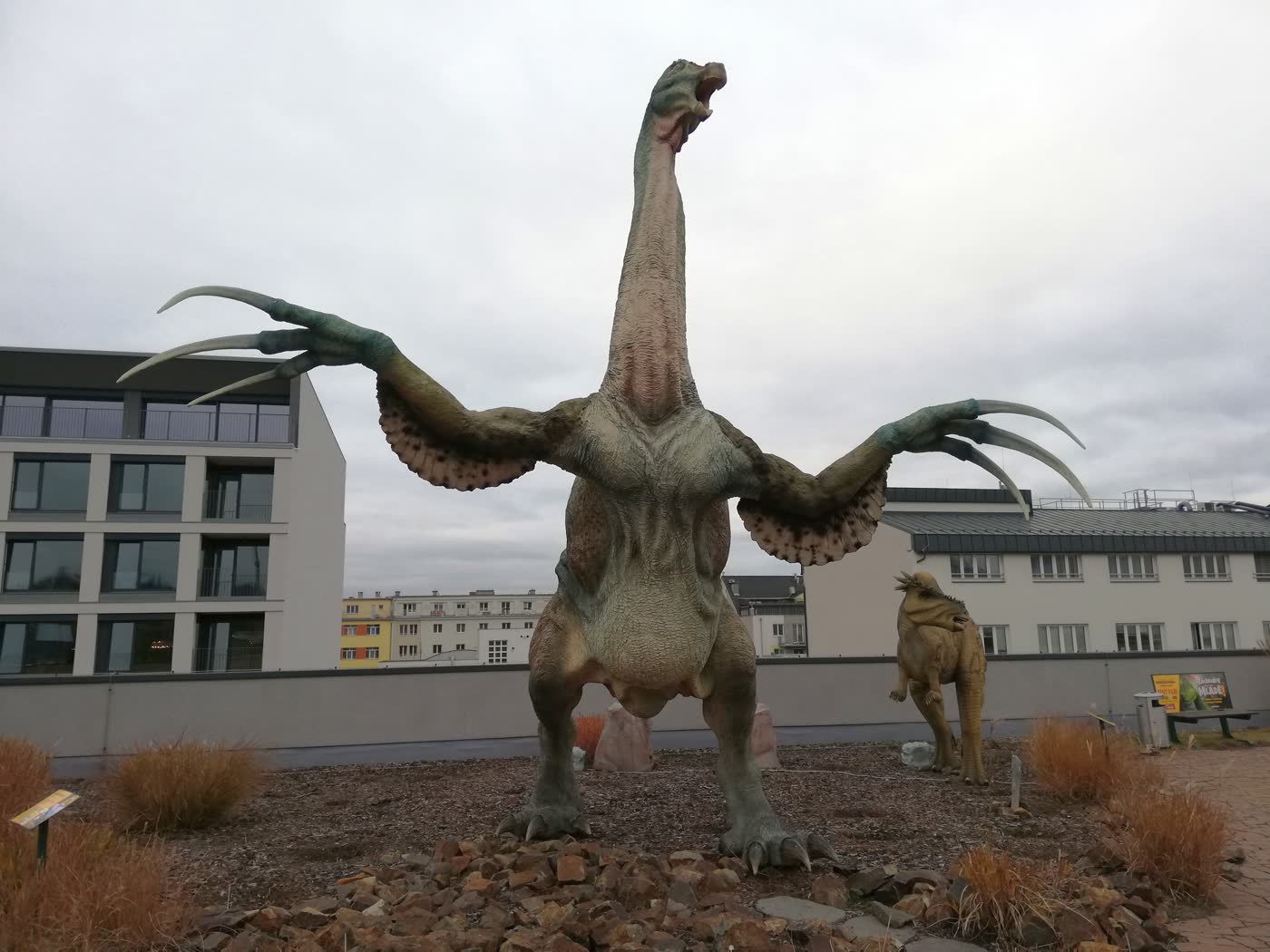
Not for killing, most researchers now think. A curved metre-long claw is a poor weapon for gripping struggling prey, and the teeth were far too soft for the job. Instead the claws likely worked like a combined fishing gaff and rake. Therizinosaurus could hook a branch overhead, drag it down and strip the foliage with its small mouth, much as a giant ground sloth such as Megatherium did millions of years later in South America.
Defence was the other obvious role. A swipe from those arms would have persuaded almost anything to keep its distance, including a young Tarbosaurus. There is even a hint that the claws served as a billboard: in life they would have been sheathed in keratin, making them look even longer, and an animal that rears up and displays four metres of arm span may never have had to fight at all.
A Feathered Giant
Therizinosaurus was not a scaly reptile. It was a maniraptoran, a member of the group that includes birds and their closest dinosaur relatives, and the family tree it sat on was full of feathers. Its smaller cousin Beipiaosaurus, from 125 million year old rocks in Liaoning, China, preserves filaments across its body along with longer display feathers on the arms.
Scale a feathered animal up to five tonnes and you get something paleontologists still argue about: a shaggy, four-metre tall browser that needed insulation for a body that also had to dump heat. Most modern reconstructions give it a coat of hair-like filaments, with banded display feathers on the arms. A decade earlier, museum art showed a bald, scaly lizard the size of a bus.
The Scythe Lizard Family
Therizinosaurus was the extreme member of a whole lineage, the therizinosaurs, that experimented with gigantism and herbivory across Asia and North America for tens of millions of years. Segnosaurus and Erlikosaurus from Mongolia, Nanshiungosaurus from China and the feathered Beipiaosaurus all show the same recipe: shrink the head, lengthen the neck, widen the gut, lengthen the arms.
A striking parallel came from the same Mongolian sands. Deinocheirus, first known only from a pair of 2.4 metre arms discovered in 1965 and described in 1970, turned out to be a hump-backed giant too, though a distant cousin in the ornithomimid branch. Two separate dinosaur lineages stumbled onto the same solution: arms so long that the animal could harvest food no competitor could touch.
Why the Scythe Lizard Matters
Therizinosaurus is a reminder that evolution does not care about our categories. The theropods were supposed to be the hunters, yet from them came browsers, giant pluckers and shaggy long-necked grazers, and eventually birds. It is also a reminder of how provisional dinosaur science is: the animal began life as a turtle, spent years as a set of mystery claws, and now stands as one of the largest, strangest plant-eaters that ever walked the Earth.