Published 2026-09-30 · by the Triops.me Editorial Team · Back to Articles
Thylacoleo: The Marsupial Lion with the Strongest Bite
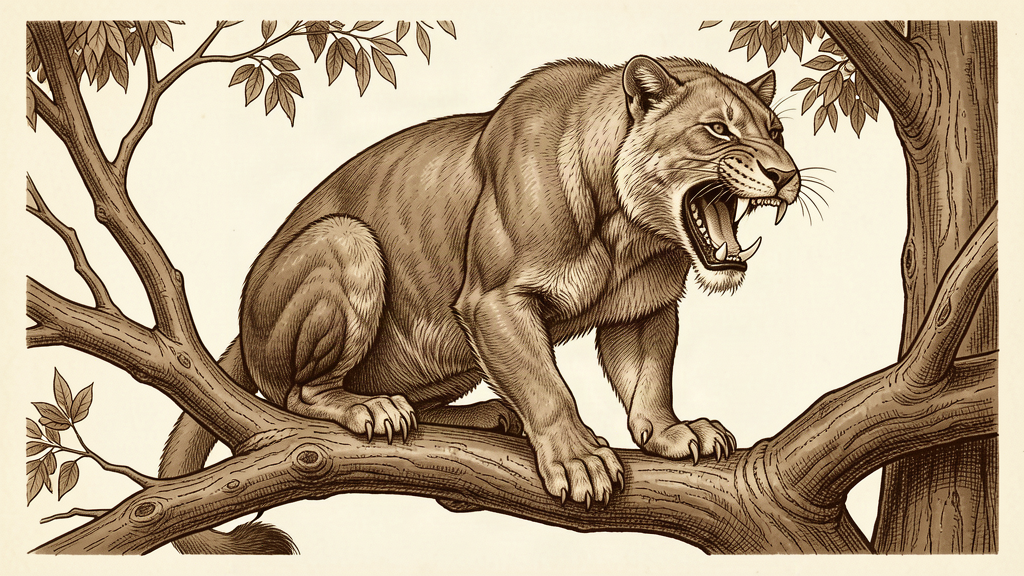
In 1859 Richard Owen, the British anatomist who had invented the word "dinosaur" only seventeen years earlier, published the description of a battered skull and jaw collected in western Victoria. He gave it a name that still carries the shock he intended: Thylacoleo carnifex, the pouch lion and executioner. Owen was certain that no Australian marsupial had ever worn teeth like these, and that whatever wore them was a hunter.
He was right about the hunting, and wrong about almost everything else. Thylacoleo was no lion. It was not related to any cat, it never saw Africa, and its own ancestry was entirely vegetarian. It was also not a side character: for two million years it was the animal that every herbivore in Australia had to watch for, and it held that job until it vanished from the fossil record about 40,000 years ago.
A Lion Built from a Wombat's Line
The family that produced Thylacoleo, the Thylacoleonidae, sits inside the marsupial order Diprotodontia, the same group as kangaroos, possums, koalas and wombats. Detailed skull work placed it with the vombatiforms, the lineage that today survives as four herbivorous species: three wombats and a koala. In other words, the closest living relatives of Australia's greatest predator are animals that graze grass and chew eucalyptus.
That reversal runs deep. The ancestors of the marsupial lions appear to have been plant-eaters themselves, and the family has been traced back about 24 million years to Microleo, a possum-sized animal from the late Oligocene. By the Miocene its descendants had grown to the size of a leopard in the form of Wakaleo. Only in the Pliocene, around two million years ago, did the genus Thylacoleo appear, and only one of its three known species, T. carnifex, grew to full size.
The Argument That Lasted a Century
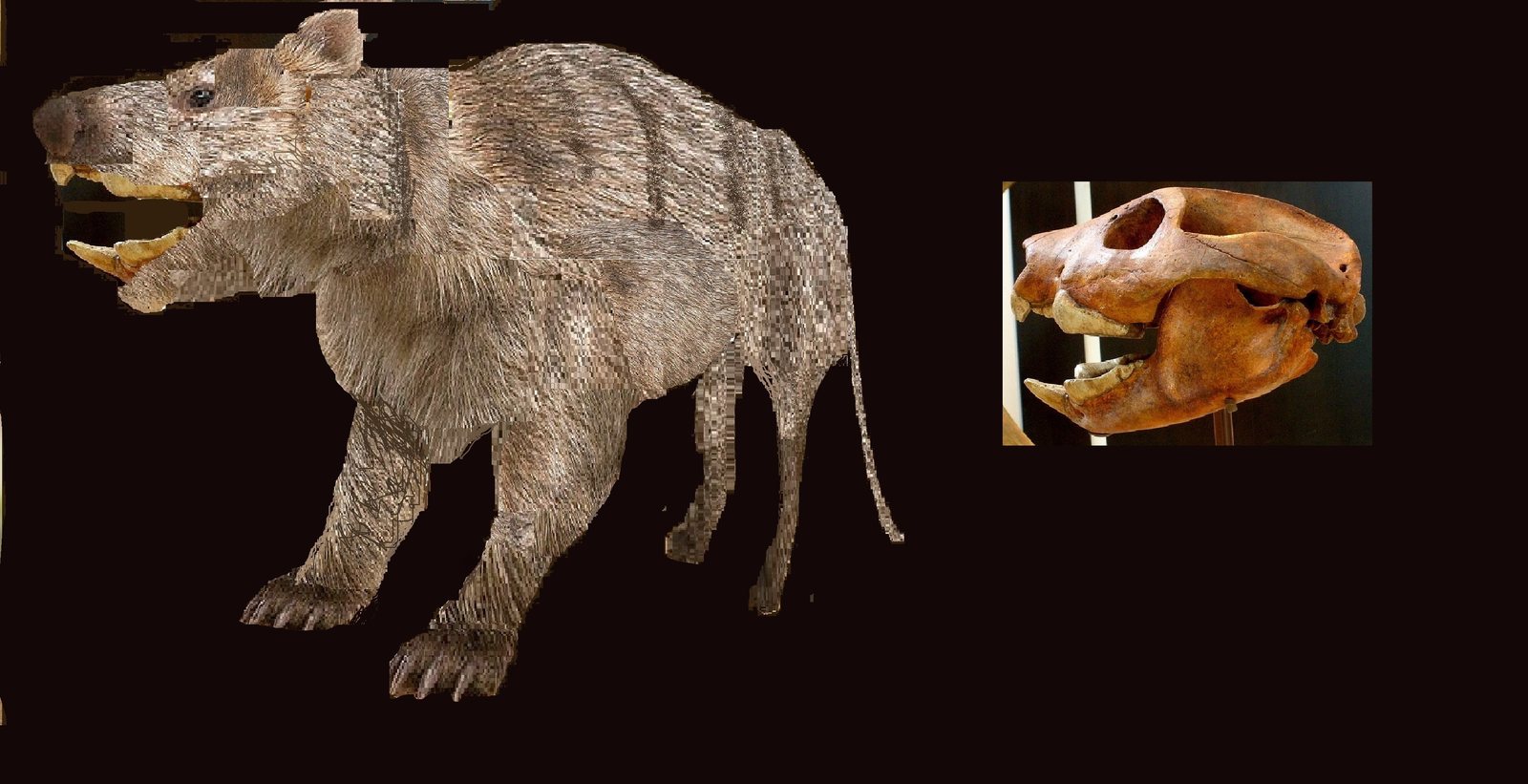
Owen called the animal a carnivore based on the skull. His rival William Henry Flower looked at the same skull, noticed that the teeth were laid out more like a koala's than a cat's, and suggested it was a plant-eater that happened to belong with the diprotodonts. Owen accepted the family placement and refused to give up the meat. The dispute never really closed in his lifetime.
For the next hundred years Thylacoleo was proposed as almost anything. One camp cast it as a scavenger that filled the role hyenas play in Africa. Another argued it specialized in crocodile eggs. A third suggested it ate melons. As late as 1954 researchers were still questioning whether it was a hypercarnivore at all. The tide turned when cut marks on the bones of giant marsupials were matched, side by side on both faces of the bone, to teeth that no human tool could have made. Since then the consensus has been firm: Thylacoleo was a predator, and a strict one.
A Mouth Full of Blades
The mouth is where the animal stops making sense as a marsupial. Instead of the blade-like carnassials that cats and dogs use at the back of the jaw, Thylacoleo carried enormous shearing premolars much further forward, in both the upper and lower jaws. The true canines were stubby and useless. The pair of front incisors was enlarged to do the work of canines, and the molars behind were reduced until almost nothing was left for grinding. There was no surface anywhere in that mouth for processing a leaf.
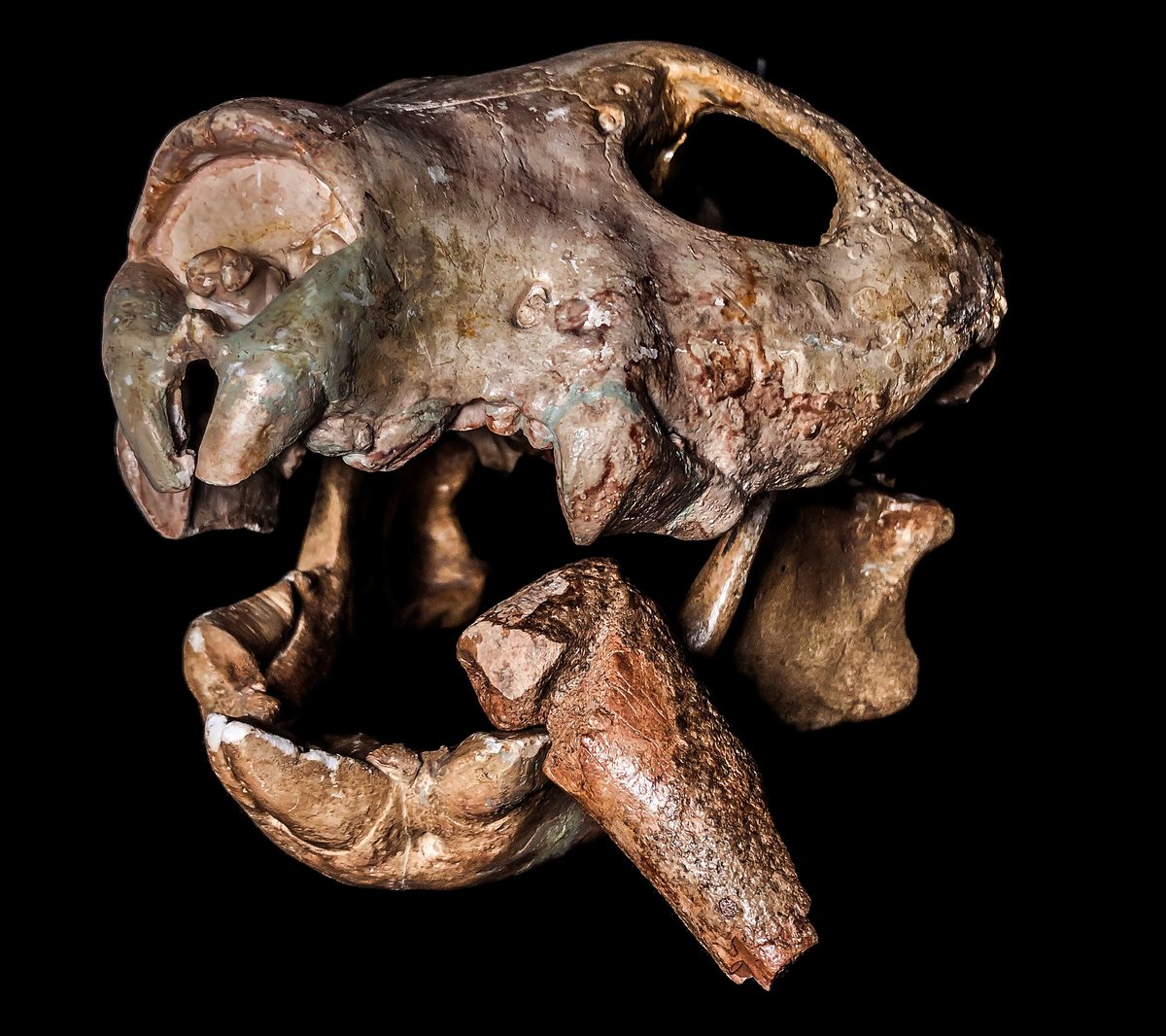
The result was a set of biological secateurs in the front of the skull. Computer modelling of the jaws has ranked Thylacoleo's bite force quotient among the highest ever measured for a mammal, living or extinct. A 101 kilogram marsupial lion packed a bite comparable to that of a 250 kilogram African lion, which is exactly the sort of mismatch that lets a predator take prey much larger than itself. Because the skull could not deliver the slow suffocating throat grip of a big cat, the modelling suggests a different kill: the incisors stab and pierce, then the shearing teeth crush the windpipe and sever the spinal cord and the major vessels of the neck. The trade-off was specialization. A jaw built for big game was clumsy on small animals.
Built for the Ambush
Measurements across many specimens give an average weight of 101 to 130 kilograms, with larger individuals reaching around 160 kilograms, which puts T. carnifex in the size class of a modern lioness. Its limb proportions and the way weight was distributed across its muscles tell us something important though: it was not a fast runner. The picture that has emerged is an ambush hunter that closed the distance with a leap rather than a chase.
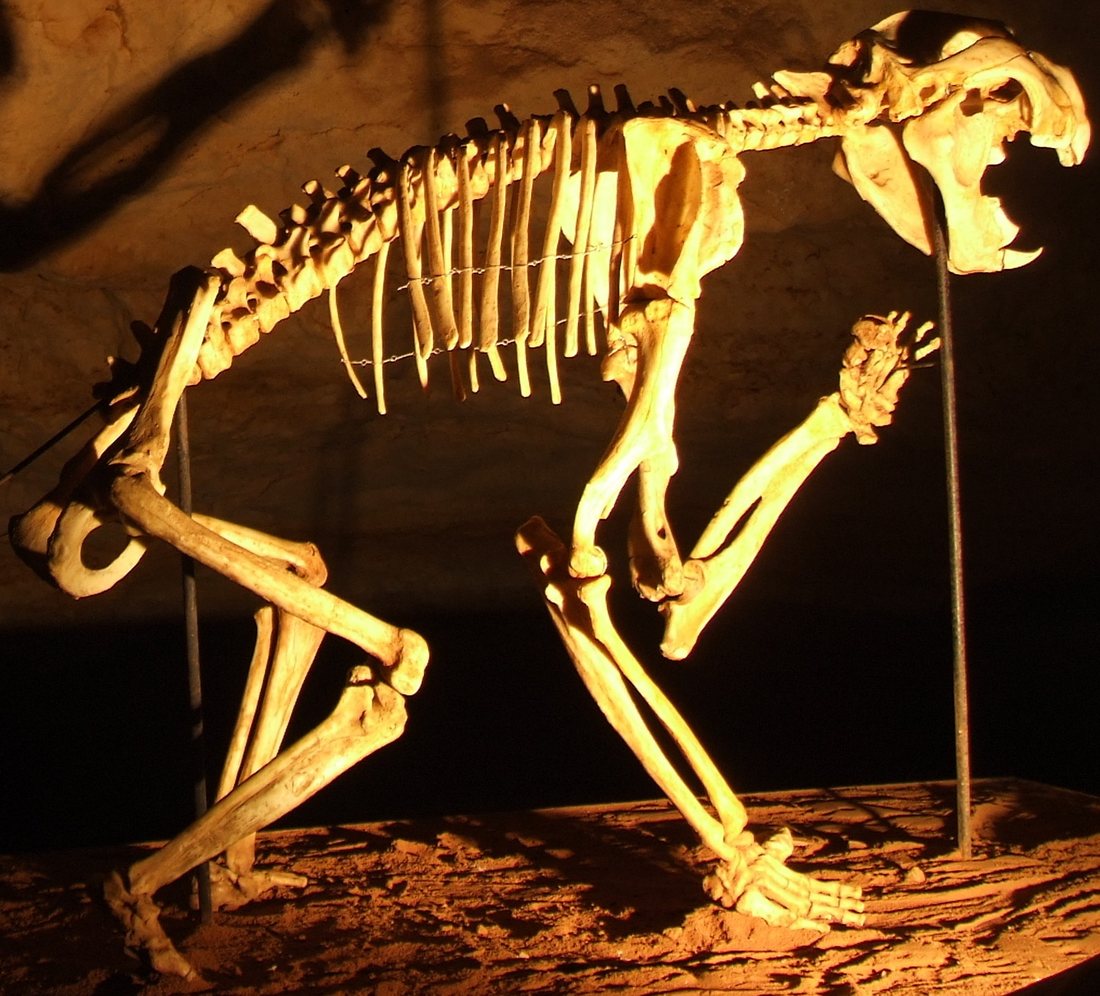
The forelimbs were mobile and heavily muscled, ending in a hand with a single huge hooked claw that could be retracted, set on a semi-opposable thumb. That claw gripped and grappled. The hind feet kept the fused second and third toes that every diprotodont shares, plus a roughened pad like a possum's that would have helped on bark and rock. Reinforced tail bones suggest the animal propped itself up on its tail when rearing, whether to climb or to bring down something large. Claw marks and bones in caves in Western Australia have been read as evidence that marsupial lions climbed rock faces and raised their young in caves, with a high share of juveniles hinting that they did so in groups. Fossils from the Nullarbor Plain point to open, arid country much like the landscape there today.
What Was on the Menu
The menu of the Ice Age included animals that no predator alive has to deal with. Giant short-faced kangaroos such as Sthenurus and Procoptodon, the huge Protemnodon, and Macropus titan all show the kind of slicing damage attributed to those forward shearing teeth. The biggest prize was Diprotodon, a rhinoceros-sized wombat relative and the largest marsupial ever to walk. Marks on kangaroo ribs suggest a feeding strategy more like a cheetah than a hyena: open the chest, reach the organs, move on.
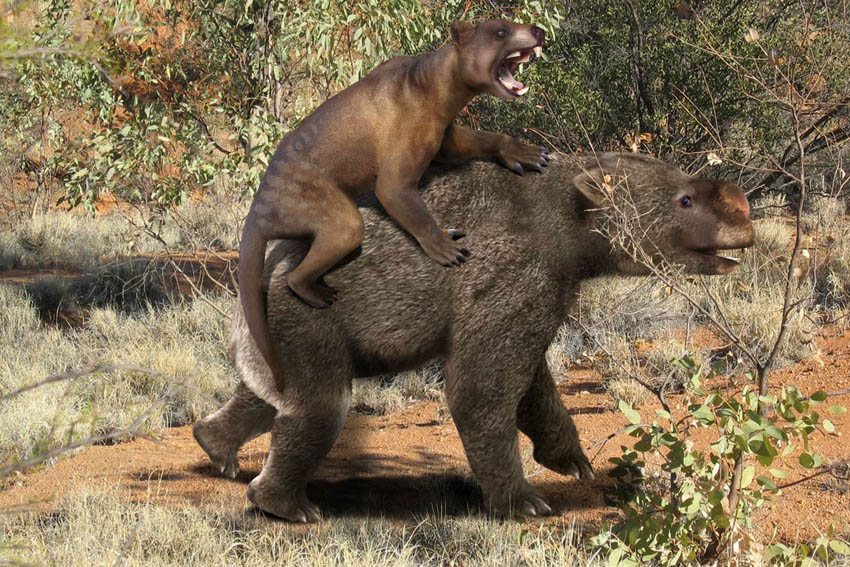
It shared the continent with the thylacine, the striped wolf-like marsupial that survived until 1936, and the two seem not to have competed, because they hunted in different weight classes and ate different things. It also shared Australia with Megalania, a monitor lizard several metres long, which is a reminder that the top of the food chain was crowded.
Painted Before It Vanished
In 2009 researchers published a rock painting from the Kimberley region of Western Australia that they read as a depiction of Thylacoleo carnifex, a portrait made by people whose ancestors had watched the animal alive. Other art from Arnhem Land has been suggested to show a striped coat, which would explain why modern reconstructions often give the marsupial lion bands across the flanks. Both readings are contested, and neither can be proved, but they make a point that no bone can: the animals of Ice Age Australia were watched, and then drawn, by people who knew exactly what they were looking at.
The Last of the Marsupial Lions
Thylacoleo disappears from the record around 40,000 years ago, essentially together with most of the rest of the Australian megafauna. People had reached the continent somewhere between 50,000 and 60,000 years earlier, which makes the timing suspicious, but the evidence for direct conflict between hunters and megafauna in Australia is thin, and the climate of the late Ice Age was shifting as well. Cause of death has never been settled. What is settled is the length of the run: 24 million years of marsupial lions, ending with the largest of them.
The story has an obvious counter-example on this site. Triops rode out five mass extinctions by refusing to specialize, hatching from eggs that wait for the next rain. Thylacoleo did the opposite and bet everything on one jaw, one prey size and one landscape. Specialists win until the world changes.
Image credits: sepia restoration on the server via Wikimedia Commons; skull by David Hocking, Museums Victoria (CC BY 4.0); life model restoration by Sergio Gauci (CC BY-SA 4.0); Naracoorte skeleton by Karora and the Diprotodon scene by Roman Uchytel (public domain).