Published August 13, 2026, 17:38 by the Triops.me Editorial Team · Back to Articles
Triops in Popular Culture: From Ancient Myths to Modern Science Kits
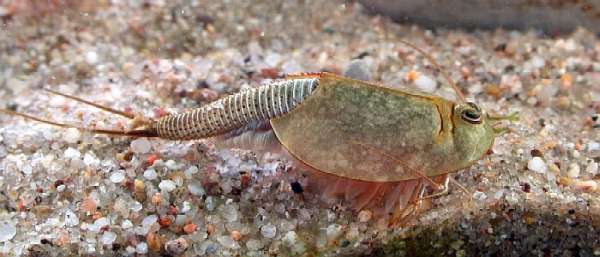
For a creature that has existed for over 200 million years, Triops has had a surprisingly colorful relationship with human culture. From its first scientific description in 18th-century Bavaria to its current status as one of the world's most popular educational science kits, the tadpole shrimp has quietly woven itself into the fabric of popular imagination across continents and centuries.
The Three-Eyed Stranger: First Encounters with Science
The story of Triops in human culture begins not with myths, but with curiosity. In the 1750s, German naturalist Jacob Christian Schaffer obtained specimens from pools near Regensburg, Bavaria. Half a century later, in 1803, Franz von Paula Schrank formally named the genus "Triops" from the Ancient Greek words for "three" and "eye," a reference to the creature's most striking anatomical feature: the naupliar ocellus, a simple third eye sitting between the two compound eyes.
For most of the 19th and early 20th centuries, Triops remained a footnote in natural history texts, known primarily to freshwater biologists and taxonomy enthusiasts. The German name "Dreyauge" (three-eye) captured the creature's eerie quality, but Triops did not yet capture the public imagination. That would change dramatically in the second half of the 20th century.
Japan's Red Shield Shrimp: A Cultural Staple
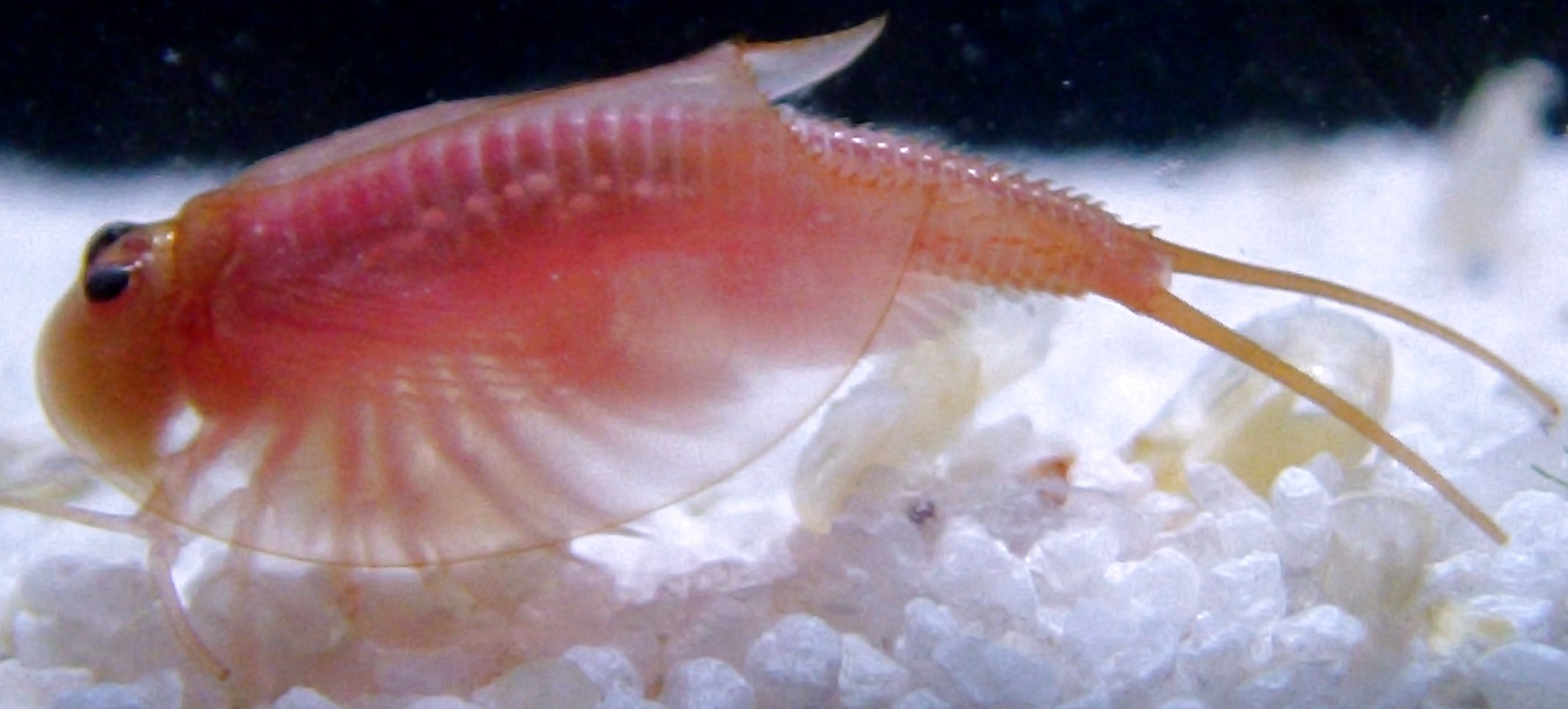
While Triops remained obscure in the West, it was building a devoted following in Japan, where it is known as "kabuto ebi" (盔虾, helmet shrimp) because its rounded carapace resembles a samurai's kabuto helmet. Japanese farmers had known Triops for centuries. In rice paddies across the country, Triops longicaudatus served as a natural form of pest control, consuming weed seeds and insect larvae that threatened young rice plants.
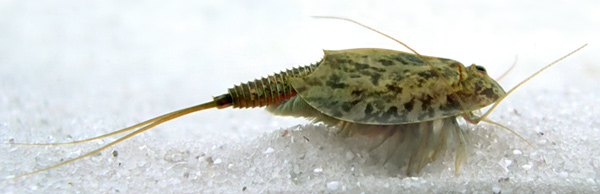
But the real cultural breakthrough came with the albino variant of Triops cancriformis, known in Japan as "Beni-Kabuto Ebi" (紅カブトエビ, red helmet shrimp). This mutation produces a striking translucent creature with a pinkish-white carapace, and it became prized not just for its agricultural utility but for its unusual beauty. Japanese breeders developed careful selection lines for the albino trait, and the Beni-Kabuto Ebi became a minor cultural icon, appearing in nature documentaries and regional folklore.
Today, Triops are a staple of Japanese elementary school science education. Many Japanese children grow up hatching Triops eggs as their first hands-on biology experiment, a tradition that predates the Western science kit boom by decades.
The Science Kit Revolution
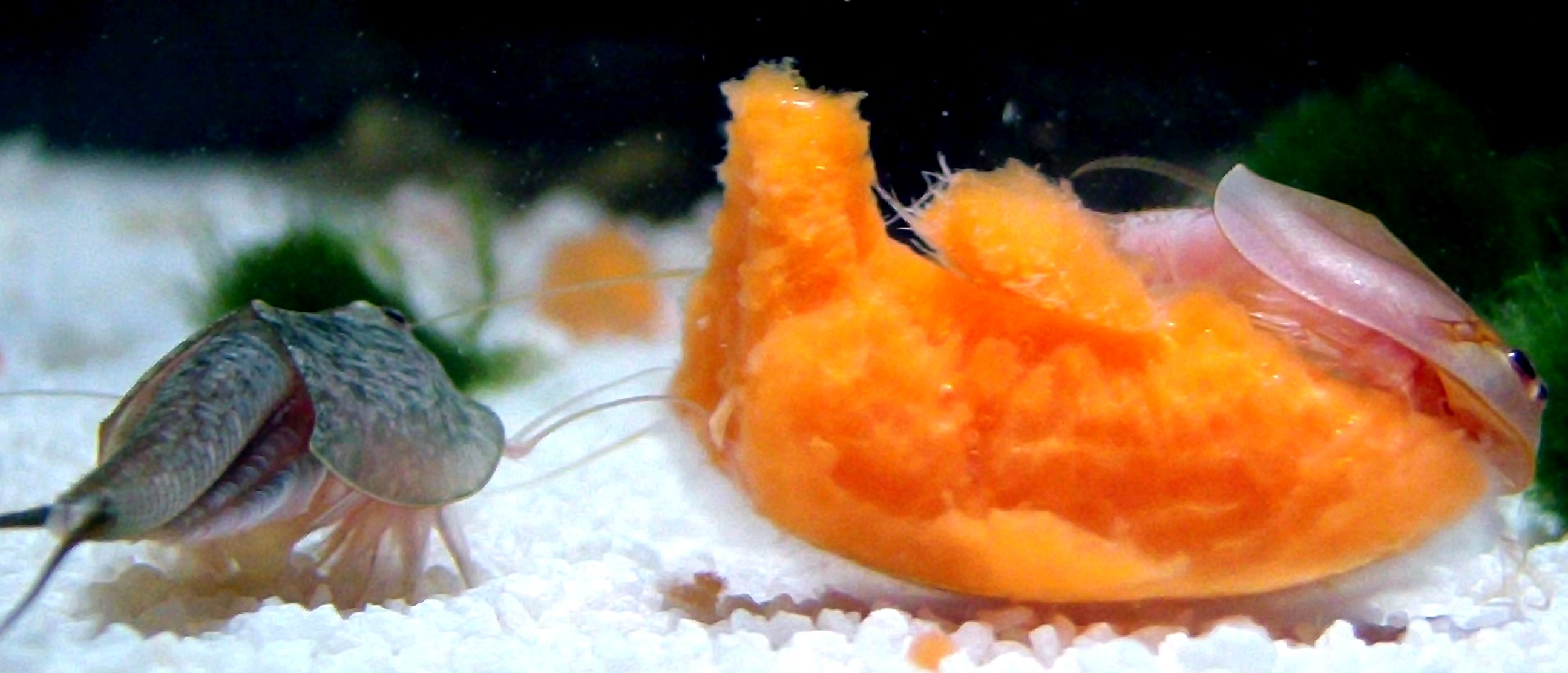
The transformation of Triops from laboratory specimen to household pet happened through an unlikely vehicle: the science kit. Beginning in the 1980s and accelerating through the 1990s, companies in Germany, Japan, and eventually the United States began packaging dried Triops eggs in small plastic containers with gravel, food, and simple instructions. The promise was irresistible: add water, and within 24 hours you would have living prehistoric creatures swimming in your living room.
Several brands emerged to dominate the market. In Germany, where Triops had always been better known, the brand "Triops" became nearly generic, much like how "Kleenex" came to mean any facial tissue. In the United States, competing brands marketed the same basic product under names like "Aquasaurs," "Trigons," and "Dino Shrimp," all emphasizing the prehistoric angle. The scientific name Triops longicaudatus was sometimes replaced with catchier marketing names, but the core appeal remained the same: instant, living history in a fishbowl.
What made Triops perfect for science kits was their biology itself. The eggs could survive years of complete desiccation, making them easy to ship and store. They hatched rapidly, often within 24 hours of contact with water. They grew fast, reaching adulthood in just two to three weeks. And they died relatively quickly, usually within 60 to 90 days, which meant the experiment had a natural beginning, middle, and end. For parents and teachers, Triops offered a complete life cycle lesson in a single affordable package.
The science kit market boomed in the early 2000s and has remained strong ever since. A quick search on Amazon reveals dozens of Triops kits at price points ranging from ten to thirty dollars, with brands like "Jurassic Pets," "Science4you," and "Gigantic Triops" competing for the attention of curious children and their gift-buying relatives.
Triops in Video Games and Media
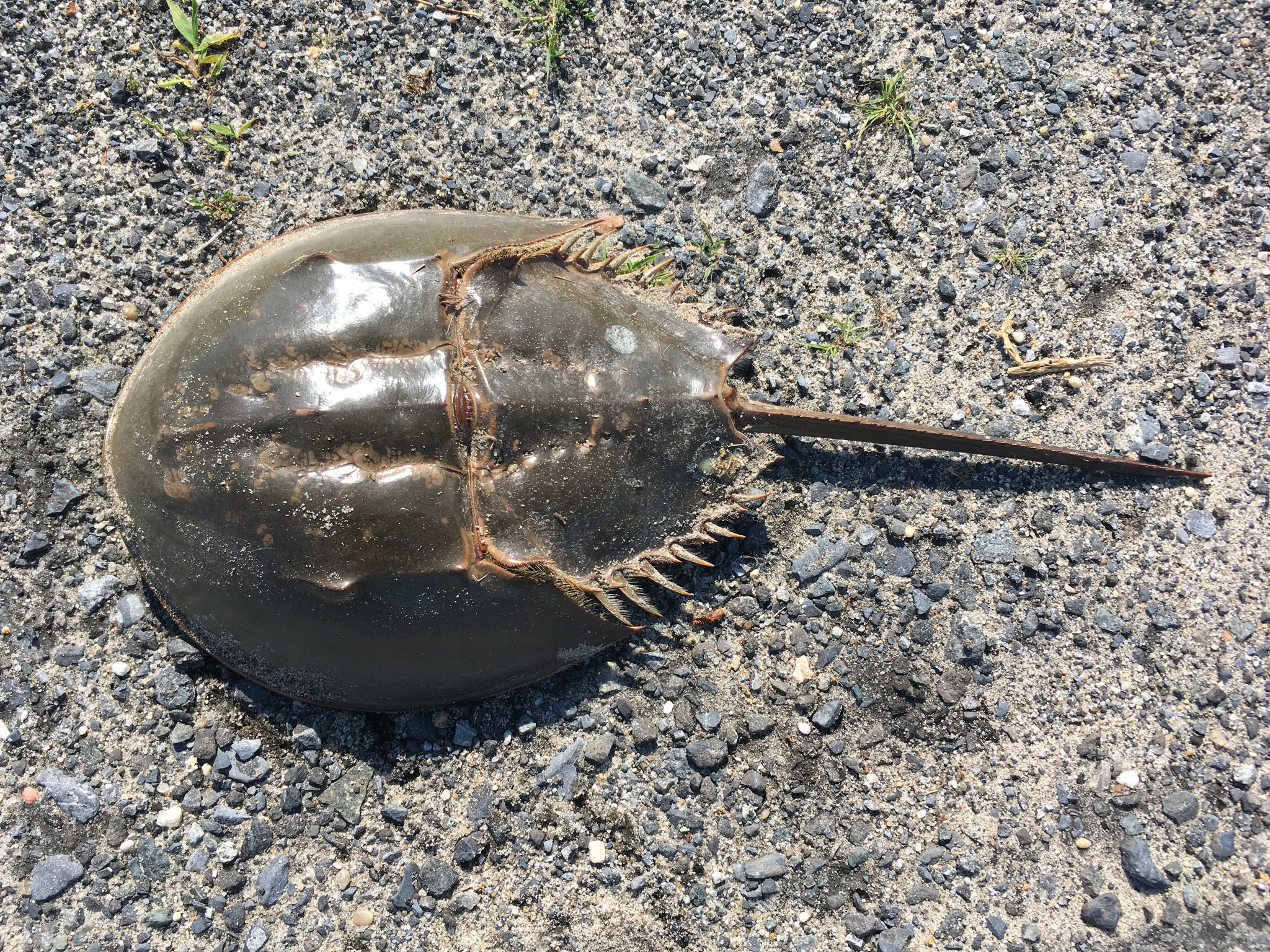
The distinctive shape of Triops, with its broad shield-like carapace and forked tail, has inspired several appearances in video games and media. The most famous example is Kabuto and its evolution Kabutops from the Pokemon franchise. Kabuto, introduced in the original Pokemon Red and Blue games in 1996, is a fossil Pokemon whose design draws directly from Triops and horseshoe crabs. The name "Kabuto" is the Japanese word for samurai helmet, mirroring the real-world connection between Triops and Japanese kabuto ebi culture. Kabutops, the evolved form, adds scythe-like claws and a more predatory posture, but the basic body plan remains recognizably Triops-inspired.
In the creature-simulation game Spore, players can create organisms inspired by Triops and other branchiopods, using the game's flexible body-part system to build shield-backed arthropods that inhabit tide pools and shallow waters. The game's community has produced countless Triops-inspired creations, celebrating the creature's alien-yet-familiar body plan.
More broadly, Triops have found a niche in YouTube and social media culture. Hatching videos, where users document the process from adding water to watching nauplii emerge, regularly attract millions of views. Channels dedicated to raising exotic pets have featured Triops as a gateway species, introducing millions of viewers to the concept of living fossils. The visual appeal is undeniable: tiny, translucent creatures with three visible eyes, darting around a tank, growing visibly larger each day.
The Online Community
Beyond the mainstream kit market, a passionate online community of Triops enthusiasts has developed over the past two decades. Forums, Facebook groups, and Discord servers dedicated to Triops breeding bring together hobbyists from dozens of countries. These communities share tips on water quality, feeding regimes, and breeding techniques, and they maintain gene pools of various species that might otherwise be difficult to obtain.
One of the most active areas of community interest is selective breeding. Just as dog breeders have created hundreds of varieties from wolf ancestors, Triops breeders have developed lines with unusual color patterns, sizes, and carapace shapes. The albino Beni-Kabuto Ebi, once confined to Japanese rice paddies, is now bred by hobbyists worldwide. Some breeders have even developed semi-transparent varieties that reveal internal organs, creating living anatomy demonstrations.
The community also serves as an informal conservation network. Many Triops species inhabit threatened vernal pool ecosystems, and hobbyists who maintain captive populations preserve genetic diversity that might otherwise be lost as development and agriculture eliminate temporary pools from the landscape.
Scientific Illustration: A Visual Legacy
Triops has a rich history in scientific illustration that stretches back to the earliest natural history drawings. The creature's unusual morphology, with its flattened carapace, segmented body, and multiple pairs of leaf-like legs, made it a favorite subject for anatomical illustrators. Early drawings from the 18th and 19th centuries show meticulous attention to the arrangement of appendages, the structure of the naupliar eye, and the details of the telson.
Modern photography has largely replaced hand-drawn illustration, but Triops remains a popular subject for macro photographers. The creature's translucence, the visible beating of its heart through the carapace, and the rhythmic motion of its dozens of swimming legs make for compelling close-up images. Some of the most widely shared nature photographs of Triops come from amateur photographers who keep them as pets, blurring the line between hobby and scientific documentation.
Why Triops Captures the Imagination
There is something deeply appealing about Triops that transcends its modest size and brief lifespan. The creature is a living bridge to deep time, an organism that has watched dinosaurs rise and fall, ice ages come and go, and continents drift apart, all while keeping essentially the same body plan. In an era of rapid environmental change, Triops represents resilience, adaptability, and the quiet persistence of life.
For children, Triops offers something rare in modern education: a genuine, hands-on encounter with a living fossil. Watching a creature hatch from an egg that may have been dormant for years, seeing it grow from a microscopic nauplius to a fully formed adult in just weeks, and understanding that this same process has been playing out in temporary pools for millions of years, is a powerful lesson in both biology and time.
For adults, Triops offers something different but equally valuable: a reminder that the most extraordinary things are often the most overlooked. Hidden in muddy puddles and roadside ditches, Triops has survived every mass extinction event of the past 200 million years without ever making headlines. Its journey from obscurity to science kit stardom is, in its own quiet way, one of the great cultural comebacks in natural history.