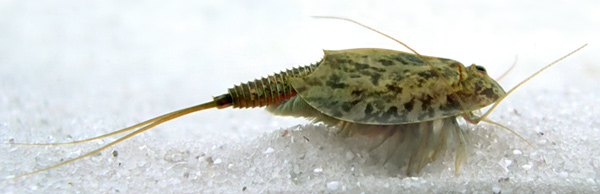
When people think of Triops, they usually picture a single type of creature: a small, three-eyed crustacean with a horseshoe-shaped shell, paddling around in a puddle. But the genus Triops is far more diverse than most people realize. Across the world, at least 30 recognized species of Triops inhabit temporary freshwater pools, rice paddies, and desert playas. Each species has adapted to its local environment in subtle but fascinating ways. If you have ever hatched a Triops kit or studied them in a classroom, there is a good chance you were working with one of just a few common species. Here is how the major Triops species compare, and what makes each one unique.
Triops cancriformis: The European Classic
Triops cancriformis is the species most closely tied to the living fossil narrative. Found across Europe, parts of Africa, and western Asia, this is the species whose fossils from the Triassic period, over 220 million years ago, look almost identical to living specimens. Adults typically reach 5 to 7 centimeters, with a broad, rounded carapace that ranges from olive green to dark brown. T. cancriformis prefers cooler, Mediterranean climates and is commonly found in temporary pools across Spain, Italy, Germany, and the British Isles. Hobbyists who purchase European Triops kits are almost always receiving T. cancriformis eggs.
What sets cancriformis apart is its remarkable genetic stability. Population studies across Europe have shown extremely low genetic diversity between distant populations, suggesting this species survived multiple ice ages without significant speciation. It is the "type species" of the entire genus, the one against which all others are measured.
Triops longicaudatus: The Americas' Most Common Triops
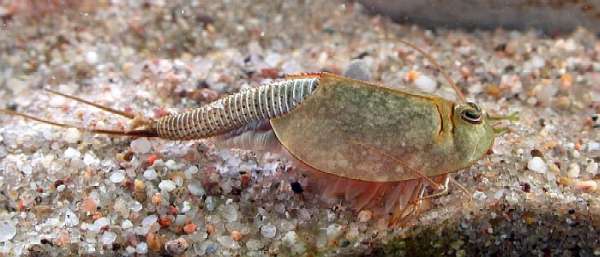
Triops longicaudatus is the dominant species across North and South America. As its name suggests (longicaudatus means "long-tailed"), this species is distinguished by a notably elongated telson, the forked tail structure that extends well beyond the carapace. Adults generally measure 4 to 7 centimeters, with the tail accounting for a significant portion of total body length. The carapace is slightly narrower and more pointed than that of cancriformis, giving the animal a more streamlined appearance.
T. longicaudatus thrives in a wide range of habitats, from temporary desert pools in the American Southwest to agricultural rice fields in Brazil. This species is particularly tolerant of warm water temperatures and can complete its life cycle in pools that exist for just a few weeks. It is the species most commonly sold in North American Triops kits, and it is the one most often used in classroom science projects. The eggs of T. longicaudatus are notoriously hardy and can remain viable in dry soil for well over a decade.
One key behavioral difference: T. longicaudatus tends to be more active and aggressive than cancriformis. In mixed-species tanks (not recommended), the American species will often outcompete and even prey upon the European one. This higher activity level also makes longicaudatus a more entertaining pet for hobbyists who enjoy watching their Triops dart around the tank.
Triops australiensis: Australia's Desert Survivor
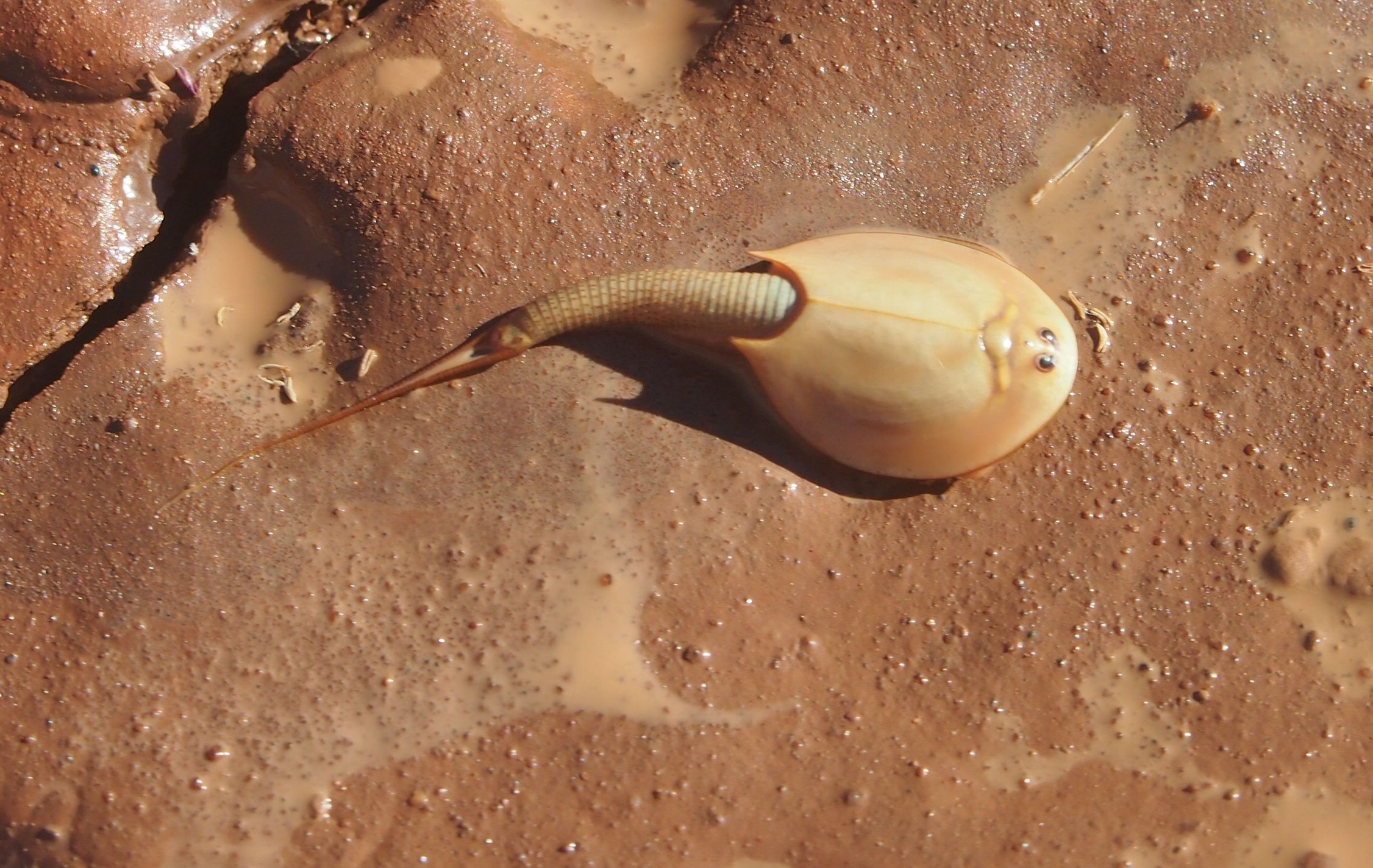
Endemic to Australia, Triops australiensis has adapted to some of the harshest freshwater environments on the planet. The Australian outback experiences extreme temperature swings, with summer temperatures exceeding 45 degrees Celsius and nighttime temperatures sometimes dropping below freezing in winter. T. australiensis eggs are among the most desiccation-resistant of any Triops species, capable of surviving years of complete drought in baked clay soils.
Adults of this species are generally smaller than their Northern Hemisphere counterparts, typically reaching 3 to 5 centimeters. The carapace tends to be lighter in color, often a sandy tan or pale green, which may provide camouflage against the light-colored soils of inland Australia. T. australiensis is found across a vast range of the continent, from tropical northern Queensland to the arid interior of Western Australia and South Australia. After heavy rains, these creatures can appear almost overnight in enormous numbers in ephemeral desert lakes, completing their entire life cycle in just a few weeks before the water disappears again.
Lesser-Known Species: The Rest of the Genus
Beyond the big three, the genus Triops includes several other noteworthy species. Triops mauritanicus, found in North Africa, was only recently recognized as distinct from cancriformis. Triops granarius, found across parts of Africa and Asia, is adapted to tropical monsoon climates and tends to have a more elongated body. Triops kanivok, described from Madagascar, is one of the more geographically isolated species and is still being studied by taxonomists.
There is also the closely related genus Lepidurus, which some scientists once grouped within Triops but is now considered a separate lineage. Lepidurus species, such as Lepidurus apus, can be distinguished by their broader, paddle-shaped tail forks compared to the slender, hair-like forks of Triops.
The taxonomy of Triops remains a subject of active debate. Some researchers argue that many named species are simply regional variants of a single, highly plastic species. DNA sequencing studies are helping to resolve these questions, but the picture is complicated by the fact that Triops eggs can travel long distances via wind and water, blurring the lines between populations.
How to Tell Species Apart
For hobbyists and casual observers, distinguishing Triops species comes down to a few key features. Carapace shape is the first clue: cancriformis has the broadest, most rounded shell, while longicaudatus has a narrower, more triangular profile. Tail length is another useful marker, with longicaudatus living up to its name. Geographic origin is often the easiest indicator: European supplier means cancriformis, American supplier means longicaudatus, and Australian supplier means australiensis.
For a closer look at Triops biology, visit our Full Triops Guide. To explore other prehistoric creatures, check out the Creature Gallery.
Why Species Diversity Matters
Understanding Triops species diversity is not just an academic exercise. Different species have different tolerances for temperature, salinity, and drought duration, which has implications for conservation biology, agricultural pest management, and even astrobiology. Scientists studying Triops eggs as potential analogs for life on Mars need to know which species' eggs are most resistant to extreme conditions. Agricultural researchers looking at Triops as natural mosquito control agents need to know which species are most effective in tropical rice paddies.
For 220 million years, the genus Triops has quietly diversified across every continent except Antarctica. The fact that all these species still look so similar on the surface masks a deep history of adaptation and survival. Next time you see a Triops in a pool, take a closer look. It might be a species with a story 200 million years in the making.