Published August 11, 2026 by the Triops.me Editorial Team · Back to Articles
Why Triops Have Three Eyes
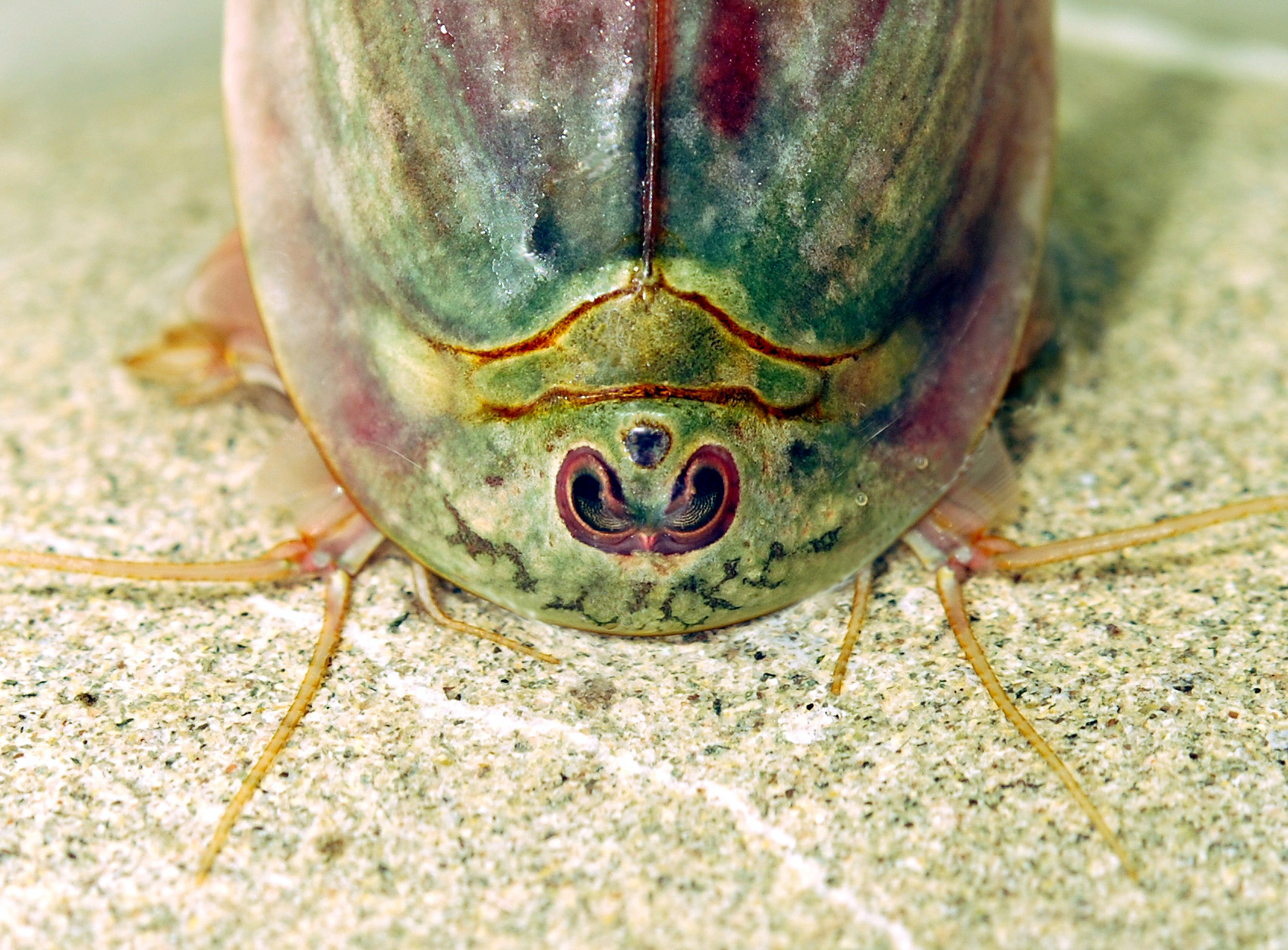
If you have ever looked closely at a Triops, you may have noticed something unusual sitting right between its two large, dark compound eyes. A small, round dot, almost like a tiny jewel embedded in the center of its shield-like carapace. That is the third eye, and it is the reason this creature carries a name that literally translates to "three-eyed one" from Latin and Greek.
But why would a crustacean need three eyes? The answer takes us back hundreds of millions of years, into the early stages of crustacean evolution, and into the strange physics of temporary pools where Triops live and die in a single season.
The Name Says It All
The genus name Triops is a straightforward blend of Latin tri (three) and Greek ops (eye). Taxonomists who first described these animals in the 18th and 19th centuries were clearly struck by the three ocular structures visible on the head. Unlike most crustaceans, which shed their larval features as they grow, Triops kept all three eyes from birth to death.
Two of the eyes are compound eyes, the large dark spheres you can see with the naked eye on either side of the head. These work much like the compound eyes of insects, built from hundreds of tiny lenses called ommatidia. They give Triops decent vision for a freshwater invertebrate, enough to detect movement, navigate around obstacles, and spot predators.
The third eye is something different entirely.
The Naupliar Eye: A Larva That Never Grew Up
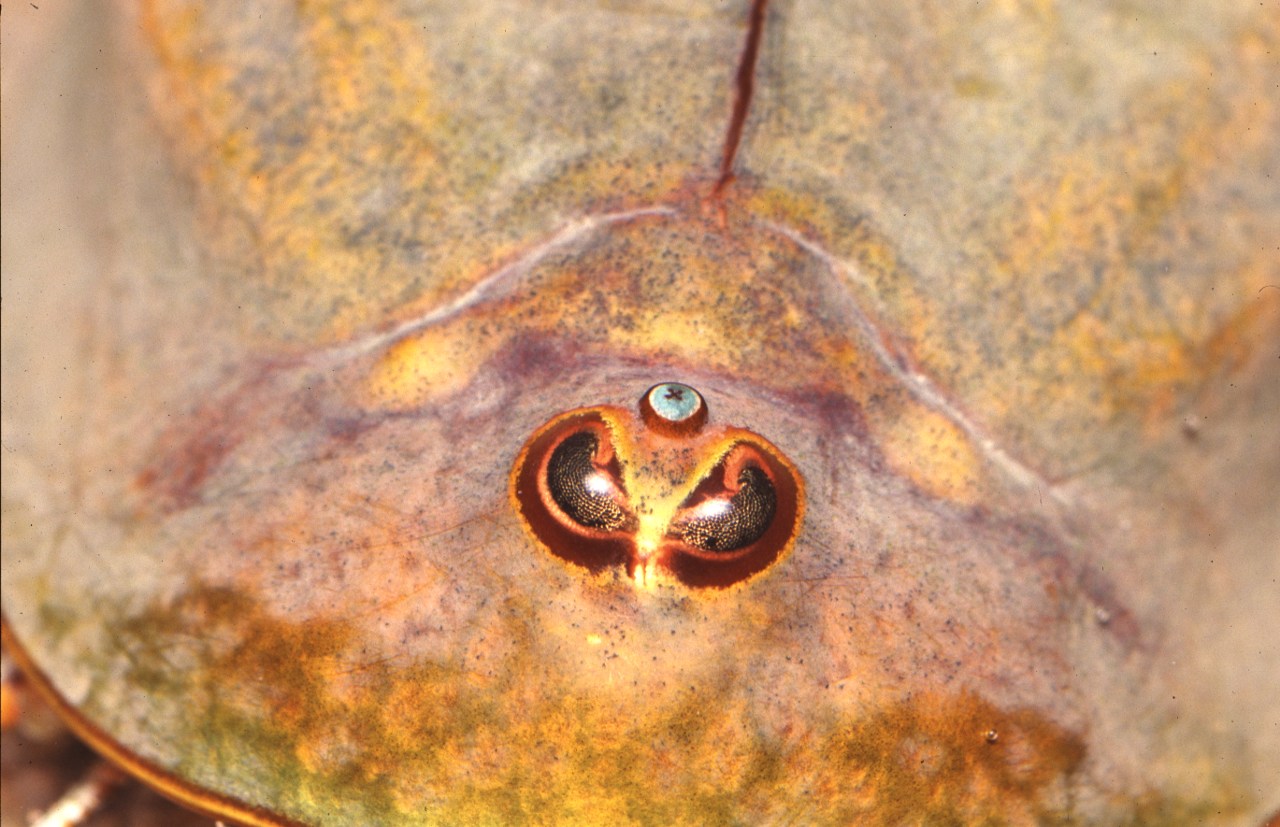
The third eye is called the naupliar eye, or sometimes the nauplius eye. Its name comes from the nauplius, the first larval stage of most crustaceans. When a shrimp, crab, or lobster hatches, it starts life as a tiny nauplius with a single simple eye sitting on top of its head. This eye has no lenses, no ommatidia, nothing complex. It is a basic photoreceptor, a cluster of light-sensitive cells that can tell the difference between light and dark. That is about it.
In virtually every other crustacean, the naupliar eye disappears as the animal matures. The larva molts, grows, and develops its compound eyes, and the simple larval eye fades away. It is part of normal development, like how human babies lose certain reflexes they had at birth.
Triops never lost theirs. The naupliar eye persists through every molt, every growth stage, every day of the adult animal's roughly 60 to 90 day lifespan. It sits right in the center of the head, between and slightly above the compound eyes, and it never stops functioning.
Scientists who study crustacean neurology, including researchers at the University of Vienna, have mapped the development of this organ in detail. The naupliar eye forms from the neuro-ectoderm of the head in three distinct developmental steps. Unlike the compound eyes, which are connected to the optic lobes and the brain's higher processing centers, the naupliar eye has a simpler neural pathway. It feeds information directly to basic orienting circuits, bypassing the more complex visual processing that the compound eyes use.
What Does It Actually Do?
For a long time, the naupliar eye was assumed to be a simple light detector, a vestigial organ with no particular purpose. That assumption turned out to be wrong. Research by hydrobiologist Dr. Erich Eder, one of the foremost experts on temporary-water crustaceans, revealed that the naupliar eye plays a specific and critical role in the lives of Triops.
Triops live in ephemeral pools, bodies of water that appear after rainfall, last for a few weeks or months, and then dry up completely. The salinity and chemical composition of these pools can change rapidly. A heavy rainstorm can dilute the water dramatically in hours. Evaporation on a hot day can concentrate it just as fast.
For a soft-bodied invertebrate, these changes are dangerous. If the water outside the body becomes much less salty than the body fluids inside, water floods in through the skin by osmosis, and the animal can literally burst. If the water becomes too salty, fluid is pulled out and the animal desiccates from within.
Dr. Eder's research suggests that the naupliar eye, or more precisely the nuchal organ associated with it, monitors the osmotic conditions of the surrounding water and triggers rapid physiological responses. When salinity shifts, the organ detects the change and signals the body to adjust its internal fluid concentration. This allows Triops to survive in pools that would kill most other organisms within hours.
A 1930 study by Rudolf Seifert added another layer. Seifert demonstrated that Triops use light direction for spatial orientation. They position themselves perpendicular to the light source, keeping their backs toward the incoming light. The naupliar eye appears to help calibrate this orientation, acting as a reference point for the light-back reflex that keeps the animal properly aligned in its murky, shallow-water habitat.
Why Keep a Larval Feature?
The evolutionary logic becomes clear when you consider where Triops live. Ephemeral pools are among the most hostile aquatic environments on Earth. They are warm, shallow, oxygen-poor, and their chemistry swings wildly. An animal that lives its entire life, from hatching to reproduction to death, in a few dozen days in such a place needs every survival advantage it can get.
The compound eyes help Triops find food, avoid predators, and navigate the pool. The naupliar eye handles something the compound eyes cannot: monitoring the invisible chemistry of the water. It is not an eye in the way we think of eyes. It is more like a chemical sensor disguised as an eye, a sensory organ that happens to use light-sensitive cells to calibrate osmoregulation rather than to form images.
This dual-purpose design is part of what makes Triops such successful survivors. While other crustaceans lost the naupliar eye because it was no longer useful in their stable marine or freshwater environments, Triops kept it because it was genuinely keeping them alive. In evolutionary terms, there was no reason to discard a feature that was actively contributing to survival.
A Window Into Deep Time
The naupliar eye is also a living fossil in miniature. Every nauplius larva of every crustacean species on Earth still develops this same basic eye structure. It is one of the most ancient sensory organs in the animal kingdom, present in forms that have barely changed since the Cambrian period, over 500 million years ago.
In most species, it is a brief chapter, a larval tool discarded after a few molts. In Triops, it is a permanent feature, a window into what the earliest crustaceans might have looked like when they first crawled through the primordial shallows. When you look at that tiny dot between a Triops' compound eyes, you are looking at one of the oldest continuously functioning sensory structures in the history of animal life on Earth.
It is not a mystical third eye. It is not a sixth sense. It is something arguably more remarkable: a 500-million-year-old technology that still works perfectly, still does its job every day, and has never needed an upgrade.