Published August 11, 2026, 16:55 by the Triops.me Editorial Team · Back to Articles
Triops vs Horseshoe Crabs: Two Ancient Survivors Compared
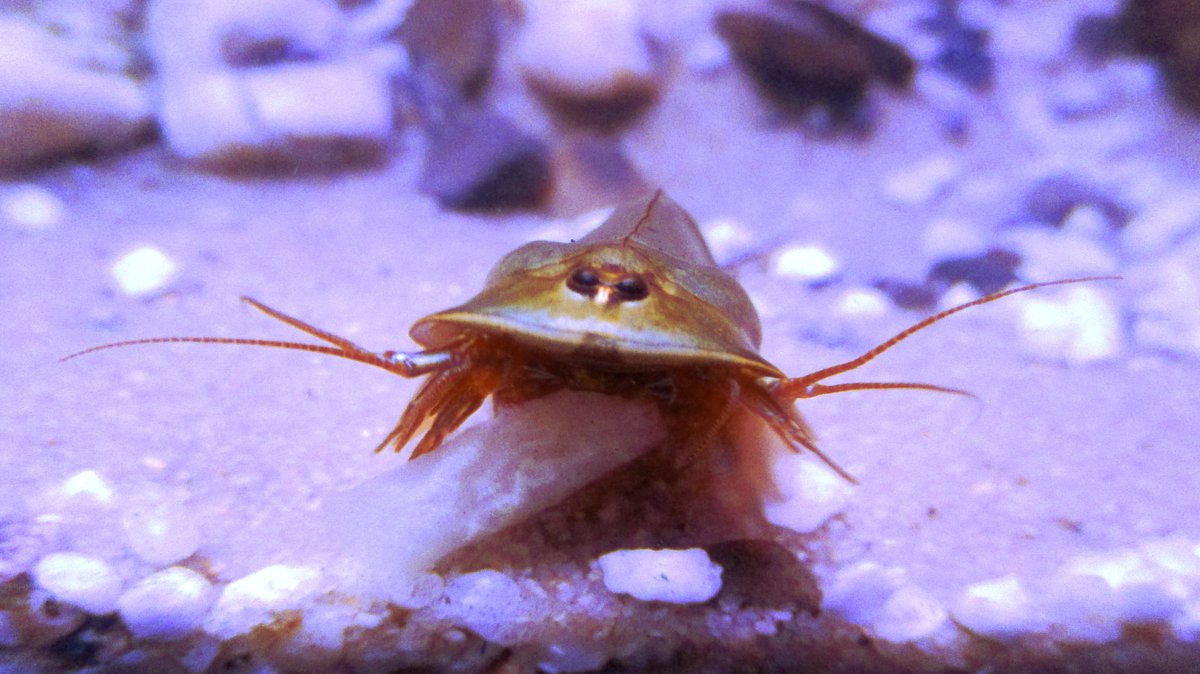
When people hear the phrase "living fossil," two creatures come to mind. The horseshoe crab, with its helmet-like shell and lineage stretching back hundreds of millions of years, is the most famous. But there is another survivor that deserves equal billing: the triops, a small freshwater crustacean that has persisted through mass extinctions with barely a morphological change.
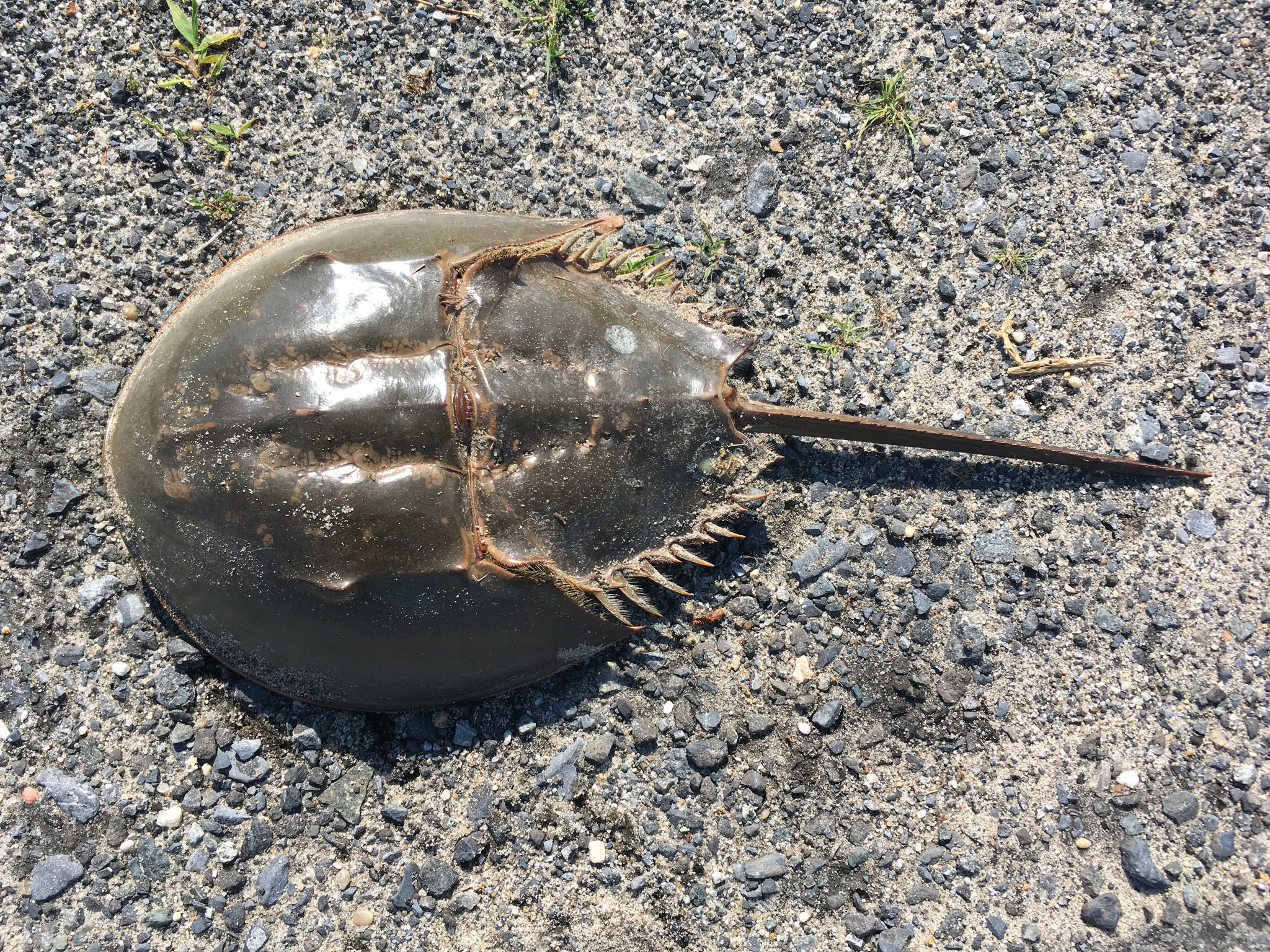
Though they share the title of living fossil, these two animals could not be more different in biology, habitat, and survival strategy.
Family Trees: How Are They Related?
Despite their superficial resemblance, a broad carapace and a tail spine, triops and horseshoe crabs belong to entirely different subphyla of the arthropods. Horseshoe crabs are chelicerates, related to spiders and scorpions, and are the only surviving members of the order Xiphosura. Fossil relatives stretch back 480 million years to the Ordovician, while modern forms appear around 250 million years ago.
Triops are crustaceans in the class Branchiopoda. Their lineage dates to the Triassic period, with fossils of Triops cancriformis found in rocks 220 to 250 million years old. Their broader group, the branchiopods, extends back to the Devonian, over 350 million years ago. Both arrived at their living-fossil status through independent evolutionary paths, their similar body plans shaped by convergent evolution in shallow-water environments.
Scale and Size
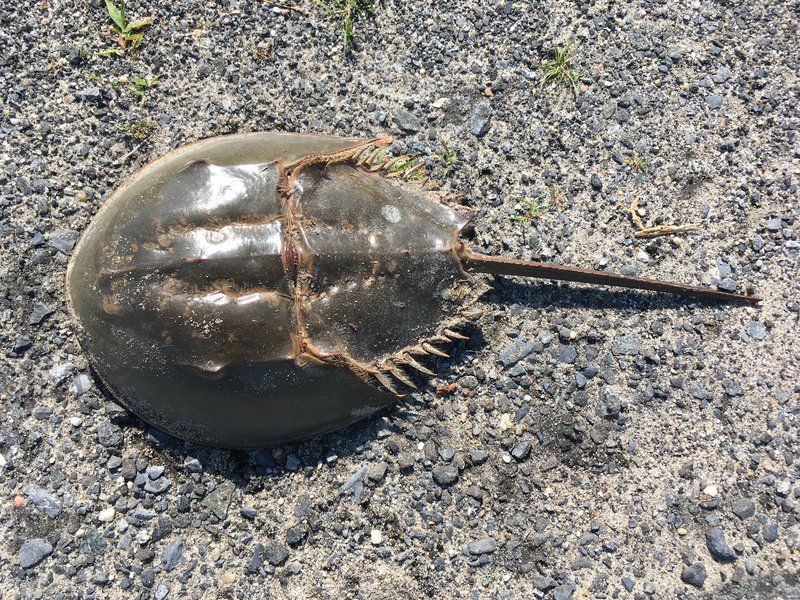
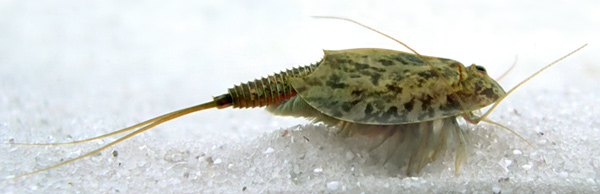
The size difference is dramatic. A typical triops measures two to seven centimeters, with some species reaching ten centimeters. They are delicate animals living in shallow pools that may dry within weeks. Horseshoe crabs are far more imposing. The Atlantic horseshoe crab, Limulus polyphemus, can grow to sixty centimeters including the tail, with females weighing up to four kilograms. The tri-spine horseshoe crab, Tachypleus tridentatus, found in East Asia, can exceed seventy centimeters.
Yet despite this enormous difference, both share a remarkably conserved body plan: a wide protective carapace, segmented body beneath, and a pointed tail spine called a telson.
Where They Live
Perhaps the most striking difference is habitat. Triops are freshwater specialists. They thrive in ephemeral pools, rice paddies, and temporary wetlands. Four species are recognized worldwide: Triops cancriformis in Europe, Triops longicaudatus in the Americas, Triops australiensis in Australia, and Triops granarius in Africa and Asia.
Horseshoe crabs are marine and estuarine animals. Only four species exist today. The Atlantic horseshoe crab lives along eastern North America. The three Asian species, Carcinoscorpius rotundicauda, Tachypleus gigas, and Tachypleus tridentatus, inhabit coastal waters from South Asia to Japan. Both groups face habitat loss, but in different ways: triops lose their pools to drainage and development, while horseshoe crabs face coastal pollution and overharvesting.
The Secret Weapons of Survival
Both creatures have evolved extraordinary survival strategies, but they could not be more different in their approach.
Triops rely on cryptobiosis, a form of suspended animation. When their pools dry out, triops produce resting eggs that can survive years, even decades, of complete desiccation. These eggs tolerate extreme temperatures, UV radiation, and even the vacuum of space in laboratory experiments. When rain returns, the eggs hatch within days, and a new generation begins the cycle. This strategy of disappearing between wet periods is what has allowed triops to persist through ice ages, droughts, and the extinction event that killed the dinosaurs.
Horseshoe crabs use a different strategy entirely. They are large, mobile, and long-lived, with individuals potentially surviving for twenty years or more. They have hard shells that protect them from most predators. Their blue blood contains copper-based hemocyanin for oxygen transport and a unique clotting agent called Limulus amebocyte lysate, or LAL, which can detect bacterial contamination at concentrations as low as one part per trillion. This biological quirk has made horseshoe crabs invaluable to modern medicine, but it has also put them under pressure from the biomedical industry.
Mass Extinctions: Who Survived What?
Both lineages have endured the five major mass extinctions. The Permian-Triassic extinction, 252 million years ago, wiped out roughly 90 percent of all marine species. Horseshoe crabs, as marine animals, were directly affected but their ancestors persisted. Triops, as freshwater organisms, were somewhat insulated from the marine catastrophe.
The Cretaceous-Paleogene extinction that ended the dinosaurs reduced horseshoe crab diversity from 22 known species to the four we see today. Triops, buffered by their freshwater habitat and cryptobiotic eggs, came through with their body plan essentially unchanged. Neither strategy is inherently superior. Both found ways to persist through catastrophes that eliminated the vast majority of life on Earth.
Conservation: Two Different Crises
Today, both groups face serious threats. Horseshoe crabs are the more visible concern. Populations have declined sharply due to overharvesting for bait, biomedical harvesting for LAL production, and habitat destruction along spawning beaches. The red knot, a migratory shorebird, depends on horseshoe crab eggs for fuel during its migration from South America to the Arctic, linking two species in a complex conservation challenge.
Triops face a quieter crisis. Ephemeral pools are being drained and filled across Europe, North America, and Asia. Because triops are small, inconspicuous, and live in temporary water, they rarely attract the conservation attention that larger marine species receive.
The Verdict: Different Strategies, Same Lesson
Comparing triops and horseshoe crabs teaches us something important about survival on Earth. There is no single winning formula for longevity. The horseshoe crab succeeded by being tough, mobile, and marine. The triops succeeded by being tiny, cryptobiotic, and freshwater. Both body plans have remained largely unchanged for hundreds of millions of years, not because evolution stopped working, but because these designs were already well suited to their environments.
Both creatures remind us that living fossils are not frozen relics. They are active participants in their ecosystems, and both face real threats from human activity. The horseshoe crab's blue blood saves human lives, while triops eggs have taught scientists about the limits of biological endurance. Losing either group would diminish our understanding of what life is capable of.