Published 2026-10-01 · by the Triops.me Editorial Team · Back to Articles
Velociraptor: Feathered Hunter of the Mongolian Gobi
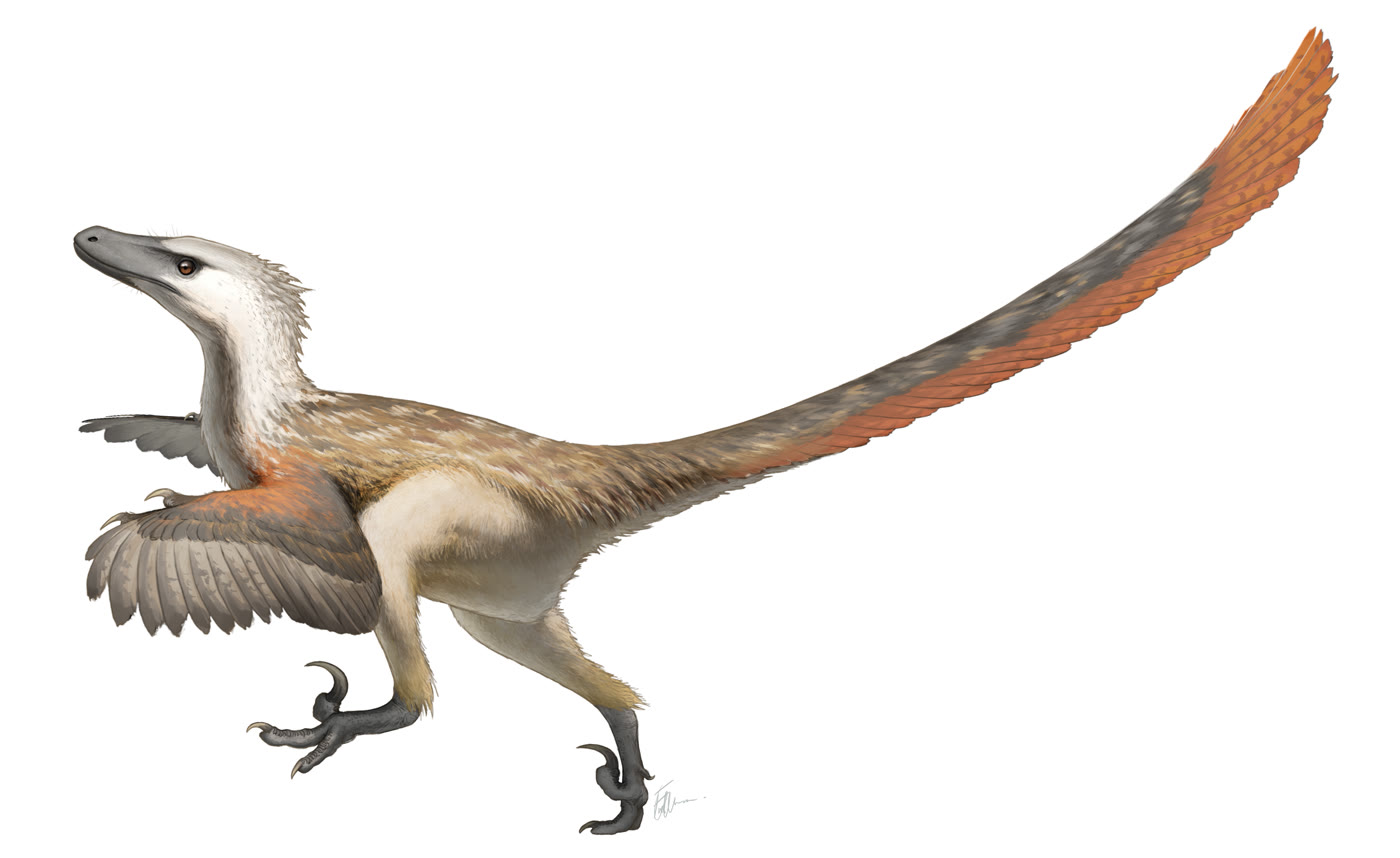
Collector Peter Kaisen was sweeping a hillside at the Flaming Cliffs of the Mongolian Gobi on 11 August 1923 when he picked up a crushed skull with a single hand claw still welded to it. The bones travelled to the American Museum of Natural History in New York, and in 1924 the museum's president Henry Fairfield Osborn gave the animal a name: Velociraptor mongoliensis, from the Latin velox for swift and raptor for plunderer. He was describing a fast meat eater from Central Asia. He had no idea he was naming one of the most recognizable animals that ever lived.
Most of that fame belongs to a movie. Almost everything the public knows about Velociraptor comes from Jurassic Park, where the raptors stand two metres tall, have bare reptilian skin and organise themselves into hunting teams. The real animal measured roughly 1.5 to 2 metres from snout to tail tip, stood about half a metre high at the hip and fell somewhere between 14 and 20 kilograms, which makes it a large turkey on legs. It was feathered. It lived between 75 and 71 million years ago in the deserts of Mongolia. And because more than a dozen skeletons have been described, including one that froze it mid attack, the Velociraptor of the fossil record is far stranger than the one on screen.
The Shape of the Real Animal
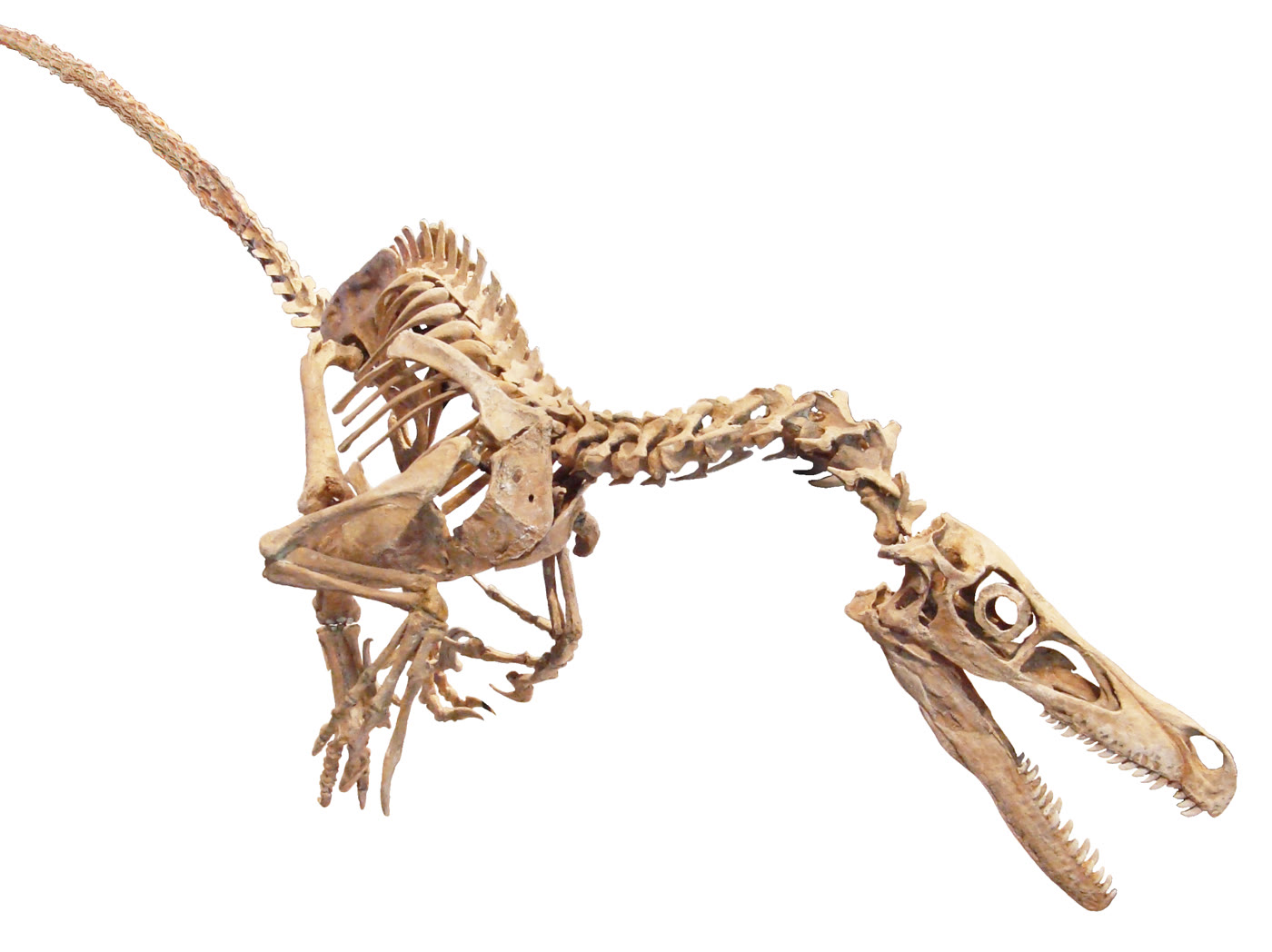
The skull was long and low, up to 23 centimetres, with a narrow snout that made up most of its length and curved upward at the tip. Inside sat rows of serrated, slightly recurved teeth made for gripping live prey rather than crushing bone. The hands carried three long fingers with hooked claws, and the wrist locked so the palms faced inward toward the body, exactly the way a bird folds its wings.
The feet are the famous part. Velociraptor walked on its third and fourth toes while the second toe rode clear of the ground, and that raised toe carried a sickle shaped claw that could exceed 6.5 centimetres along its outer curve. The tail was another compromise. Long bony projections above the vertebrae and ossified tendons underneath once persuaded researchers that the whole structure was a rigid balancing rod, yet one specimen preserves the tail bent sideways in an S, which means the animal could still swing it.
A Claw That Holds Instead of Slashing
For decades the sickle claw was drawn as a belly ripping weapon. The idea was simple and cinematic: the raptor leapt, raked, and the prey opened up. In 2005 the BBC programme The Truth About Killer Dinosaurs tested it by building an artificial Velociraptor leg and swinging it at a slab of pork belly. The claw punched through the outer layer and could not tear it further. The inside edge of the bone core is rounded rather than razor sharp, and the thick hide and muscle of a large animal would have resisted that shape anyway.
What the claw did instead is written in stone. In 1971 a Polish and Mongolian expedition working at Tugriken Shireh uncovered the specimen known as the Fighting Dinosaurs: a Velociraptor lying underneath a Protoceratops with one sickle claw buried in the plant eater's throat, while the beak of the Protoceratops clamped down on the raptor's right forearm. Both animals died in lifelike positions, and the sand around them is structureless, so the likely ending is a collapsing dune or a sandstorm that buried a fight already in progress. The fossil is treated as a national treasure of Mongolia and was loaned to the American Museum of Natural History for exhibition in 2000.
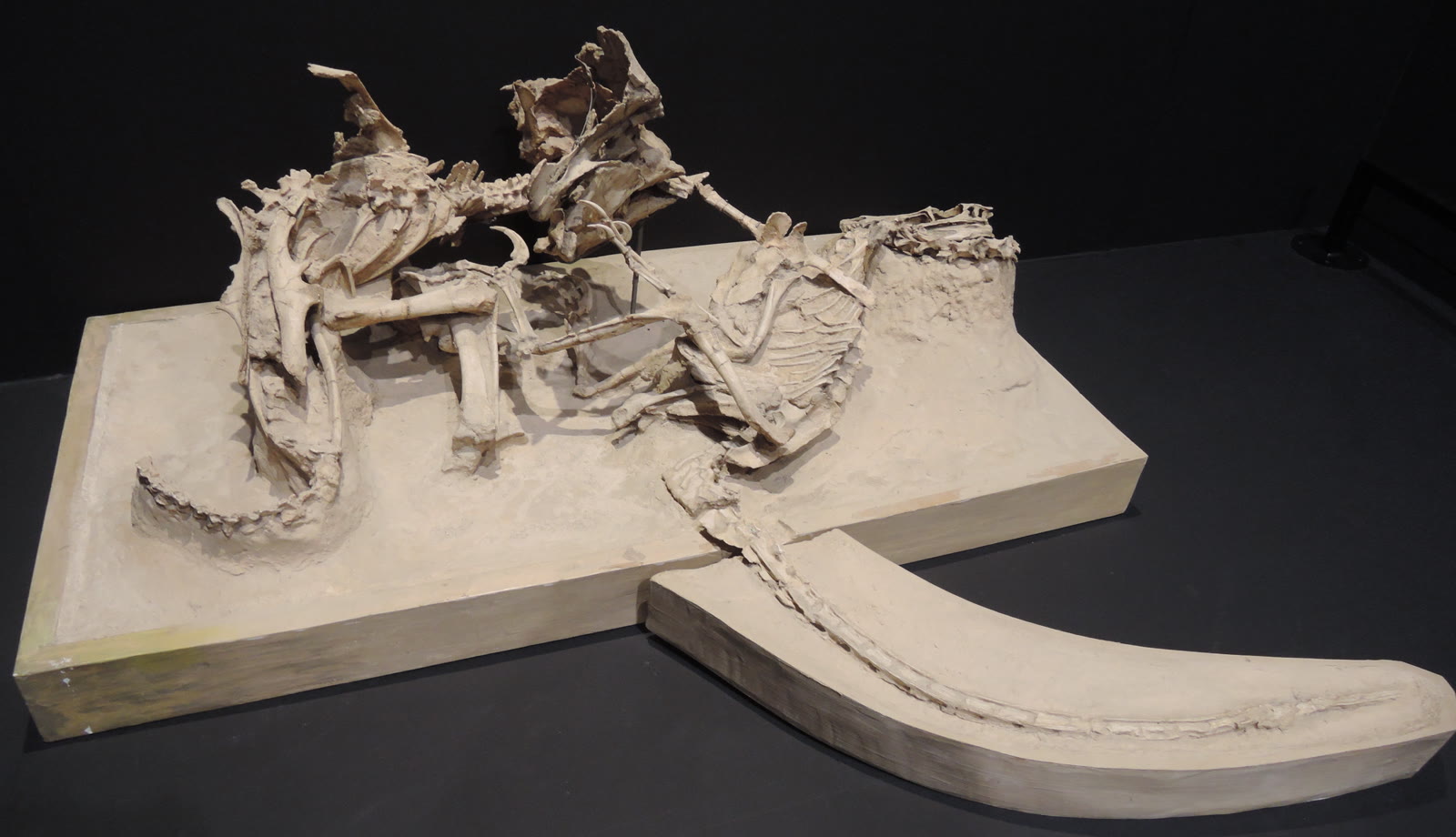
The pose suggests a throat punch rather than a slash. A sickle claw driven into the neck could reach the jugular vein, the carotid artery or the windpipe, and that would end the fight quickly. Work published by Denver Fowler and colleagues in 2011 pushed the picture further with the raptor prey restraint model: dromaeosaurs behaved like hawks and eagles, leaping onto prey, pinning it under their own weight, gripping with those curved claws and feeding while the animal was still alive. The arms, strong and probably feathered, would have worked as balance flappers and the stiff tail as a counterweight. The jaws were weak by comparison, with one 2022 estimate putting the bite force at 304 newtons, less than in its larger relatives, which suits a sawing bite rather than a crushing one.
Feathered, With Nowhere to Fly
In 2007 Alan Turner and colleagues reported six quill knobs on the forearm bone of a Velociraptor specimen from the Ukhaa Tolgod locality. Quill knobs are the bumps where large feathers anchor to bone, so they are direct evidence of a feathered arm, not an educated guess. The spacing implies roughly fourteen quills in total, enough to carry a proper set of secondaries on an animal that could not fly. Turner argued that this matters twice over. Modern flightless birds almost never keep quill knobs, so Velociraptor probably descended from ancestors that could fly and lost the ability again. Its feathers were doing something else: display, brooding over a nest, or extra thrust while running up a dune.
Phylogeny backs this up even where skin does not survive. Close relatives such as Microraptor, Zhenyuanlong and Daurlong preserve feathers in fine detail, and no serious reconstruction of a dromaeosaur today shows bare skin. The insulation also hints at blood: feathery coats usually mean warm blooded animals, though bone growth rates suggest a metabolism more moderate than a modern bird's.
Pack Hunter or Lone Opportunist
The films need coordinated packs, and artists obliged for thirty years. The evidence is thinner than the habit suggests. Velociraptor's North American cousin Deinonychus has been found in groups and alongside the plant eater Tenontosaurus, which prompted the pack hunting idea in the first place, and a Chinese trackway shows six dromaeosaurs moving in the same direction. Against that, no Velociraptor has ever been found with other individuals.
The opportunism shows up in the diet. Shed teeth beside a chewed Protoceratops jaw suggest late stage carcass feeding, a Velociraptor eating what was left of a body it did not necessarily kill. Another specimen held the bones of an azhdarchid pterosaur in its gut, a meal more consistent with scavenging than with a chase. A 2024 study of skull mechanics found unusually high resistance to bite forces in this genus and read it as an adaptation for pulling meat off difficult carcasses. Even violence inside the species is on record: one skull from Tugriken Shireh carries two parallel rows of punctures that match Velociraptor teeth, with no healing in the bone. That animal died of a bite from its own kind.
A Desert That Swallows the Evidence
Almost every Velociraptor comes from the Djadochta Formation in Ömnögovi Province, sand laid down by wind between 75 and 71 million years ago. The reconstructed landscape is dune fields under a semi arid climate with only intermittent streams, which is roughly what the Flaming Cliffs look like today. The neighbours are known from the same rocks: the beaked ceratopsian Protoceratops, the egg thief Oviraptor, the ankylosaur Pinacosaurus and small hunters like Saurornithoides.
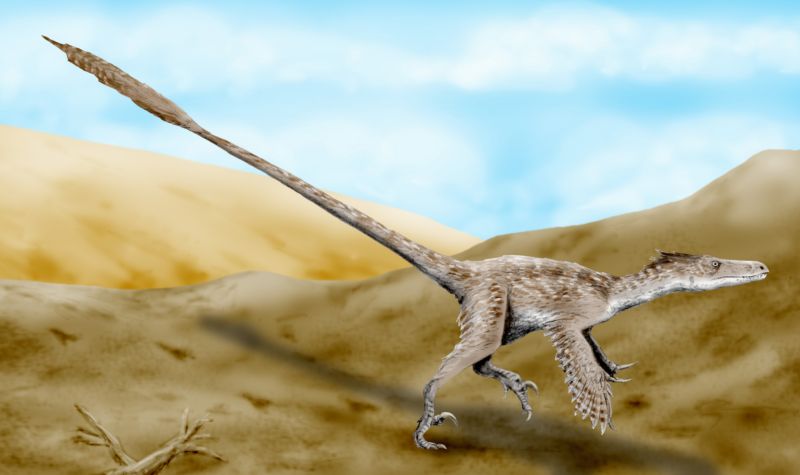
That environment is also the reason so much is preserved. Sand-bearing events, from collapsing dunes to sandstorms, buried animals alive and fast, which is why the Fighting Dinosaurs keep their grip on each other instead of relaxing after death. It is a brutal archive, and it is the only kind of archive that records behaviour rather than just anatomy.
The Name That Beat the Animal
Michael Crichton consulted John Ostrom, the Yale paleontologist who described Deinonychus, several times while writing Jurassic Park, and later told him he had swapped in the name Velociraptor because it sounded more dramatic. Everything else in the book and the 1993 film followed Deinonychus: the size, the proportions, the snout shape, even the dig site, which is set in Montana rather than Mongolia. By the time the first sequel appeared, feathered dromaeosaurs were entering the literature, and the later Jurassic World films kept the scaly design anyway, though Jurassic World Dominion finally put feathers on a raptor.
What the Real Velociraptor Gives Us
Strip away the franchise and the animal is more interesting, not less. It is one of the few dinosaurs caught in the act of attacking, one of the clearest cases of a predator built for restraint rather than slashing, and a link in the chain that runs from feathered ground hunters to the first birds. It never grew large and it never spread far beyond Central Asia, yet its lineage outlasted the group itself: dromaeosaurs disappeared in the end Cretaceous extinction described here, while birds, their closest living relatives, are still around. A turkey sized hunter in a desert of sandstorms turned out to be the dinosaur the whole world knows best.