Published 2026-09-08 · by the Triops.me Editorial Team · Back to Articles
When Whales Walked: The Strange Origin Story of Earth's Giants
A blue whale has a heart the size of a small car and a tongue heavier than an elephant. It is the largest animal that has ever lived on Earth, and it spends its entire life at sea. It might surprise you, then, that the very first whale was a small, furry, four-legged mammal that hunted by the edge of a river and had never once considered the open ocean.
The story of whale evolution is one of the most complete in the entire fossil record. Paleontologists have found animals that are almost whales, animals that are half whales, and animals that are whales in every way except one. Together they trace a journey of about 50 million years, from a wolf-like creature trotting along riverbanks to a 20-metre sea serpent patrolling the Tethys Ocean. It is a story of transformation so dramatic that for a long time, science simply refused to believe it.
A Land Mammal in Denial
Our story begins about 50 million years ago, in the early Eocene, in what is now Pakistan. The creature is Pakicetus, and at first glance it looks nothing like a whale. It is roughly the size of a wolf or a large fox, with four sturdy legs, a long snout full of teeth for snapping up small animals, and hooves on its feet. Its ancestors were land-dwelling plant-eaters and omnivores. If you saw one on a riverbank, you would probably file it away as just another early mammal.
But the skull tells a different story. Inside the ear region of Pakicetus, there is a large, thickened, bony structure called an involucrum, a feature found in every living whale, dolphin, and porpoise, and in nothing else. The inner ear was also adapted for hearing underwater. To a trained eye, that single piece of anatomy screams "cetacean" even when attached to an animal with hooves. The rest of the skeleton, including a distinctive double-pulley ankle bone shared with cows, sheep, deer, and hippos, places Pakicetus among the even-toed ungulates. Its closest living relative, DNA confirms, is the hippopotamus.
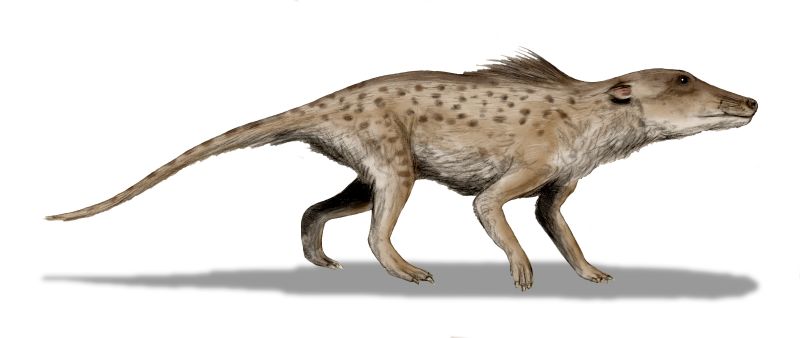
Pakicetus was not yet an ocean creature. It probably lived much like a small river predator today, wading into shallow streams to catch fish and other animals. The ocean was a career change it had not yet made. But the anatomy of a whale was already assembled in miniature, waiting for the rest of the body to catch up.
The Walking Whale
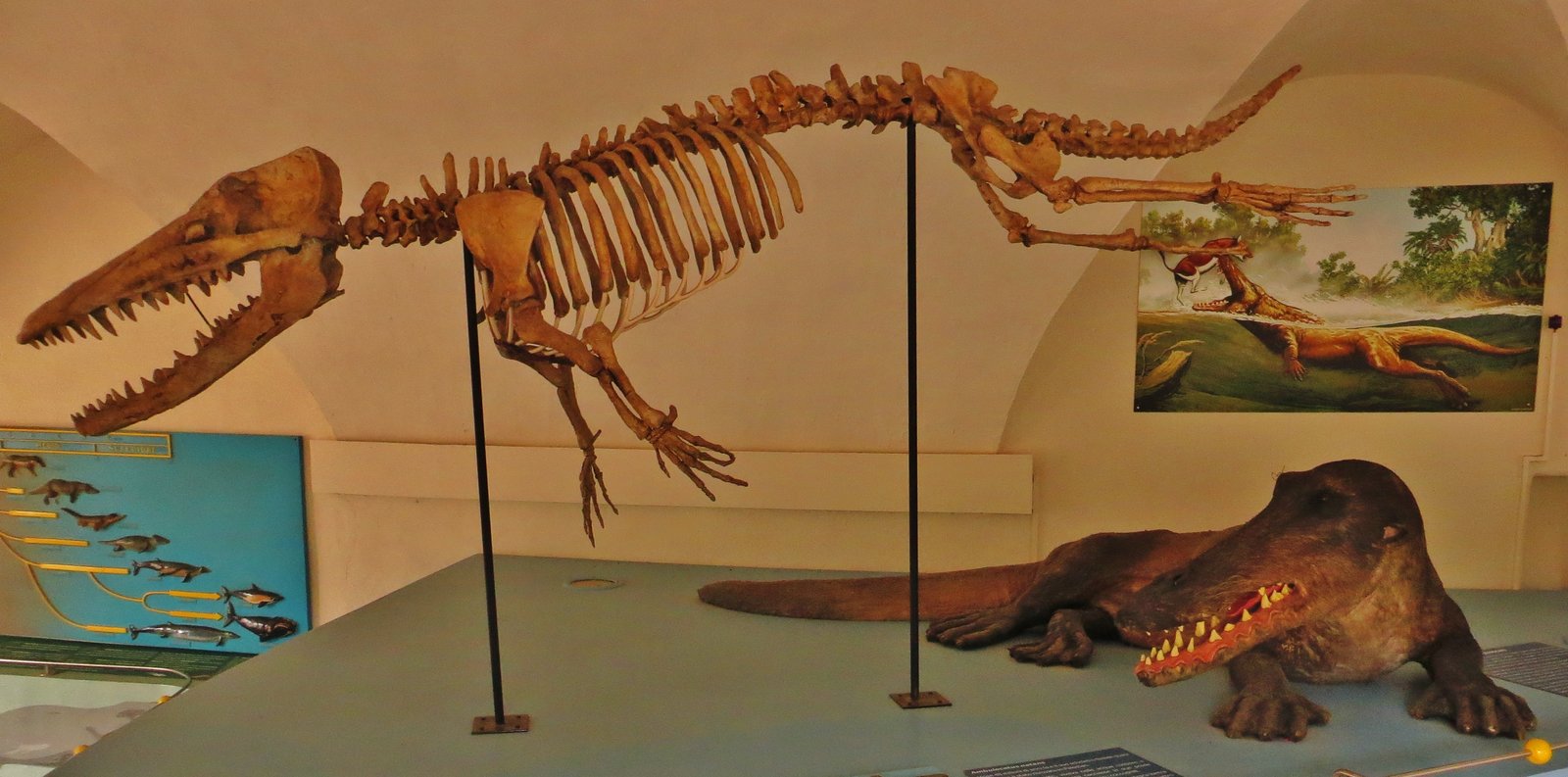
A few million years later, a more committed candidate appeared. Ambulocetus natans, whose name literally means "the walking and swimming whale," lived around 49 million years ago in what is now Pakistan and India. It was larger than Pakicetus, about three metres long, with a body like a crocodile and limbs that had begun to transform. Its hands and feet were enlarged into paddles. Its tail was longer and more muscular, useful for swimming with strong up-and-down strokes.
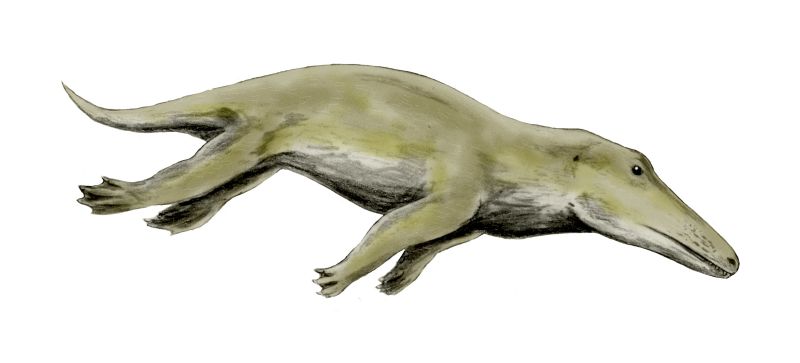
Ambulocetus could still walk on land, though it was probably slow and awkward, a bit like a modern sea lion hauling itself along a beach. But the chemical evidence locked inside its bones shows it was spending serious time in the water. Oxygen isotopes in its skeleton match an animal that drank both freshwater and saltwater, which fits an estuary lifestyle, prowling the brackish waters where rivers meet the sea. Its fossils are found in exactly those ancient estuary sediments. In other words, Ambulocetus was a whale that had not yet decided which world it lived in.
Over the following millions of years, whales committed to the water. Successive species, such as Rodhocetus and other protocetids, show nostrils sliding further back along the snout, the beginning of the blowhole. Their hind legs shortened. Their vertebrae changed shape to support the powerful tail-driven swimming that modern whales use, undulating the body up and down rather than side to side like a fish. That swimming style is a fossil clue in itself: it reflects their heritage as land mammals, whose spines already flexed up and down when they ran.
Whales with Legs, Giants in the Sea
By about 41 million years ago, the basilosaurids had arrived, and these were unmistakably whales. Basilosaurus reached up to 20 metres, with an elongated, eel-like body and a powerful tail fluke. Dorudon, a smaller relative, looked much more like a modern whale and probably fed on fish and small squid.
Yet basilosaurids still carried a secret. Hidden near their hips were tiny, almost useless hind legs, complete with a knee, ankle, and several toe bones. They were far too small to support the animal's weight, and many scientists think they were completely enclosed within the body wall. These vestigial limbs are a beautiful piece of evidence: they show exactly where these animals came from, even as they had fully committed to the sea. Occasionally, living whales are found with the same vestiges, tiny hindlimb bones buried inside their bodies.
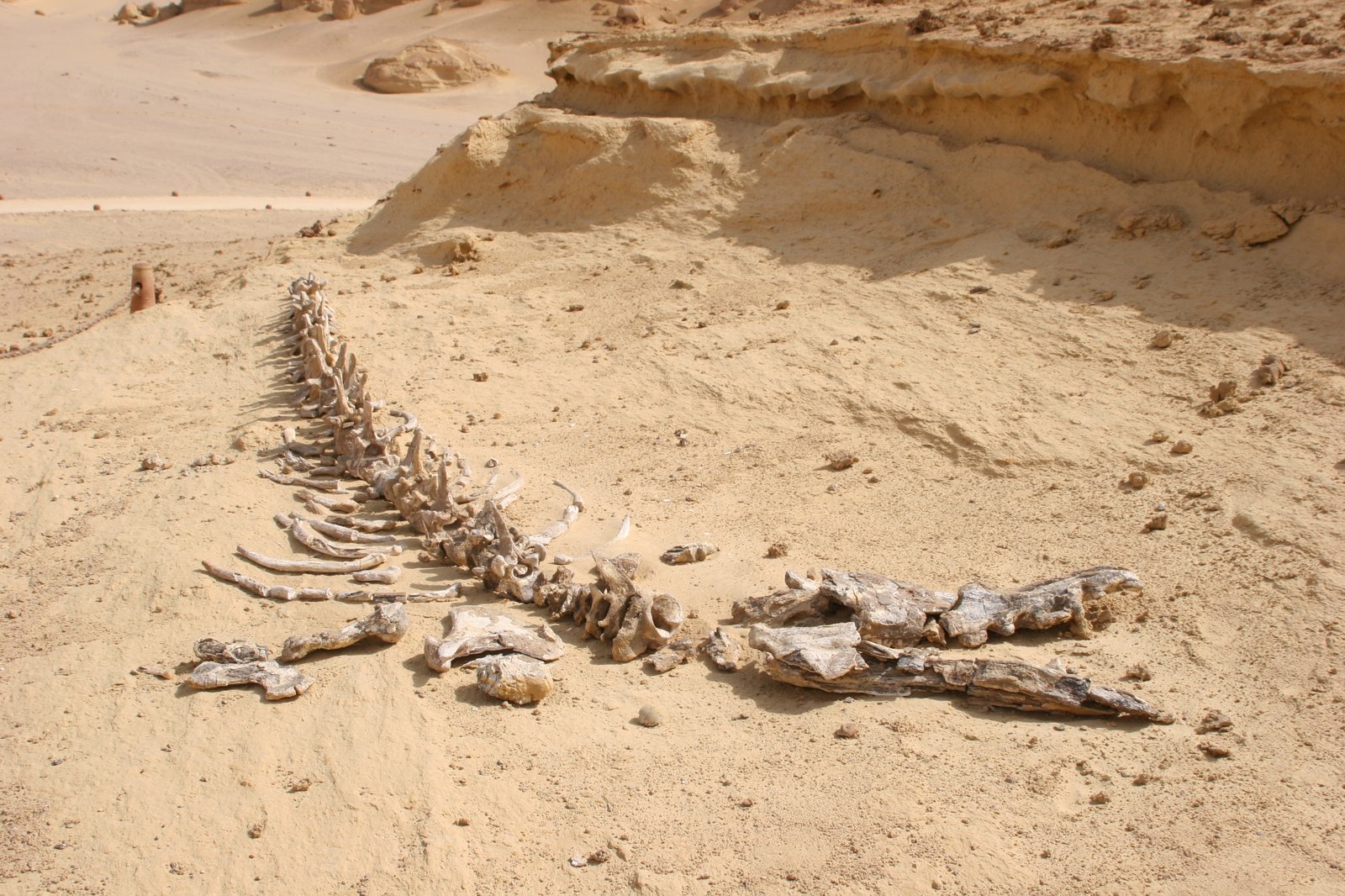
The best place in the world to see this transition with your own eyes is Wadi El-Hitan, the Valley of the Whales, in the Egyptian desert. Here, in a UNESCO World Heritage Site about 150 kilometres southwest of Cairo, hundreds of whale fossils lie exposed in the sand, including near-complete Basilosaurus and Dorudon skeletons. Forty million years ago this desert was the floor of the Tethys Ocean. Today you can walk between the ribcages of whales, in the middle of the Sahara, and see the tiny leg bones sticking out beneath their tails.
How Do We Know It Was a Whale?
It is fair to ask why Pakicetus and Ambulocetus are called whales at all, when they look like dogs and crocodiles. The answer comes from anatomy that ordinary eyes never see. The involucrum in the ear is unique to cetaceans. The double-pulley ankle bone links them to even-toed ungulates. The details of the skull, the teeth, and the inner ear all form a connected chain through the fossil record, with each new species fitting neatly between its neighbours.
DNA provides a second, completely independent line of evidence. Genetic studies of living whales and their relatives point to hippos as the closest living cousins, and the fossil record agrees: the ancient land relatives of whales sit near the base of the same group that gave rise to hippos. Two entirely different kinds of evidence, the anatomy of long-dead animals and the genetics of living ones, tell the same surprising story.
A Transformation Worth Remembering
Whales are not the only animals to make such a journey. The ancestors of dolphins did the same thing. Sea turtles, seals, and penguins each evolved from land animals that returned to the sea at different times. But the whale transition stands out because the fossil record happens to be so complete. There are few other groups where you can lay out skeletons in a row and watch legs become flippers, nostrils become blowholes, and fur become blubber, step by step, over 50 million years.
It is a useful reminder that evolution is not a ladder pointing upward toward any particular goal. Whales did not set out to become the giants of the ocean. A small, wolf-sized mammal simply followed the water, generation by generation, and the anatomy it inherited reshaped itself around that new life. Today, every time a humpback breaches or a blue whale's call echoes across an ocean basin, there is a memory of riverbanks and running legs buried in the motion.