Published August 31, 2026, 16:20 by the Triops.me Editorial Team · Back to Articles
Tiktaalik: The Fish That Walked onto Land
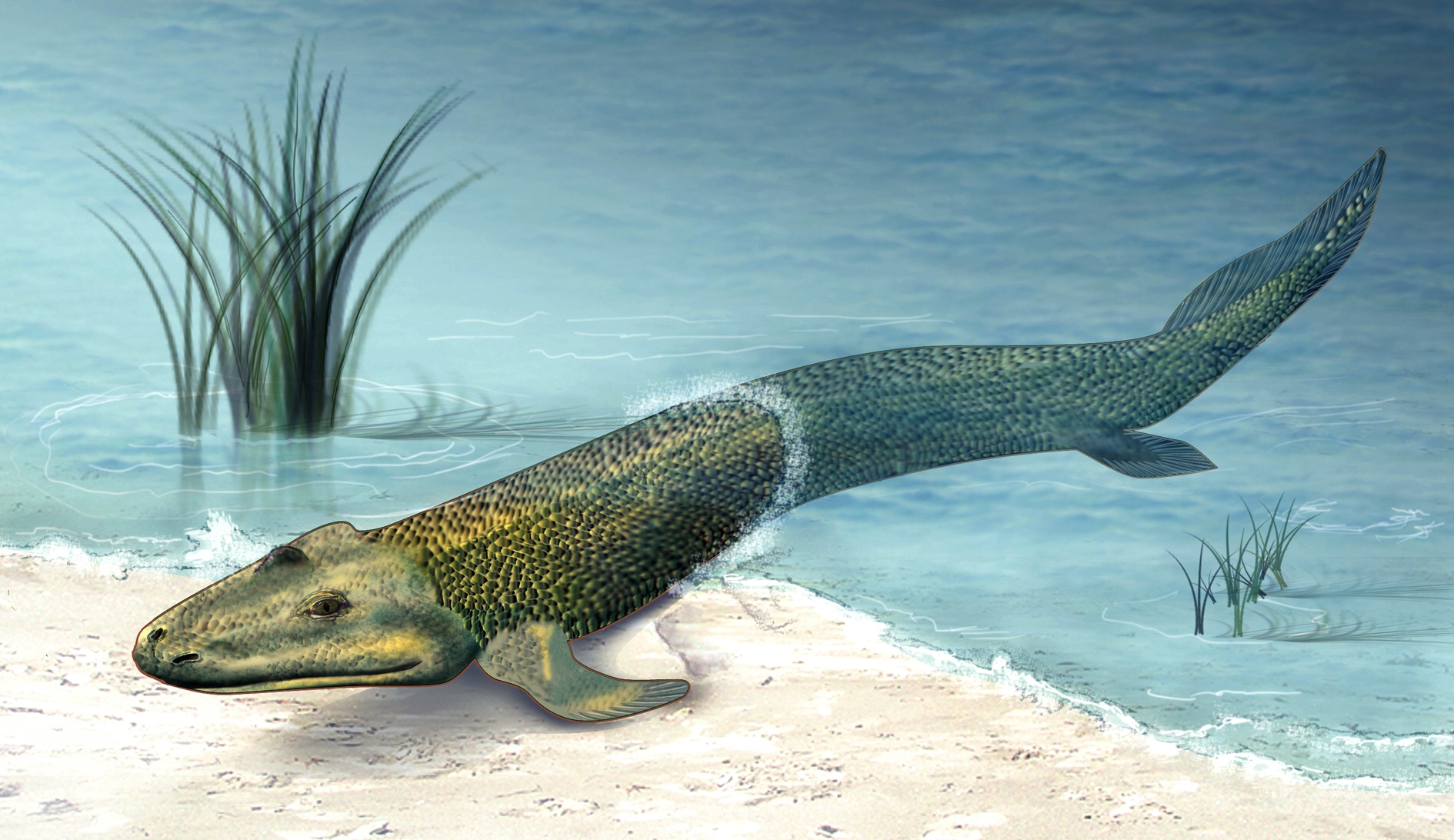
Three hundred and seventy-five million years ago, during the late Devonian period, a strange creature dragged itself through the shallow, swampy waters of what is now Arctic Canada. It had scales like a fish and gills that filtered oxygen from water. But it also had something no ordinary fish possessed: sturdy, limb-like fins capable of propping its body off the ground and supporting its weight on solid surfaces. This animal was Tiktaalik roseae, and it is one of the most important fossils ever discovered.
Often called a "missing link" between fish and four-legged land animals, Tiktaalik captures a pivotal moment in vertebrate evolution, the transition from water to land. It is not a dinosaur, not a reptile, and not quite a fish. It is something in between, a snapshot of evolution caught mid-step, frozen in stone for 375 million years before humans dug it up on a remote Arctic island.
What Is Tiktaalik?
Tiktaalik is a genus of extinct sarcopterygian, a group of lobe-finned fish that includes the ancestors of all tetrapods, the four-limbed vertebrates that include amphibians, reptiles, birds, and mammals. The name comes from Inuktitut and translates roughly to "large freshwater fish." The species name, roseae, honors Rose Maiorino, the daughter of one of the discoverers.
A Brainstorm in the Arctic
The story of Tiktaalik's discovery is as remarkable as the fossil itself. In the early 2000s, paleontologist Neil Shubin and his colleagues at the University of Chicago set out to find a transitional form between fish and land vertebrates. Instead of combing through museum collections, they made a bold prediction: they knew exactly what rock layer and time period to search in. The fossil record told them the transition happened during the late Devonian, roughly 375 million years ago, and they needed rocks of exactly that age exposed at the surface.
The answer lay on Ellesmere Island in Nunavut, deep in the Arctic. The team endured brutal conditions, winter temperatures below minus 30 degrees Celsius, and a narrow summer field season. In 2004, their patience paid off. Within minutes of the first rock splitting open, they found a skull fragment matching their predictions. The discovery was published in the April 6, 2006 issue of Nature, authored by Edward Daeschler, Neil Shubin, and Farish Jenkins, and immediately recognized as one of the most significant paleontological finds of the century.
Half Fish, Half Land Animal
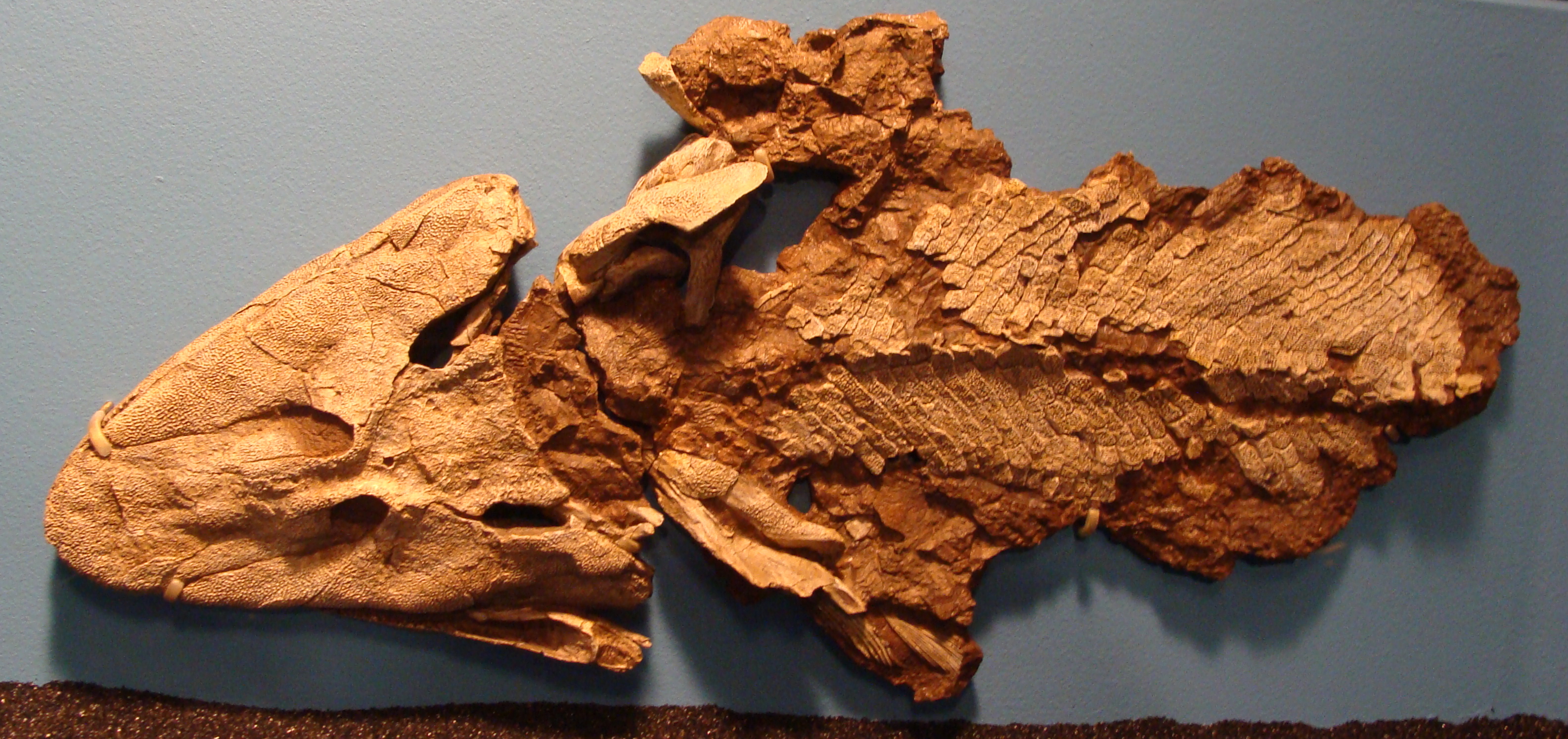
What makes Tiktaalik so extraordinary is the combination of features it possesses. It is not a fish with a few land animal traits, nor a land animal with a few fish traits. It is a mosaic, a creature where aquatic and terrestrial anatomy coexist in a single organism. Like a fish, Tiktaalik had scales, gills, and fins with thin ray bones for paddling. But its fins also contained sturdy interior bones, arranged in a pattern remarkably similar to the limb bones of later tetrapods. These inner bones allowed Tiktaalik to flex its fins in ways that ordinary fish cannot, bending them at what paleontologists interpret as a wrist-like joint. In shallow water, Tiktaalik could use these fins to push itself up, support its body, and possibly even make short, crawling movements across mudflats.
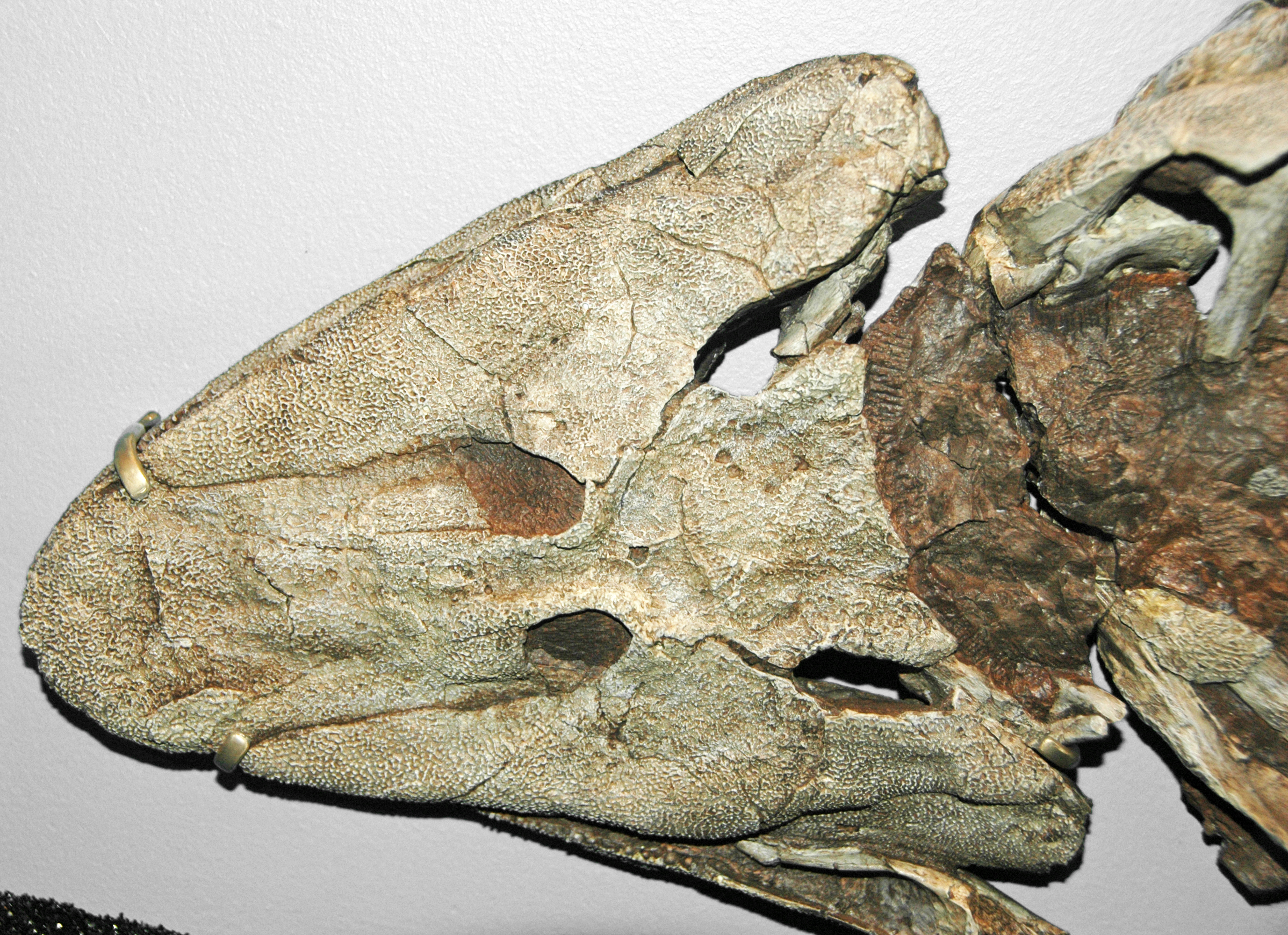
Tiktaalik's skull tells another part of the story. Unlike most fish, which have skulls rigidly attached to their shoulder bones, Tiktaalik had a neck. This meant it could move its head independently of its body, a crucial adaptation for land life. Its ribs were large and overlapping, which may have helped support the body cavity against gravity, something fish gills do not need to do.
Why Tiktaalik Matters
The significance of Tiktaalik extends far beyond its own bones. Before the Devonian transition, all vertebrates lived in water. After it, the descendants of lobe-finned fish like Tiktaalik radiated across every continent, giving rise to amphibians, reptiles, dinosaurs, birds, and eventually mammals. Every land vertebrate alive today traces its ancestry back to a fish that decided to leave the water. Tiktaalik also demonstrates predictive paleontology: the team used evolutionary theory to predict exactly where to look, validating the idea that evolution leaves a traceable signature in the rock record.
A Creature of Its Time
The late Devonian world Tiktaalik inhabited had no grasses, no flowering plants, no birds, and no mammals. Armored fish called placoderms dominated the water, and the land was colonized by early vascular plants and swamps. In this environment, the ability to drag oneself through shallow water, prop up on solid ground, and breathe air even briefly would have been a significant advantage. Tiktaalik was not the only creature experimenting with terrestrial life. Its relatives, including Acanthostega and Ichthyostega from Greenland, took the transition even further, developing more fully formed limbs. But Tiktaalik captures the moment just before that leap, when the fins were becoming legs but had not yet finished the job. Since its publication, Tiktaalik has become one of the most famous fossils in the world. A cast of the holotype specimen is on display at the Field Museum in Chicago, and Neil Shubin's book Your Inner Fish became a bestseller.
Tiktaalik and Triops: Survivors of Different Eras
At first glance, Tiktaalik and Triops could not seem more different. One is an extinct fish that lived 375 million years ago. The other is a living crustacean that has existed, in broadly similar form, for over 200 million years. But both tell us something important about how life persists through time. Triops survives by being adaptable, breeding rapidly, and producing eggs that withstand years of drought. Tiktaalik's legacy is different: it did not survive as a species, but its descendants conquered the land. Both are reminders that evolution rewards flexibility, and that the boundaries between water and land, between one body plan and another, are more fluid than they appear.
Want to learn more about prehistoric life? Explore our creature gallery or read about the Cambrian Explosion, when life first got interesting.