Published 2026-10-05 · by the Triops.me Editorial Team · Back to Articles
Cave Bear: Europe's Hibernating Giant
Under the limestone hills of Central Europe, far from daylight, there are chambers where the floor is not stone but bone. In some caves the remains of a single species are so dense that excavators have counted tens of thousands of skeletons in one tunnel system. None of those animals died in a disaster. They walked in, lay down, and never got up again.
Those bones belong to the cave bear, Ursus spelaeus, a heavy plant-eating bear that shared Ice Age Europe with mammoths, woolly rhinos, cave lions and our own ancestors. It ranged from Spain and Italy to the Caucasus for more than two hundred thousand years, then disappeared about 24,000 years ago, at the coldest moment of the last glaciation. Almost everything we know about it comes from the places where it slept.
A Species Named by Its Graveyard
The first cave bear skeletons reached naturalists in 1774, when Johann Friedrich Esper published a study of bones from the Zoolithen Cave near Muggendorf in Franconian Switzerland. The skeletons were so unlike anything living that the guesses ran wild. Some colleagues proposed an extinct ape, others a giant dog or cat, and one idea held that the bones came from dragons or unicorns. Esper himself argued for polar bears, a sensible comparison until you look at the teeth.
Twenty years later the anatomist Johann Christian Rosenmüller gave the animal its scientific name, and the argument settled into the one we still use: the species is defined by where it is found. The bones were never scarce either: during the First World War, earth from Austrian bear caves was mined for phosphate fertilizer, and workers kept only the skulls and leg bones.
Built Like a Brown Bear, Only Heavier
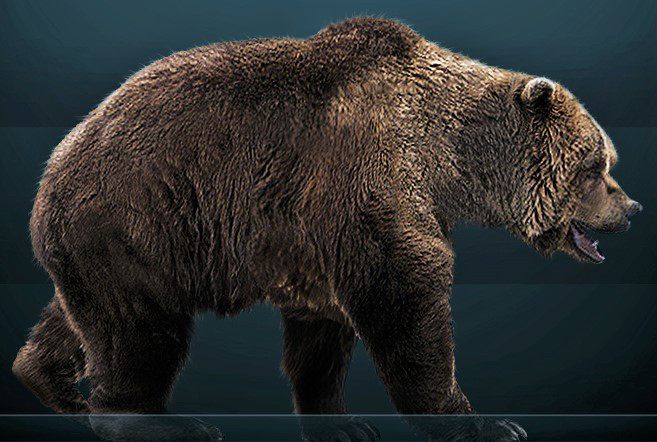
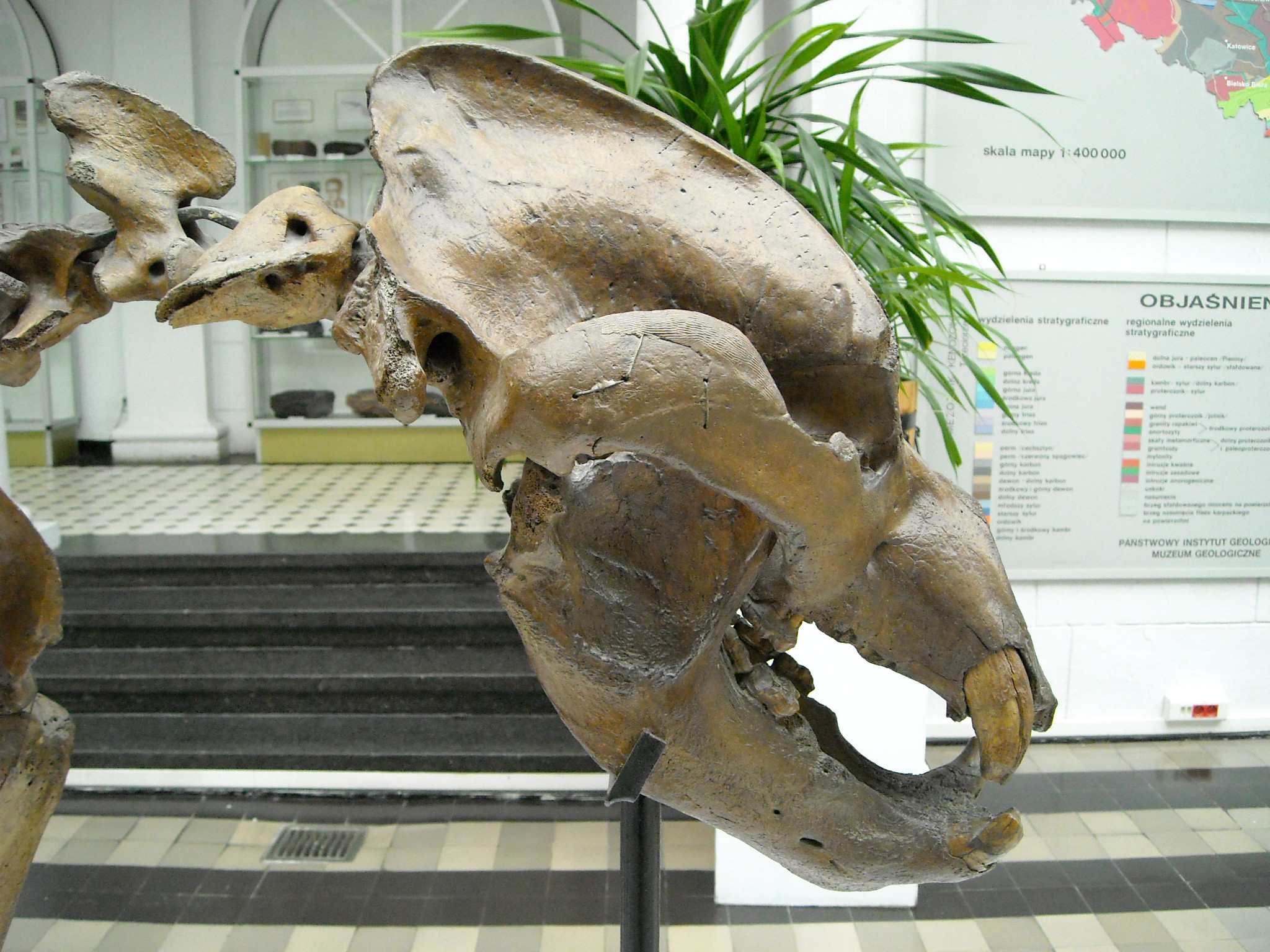
Strip the fur off a cave bear and you have an animal any zoologist would recognise as a bear, close to the brown bear in its limbs and spine. The differences are in the head and the scale. The skull is broad with an unusually steep, domed forehead that gives the species a distinctive profile even in a worn fossil. Males are estimated at 350 to 600 kilograms, which is at the top of the range for any bear that has ever lived, while females weighed 225 to 250 kilograms.
That gap between the sexes misled scientists for decades. Around ninety percent of cave bear skeletons in museum collections were long catalogued as males, simply because the smaller female skeletons were assumed to be stunted or dwarfish individuals. The animals also grew larger during glaciations and smaller during warmer interglacials, the pattern that biologists expect when body size tracks heat loss. Their thigh bones in large males rival those of Kodiak bears.
A Vegetarian Between the Teeth
The clearest evidence of what a cave bear ate is in its mouth, and it points away from hunting. Cave bears lost the two or three premolars that other bears carry, and the remaining back teeth grew larger, extra cusped and tightly packed, a process called molarisation that turns a shearing dentition into a grinding battery.
Bone chemistry agrees. Cave bear collagen carries low levels of nitrogen fifteen and carbon thirteen, the signature of an animal low on the food chain eating plants rather than meat, and most studies place the cave bear as the most herbivorous member of its genus, living mainly on C3 forest vegetation. The picture is not that simple. Microwear on the teeth differs between regions, a population in Belgium lived on soft foods, bears in Romania show a more omnivorous signal, and the animals sometimes chewed bone. Toothmarks on skeletons in caves where no other predator lived suggest hungry bears fed on companions that had died in their sleep.
The Dead Piled Up in the Dark
Hibernation was dangerous, and the caves recorded the cost. Bears that went into winter thin, sick or old did not come out, and their skeletons accumulate in the same chambers year after year. The bones themselves carry the medical history of those animals: fused spines, bone tumours, cavities, rickets, kidney stones, jaw infections, even tuberculosis. A cave bear seldom seems to have lived much beyond twenty years.
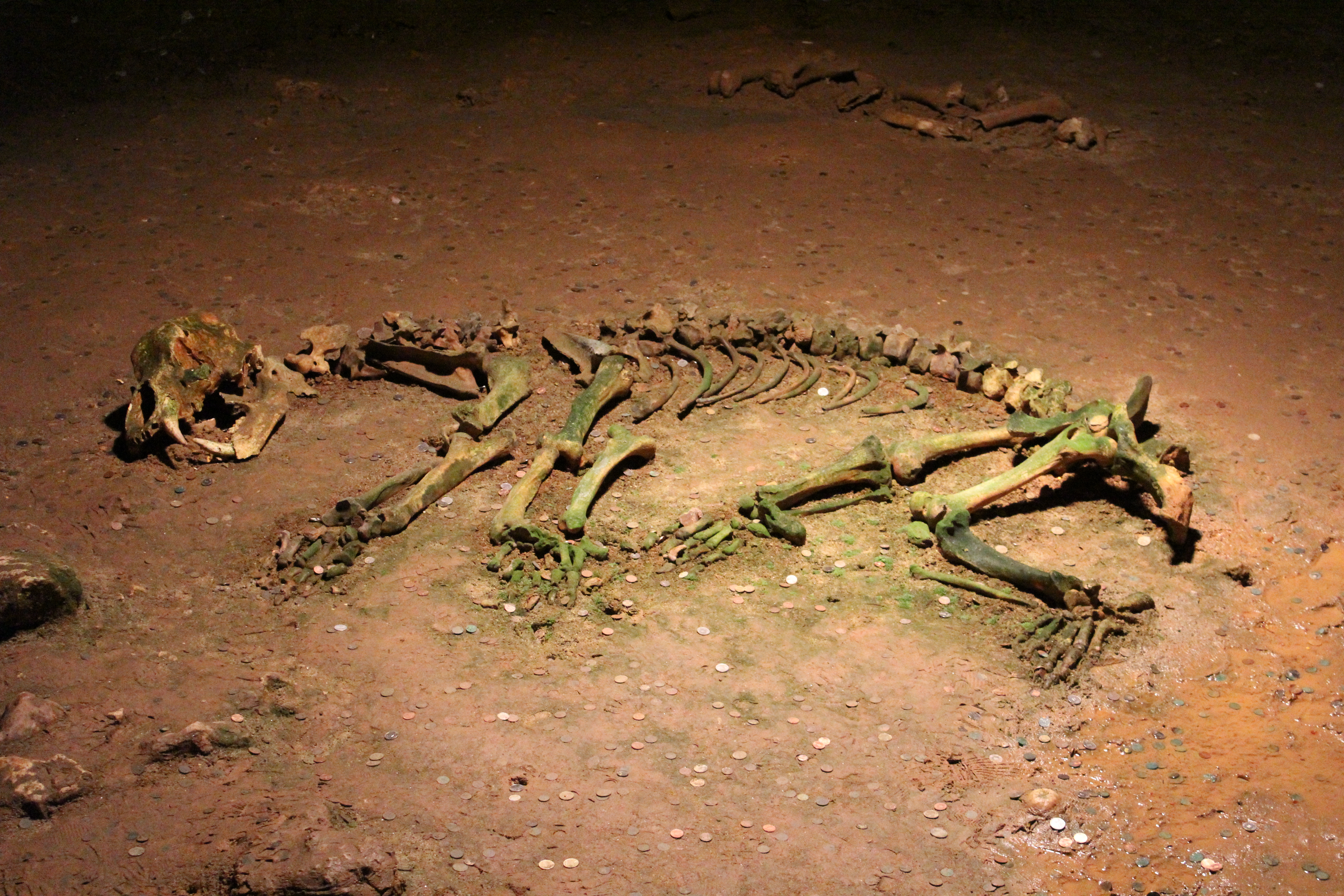
The totals are staggering. Emil Bächler excavated the Drachenloch in Switzerland between 1917 and 1923 and recovered more than thirty thousand cave bear skeletons. A cave in Romania yielded a hundred and forty skeletons in 1983 alone, and the Chauvet Cave in France preserves around three hundred hollows scooped out by sleeping bears. Even so, the arithmetic is modest: bones that took a hundred thousand years to accumulate require only two deaths per year to explain. Predators kept watch at the entrance. Wolves and cave hyenas took the weak, and fully articulated cave lion skeletons found deep inside bear dens show lions that walked in to kill hibernating bears, and sometimes died there.
Did People Worship the Bear?
Neanderthals and later modern humans lived alongside cave bears and used them. Bones modified into tools turn up across Europe, and the animals were butchered and eaten. The more dramatic claims come from arrangements of bones that look deliberate: at the Regourdou site in France a stone covered pit held at least twenty bears next to a Neanderthal burial, and at Drachenloch the chest of skulls sat against a cave wall.
Archaeologists once called this a cave bear cult, an Ice Age religion built on reverence for a hibernating giant. The interpretation has worn badly. Excavation methods of the era disturbed the layers, and a review of the evidence concluded that proof of ritual behaviour is far from convincing. One artefact keeps the debate alive: a cave bear femur from Divje Babe in Slovenia with two neat holes, claimed by some as the oldest flute and by others as hyena gnaw marks. Cave art gives little support to cult ideas either. Unlike brown bears, cave bears are almost absent from the painted walls of Ice Age Europe, appearing in only a handful of engravings.
Losing the Caves, Losing the Cold
The range of the cave bear was broad but patchy, tied to limestone country with forests or forest edges nearby and free of ice. Scandinavia, the Baltic and the northern British Isles were under glaciers, so the animal never reached them, while the densest bone deposits lie along the Pyrenees, Alps and Carpathians. That geography mattered when people arrived.
Two lines of evidence point at our species. A large ancient DNA study sampling sites across Switzerland, Poland, France, Spain, Germany, Italy and Serbia found that the population crashed from around 40,000 years ago, at the moment the Aurignacian culture appears in the record, and radiocarbon work shows the bear had stopped being abundant in Central Europe by about 35,000 years ago. The final survivors held on until roughly 24,000 years ago, near the peak of the last glacial maximum. Mitochondrial DNA also shows genetic diversity shrinking long before the end, which argues against a sudden climate kill.
Competition explains the pattern better than hunting does. Cave bears appear to have hibernated in caves and nowhere else, unlike the adaptable brown bear, and DNA from Spanish sites shows each cave hosted its own closely related line of females returning to the same maternity and hibernation chambers. An animal with that much homing instinct cannot simply move when people take over its tunnels for shelter and firelight. Add a specialised diet, a shrinking supply of suitable caves, and a rival that was spreading across Europe at the same time, and the slow fade makes sense. Some hybridisation with brown bears is recorded in the genomes, but not enough to rescue the lineage.
The Ice Age Animal Written in DNA
The cave bear has a second career in science as a subject of molecules. It became a benchmark for ancient DNA research: mitochondrial sequences came from specimens between twenty thousand and a hundred and thirty thousand years old, and in 2005 researchers read twenty one genes straight from a tooth aged 42,000 to 44,000 years. Those results confirmed what the skeletons suggested: the cave bear split from the brown bear line about 1.2 to 1.5 million years ago, before brown and polar bears separated, both descending from an earlier European bear, Ursus etruscus, through Deninger's bear.
Genomes have also blurred the species boundary. Populations from eastern Europe to the Caucasus differ so much in DNA that researchers now treat the late cave bear as a complex of up to six species rather than one, a reminder that a name drawn from a cave in Bavaria was always a rough label for a varied, widespread animal. Keep reading with our look at the Neanderthals who shared those caves, the woolly mammoth of the same frozen world, and the full creature gallery.
Image credits: cave bear life restoration by Sergiodlarosa (CC BY-SA 3.0), cave bear skull by Wikipek (CC BY 3.0), and cave bear skeleton in the cave by Zátonyi Sándor (CC BY 3.0), all via Wikimedia Commons.