Published 2026-10-11 · by the Triops.me Editorial Team · Back to Articles
Deinotherium: Elephants With Downward Tusks
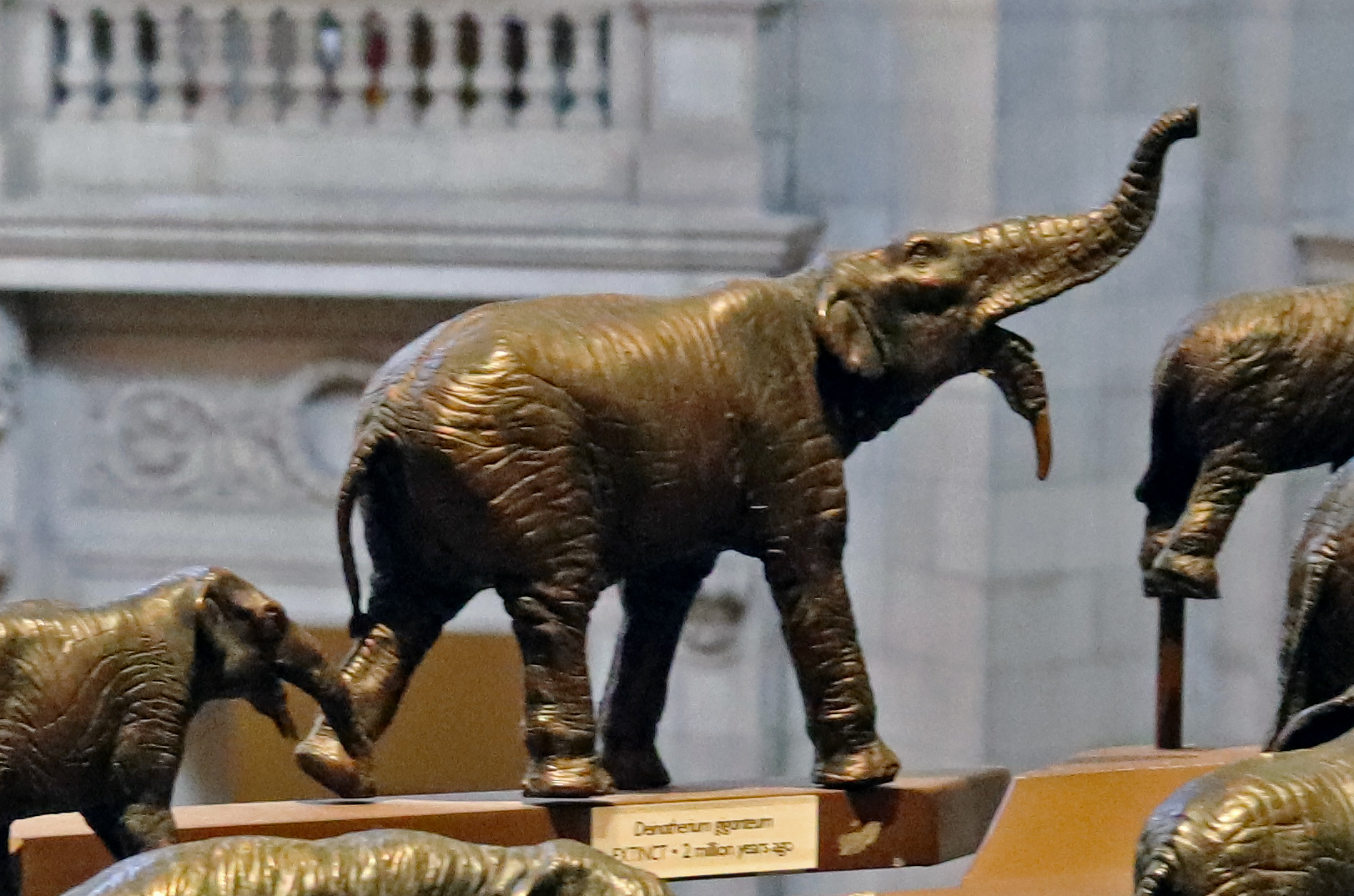
Every elephant relative ever dug up shares one piece of anatomy: ivory growing out of the upper jaw. Then there is Deinotherium. Its tusks came out of the chin, curving down and back, and the upper jaw carried no tusks at all, no incisors, no canines, nothing. The name comes from the Greek for "terrible beast", and for about twelve million years that beast browsed through the forests of Africa, Europe, India and even Crete. It was one of the largest land mammals ever to walk, and it left no descendants at all.
Fossils of the genus turned up in French turquoise mines as early as 1715, where miners mistook blue-green stained fossil teeth for ore. By 1822 Georges Cuvier had studied a huge lower jaw from Haute-Garonne and concluded it belonged to a giant tapir. It took the German paleontologist Johann Jakob Kaup, working seven years later on a broken mandible from the sands of Eppelsheim in Germany, to give the animal a name of its own: Deinotherium giganteum. Even he got it wrong at first, rebuilding the jaw with the tusks pointing upwards, a mistake he corrected a few years later.
Decades of Wrong Guesses
The early history of Deinotherium research is a catalogue of confident errors. Henri de Blainville argued in 1837 that it was closely related to sirenians, the manatees and dugongs. Hercule Straus-Dürckheim decided the skull was too heavy for a land animal and placed the creature in the sea, somewhere between whales and pachyderms. William Buckland agreed that it was aquatic and proposed that the downturned tusks were hooks for clinging to river banks, as well as tools for burrowing.
Stranger still is the story of the bones themselves. In 1613 a gravestone naming a supposedly giant king called Theutobochus Rex was dug out of a sand pit near Langon in southeast France, along with enormous bones. A French surgeon toured the country exhibiting the find until scholars showed it was a hoax, the coins buried alongside it telling a different story. Those bones eventually reached the Paris museum, where they sat for centuries before someone recognised them as Deinotherium.
Tusks in the Wrong Jaw
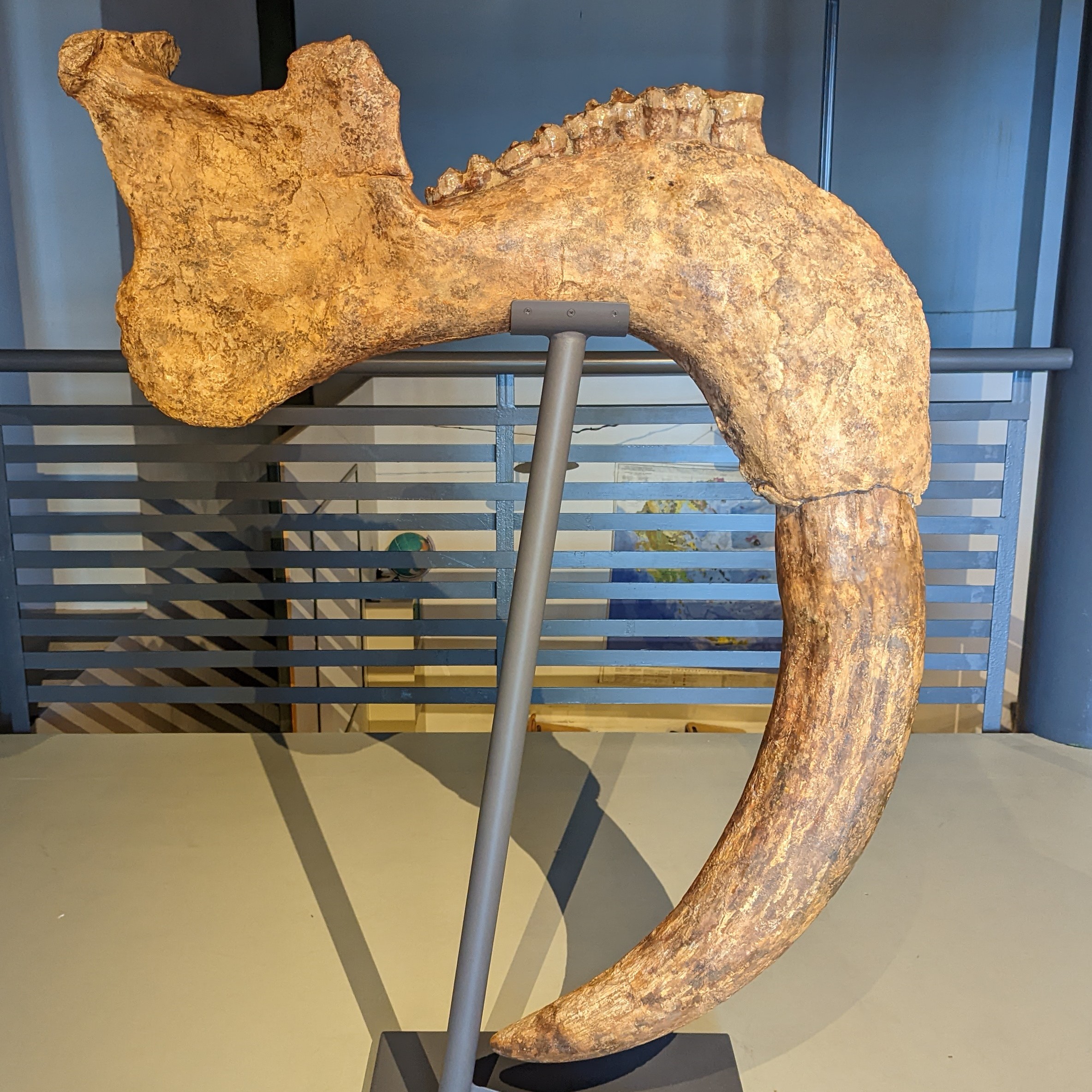
Modern elephants grow their tusks from the second pair of upper incisors, pushing up through the lip. Deinotherium ran the whole arrangement in reverse. Its single lower incisor on each side became the tusk, erupting from a mandibular front that itself curved sharply downwards, so the tooth followed a curve the bone had already drawn. Individual variation was wide: on some specimens the tusks swept back in an almost perfect semicircle, on others they hung nearly straight down.
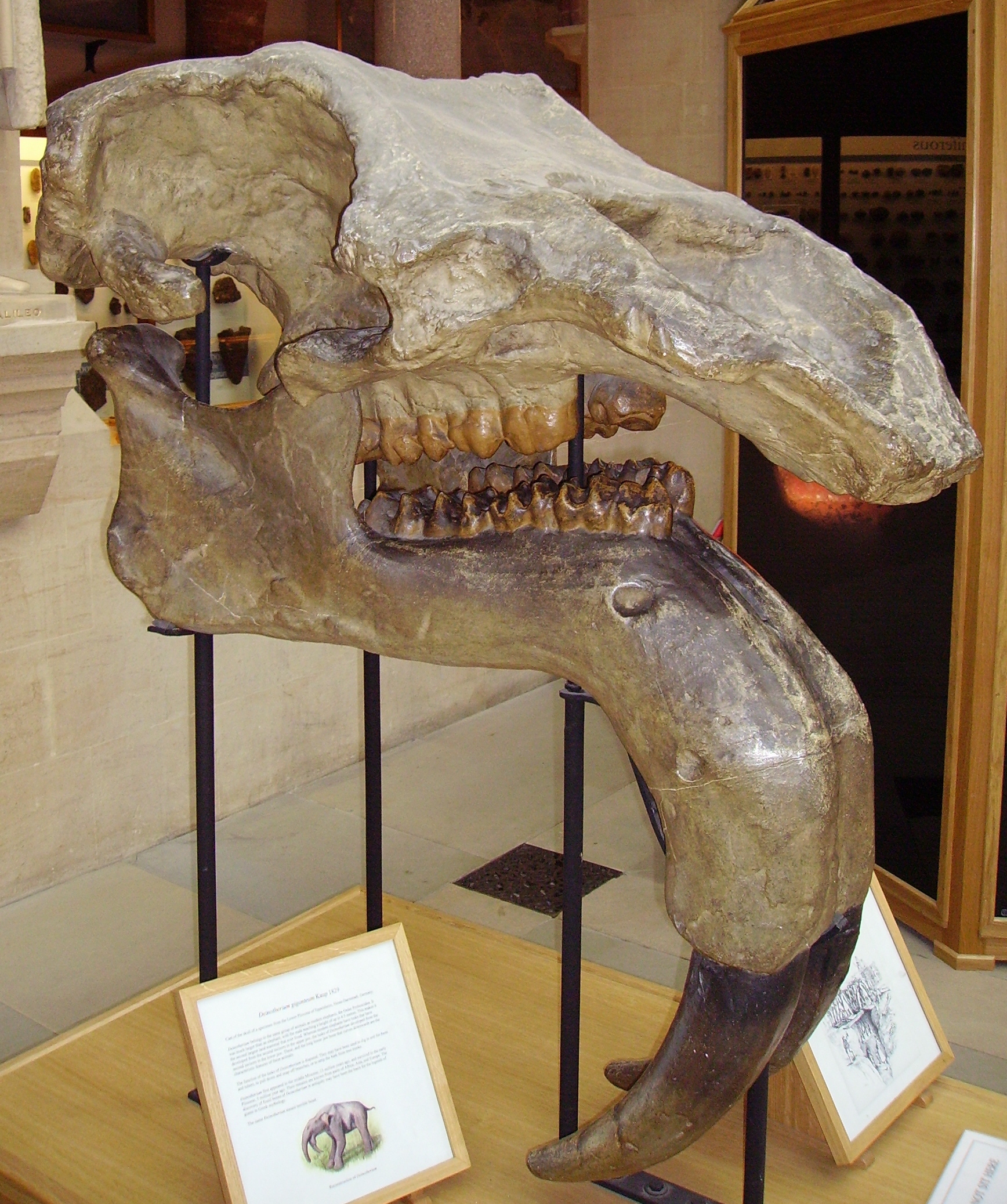
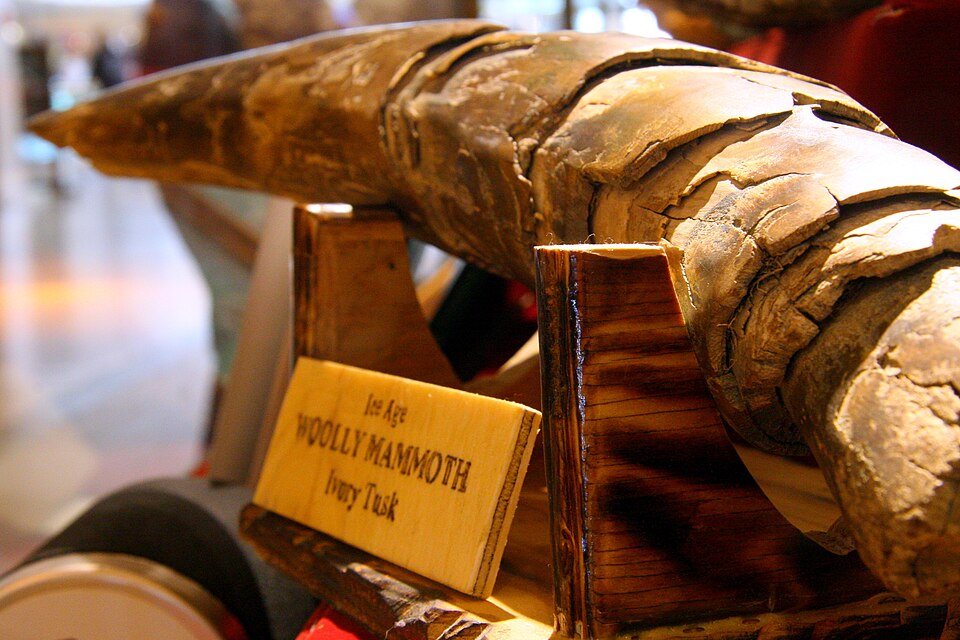
The tusks reached 1.4 metres in length and had an oval cross-section. Above them sat a skull that was short, low and flat on top, with a large retracted nasal opening that tells us a trunk hung from it. The biggest skulls run 120 to 130 centimetres long. Compare that with a mammoth's ivory, which grew from the opposite jaw and curled up over the trunk, and you can see how thoroughly this animal diverged from the elephant blueprint.
What Do You Do With a Downward Tusk?
This is the question that has bothered researchers for two centuries, and the short answer is that nobody knows for certain. What can be ruled out is digging: wear studies do not support it, and the tusks show no difference between males and females, which removes sexual display from the list too. That leaves feeding, which is where the wear patterns point. The tusks are worn most on their inner and rear sides.
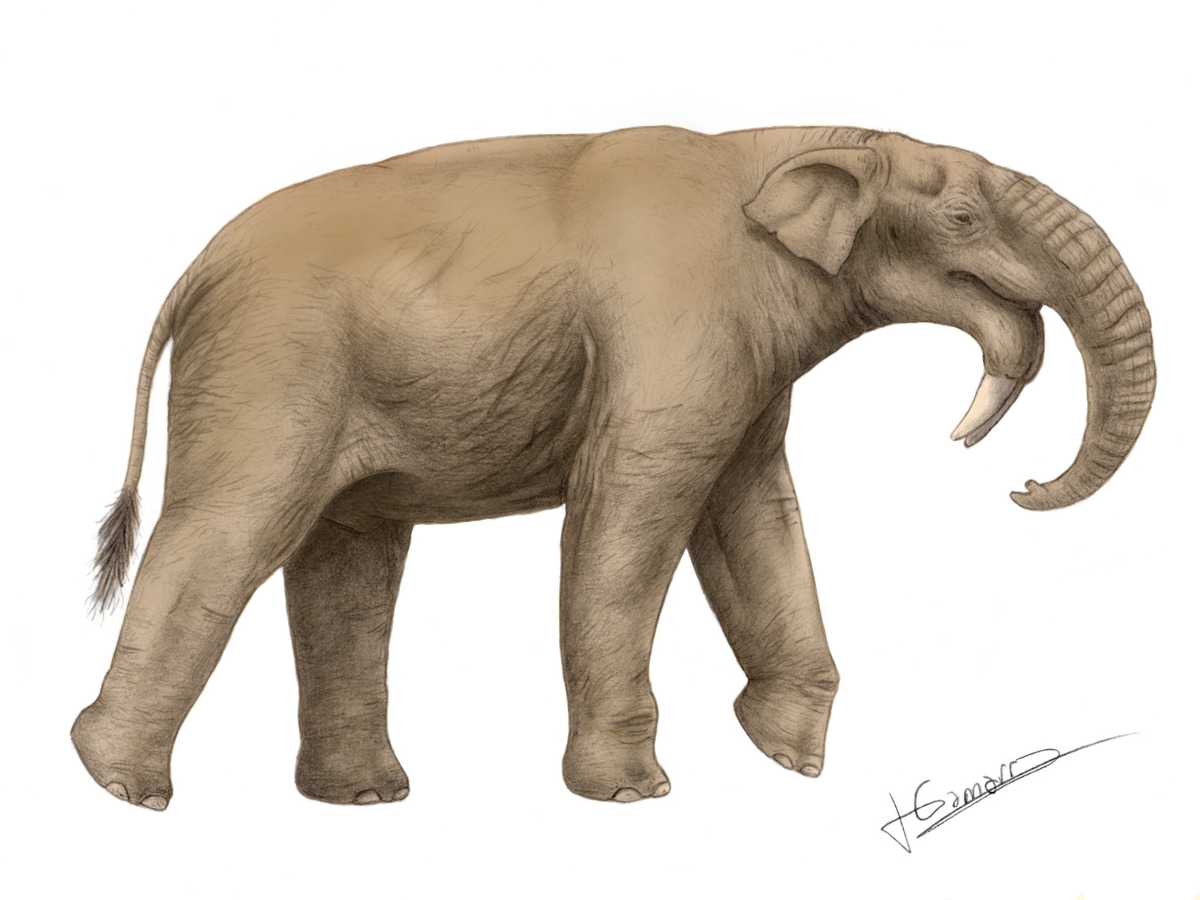
In a 2001 paper Markov and colleagues proposed a tidy division of labour. The animal hooked the tusks over a branch and pulled it aside or snapped it off, used its trunk to strip and carry leaf material, and manipulated the food with a powerful tongue, the muscle attachment for which is visible as a deep trough at the front of the jaw. Young animals had differently shaped tusks, suggesting juveniles fed in a different way from adults. The trunk itself was probably shorter and more muscular than an elephant's, with the lower lip sitting beneath the tusks rather than behind them, though it still had to be long enough for a four metre tall animal to drink.
The teeth confirm the menu. Where elephants replace their cheek teeth horizontally, shifting a fresh grinder forward from the back of the jaw, Deinotherium replaced them vertically like a normal mammal, and the teeth themselves were low, ridged and tapir-like. Dental microwear shows a diet of dicotyledonous foliage: leaves, twigs, bark and fruit taken from the woodland canopy. It was a browser living off soft food, with a slightly raised head posture suited to reaching into the trees.
How Big Did It Get?
Big enough to embarrass an elephant. Adult males of D. giganteum stood 3.63 to 4.0 metres at the shoulder and weighed between 8.8 and 12 tonnes. One large European specimen reached 4.01 metres and 13.2 tonnes. The last African species, D. bozasi, was smaller at around 3.6 metres and 9 tonnes, still heavier than most elephants alive today. The proportions differ too: the limbs are longer and more slender than an elephant's, the toes longer, the neck more flexible, and the whole build suggests an animal built to cover ground between scattered patches of woodland.

Only one land mammal clearly outclassed it. Paraceratherium, the hornless rhino relative of the Oligocene, probably outweighed even the biggest deinothere, and our article on why prehistoric animals grew so large covers the rules that push bodies to those limits. Being enormous was no accident for Deinotherium either. Size deterred the Miocene's predators, which included hyaenodonts, bear-dogs and the first big cats, and it let the animal travel far across a drying landscape where the next meal might be kilometres away.
From Africa to Crete by Land Bridge
Deinotheres began in Africa. The earliest members of the family come from the Oligocene of Ethiopia around 28 million years ago, with undoubted examples from Kenya a few million years later, and the ancestral Prodeinotherium stood only about two metres at the shoulder. When the African plate pushed north far enough to form the so-called Gomphotherium land bridge around 18 to 19 million years ago, proboscideans poured into Eurasia, deinotheres among them.
Deinotherium itself first appears in Europe roughly 13 to 11 million years ago and vanishes from the continent at the end of the Miocene, around 6 to 5 million years ago. Indian remains span about 13.5 to 8 million years ago. Africa held on longest: the genus persists there from the Late Miocene until roughly 1 million years ago, with the last Kenyan populations at Kanjera and relatives of the same stock found at Olduvai Gorge, Koobi Fora and the Omo Basin. Europe's richest sites include the Dinotheriensande of the Mainz Basin in Germany, where the type specimen came from, and the southeast of the continent, where Bulgaria has produced a large share of all European specimens. Fossils have also come out of Romania, Greece and Crete, the last while the island was still connected to the mainland.
The Last Deinothere
Nothing killed Deinotherium suddenly. It died of a slow mismatch. Through the middle and late Miocene the woodlands it depended on kept splitting apart as the climate dried, and every population left with less of the soft browse it was built to eat. The western European populations went first, then the eastern ones, then India. What finished the African survivors around a million years ago was the spread of C4 grasslands, which replaced open woodland with exactly the wrong kind of food.
Other proboscideans coped because they came equipped for the change: upper-jaw tusks for digging and stripping, and horizontal tooth replacement that kept fresh grinding surfaces coming as grass wore teeth down with its silica grit. Deinotherium kept its downward hooks and its fixed dental battery to the end. There is a useful contrast on this site with how Triops survived five mass extinctions and with the woolly mammoth that outlasted it by a few million years. One lineage survived by betting on short-lived pools, the other by flexing its diet, and the specialist with perfect tools for a world that stopped existing lost every time.
The next time you pass a proboscidean skeleton in a museum, look at the chin. If the lower jaw runs forward into a long beak with a pair of ivory hooks curving back underneath it, you are looking at the branch of the elephant family that went its own way and never came back: a browser with the jaws upside down, ruling the Miocene woodlands from Africa to the edge of Asia.