Published 2026-10-14 · by the Triops.me Editorial Team · Back to Articles
Isotelus: The 72 Centimetre King Of The Trilobites
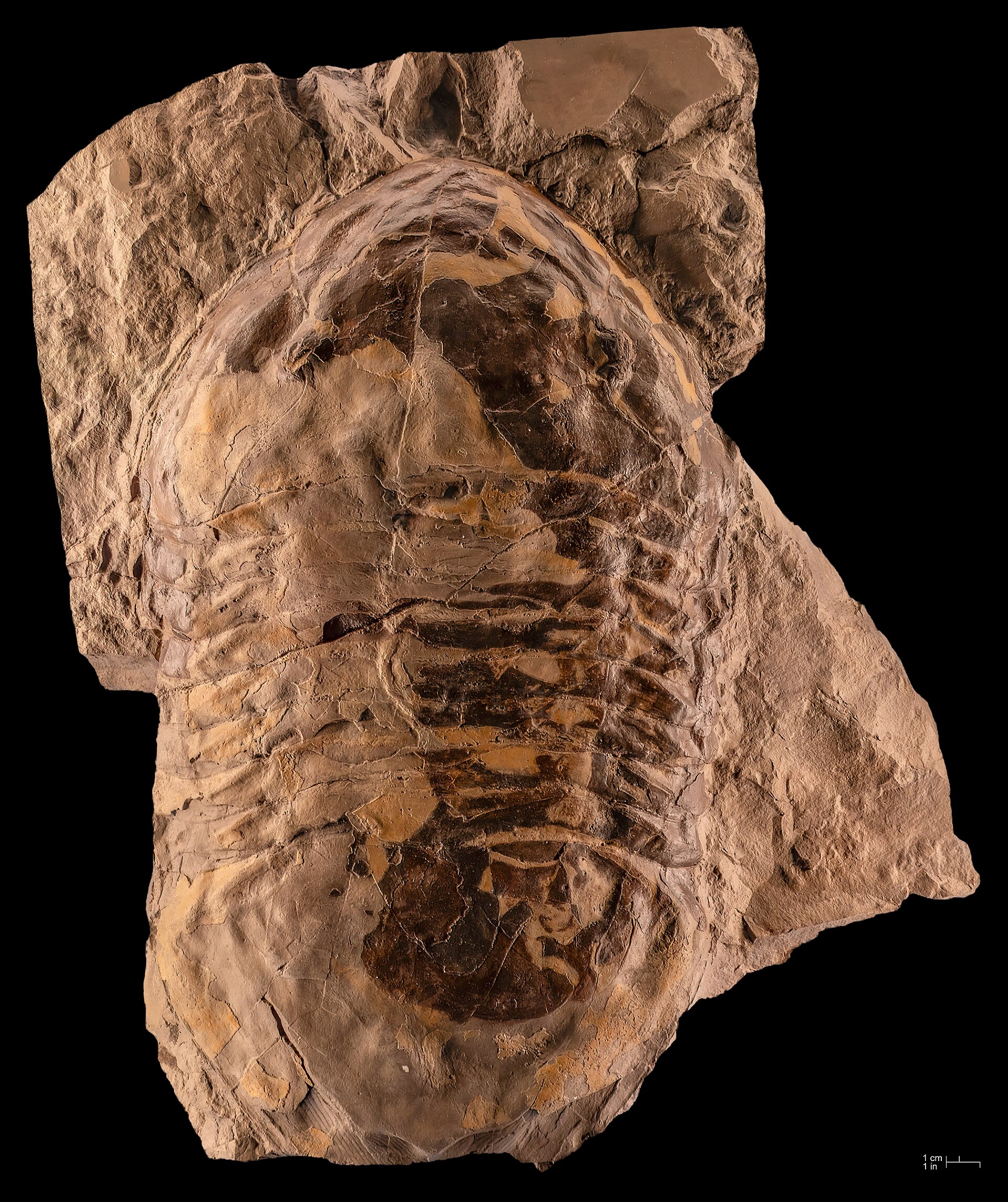
The largest complete trilobite ever found is not a spiny horror. It is a broad, smooth, almost featureless animal, an oval slab of a thing that looks like a horseshoe crab has been flattened and stretched, and it measures 72 centimetres from the front of its head to the tip of its tail. It is called Isotelus rex, and in 1999 a four person team from the Royal Ontario Museum, the University of Manitoba and the Manitoba Museum dug it out of Ordovician shoreline rock near Churchill, on the western coast of Hudson Bay. The rocks were laid down in a warm, rocky, shallow subtidal zone, and during the Late Ordovician that part of Canada sat on the equator. The description was published in 2003, and the specimen has held the record ever since.
The word complete is doing a lot of work in that sentence. Trilobite fragments turn up by the thousand and size claims are usually built from pieces, but Isotelus rex arrived as a nearly whole articulated dorsal shield. It belongs to a genus, Isotelus, that the zoologist James Ellsworth De Kay named in 1824 from fossils found at Trenton Falls in New York. The name is Greek for equal extremities, a nod to the matched head and tail shields that give the animal its tidy outline, and the first species he described was Isotelus gigas, which translates, without much imagination, as giant equal extremity.
A Record Built On Dams And Daydreaming
Big Isotelus fossils have been part of American palaeontology from the start. In 1838 John Locke, working through the Ohio state survey, named Isotelus maximus from a partial tail shield found near Dunkinsville and worked out that the whole animal would have reached about 53 centimetres. He also recorded what local people called these fossils when they turned up while ploughing: petrified locusts, butterflies, bugs and frogs. In the autumn of 1882 a fossil found by D. S. McCord and described the next year by John Mickleborough became the first trilobite ever shown to preserve legs, a detail Charles Doolittle Walcott later followed up by describing the feathery gills on the limbs.
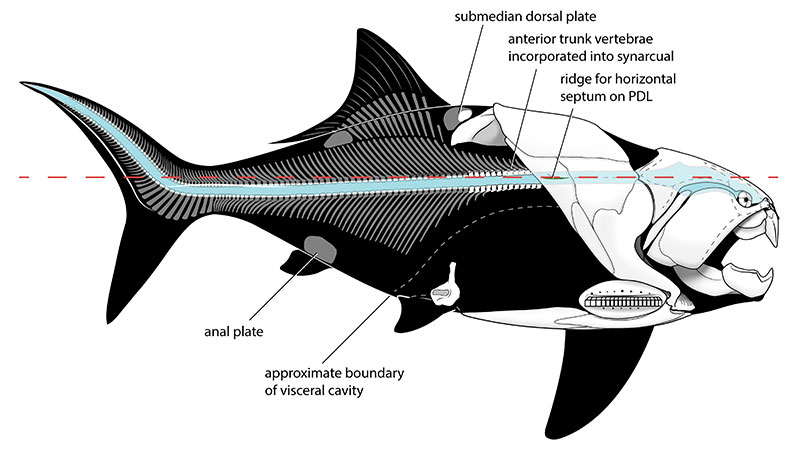
The specimen that made the genus famous, though, came out of the ground during construction work on an outlet tunnel for the Huffman Dam in Ohio, where workmen reported finding a fossil turtle. It was a trilobite, 37 centimetres long and 25.5 centimetres wide, and a photograph of it was already being passed around by 1919. It hung for decades in the National Museum of Natural History. Inspired by it, a group of students in Dayton petitioned the state government, and on 20 June 1985 Isotelus became the official state fossil of Ohio. The armoured Devonian fish Dunkleosteus, which we have met before on this site, was later added to the honour alongside it.
How A Giant Trilobite Made A Living
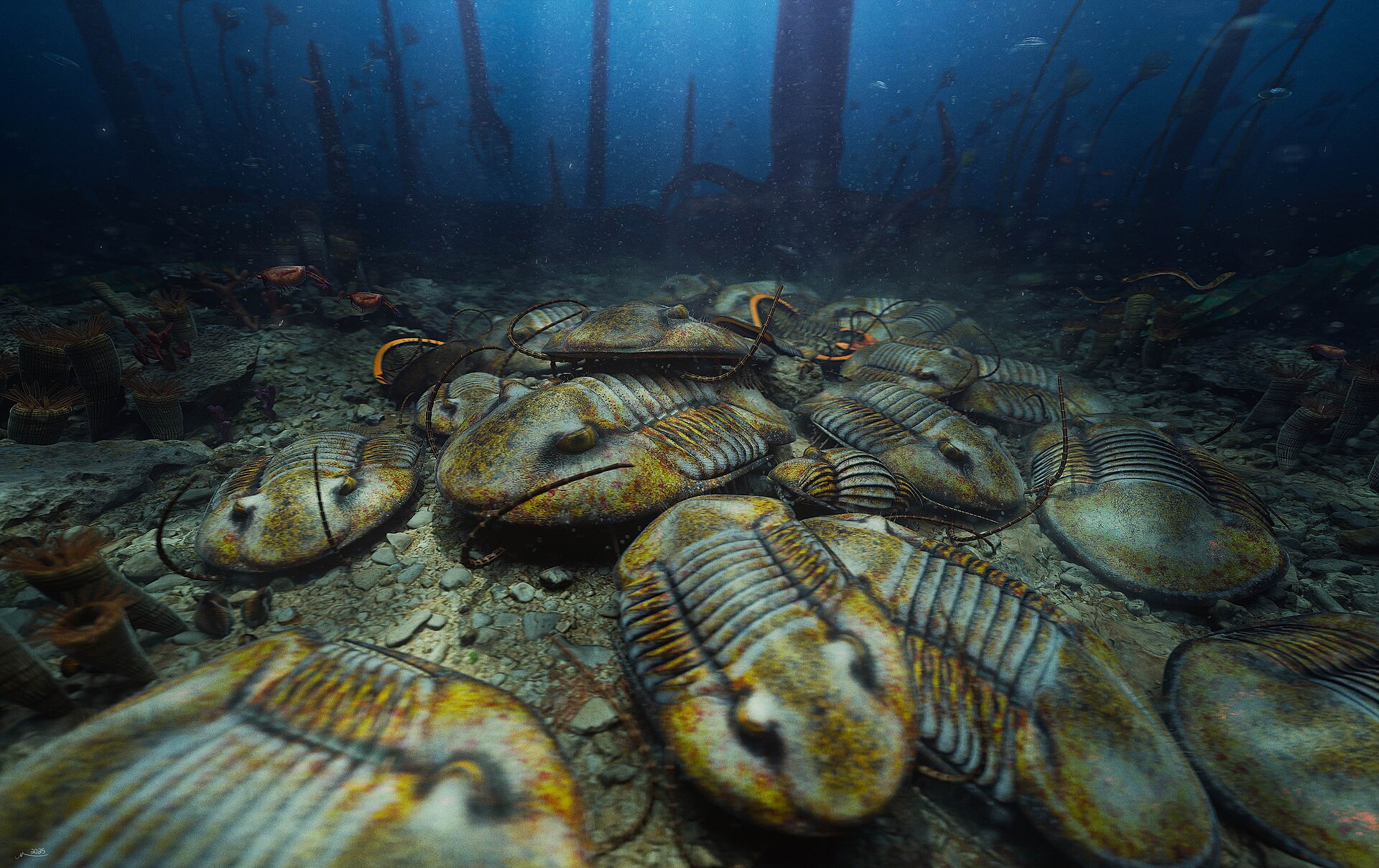
Underneath that plain shell was an animal with a job to do. Isotelus was a burrower, and its large shovel shaped head is built for pushing through sediment. The usual reconstruction has the animal partly buried with only its eyes and the top of its back showing, which also explains why so many specimens are found intact, since a half buried carcass is far less likely to be torn apart and scattered by currents before it is buried for good.
It was hunting down there. The mouthpart, a plate called the hypostome, was large and forked with two sturdy prongs, and it has been compared to a claw hammer used for levering soft bodied worms out of the mud. The evidence for that is unusually direct: a 17.5 centimetre trace fossil from Ordovician rock in Clermont County, Ohio, preserves the outline of the trilobite that made it, including the head spines, and running beneath it is a worm burrow that stops right under the animal's head. The worm was digging, the trilobite dug in on top of it, and the trail ends there.
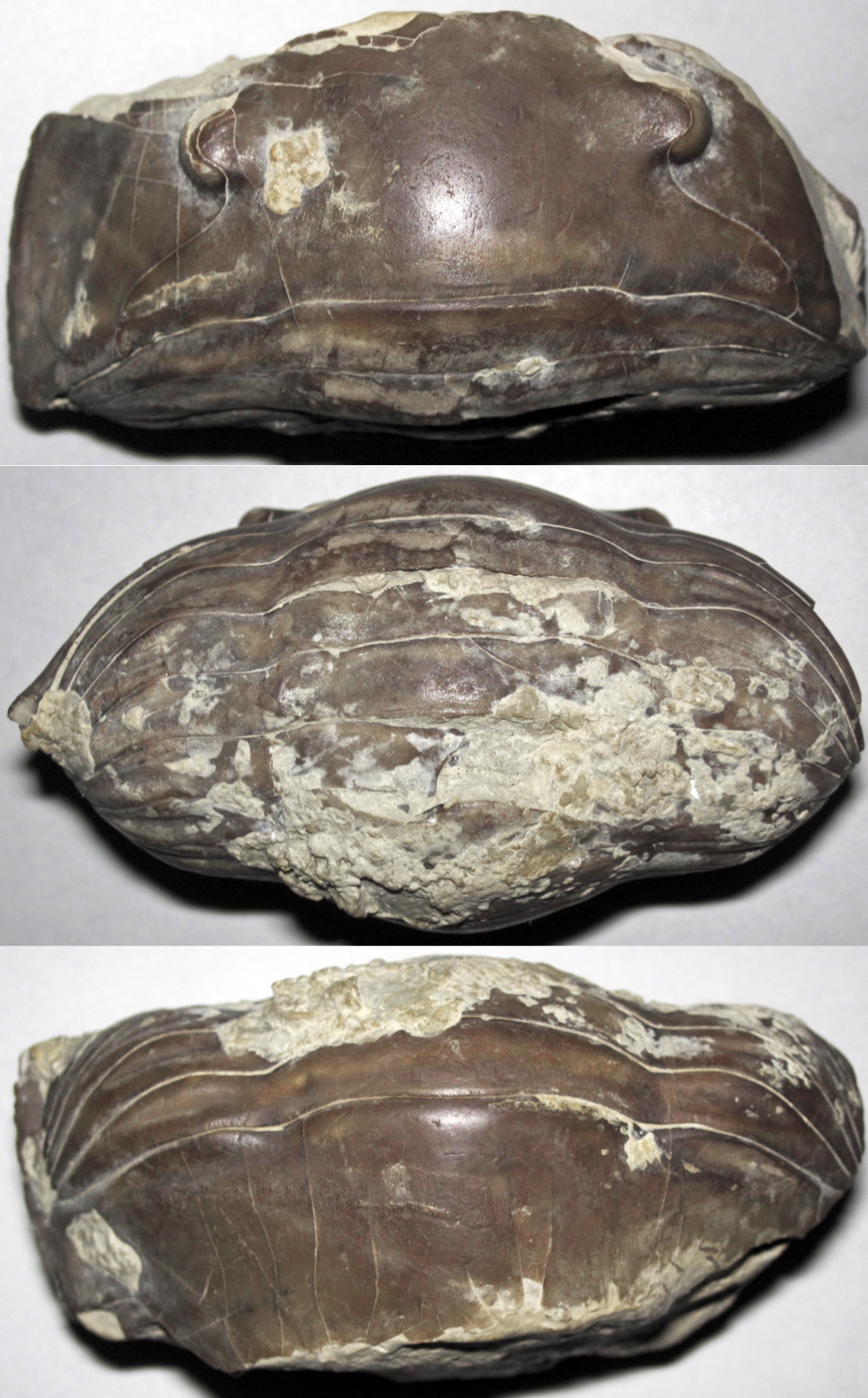
Those fine step like ridges that cover the shell, known as terrace structures, were probably sensory equipment as well as grip. The canals in them held tiny hairs angled with the current, so the buried animal could feel which way the water was moving over its back. When threatened, Isotelus rolled into a ball like its smaller cousins, and the ridges on the overlapping segments criss crossed in a way that left small channels open, letting the animal keep respiring through its gills while sealed up. Moulting was the dangerous part, and juveniles seem to have used empty nautiloid shells lying on the sea floor as temporary shelters while their new armour hardened.
Eight Segments, Five Thousand Lenses
Anatomically, Isotelus is a textbook asaphid trilobite: a big rounded head, a thorax of eight equal segments, and a wide tail shield. Adults of I. rex and I. gigas lost the head spines that other species kept, which is part of what gives them that smooth, horseshoe crab like profile. The eyes were holochroal, a single visual surface over a bed of hexagonal lenses, and in Isotelus iowensis each eye carried up to about 5000 lenses of roughly 0.07 millimetres across.
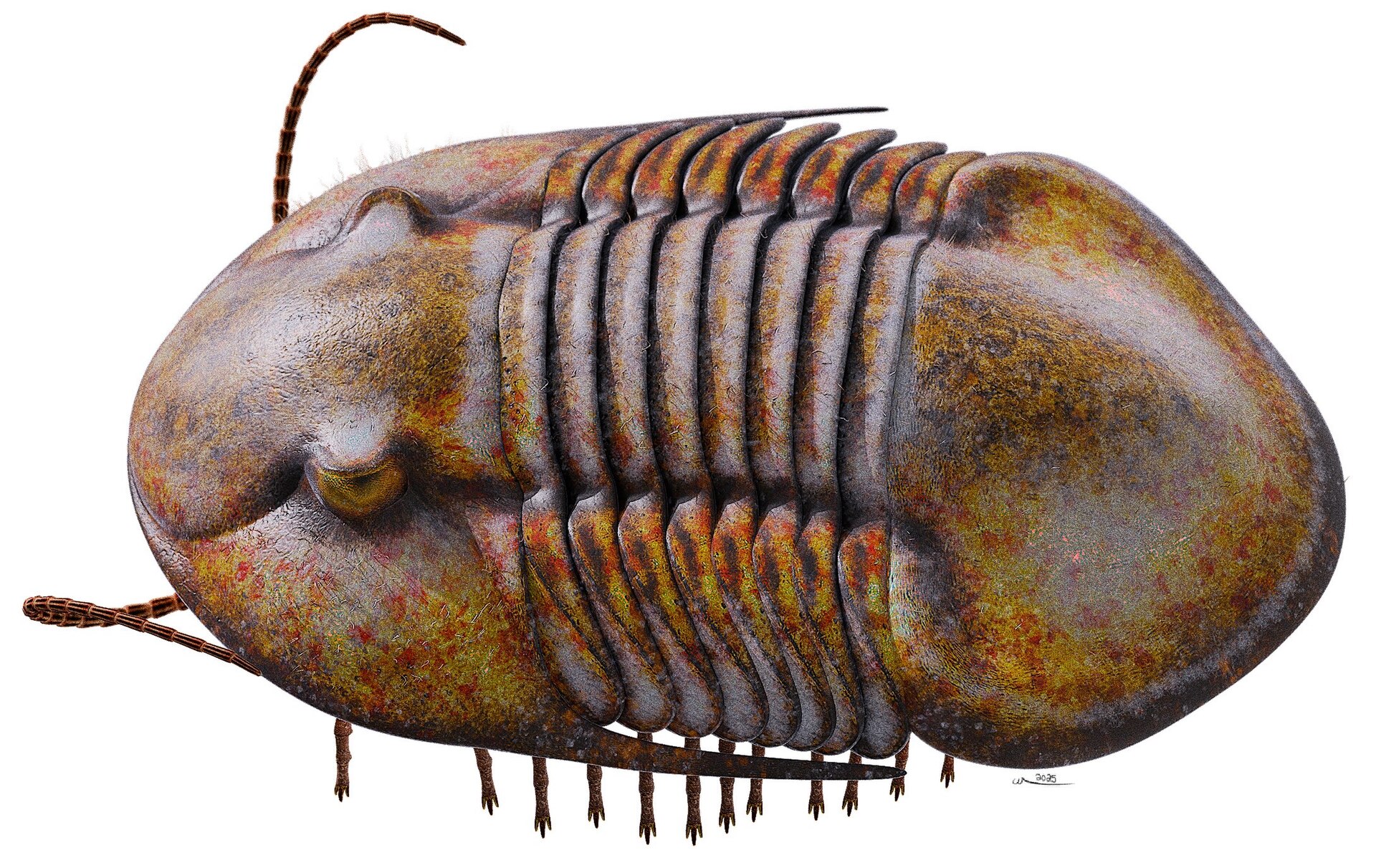
Colour has survived too. Chemically detected pigment on the shell suggests two dark stripes running the length of the body along the grooves of the thorax, continuing onto the head and tail, with a dark crescent below each eye and darker head spines in the species that had them. So the animal that sat half buried in Ordovician mud was not a uniform brown either. The Ohio specimen that preserved legs showed at least 26 pairs of them, three sets under the head, one pair per thorax segment, and about 16 more tucked under the tail shield.
Starting Life At Half A Millimetre
The adults are giants, but they did not start that way. The earliest known Isotelus larvae were about 0.6 millimetres long and lived drifting in the plankton, shaped nothing like their parents: globular, spined, with a plate of a mouth and a handful of simple eyes. Only at 8 to 10 millimetres did they settle onto the sea floor and take on the adult form. Asaphid trilobites are inferred to have spent far longer in that planktonic stage than most, and huge numbers of them gathered together to moult and breed, which is why sites with masses of individuals in one bed are known from the Ordovician of North America.
The Cold That Finished The Giants
None of the asaphids survived the Late Ordovician mass extinction, and the planktonic larva may be the reason. The group thrived in warm, low latitude water where free drifting larvae were an advantage. When the glaciation drove ocean temperatures down and spread low oxygen conditions across the seas, the species that did better were the ones laying a few large eggs that hatched as bottom living, already benthic young. The giants went first. Trilobites as a whole lasted far longer, right through to the end Permian extinction 252 million years ago, but the family of Isotelus never came back.
The Trick Triops Never Needed
There is a version of this story with a different ending, and it is the one this site keeps coming back to. Triops also lives in shallow, temporary water and has done since the Triassic, but instead of betting on larvae that drift, it produces eggs that dry out, wait in the mud for years, and hatch only when the pool refills. No asaphid trilobite ever solved drought that way, and no trilobite solved it at all. The largest one remains a museum piece from Hudson Bay, while the little shrimp that looks like a trilobite is still swimming. For how that survival trick works, see our pieces on five mass extinctions and egg cryptobiosis, and for the animals themselves, the trilobite overview.