Published 2026-09-29 · by the Triops.me Editorial Team · Back to Articles
Livyatan: The Sperm Whale That Hunted Whales
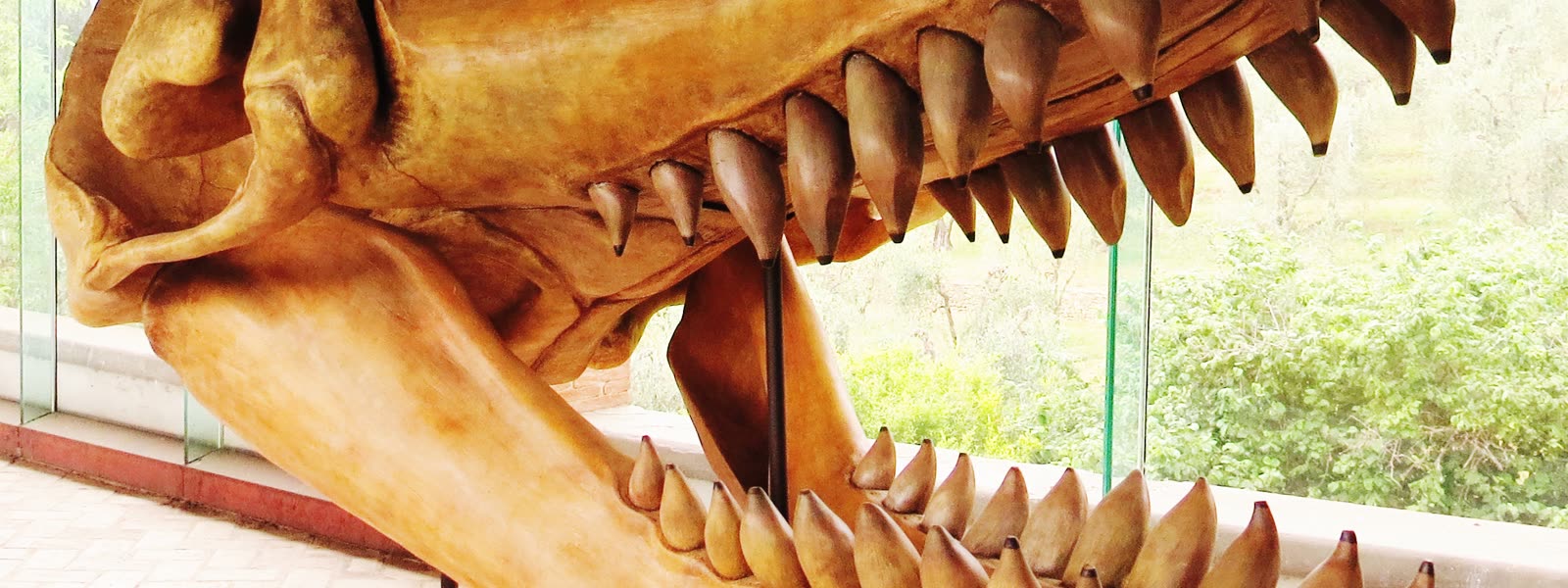
Twelve million years ago, off the coast of what is now Peru, a whale the size of a modern sperm whale swam with a completely different appetite. Its skull alone was about three metres long, its jaws were packed with cone-shaped teeth in both the upper and the lower jaw, and the biggest of those teeth stood around 36 centimetres tall. It did not filter anything and it did not gulp squid from the dark. It bit. And judging by the animals buried alongside it, one of the things it bit was other whales.
The animal is Livyatan melvillei, described in 2010 from fossils collected in the Pisco Formation on the southern coast of Peru. It belongs to the sperm whale group, which today contains exactly one living representative, the deep-diving giant that eats squid in the dark. Livyatan shows what that family looked like when it was still hunting at the surface: not a gentle vacuum with vestigial fangs, but an animal built like a shark with a whale's body.
A sperm whale that did not suck
Modern sperm whales have a strange head. Roughly a third of the body length is a huge forehead filled with oil and waxy material inside a basin of bone called the supracranial basin. The lower jaw carries slender teeth that fit into sockets in the upper jaw, and the animal rarely uses them for chewing. Sperm whales hunt by opening their mouths near a squid and sucking the prey in, a technique that works beautifully on soft, slippery animals in darkness.
Livyatan had that same basin in its skull, so its head probably held something like the same organ. Everything below it was different. The teeth were thick, curved and interlocking, they sat in both jaws, and they were built to meet each other with force instead of sliding past each other. That is the difference between a suction feeder and a predator that holds onto large, struggling prey and cuts it into pieces it can swallow.
Teeth the length of a forearm
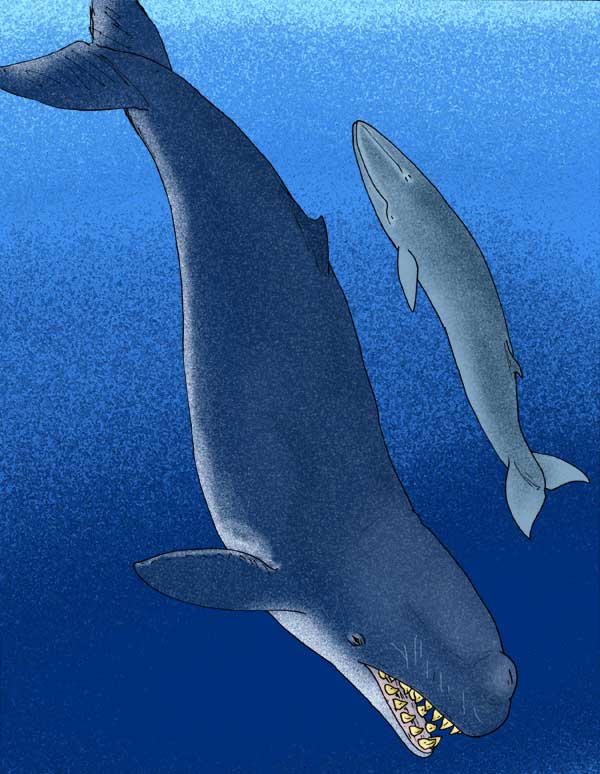
The crowns of the largest Livyatan teeth reach about 36 centimetres, which puts them in the running for the largest functional teeth of any animal ever measured, including the famous serrated teeth of giant Cretaceous sharks. The thickness matters as much as the length. Long thin teeth snap when they hit bone. These were blunt, heavy pegs that could close around a ribcage and stay in one piece.
Estimates of the whole animal land between roughly 13 and 16 metres in length, which makes it comparable to an adult female sperm whale today, and heavier than most whales alive in its own seas. It was not the longest animal of the Miocene, but in terms of what it could do with its mouth it had very little competition.
The sea it hunted in
The fossils come from the Pisco Formation, a stretch of rock on the Peruvian coast near the town of Sacaco that records a cold, nutrient-rich upwelling sea much like the Humboldt Current that drives Peru's fisheries today. The water was crowded with life. Small baleen whales and toothed whales fed on fish and squid, penguins dived among them, seals hauled out on the beaches, and sharks of several kinds patrolled the same grounds. Cold water holding that much food is exactly the sort of place where a large predator can make a living by eating other large predators.
That abundance also explains why we know anything at all. Animals that died in the shallow bays sank into oxygen-poor sediment, which slows decay and scattering, so the Pisco Formation has produced skeletons of whales, dolphins, penguins and sharks in unusual numbers. The Livyatan type specimen, a large skull with part of the spine attached, came out of that same deposit, and it remains one of the very few pieces of the animal that have ever been found.
Rival of the biggest shark
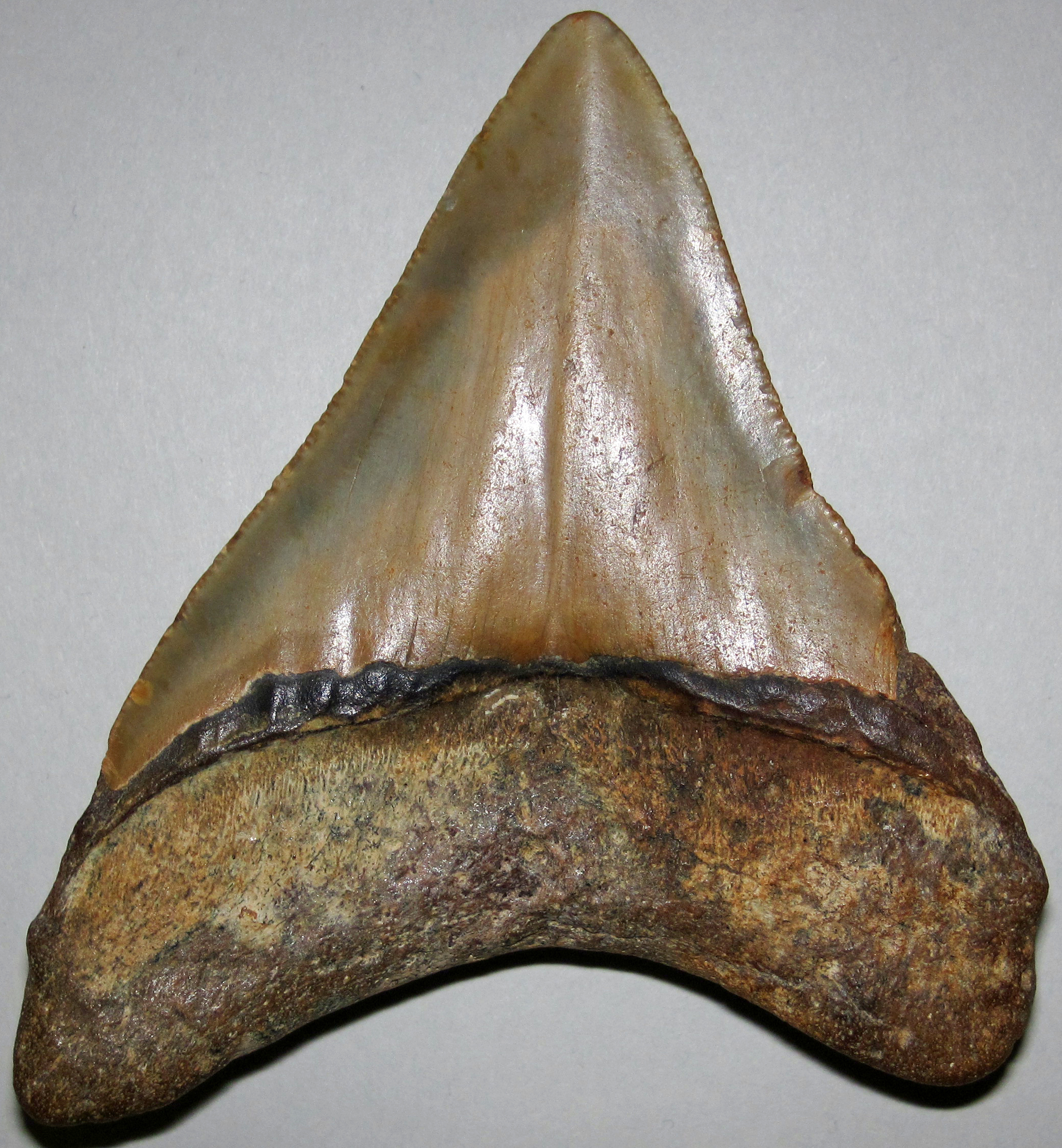
The Miocene seas that held Livyatan also held Otodus megalodon, the largest shark that ever lived, at something like 15 metres. Two apex hunters of nearly the same size sharing one coastline is a comparison that writes itself, and artists have been painting the confrontation ever since. What the fossils do not show is whether they actually fought, whether they hunted the same prey, or whether they simply avoided each other. There is no bite mark on any Livyatan bone and no shark tooth in any whale skeleton that settles the question.
Livyatan was also not alone in its own family. Several other large predatory sperm whales swam the Miocene oceans, including Zygophyseter and Brygmophyseter from the northern hemisphere and Acrophyseter from South America. It looks as though the sperm whale family once ran an entire guild of raptorial species and later contracted to a single squid-eating survivor. In ecological terms, Livyatan was roughly the equivalent of a modern killer whale wearing a sperm whale's body plan.
Why the giant disappeared
After the middle Miocene the record goes quiet. No Livyatan fossils have turned up in younger rocks, and nobody knows the exact date of its disappearance. The general story of that interval is cooling and shifting ocean circulation, changes that rearranged where productive water sat and probably which prey species gathered above it. A predator that depended on schools of small to medium whales would have felt that restructuring first, because unlike a scavenger it could not simply switch to eating whatever washed past.
It is the same pattern this site keeps running into from the other direction. Livyatan was superbly built for a specific job in a specific sea, and superbly built things are expensive to keep running when the sea changes. Triops survives five mass extinctions by refusing to be impressive at all.
What the survivors kept
Modern sperm whales are the quiet aftermath of all that. They kept the enormous head and the oil-filled basin, they dropped the bone-crushing dentition to a set of lower-jaw teeth that mostly never meet anything, and they moved their hunting grounds from the sunlit surface to several kilometres down, where squid live. The family went from whale-eating generalists at the top of the food chain to specialist suction feeders in the dark, and did fine. Their earlier relatives, like the Eocene Basilosaurus, had already shown that toothed whales could cut as well as swallow.
That is the value of a skull in a Peruvian desert. Livyatan tells us the modern sperm whale is not the natural end state of its lineage, just the version that is left. Read the family's history in reverse and the animal with 36-centimetre teeth looks less like a monster and more like the rule, and today's silent squid hunter looks like the strange one. See also how whales walked before any of this existed, and what turned them into swimmers.