Published August 24, 2026 by the Triops.me Editorial Team · Back to Articles
Ichthyostega: The First Vertebrate to Walk on Land
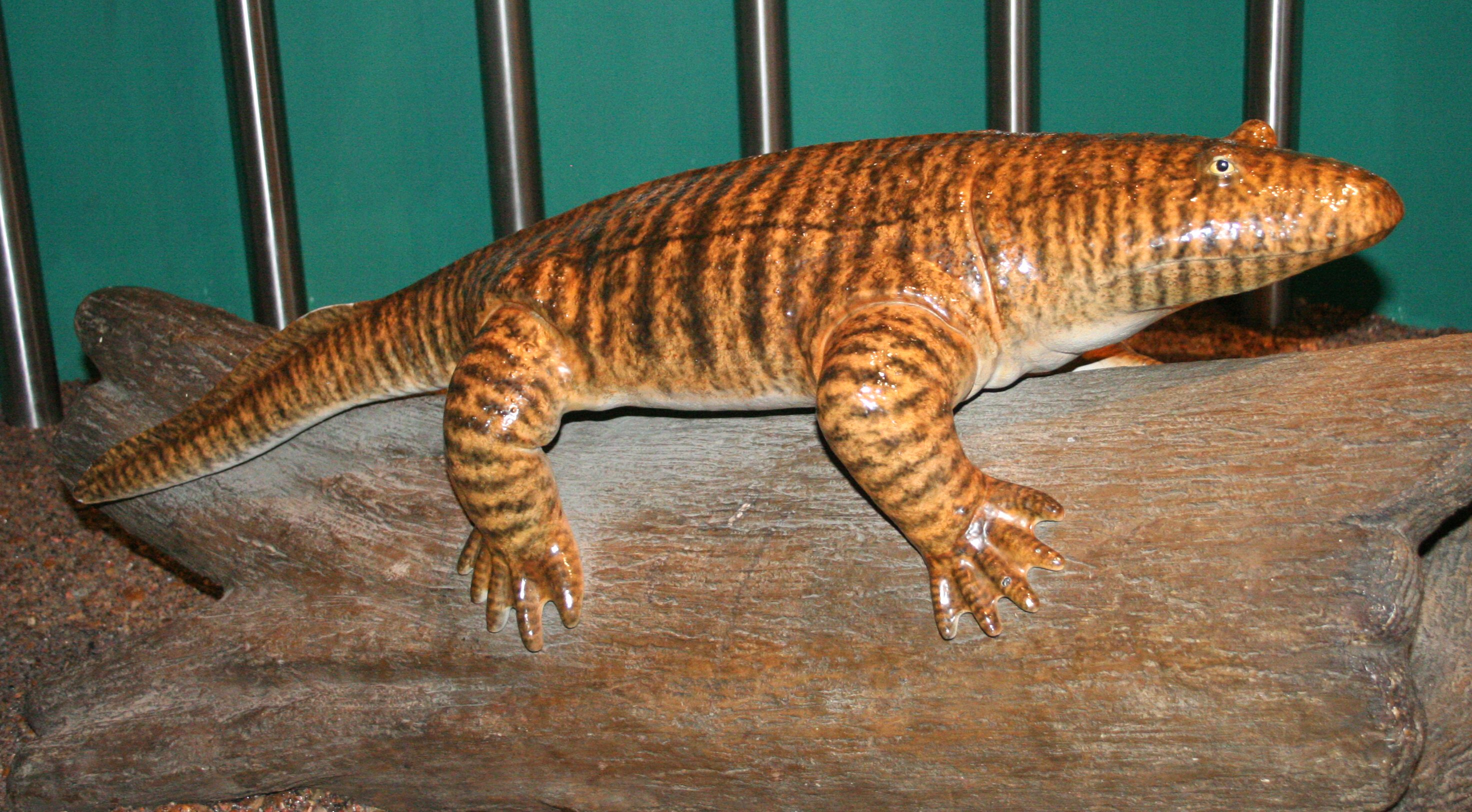
Imagine a world without birds, without trees, without a single footprint on solid ground. That was Earth 365 million years ago, in the Late Devonian period. Rivers and swamps teemed with life, but dry land was barren, rocky, and lifeless. Then something remarkable happened: a fish with stubby, limb-like fins dragged itself out of the water and onto the mud. That fish was Ichthyostega, and its story is one of the most extraordinary in the history of life on Earth.
A Giant of the Devonian Swamps
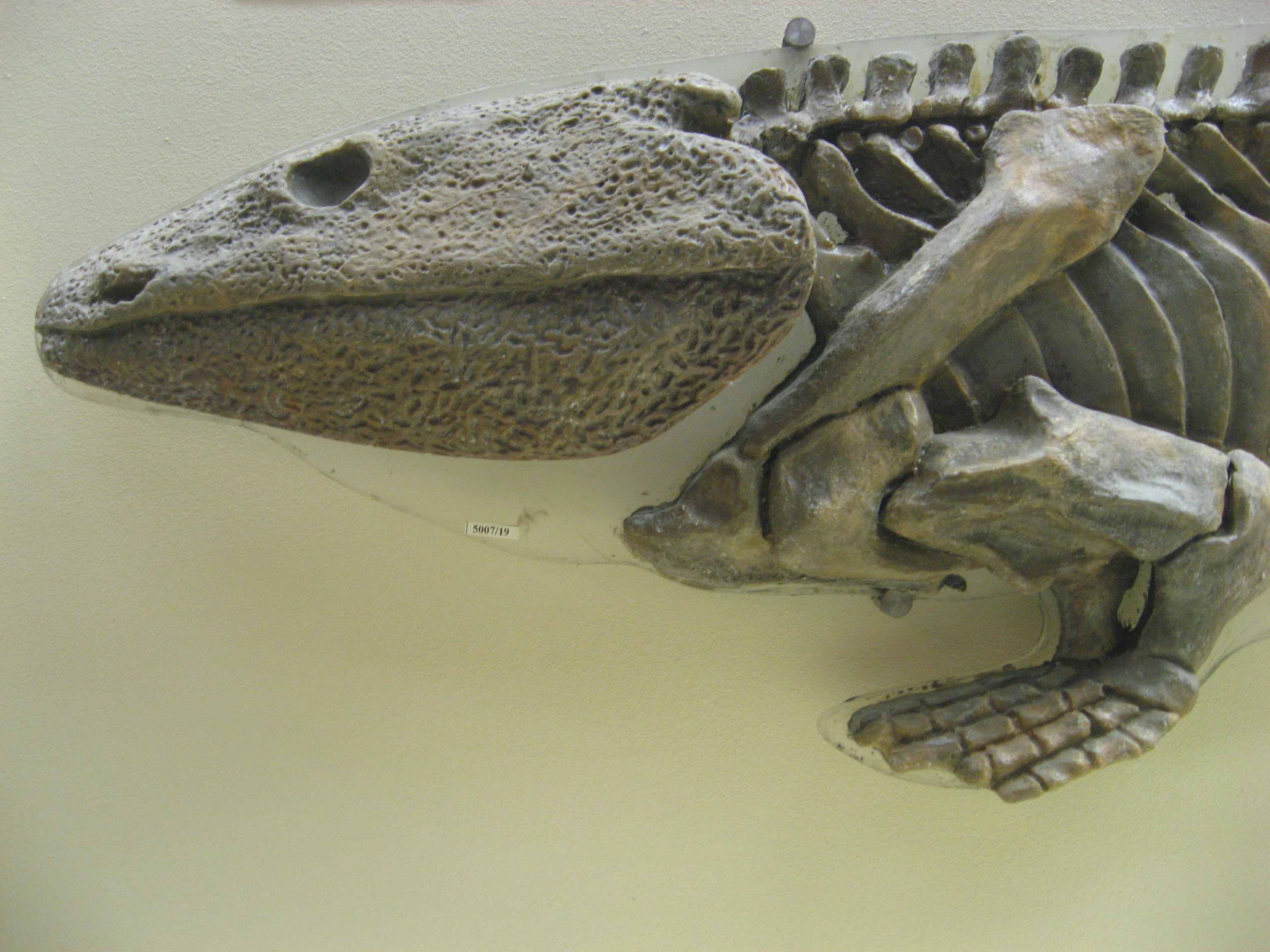
Ichthyostega (pronounced ik-thee-oh-STEE-guh) was named by Danish paleontologist Erik Jarvik in 1952, based on fossils collected from the famous East Greenland expeditions of the 1930s. The name means "fish roof," referring to the bony plates that covered the top of its skull, forming a protective shield. But this was no ordinary fish. Measuring roughly one meter (3.3 feet) in length and weighing perhaps five kilograms, Ichthyostega was larger than most fish of its time and far more advanced in its body plan.
Its fossils come from the Fleming Fjord Formation in East Greenland, a region that during the Late Devonian sat near the equator, covered in vast tropical swamps and river systems. These were the same environments where Tiktaalik, its famous predecessor, also lived just a few million years earlier. Together, these creatures paint a picture of a gradual, messy transition from water to land, not a sudden leap.
Not Quite a Fish, Not Quite a Tetrapod
What makes Ichthyostega so fascinating is that it defies neat classification. It had fish-like features: a tail fin for swimming, gills for breathing underwater, and a body plan that still looked mostly aquatic. But it also had tetrapod features: limbs with digits (not fins), a flattened ribcage, and eyes positioned on top of its skull like a crocodile. It was stuck in the evolutionary middle ground.
For decades, Ichthyostega was depicted as a lurching, fish-like creature dragging itself across mudflats. But modern biomechanical studies have completely revised that image. Research published in Nature in 2012 by Stephanie Pierce, Jennifer Clack, and John Hutchinson revealed that Ichthyostega was far more aquatic than previously thought. Its hind limbs were paddle-shaped and poorly suited for walking, and its spine was stiff, preventing the side-to-side undulation needed for a walking gait. Instead, it likely used its front limbs to haul itself onto mudbanks, dragging its body forward like a seal on land.
Seven Toes on Each Foot
One of the strangest facts about Ichthyostega is the number of digits on its hind feet. While modern tetrapods almost universally have five digits per limb, Ichthyostega had seven on its hind limbs and eight on its front limbs. This was one of the earliest clues that the "pentadactyl limb" (five-fingered hand) pattern was not present at the very origin of tetrapods. Evolution experimented with different numbers of digits before settling on the familiar five.
The broad, webbed shape of these hind limbs suggests they functioned more like paddles for swimming than legs for walking. Combined with its stiff trunk and fish-like tail, the picture that emerges is of an animal that spent most of its time in shallow water, occasionally clambering onto mud or vegetation to rest, bask, or escape predators.
From Water to Land: A Long Process
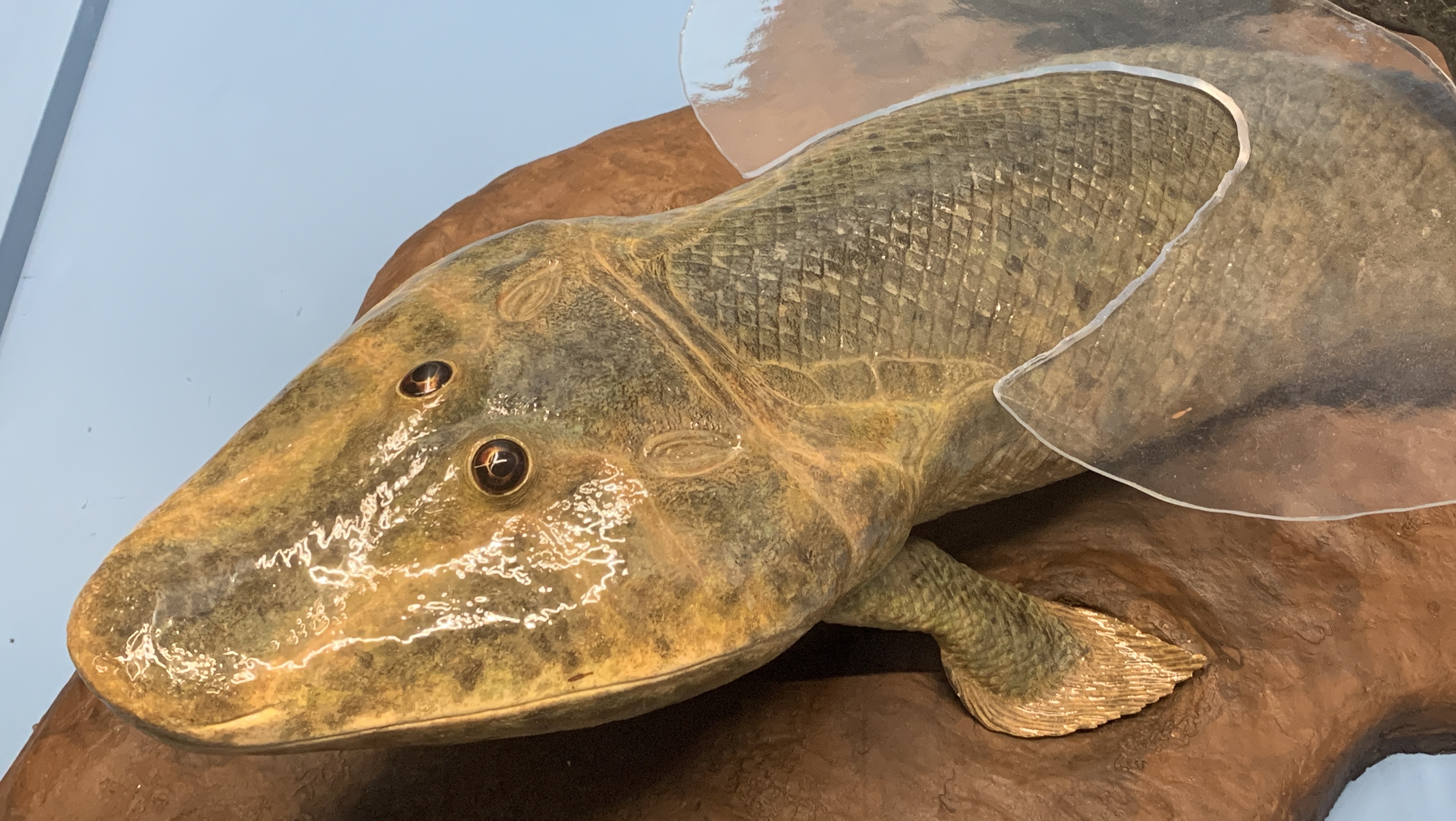
The transition from water to land was not a single event but a process that played out over tens of millions of years. Tiktaalik, discovered in the Canadian Arctic in 2004, represented an earlier stage: a fish with a flattened head, a mobile neck, and fin bones that foreshadowed limb structure. Ichthyostega came a few million years later, with more developed limbs but a body still fundamentally tied to water.
Other Devonian pioneers in this transition included Acanthostega, which had eight digits on each limb and retained internal gills throughout its life, suggesting it never left the water at all. Ichthyostega was more terrestrial than Acanthostega but less so than later tetrapods like Tulerpeton or early Carboniferous forms. It occupied a middle ground in one of the greatest transitions in evolutionary history.
Anatomy Built for Two Worlds
Several anatomical features reveal how Ichthyostega adapted to life at the water's edge. Its ribs were broad, flat, and overlapping, forming a rigid barrel that supported its body against gravity on land. This is a stark contrast to the thin, flexible ribs of most fish. The ribcage essentially acted as an internal corset, preventing collapse when the animal hauled itself out of the water.
Its eyes were positioned dorsally, on top of the head, much like a crocodile or a mudskipper. This allowed it to peer above the waterline while keeping most of its body submerged, a useful trait for spotting predators or prey on the shore. The skull was broad and flat, with a wide gape suited for ambush hunting in shallow water.
Recent CT scanning of Ichthyostega fossils has also revealed details about its inner ear structure. The ear bones were adapted for detecting vibrations transmitted through bone, suggesting that Ichthyostega may have been sensitive to ground-borne sound, another adaptation for life near the water's edge.
Legacy: The Vertebrate on Land
Ichthyostega lived roughly 365 to 360 million years ago and left no direct descendants. It was an evolutionary experiment, a branch on the tree of life that eventually ended. But the broader group it belonged to, the early tetrapods, gave rise to all land vertebrates: amphibians, reptiles, birds, and mammals. Every time you walk, you are using limbs that trace their lineage back to creatures like Ichthyostega.
The story of Ichthyostega also connects to the broader theme of prehistoric survival that defines this site. Just as Triops has persisted for hundreds of millions of years through mass extinctions and environmental upheaval, the lineage that began with Ichthyostega would eventually produce organisms capable of colonizing every habitat on Earth. The Devonian swamps where Ichthyostega hauled itself onto mudbanks were the crucible for everything that followed.
Further Reading
- Tiktaalik: The Fish That Walked Onto Land - the predecessor to Ichthyostega in the water-to-land transition
- The Cambrian Explosion: When Life Got Interesting - life 300 million years before Ichthyostega
- Trilobites: Arthropod Dominance - another group that conquered new environments
- Dimetrodon: The Sail-Backed Predator - what came after the Devonian land invasion