Published October 25, 2026, 17:48 · by the Triops.me Editorial Team · Back to Articles
Trilobite Eyes: The First Eyes on Earth
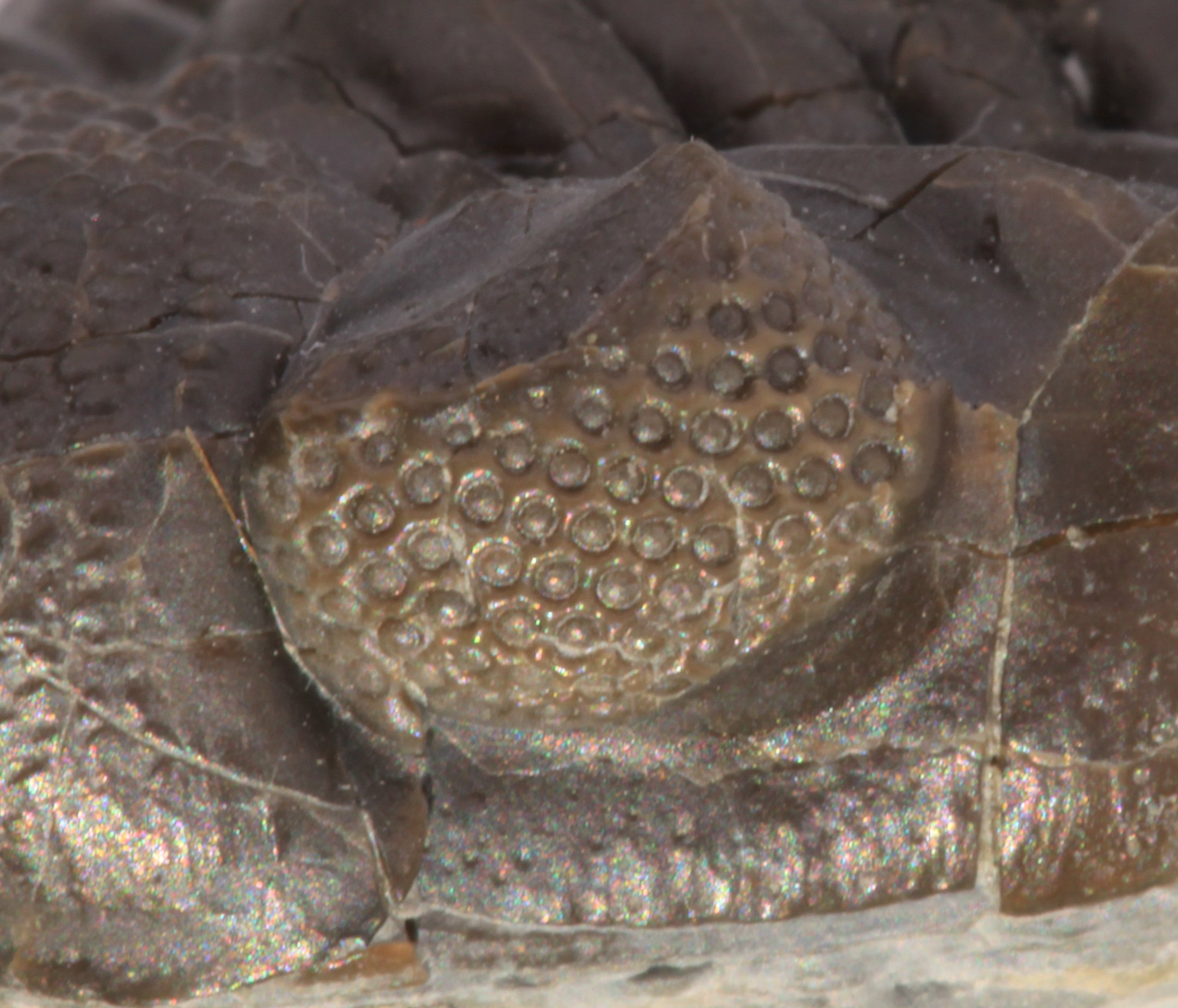
Roughly 521 million years ago, trilobites appear in the fossil record already wearing equipment no animal had carried before: eyes that could form true images. The Cambrian explosion gave the world predators, shells, and burrows, but its most quietly revolutionary invention may have been vision. For the first time, an animal could look at the water around it and actually see what was there.
Trilobites did not just have eyes. They had eyes built from stone, solved optical problems that human engineers would not touch until the seventeenth century, and then spent the next 270 million years evolving them into every shape an eye can take. Here is how the first eyes on Earth worked, and why you can still look straight into one today.
An Eye Made of Rock
Almost every animal eye ever built uses soft tissue and protein. Trilobites, being arthropods with a mineralized shell, took a different route. Their eye lenses were made of calcite, the same clear mineral that builds limestone, chalk, and seashells. As far as we know, they are the only animal group that ever used this material for vision.
This choice had a strange consequence. When a trilobite died and settled into seafloor mud, its soft parts rotted away like any other creature's, but the crystal lenses stayed right where they were. Many trilobite fossils, even ones 400 million years old, have eyes that are still translucent. Hold a specimen up to the light and the lenses glow. Fossils usually preserve shapes; trilobite eyes preserve working optics.
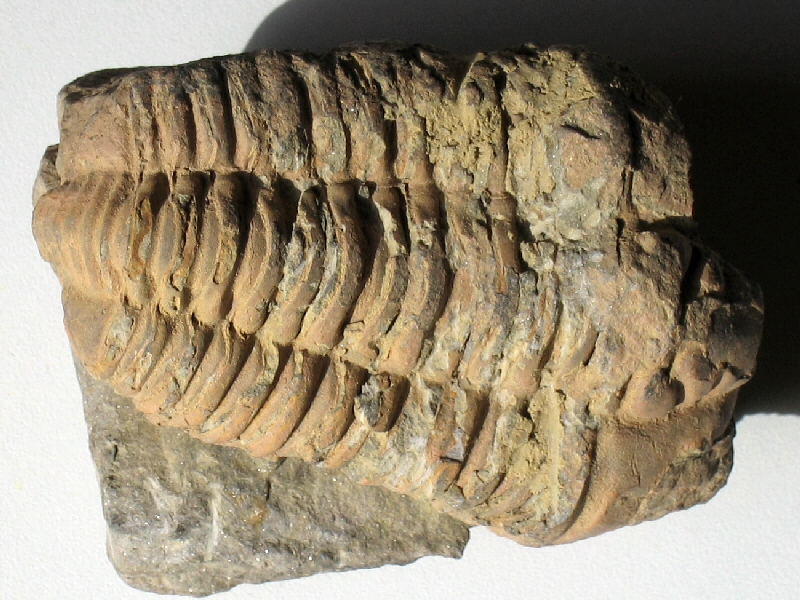
Calcite came with a catch. It is a birefringent crystal, which means light bends in two different directions depending on how it enters. A simple calcite disc is a terrible lens. Trilobites spent their entire evolution working around this flaw, and the solutions they found are the best part of the story.
Two Blueprints for an Eye
Paleontologists recognize two main types of trilobite eye. The first, and by far the most common, is the holochroal eye. It looks like the compound eye of a modern insect: a dense cluster of tiny lenses, often hundreds or thousands of them, packed together in a honeycomb and covered by a single shared corneal layer. Each lens was small, frequently well under a millimeter, and contributed one fragment of the scene. The trilobite's brain combined the fragments into a broad, mosaic view of its surroundings.
The second type is the schizochroal eye, and it is one of the strangest visual systems ever evolved. Found only in one subgroup, the Phacopina, it abandoned the crowd approach. A schizochroal eye carried a handful of large lenses instead of thousands of tiny ones, from just a couple to around 700 at most, and each lens got its own cornea, its own casing, and a visible gap of shell separating it from its neighbors. Where a holochroal eye looks like fly paper, a schizochroal eye looks like a cluster of glass bubbles.
Why build an eye this way? Each large lens may have gathered far more light than a tiny one, useful in dim or murky water, and each could produce a reasonably sharp little image on its own. The details are still debated, but the design clearly worked. The Phacopina carried it from the Ordovician period all the way to the end of the Devonian, a run of nearly 200 million years.
Descartes' Lens, 400 Million Years Early
The deepest surprise hides inside each schizochroal lens. Under the microscope, these lenses turn out to be doublets: an upper shell of calcite sitting on an inner, differently oriented pad. As a pair, the two parts cancel out spherical aberration, the smearing that plagues a simple lens, and produce a clean, focused image.
In 1975, the paleontologist Euan Clarkson and the physicist Riccardo Levi-Setti pointed out something remarkable. A French philosopher named René Descartes had designed a two-part lens that corrects spherical aberration in 1637, and Christiaan Huygens proposed a similar one shortly after. Both men thought they were inventing an improvement. Trilobites had already built that improvement, in calcite, before there were any trees on land. Nobody handed them the math; natural selection ground it out by trial and error over tens of millions of years.
Eyes for Every Lifestyle
A trilobite eye could not blink, roll, or change shape. There was no soft eyeball, just a rigid crystal window fixed into the head. So trilobites evolved eye placement instead, and their head shields record an astonishing range of optical strategies.
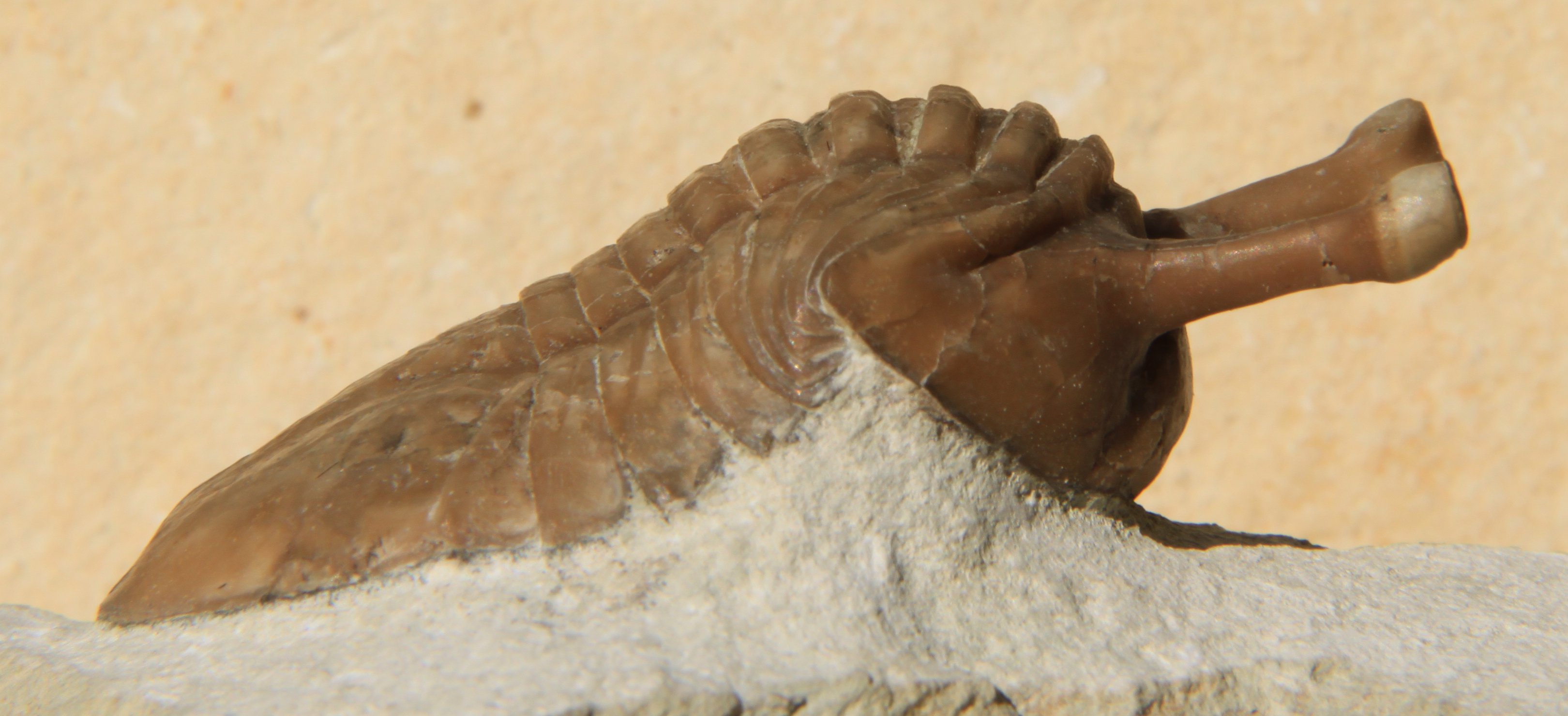
The Ordovician trilobite Asaphus kowalewskii is the showpiece. Its eyes sit on top of two tall stalks that rise from the head like periscopes. The suggestion is that it lived half-buried in soft sediment on murky seafloors, with only the stalks breaking the surface, watching for danger above. Its relatives show the whole experiment in motion: across the genus Asaphus, the stalks grow taller and taller in species after species, as if the seabed kept getting muddier.
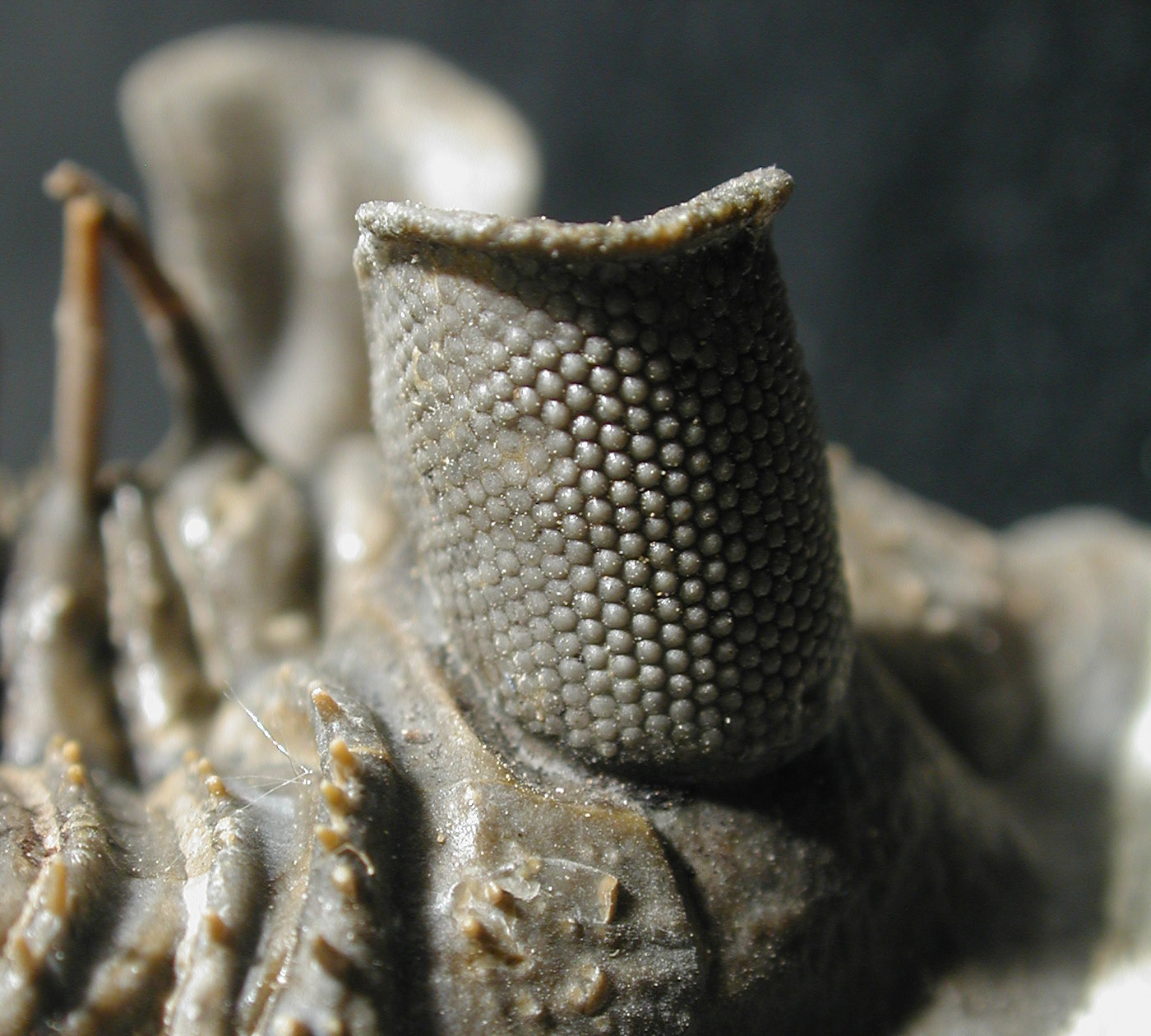
At the other extreme, the Devonian trilobite Erbenochile erbeni built its eyes upward into towering curved walls of lenses, dozens stacked on top of each other, wrapped by a projecting brim that shades them like the visor of a cap. Researchers interpret the tower as a 360-degree lookout and the brim as a sunshade, cutting glare from above and letting the animal track prey against the bright surface. It is essentially a precision instrument, grown by an arthropod, 400 million years before the word existed.
The Blind Branches
Vision was not mandatory. Whole lineages of trilobites gave it up, usually when they moved into deep water where sunlight never reached. Blind groups arose again and again in different periods, and their eye sockets simply closed over into smooth shell. In the Devonian, some phacopid lineages show eyes shrinking generation by generation in the fossil sequence, a rare case where we can watch evolutionary loss happen step by step in stone.
Eyes also tell us how trilobites grew. Juveniles started life with few lenses, and new ones were added along the margin of the eye at each molt as the animal got bigger. Count the lenses in a fossil and you can roughly tell where that individual stood on its journey from larva to adult.
A 500-Million-Year Legacy
Trilobites died out at the end of the Permian, but their optical heritage never left. The compound eye they pioneered is still the standard equipment of arthropods: every fly, bee, crab, and shrimp carries a version of it. The horseshoe crab, that other Paleozoic survivor, scuttles through the surf on exactly this kind of lateral eye. And the trilobites' closest living relatives include some surprising pocket-sized descendants.
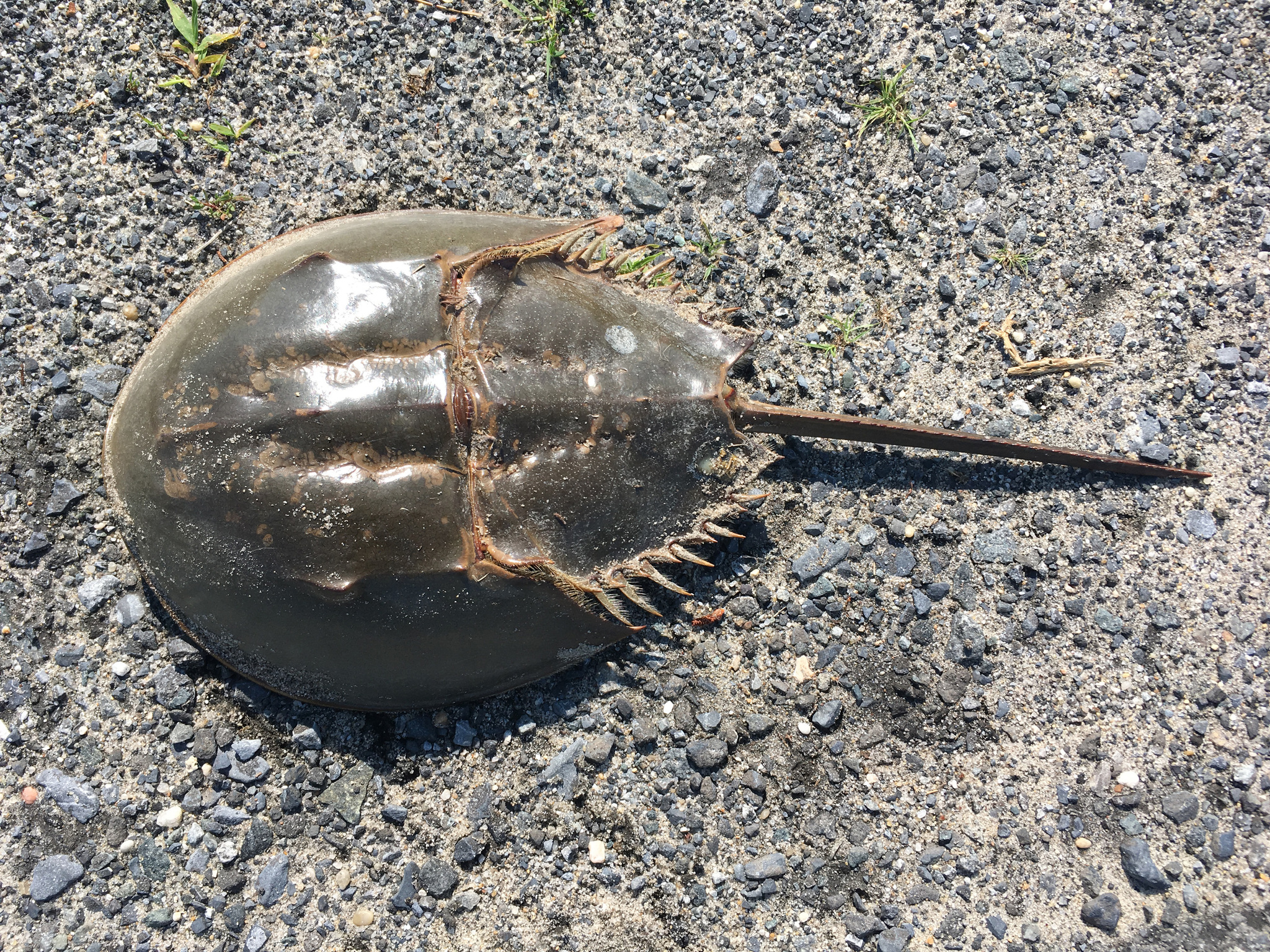
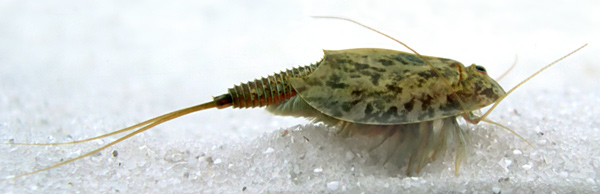
Chief among them is the Triops, the tadpole shrimp that hatches in temporary pools from desert playas to rice paddies. Watch one dart across the bottom of a tank and you are seeing trilobite optics in motion: a pair of dark compound eyes built from many small lenses, plus a tiny third eye at the center of the head, a layout we explore in Triops and Its Three Eyes. The lenses are no longer calcite, and the animals no longer wear armor quite so grand, but the underlying plan is the same one trilobites carried into the Cambrian sea.
The first creature on Earth to see its world clearly was a segmented arthropod with eyes made of limestone mineral, and its descendants still hatch in mud puddles every spring. Vision is old. Older than bones, older than teeth, older than almost anything else you can name.