Published 2026-10-13 · by the Triops.me Editorial Team · Back to Articles
Megaloceros: The Giant Deer That Was Neither Irish Nor An Elk
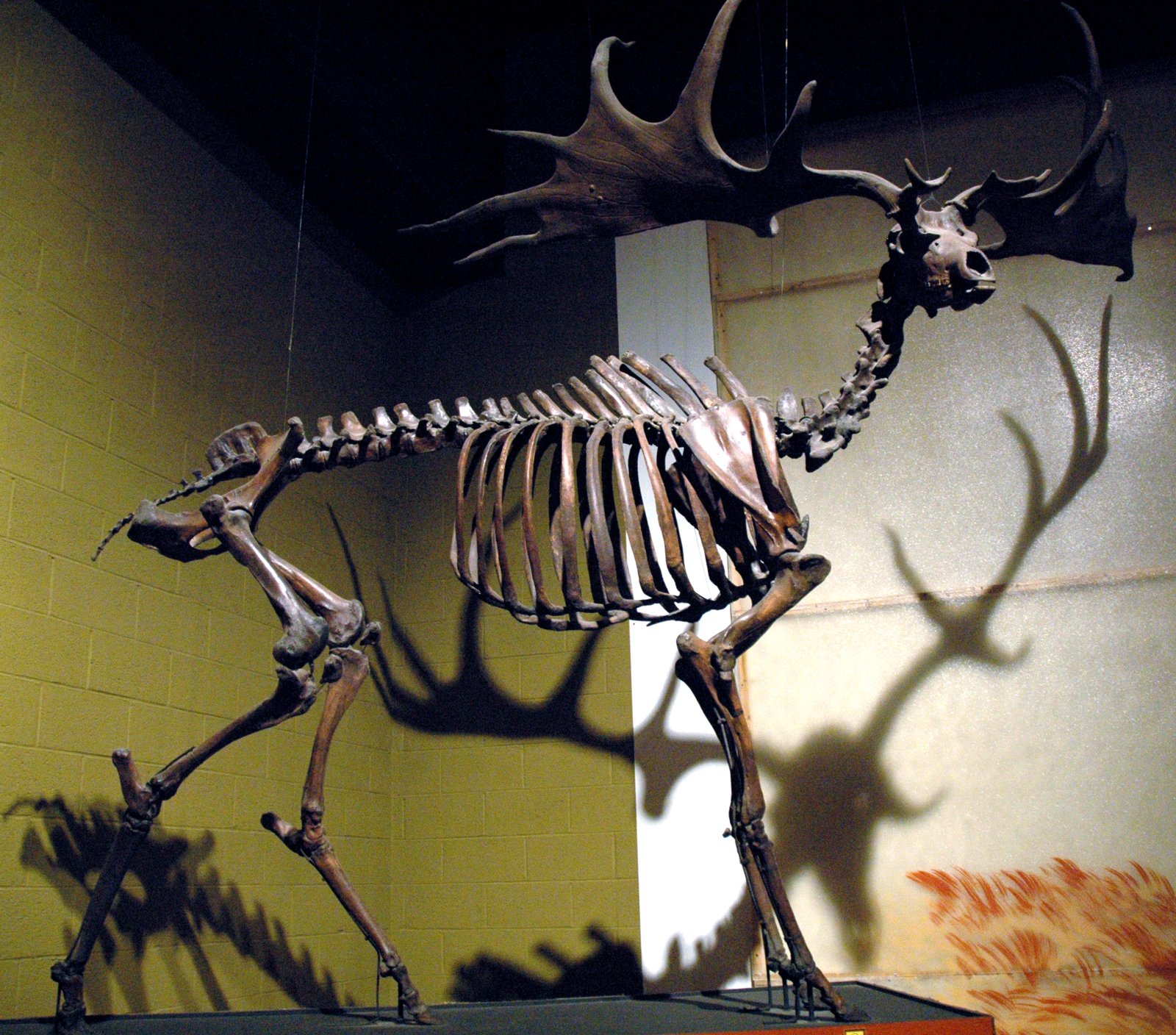
Nearly every natural history museum in Europe has one, and it never fits the case: a deer that stood about two metres at the shoulder, built like a small lorry, crowned with a fan of bone as wide as a small car is long. This is Megaloceros giganteus, the giant deer, better known as the Irish elk. It was the heaviest Old World deer that ever lived, it wandered from the Atlantic coast of Ireland to the shores of Lake Baikal, and it vanished roughly 7,700 years ago, long after humans had started farming and clearing land. On the mainland it outlasted the woolly mammoth.
The Irish part of the story is an accident of preservation. Ice age animals rot on open ground, but Ireland's peat bogs pickled them, so the country fills with antlers, and by the nineteenth century digging them out had become a trade. In 1865 a complete skeleton fetched about 30 pounds, a fine skull with antlers 15 pounds, more than thirty weeks of wages for an unskilled worker. Bogs were drained, antlers were sold to country houses as decoration, and museums on two continents were furnished from Irish peat.
Neither Irish, Nor an Elk
The name got the animal wrong twice. In 1695 the Irish physician Thomas Molyneux examined a set of huge antlers dug up at Dardistown and argued that Ireland had once held the elk, by which he meant the moose of North America and Scandinavia. He was half right about the abundance and entirely wrong about the animal. A century later, in 1799, the German naturalist Johann Friedrich Blumenbach named it Alce gigantea from Irish material, and the type specimen he worked from, a male skull carrying its antlers, came out of the ground near Dunleer in County Louth. It has never been thrown away. It sits in the library of Barmeath Castle, where the antiquarian Thomas Wright first described it.
Genetics has since settled the family argument. The giant deer was not closely related to moose, and not to red deer either. Its nearest living relative is the fallow deer, the modest palmate-antlered animal kept in English parkland. Two metres of shoulder height and half a tonne of body separate them, but the family resemblance shows in the flat, shovel-like antlers both species grow.
The Price of Carrying Antlers
Numbers do not convey the rack. The broadest antlers on record, from the Barmeath skull, measure 4.26 metres from tip to tip, and the heaviest reach 40 kilograms. On average the antlers of Megaloceros held more than twice the volume of a moose's. A stag of 450 to 700 kilograms was carrying as much as a large suitcase of bone on its head, regrowing it from scratch every single year.
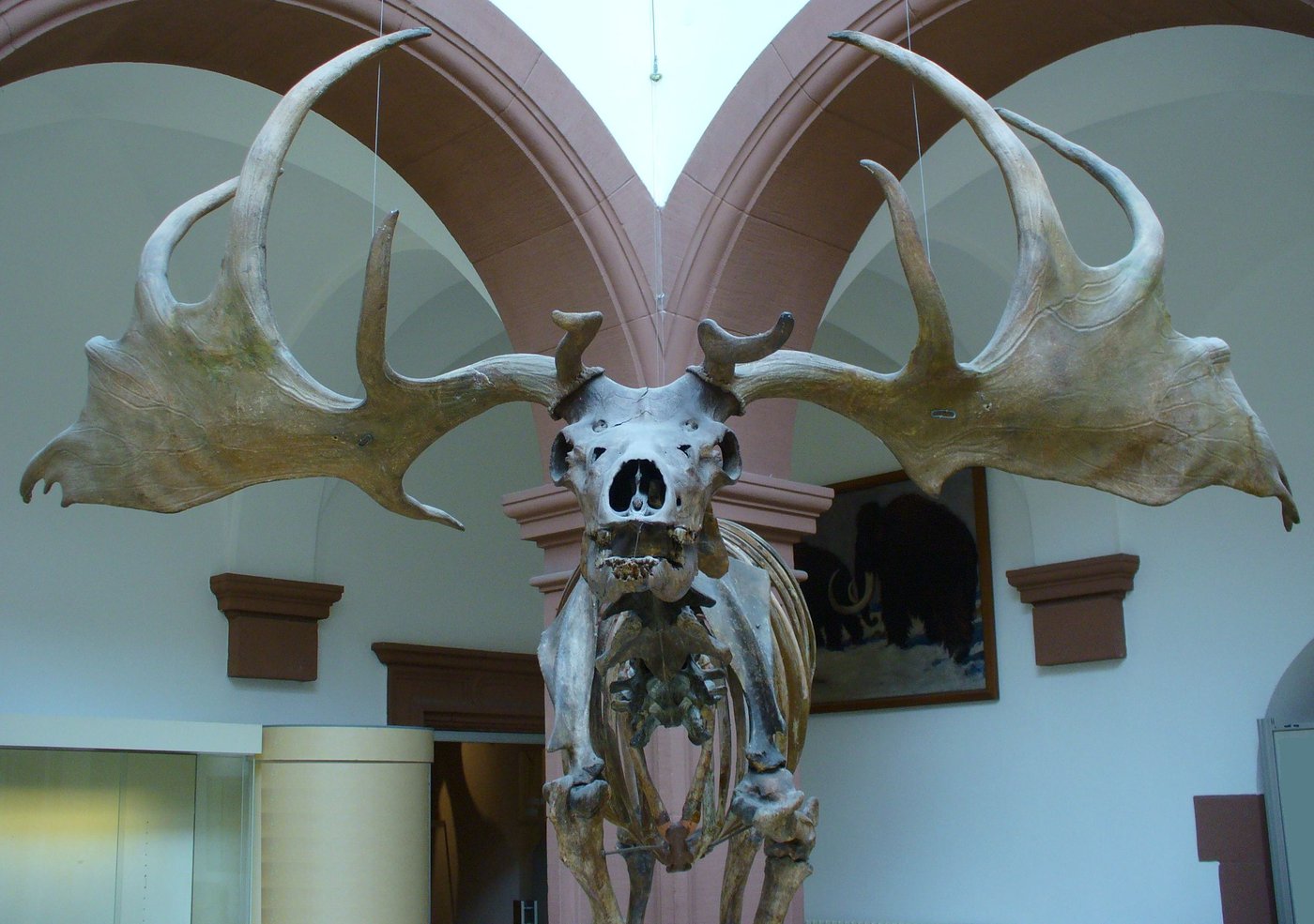
That annual cycle set a brutal calendar. The old antlers drop in early March, growth peaks in early June, the rack is finished by mid-July, the velvet is rubbed off against bark by late July, and by the second week of August the stags are fighting. A doe carries her calf for about 274 days, so a stag rutting in August produces a calf in early May, timed with the spring flush of new growth. The mineral cost is where it gets interesting. Antlers are bone, and bone needs calcium and phosphate in bulk. During the 120 days of growth the stag mines its own skeleton, developing a temporary condition much like osteoporosis, and only repays the debt from food once the antlers are finished. A lean stag of 675 kilograms needed some 39.7 kilograms of fresh forage a day, plus about 1.4 kilograms of protein daily while the antlers grew. Nutritionally, the ornament was a second animal living on the first one's credit.
Built for Open Ground
Where the giant deer lived shaped what it looked like, and that fact quietly demolishes the classic caricature of the species. Its range covered boreal steppe and open woodland, from Ireland to Lake Baikal, and it kept off the truly frozen mammoth steppe of Siberia. Teeth carry the menu with them: pollen scraped from Megaloceros molars shows wormwood and thistles, grass and willow, while wear and isotope studies describe an animal that could switch between grazing and browsing at will. It was a mixed feeder with an unusually wide tolerance, not a picky specialist.
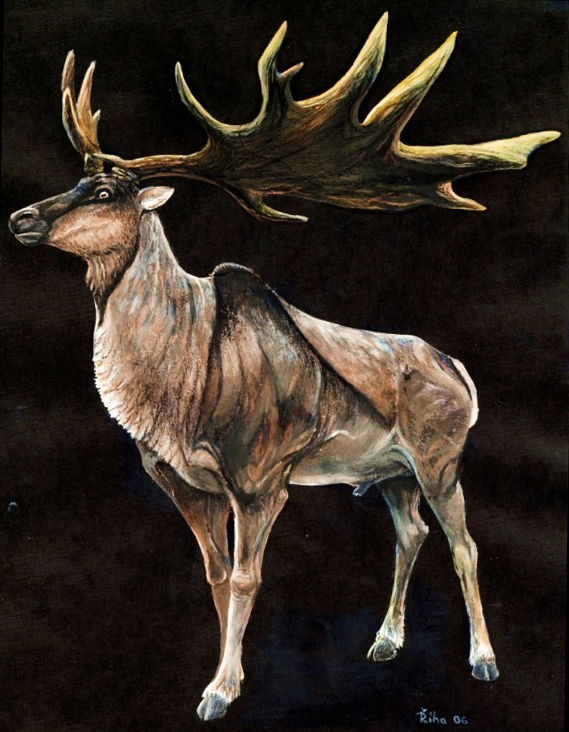
The antlers themselves followed the habitat. Populations living in closed forest carried compact, upright racks that could be pushed through trees, while open-country stags grew the wide palms that make the species famous. Shape tracked landscape rather than running away with the fashion. The build was athletic too: Valerius Geist argued the proportions match cursorial antelopes such as addax and saiga, animals capable of more than 80 kilometres an hour, and the shoulder hump seen in the fossils has been read as either a muscle anchor for a longer stride or a fat store that keeps a rutting stag from overheating. Predation kept them honest. Gnaw marks on giant deer bones belong to cave hyenas.
Painted, Butchered, Hunted
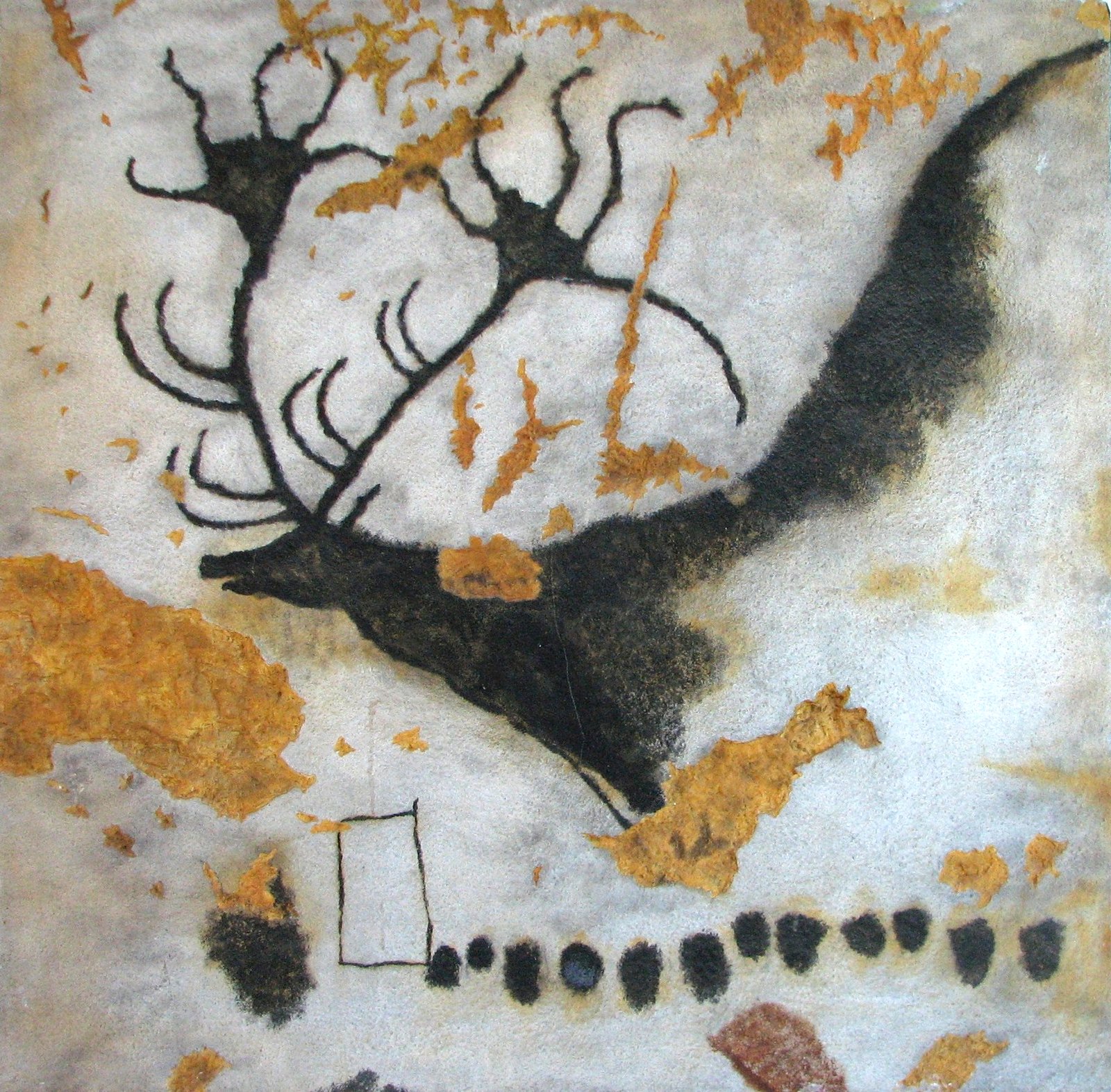
Humans knew the animal well and drew it. A giant deer panel at Chauvet Cave in France is about 36,000 years old, Lascaux has another, and a painting at Grotte de Cougnac shows the beast in colour: a pale body with dark stripes down the flanks, a dark collar at the throat and a black hump over the shoulders. The art is rarer than images of reindeer or red deer, which suggests the giant deer was seen but not encountered daily.
It was eaten too. Neanderthal cut marks turn up on giant deer bones at Bolomor Cave in Spain around 180,000 years ago, and at Italian sites dated to 71,000 and 50,000 years ago. Later people got more deliberate about it: a terminal Pleistocene skull from Lüdersdorf in Germany had its antlers and face deliberately cut away, and shed antler bases were knapped into cores for barbed projectile points. One bog tells the darker story. At Ballybetagh, south of Dublin, more than 100 animals were excavated, every one of them a small-antlered stag, and most were young or old animals in poor condition. They were not hunted into that gully. They were animals in poor condition that walked into a winter they could not cross, and winterkill is still the main way deer die today.
The Antler Myth
Because the antlers look ridiculous, the extinction explanation wrote itself. For more than a century the giant deer was the textbook case of an animal trapped by its own ornament: sexual selection pushing stags toward ever wider antlers until they could no longer run through the closing forest, a display gone terminal. Stephen Jay Gould made the species a standard example of how runaway selection works, and the story has been repeated in popular books ever since.
The evidence has moved on. Antler size shrank steadily through the Late Pleistocene and into the Holocene, exactly the wrong direction for a runaway ornament, and shrank fastest where the habitat tightened, which points at food rather than fashion. Meanwhile the range collapsed during the Last Glacial Maximum, with almost no remains between 23,300 and 17,500 years ago, recovered briefly across northern Europe during the warm Bølling-Allerød interval, then emptied again in the Younger Dryas cold snap. Mitochondrial diversity had been sliding downward from about 50,000 years ago.
The end came in the east. The youngest radiocarbon dates, around 7,700 years ago, come from western Russia and western Siberia, and they coincide with the first scattered Neolithic farmers in the region. Adrian Lister and Adrian Stuart put it plainly: thousands of years of environmental change reduced the giant deer to a small, brittle population, and at that point even light hunting by small human groups could finish the job. No single villain, no fatal antlers, just a species squeezed from every side at once.
Two Ways to Outlast an Ice Age
Compare the strategy with the animal this site is named after. Megaloceros bet everything on size, speed and display, and lost when the stage it had built them for disappeared. The Triops took the opposite road: stay small, breed fast, and pack the next generation into dried mud that waits out drought, heat and time in a state nothing can hurry along. Both approaches carried their owners through the same five mass extinctions, and only one of them is still hatching from pond sediment today. For the rest of the Ice Age cast, start with the woolly mammoth, the cave bear and the Neanderthals who cut the giant deer's bones, then work through the reasons animals grew so large in the first place.