Published 2026-10-16 · by the Triops.me Editorial Team · Back to Articles
Kaprosuchus: The Boar Crocodile of the Sahara
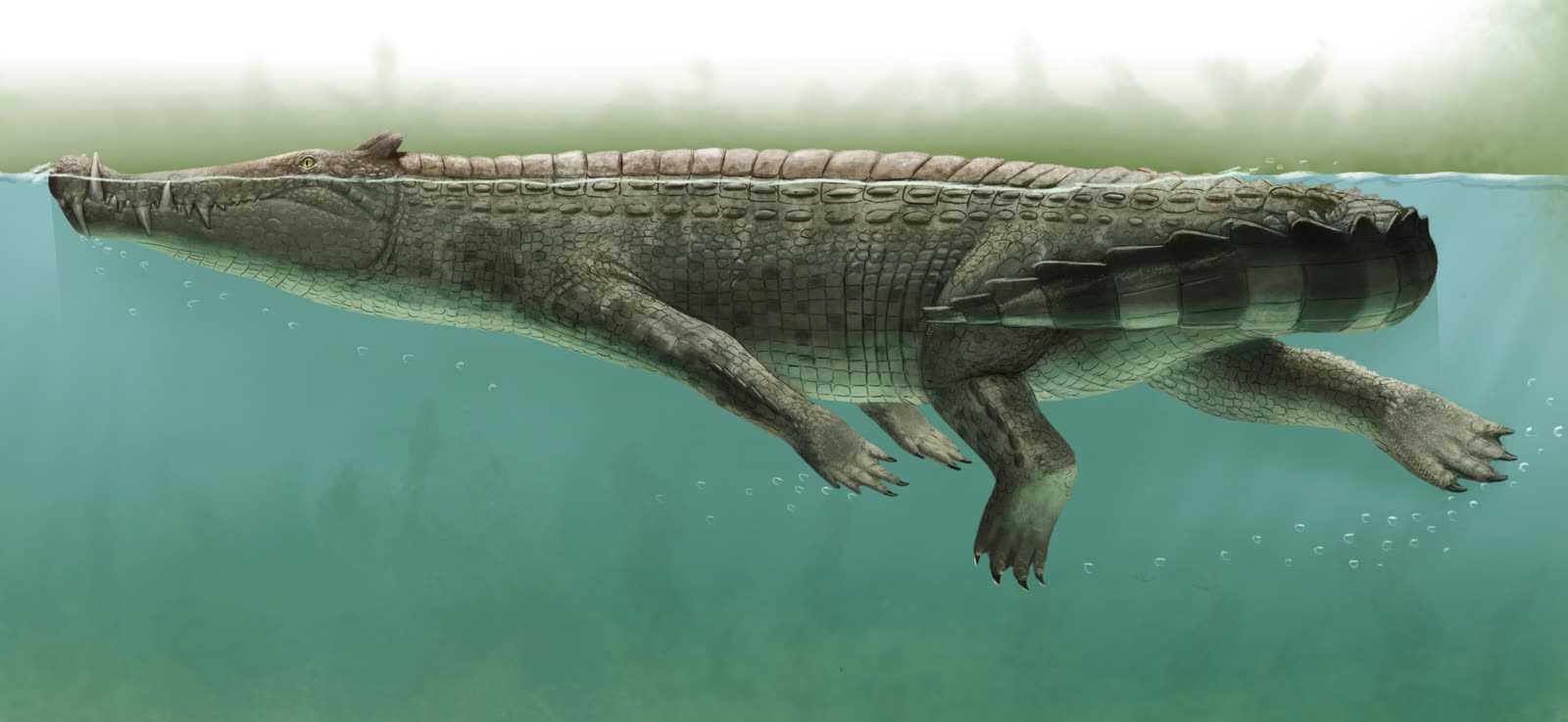
The fossils come out of a place that is now sand and wind: the Echkar Formation in Niger, where the Sahara has been eating rock for millions of years. From that ground, a Chicago and Montreal team led by Paul Sereno and Hans Larsson pulled one nearly complete crocodile skull and, in November 2009, described it in a 143-page monograph in the journal ZooKeys alongside two other new crocodiles from the Sahara. The skull got a name that says everything about it: Kaprosuchus saharicus, from the Greek kapros for boar and soukhos for crocodile. Sereno called it BoarCroc, and once you have seen the teeth, no other nickname sticks.
It is a reminder that crocodiles were not always the slow, uniform, water-bound animals of today. In the Late Cretaceous, crocodylomorphs split into branches that ran, grazed, dug and hunted on dry land, and the boar croc belongs to the strangest of those branches: the notosuchians, a mostly Gondwanan radiation of crocodiles that walked with upright legs and ate like mammals.
A Skull Built Like a Trap
The type specimen is known from a single skull about 507 mm long, with a lower jaw that measured 603 mm. Body length estimates have been revised downward over the years: an older figure of six metres did the rounds after the discovery, while a 2024 study on the pitfalls of sizing extinct animals from proxies put the animal at roughly 2.4 to 3.8 metres. That is still a heavy, deep-skulled predator, and the dentition is the part that has no parallel among crocodyliforms, living or extinct.
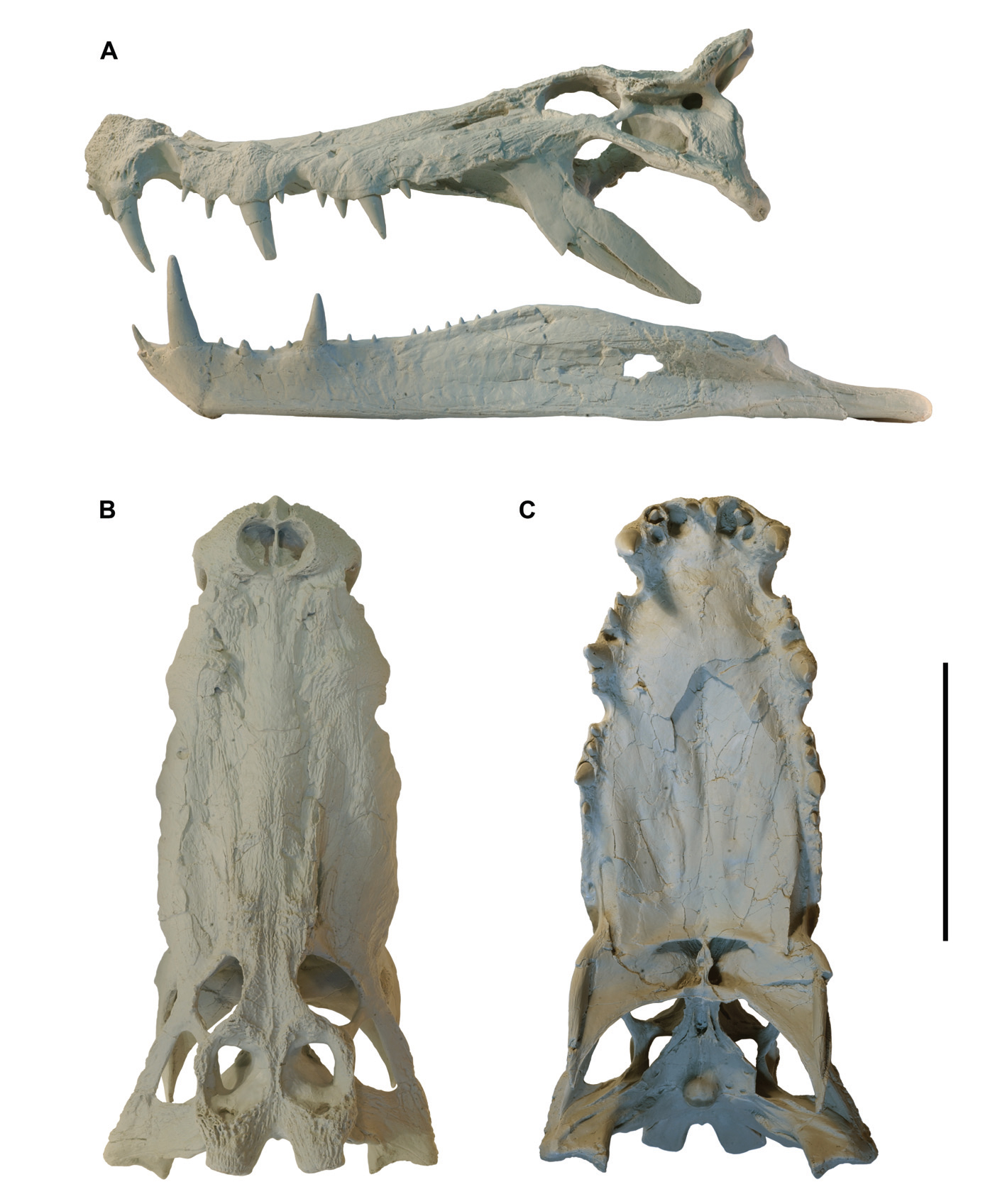
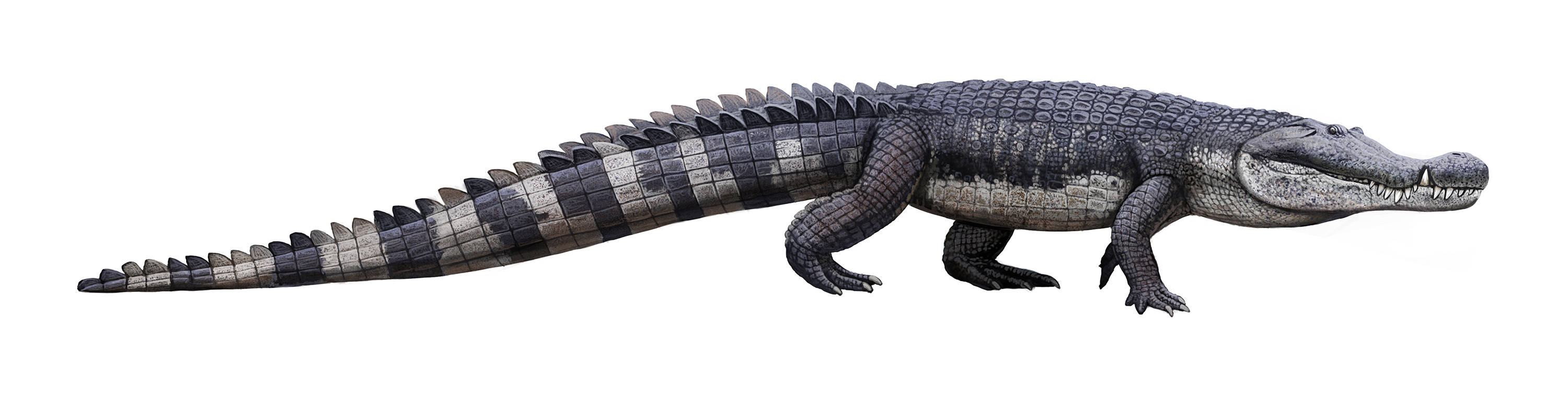
Kaprosuchus carried three sets of tusk-like caniniform teeth that project above and below the line of the jaws, with a lower tusk that slots into notches in the upper jaw when the mouth closes. No other known crocodyliform has that arrangement. The tusks are sharp-edged and relatively straight, unlike the fluted, curved, cone-shaped teeth of crocodiles that fish for a living. Behind the eyes, the squamosal and parietal bones swell into large rugose horns that project backwards over the neck, and the tip of the snout was probably covered by a keratinous shield, judging by the roughened bone beneath it. The two premaxillae at the front of the upper jaw meet along a suture that gives the snout a paired, mustache-like texture in front view. Every feature reads as weaponry rather than fishing gear.
Eyes That Looked Forward
Sereno and Larsson read the skull as the head of a terrestrial hunter. In living crocodiles the eye sockets sit high on top of the skull so the animal can float with only its eyes above water, but in Kaprosuchus the orbits open sideways and angle slightly forward, which suggests an overlap between the two visual fields and therefore some degree of stereoscopic depth perception. Straight slicing teeth, a long retroarticular process at the back of the jaw that would have allowed fast opening with a wide gape, and fused nasal bones thought to reinforce the skull against the shock of a bite all pointed the same way: an animal that faced its prey on dry ground, and possibly rammed it.
That reading has since been contested. Later work on its closest relative, Mahajangasuchus from Madagascar, argued that the big-headed genus was mainly an aquatic predator, and pointed out that both animals also show features typical of definitely semi-aquatic crocodylomorphs: elongate flattened snouts, nostrils positioned on top of the skull, and eye sockets raised above the profile. The honest summary is that Kaprosuchus was probably an ambush predator that worked the edges of rivers and floodplains in what is now the Sahara, then left the water to use its tusks on whatever it caught. Its world 95 million years ago was not desert. The Echkar sediments speak of river systems, floodplains and seasonal lakes.
The Crocodiles That Walked Like Dogs
Kaprosuchus belongs to Notosuchia, a suborder named by Zulma Gasparini in 1971, built almost entirely out of fossils from the southern continents. Notosuchians were generally small to medium-sized, with slender bodies and, crucially, legs held upright under the body instead of splayed out to the sides. Their skulls are short and deep, and their teeth are heterodont, meaning different shapes in different parts of the jaw, a trait that living crocodiles have lost but mammals have kept. Once you have grasping front teeth and grinding back teeth, you are no longer limited to swallowing prey whole.
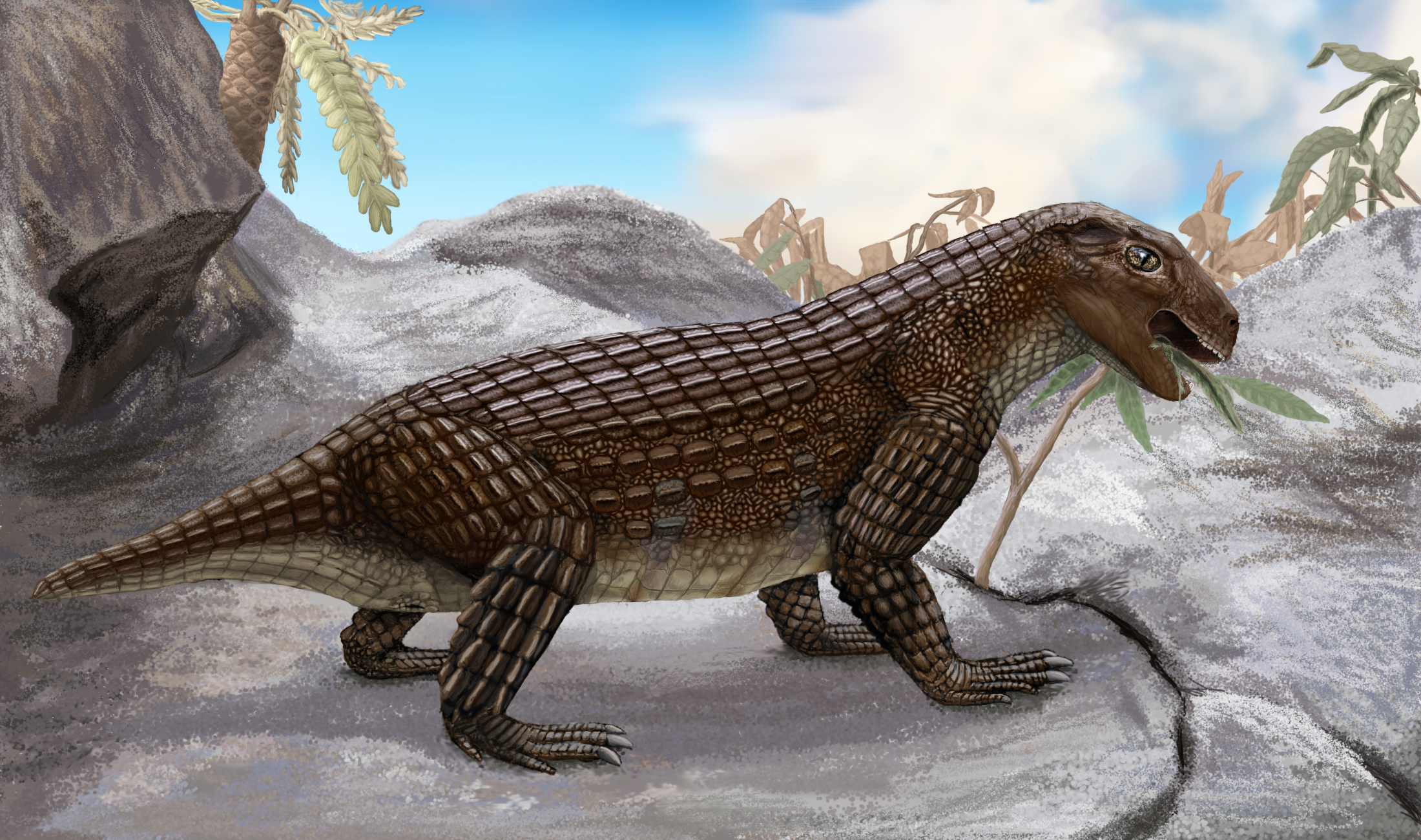
The diet menu they evolved reads like a mammal family reunion. Chimaerasuchus from China was the first notosuchian found with differentiated teeth and is thought to have been a herbivore. Simosuchus clarki from the Late Cretaceous of Madagascar was a broad-snouted, heavily armored animal about 70 centimetres long, with clove-shaped teeth, and was probably an omnivore rummaging through leaf litter. At the other end of the scale sits Baurusuchus from Brazil, a terrestrial hypercarnivore 3.5 to 4 metres long that hunted where the big theropods hunted. And Araripesuchus, a small notosuchian known from six species across Niger, Brazil, Argentina and Madagascar, is the most species-rich genus of the whole group, which tells you how successful the basic body plan was across Gondwana.
This is the part of crocodile history that usually gets skipped. While tyrannosaurs and hadrosaurs were busy in the north, the south belonged to crocodylomorphs that filled the jobs we now hand to dogs, pigs and hyenas. Notosuchians shared their landscapes with dinosaurs rather than competing with them head-on, holding the small and medium predator and scavenger niches on land.
How the Land Crocs Ended
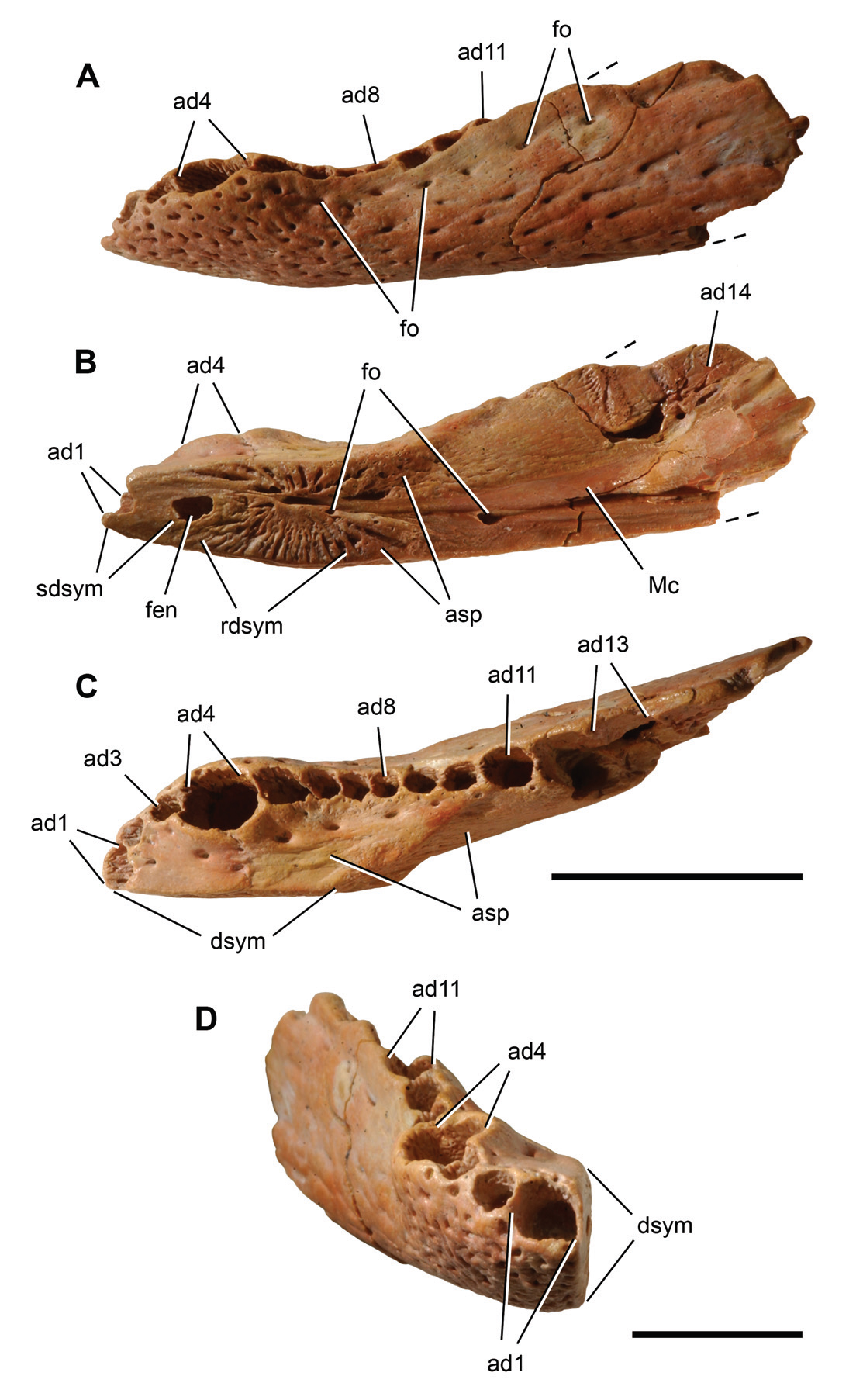
The notosuchian experiment peaked in the Cretaceous of Gondwana and then ran into the same wall as everything else at 66 million years ago. Most of the group disappears in the Maastrichtian, and after the end-Cretaceous extinction the crocodile lineage that survived was the semi-aquatic one: floating, ambush-hunting and metabolically cheap to run. Notosuchians do not vanish from the record entirely, though. Their sebecoid relatives hung on in South America into the Eocene and Miocene, and a 2025 description of a sebecid jaw from the Miocene of Hispaniola shows an apex predator of the early West Indies ecosystems, which means the land-croc body plan had at least one last stand long after the dinosaurs were gone.
What the Boar Croc Leaves Us
The boar croc matters less for its size than for what it proves about the range of the crocodilian form. The same basic body that today floats motionless in a river once carried forward-facing eyes, bone horns and a mouthful of tusks across the floodplains of a green Sahara. The giant cousins of this story are already on the site: Sarcosuchus, the supercroc that shared the Cretaceous with hunting dinosaurs, and Deinosuchus, the terror croc of North America. Both were enormous fish-and-shoreline specialists. Kaprosuchus was the odd one out: modest in size, extravagant in arms.
Compare that with the animal this site is named after. The Triops never needed tusks, horns or upright legs to survive. It solved the same problem of drying rivers and disappearing habitats with a strategy measured in millimetres: hatch fast, breed faster, and seal the next generation inside eggs that wait out years of drought in the mud, a trick that carried it through the five mass extinctions that ended the notosuchians' world. The end-Cretaceous impact finished the land crocs and left the pond shrimp untouched. Read next: Postosuchus, the ruler that came before the dinosaurs, for another take on a croc relative running the show on dry land.