Published 2026-10-09 · by the Triops.me Editorial Team · Back to Articles
Mesosaurus: The Little Reptile That Proved Continents Move
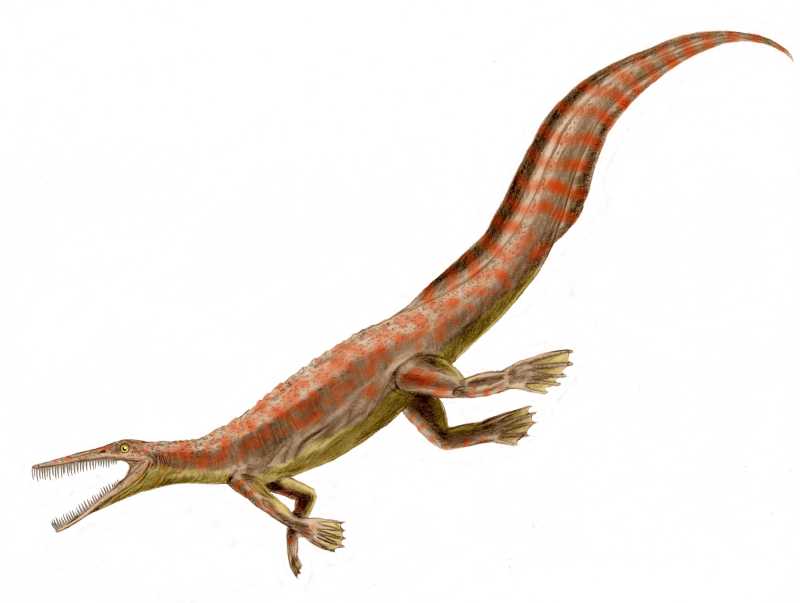
Long before the dinosaurs, a slim reptile about a metre long hunted shrimp in the shallow seas of what is now the southern hemisphere. It was not a fast swimmer, it had no armour and it never grew famous in its own time. Yet Mesosaurus tenuidens ended up doing something no dinosaur ever managed: its fossils helped convince the world that the continents move.
The animal lived around 275 million years ago, in the late Early Permian, in a shallow sea that flooded parts of southern Africa and eastern South America. Its remains turn up in the Karoo of South Africa and in the Irati and Mangrullo formations of Brazil and Uruguay, more than 5,000 kilometres apart across the Atlantic today. That odd distribution is the whole story. A small coastal reptile cannot swim an ocean, so the simplest explanation is that it never had to.
A Fossil That Started Life as a Pot Lid
The first specimen has one of the best origin stories in paleontology. Around 1830, in a hut of the Griqua people near present-day Kimberley in South Africa, someone was using a flat slab of rock as a lid for a cooking pot. The slab happened to hold an articulated skeleton. How it left the hut is unrecorded, but it eventually reached the French paleontologist Paul Gervais, who in 1865 named it Mesosaurus tenuidens, "thin-toothed middle lizard".
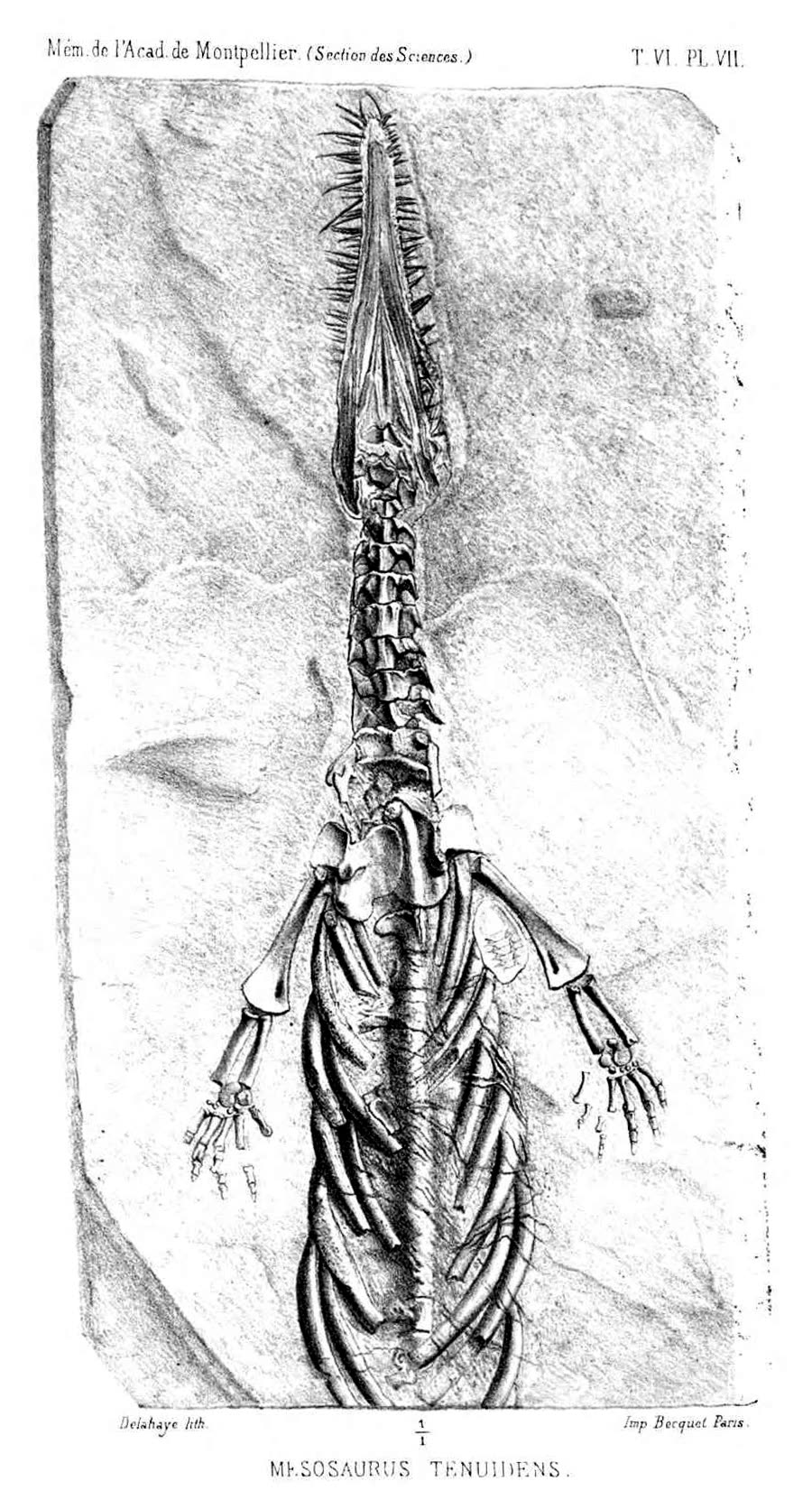
South American specimens were found later, and for over a century paleontologists described three separate genera: Mesosaurus, Stereosternum and Brazilosaurus, distinguished mainly by tooth shape. A 2021 reappraisal by Piñeiro and colleagues showed that the teeth change shape as the animal grows, so the "different genera" were really juveniles and fragmentary adults of a single species. Today only Mesosaurus tenuidens stands, which is a tidy result for a creature once split across three names.
Built for Water, Not for Walking
Hatchlings were 10 to 12 centimetres long, most adults measure around 70 centimetres, and a few rare giants are estimated at 1.5 to 2.5 metres. Whatever the size, the anatomy is unmistakably aquatic. The feet were webbed, preserved as soft tissue impressions in some fossils. The body was slender, the tail long and narrow, the ribs thickened and heavy, and the bones dense through a condition called pachyosteosclerosis. That extra weight was ballast: it let the animal hold neutral buoyancy in the top few metres of water and stay stable at the surface.
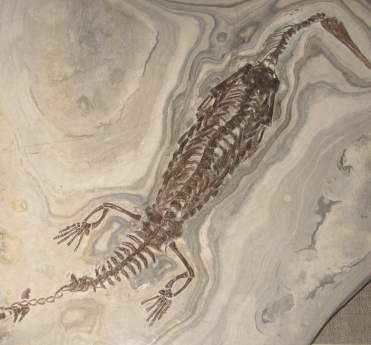
Its nostrils sat on top of the skull, so it could breathe with only the upper surface of its head above water, exactly like a crocodile. Biomechanical studies put its best cruising speed between 0.15 and 0.41 metres per second, a lazy patrol. The elbows and ankles were too stiff for walking; on land it would have hauled itself forward the way a nesting sea turtle does, if it went ashore at all. Some researchers argue adults spent time out of the water, others that they lived in open water permanently. The fossil record has not settled it.
What matters is the direction of travel. After fish and amphibians crawled onto land in the Devonian, Mesosaurus is one of the first reptiles known to have gone back the other way, into the water, and stayed there. It beat the marine reptiles of the Mesozoic to the idea by more than 150 million years.
What Was on the Menu
Older books describe Mesosaurus as a filter feeder, straining plankton through crowds of needle-like teeth. That picture came from assuming the teeth were packed closely together. Re-examination showed fewer teeth than thought, better suited to snatching prey under two centimetres long. Fossil droppings, or coprolites, attributed to the animal contain small crustaceans of the extinct order Pygocephalomorpha, which were abundant in its lagoons. Some coprolites and regurgitated pellets contain juvenile mesosaurs, so it may have eaten its own young, or simply scavenged corpses. Both behaviours are plausible; neither is proven.
The Fossils That Moved the Continents
In 1915 the German meteorologist Alfred Wegener published his case for continental drift, and the matching Mesosaurus fossils of Africa and South America were one of his exhibits, alongside Glossopteris seed ferns and similar Permian tetrapods. An animal that lived in coastal water and never crossed open sea could not be present on two continents separated by an ocean, unless those continents had once been joined.
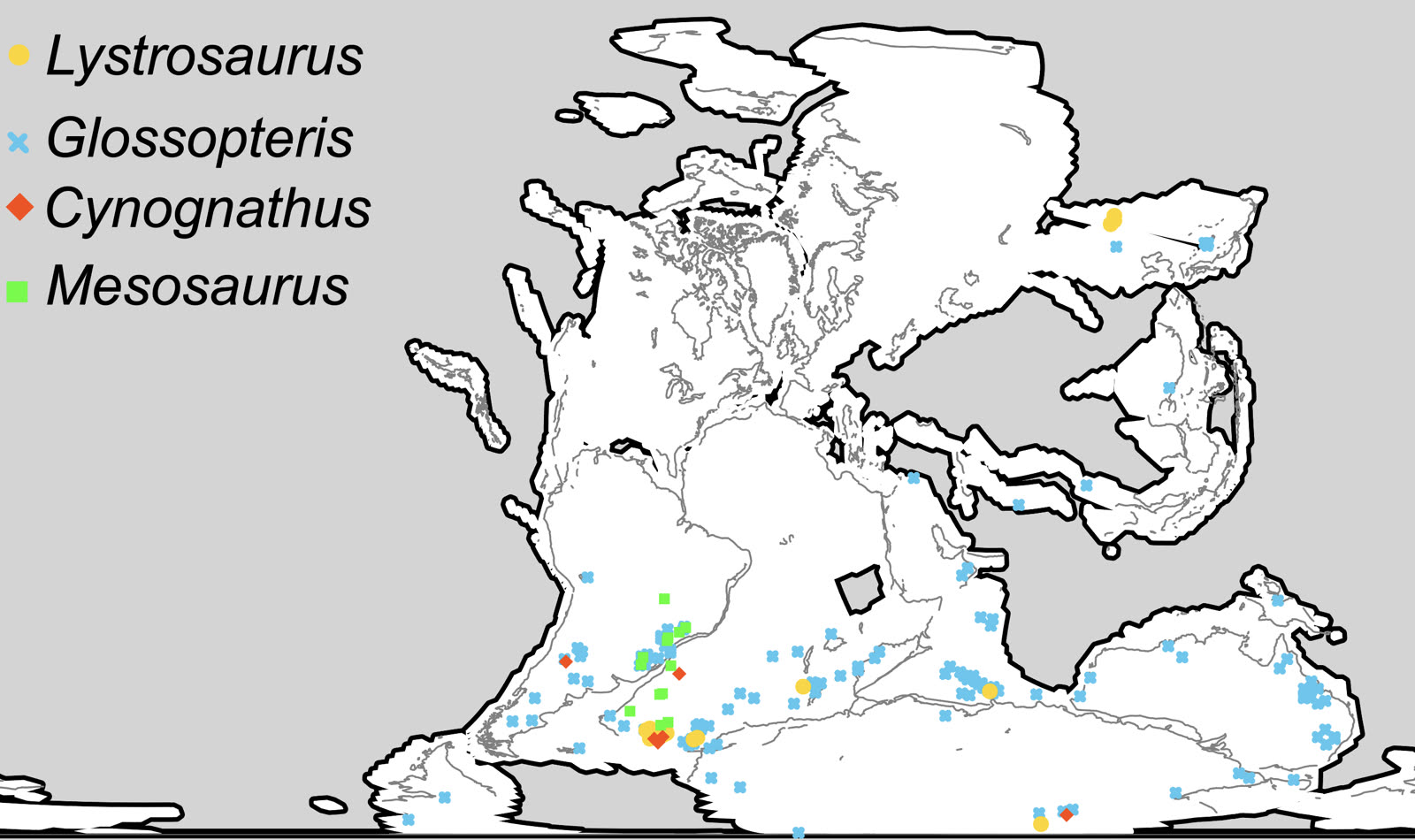
Geologists of the time rejected the idea, partly because no mechanism existed to move continents. Plate tectonics supplied the mechanism half a century later, and Wegener's evidence was vindicated. The rocks tell a specific story: the Irati-Whitehill sea was a shallow epicontinental sea that covered parts of southern Gondwana for perhaps four million years during the Kungurian, then dried up. When it vanished, so did Mesosaurus. The species was already extinct tens of millions of years before the end-Permian mass extinction wiped out so much else, including the armoured Parareptiles of the Russian plains.
The Oldest Fetuses in the Fossil Record
One more claim to fame: Mesosaurus carries the earliest known amniote embryos. Specimens from Uruguay and Brazil preserve advanced fetuses, including a coiled individual with no calcareous eggshell around it, which suggests the oviduct could not secrete calcium carbonate at all. That neatly explains why Paleozoic amniote eggs are so vanishingly rare. Another specimen preserves a small individual inside the rib cage of an adult, read by some authors as a fetus in the uterus and therefore the earliest evidence of live birth in the fossil record. Others interpret the same material as ovoviviparity. Either way, this little reptile was producing babies at sea while its relatives still laid eggs on land, much as the later mammals that returned to the sea would do again.
What a Permian Shrimp Hunter Teaches Us
Mesosaurus is a reminder that survival is not only about toughness. This animal was finely adapted to one shallow sea, and when that sea evaporated, the species had nowhere left to go. It vanished without descendants, but it left behind the clearest physical evidence that the ground beneath us is in motion. Triops took the opposite bet: broad tolerance, dormant eggs, and a willingness to live in any puddle that happens to form. One lineage needed a specific sea and died with it. The other is still here, waiting out droughts in the mud of temporary pools. Read more about these survivors on our Triops deep dive.