Published 2026-10-11 · by the Triops.me Editorial Team · Back to Articles
Tyrannosaurus rex: What a Century of Fossils Actually Revealed
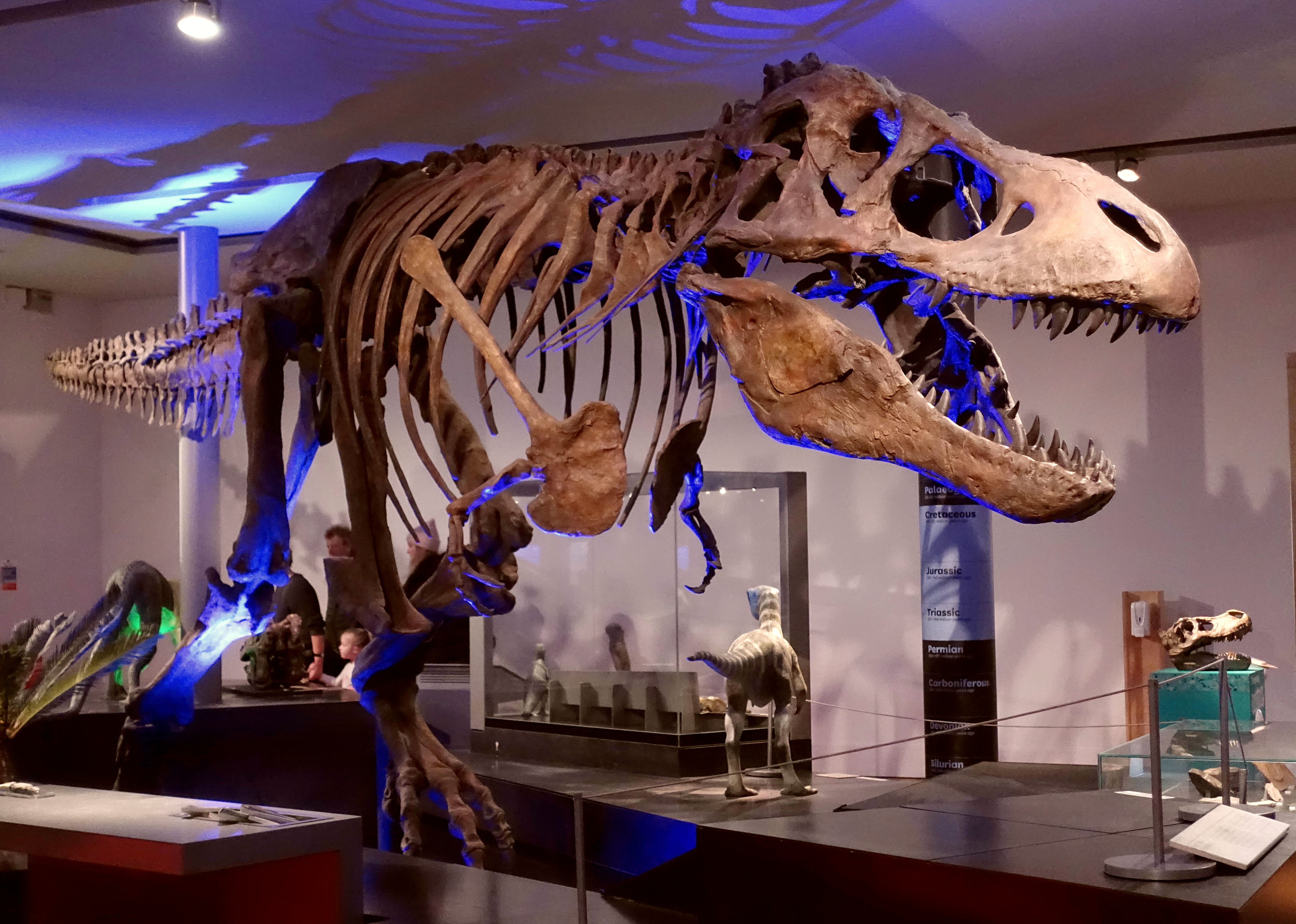
In 1902 a fossil hunter working the red beds of the Montana badlands dug out a set of enormous theropod bones that matched nothing described before. Three years later Henry Fairfield Osborn of the American Museum of Natural History named the animal Tyrannosaurus rex, tyrant lizard king, from material Barnum Brown had collected near Hell Creek. The skeleton was still fragmentary, so almost everything the public pictured about the creature, from its posture to its prey, was an artist's guess.
More than a century on, T. rex is the most closely studied extinct land animal on Earth, with dozens of partial skeletons and thousands of isolated bones in museum collections. None of those discoveries preserved the animal itself. They preserve bone, and bone turns out to hold a lot of information: growth rates read from thin sections, force measured through tooth mechanics, diet recovered from fossil dung, and skin texture stamped into rock. Here is the picture that evidence builds, minus the movie monster.
An Animal Assembled From Famous Specimens
T. rex lived in the latest Cretaceous, between 68 and 66 million years ago, on Laramidia, the island continent that covered western North America. Its bones come out of the Hell Creek, Lance, Scollard and Frenchman formations, which is to say from Montana, the Dakotas, Wyoming, Alberta and Saskatchewan. The closest relative is Tarbosaurus of Asia, so the range was wider than one country suggests, and nowhere else held this particular predator.
A full grown animal measured 12 to 13 metres and carried an estimated 8,000 to 9,000 kilograms. The celebrity specimen is Sue, found in South Dakota in 1990 and around 90 per cent complete, which was about 28 years old when it died and carried the scars of a long, violent life. The heaviest is Scotty, found in Saskatchewan and described in 2019, estimated at roughly 8,800 kilograms over 13 metres. Growth rings in the bone say this was a slow, deliberate build to enormous size, not a fast burning life.
A Bite Engineered To Shatter Bone
The jaws are why the animal became an icon. In 2012 Gregory Erickson and colleagues used X-ray fluoroscopy on living alligators to calibrate their model, then applied it to T. rex tooth positions and produced sustained bite forces of 35,000 to 57,000 newtons at a single posterior tooth, by far the highest estimated for any land animal. A saltwater crocodile, the hardest biting living reptile, manages around 16,000 newtons, and a lion sits well below a fifth of that.
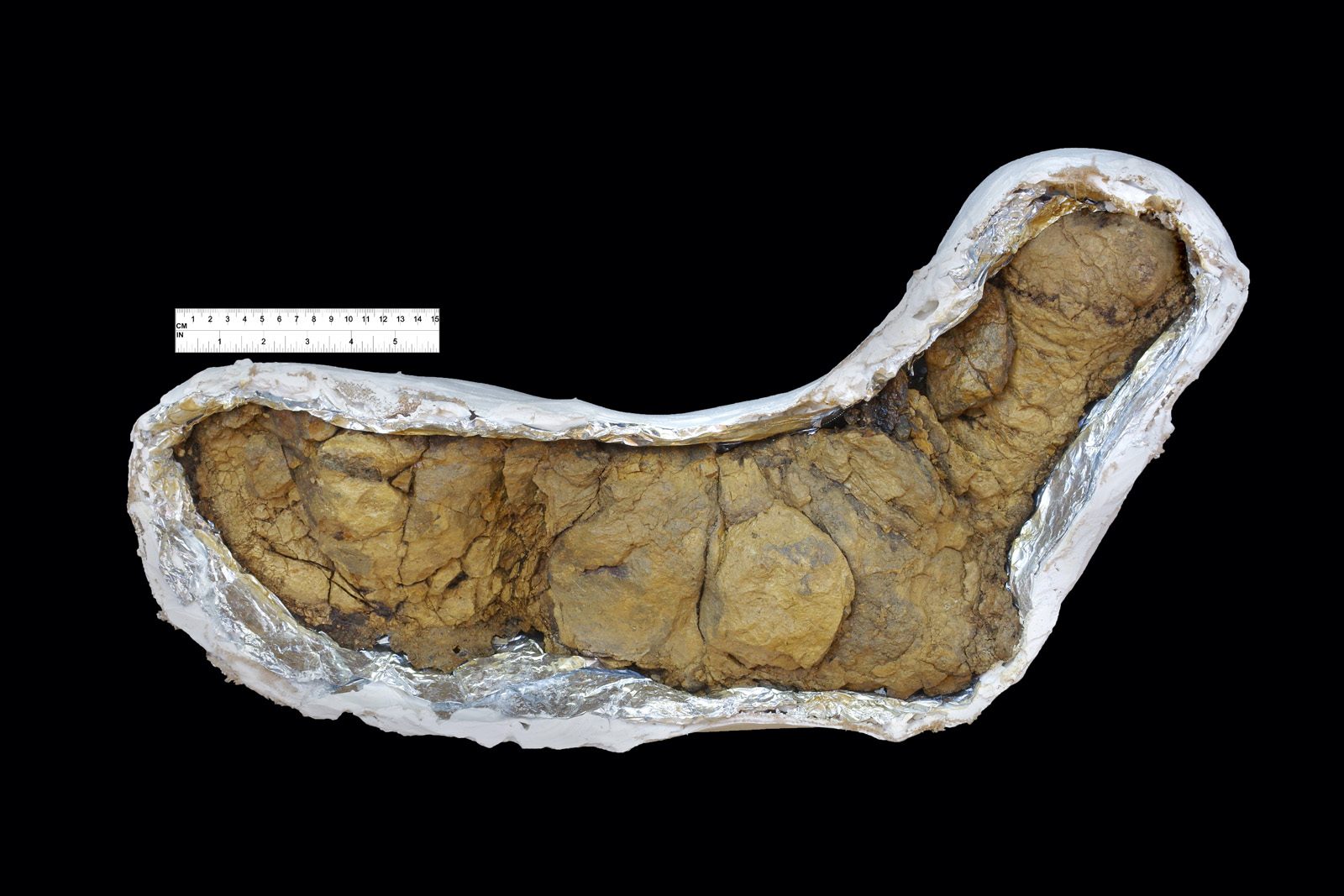
The teeth explain how the force was spent. They were thick, conical, serrated and up to 20 centimetres from root to tip, more like railroad spikes than the slicing blades of a raptor, and the skull was deep and heavily braced at the back to survive the recoil of its own muscles. The payoff shows up in fossil droppings, or coprolites, attributed to T. rex from Saskatchewan: they are packed with shattered bone, including fragments of juvenile dinosaurs. This was an animal that ate its prey whole where it could and ground up the rest.
Twenty Years Of Growing Up
Long bones carry annual growth rings, much like a tree, and paleontologists have cut them from dozens of tyrannosaur specimens. The pattern is a slow start, then a teenage spurt in which a young T. rex packed on close to two kilograms of body mass per day for several years running, then a plateau at full size around the age of twenty. The oldest known individuals lived into their late twenties.
Growth also changed the animal's lifestyle. Subadults have proportionally longer legs, narrower snouts and differently shaped teeth than adults, so juveniles were not just scaled down parents. Several researchers argue young T. rex hunted smaller, faster prey on different ground while the adults took armoured targets, which would keep the two age classes out of each other's way. The species would then occupy two niches at once, from knee height to roof line.
Senses, Arms, And The Myth Of The Sprint
The skull shows eyes set far forward with a wide binocular overlap, so the animal judged distance well, while enlarged olfactory bulbs point to a powerful sense of smell rather than eagle vision. The inner ear proportions suggest it heard low frequencies clearly. This looks like a hunter that worked by scent across a floodplain, then turned to face what it found.
The arms cause endless ridicule and get the science wrong. Each was about a metre long, which is the length of a horse's foreleg, and the muscle scars indicate heavy construction. The two clawed fingers could not reach the mouth, but analyses of the muscle attachments suggest they could grip struggling prey or lever the animal off the ground, a job stubby limbs suit well.
Speed is the stubborn one. Films show a blur at full sprint, while biomechanical estimates in the literature range from roughly 19 to 40 kilometres per hour, and a separate line of work argues that at 8,000 kilograms the legs could not sustain a running gait without damage, leaving a fast walk and short lunges from ambush as the realistic technique. Either way it is a long way from a chase across open ground, and prey were not standing still.
The Feather Question That Will Not Close
In 2012 a fossil from Liaoning in north eastern China named Yutyrannus huali reset the argument. It was a nine metre tyrannosauroid from the same broad family, preserved with filamentous feathers up to 20 centimetres long. Feathers that deep in the family tree almost certainly mean the group started out clothed, and T. rex descended from feathered ancestors.
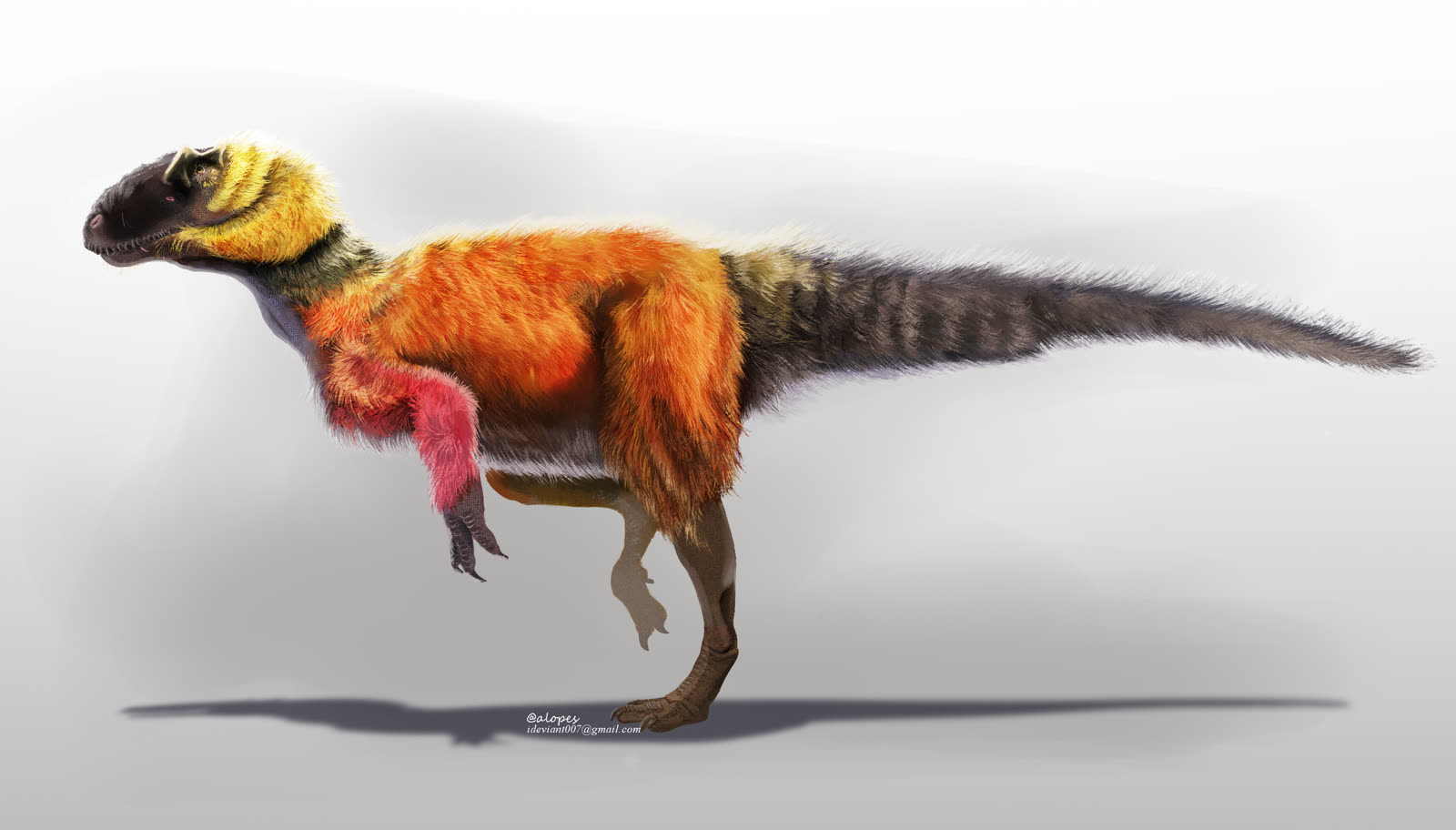
Then in 2017 Phil Bell and colleagues published skin impressions taken from several body regions of T. rex specimens, and every one showed scales. The reading most paleontologists accept now is a largely scaly adult, perhaps with a sparse covering of filaments along the back or neck, and a feathered juvenile stage at most. It remains a patchy record, since impressions survive only where skin happened to press into sediment, so the honest answer is that we know what a few square centimetres of this animal looked like. The paleoart still splits down the middle.
Hunter, Scavenger, And The Arms Race With Triceratops
Scavenger or predator was argued for decades, largely because nobody had watched it, and the fossils settle it in the middle. Healed injuries on Triceratops frills and skulls carry tooth marks spaced like a tyrannosaur's, and the bone had remodelled around them, meaning the animal was struck, survived and lived on. Predators that only find carrion do not leave healed wounds. Other T. rex bones carry tooth marks that only another T. rex could have made, so opportunistic feeding and even cannibalism were on the table.
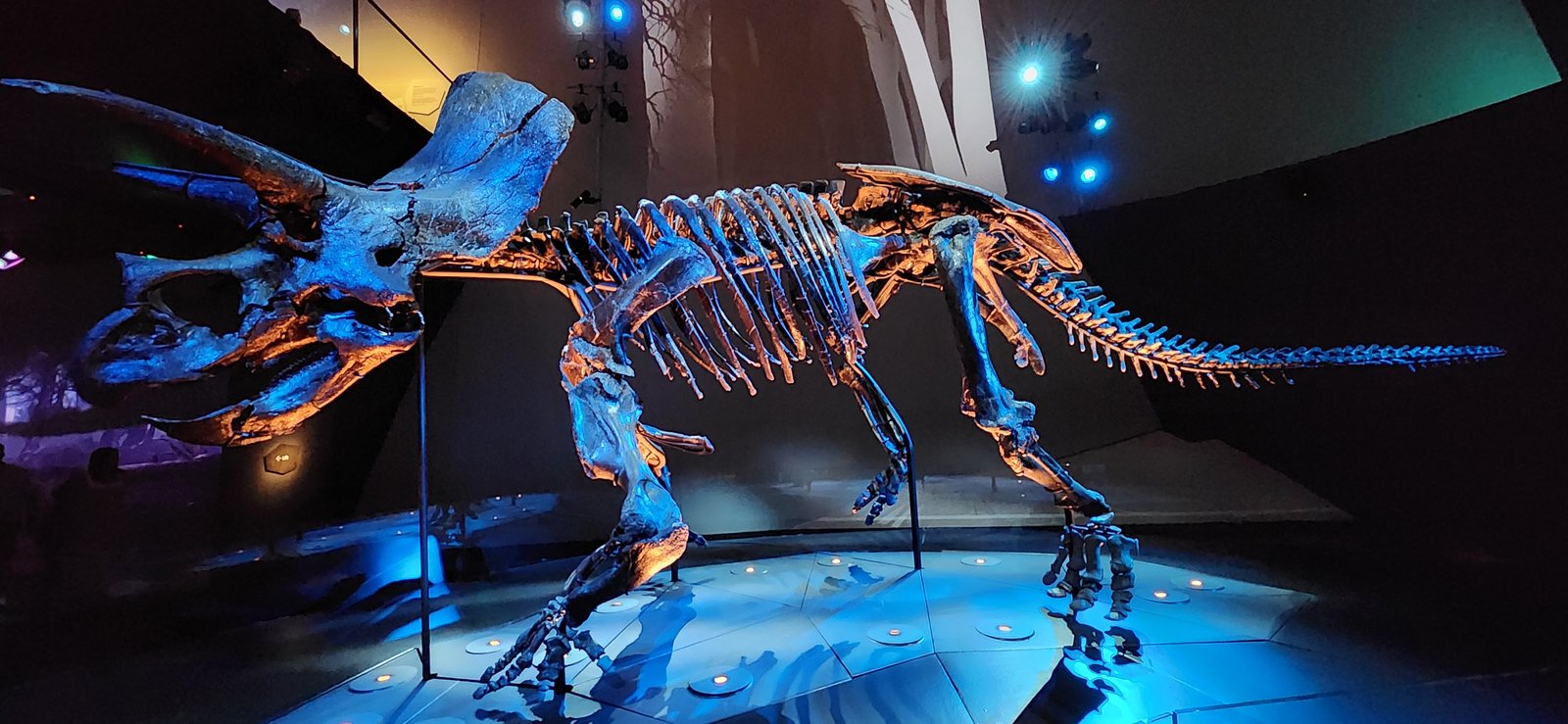
The main prey were armoured Triceratops and the duck billed hadrosaurs of the same floodplains, which sets up one of the classic evolutionary arms races: horn, frill and herd against jaw, vision and ambush. Both sides invested in defence and weaponry for millions of years, and both disappeared together at the end of the Cretaceous. The horned dinosaurs have their own story in our piece on the ceratopsians.
The Day It Stopped Being The Answer
Sixty six million years ago an asteroid struck the Yucatan, the end Cretaceous extinction followed, and the last Tyrannosaurus went with it, leaving no descendants of its own. Its reign was shorter than the fame suggests: at most two or three million years on the planet, a blink beside groups that lasted a hundred million.
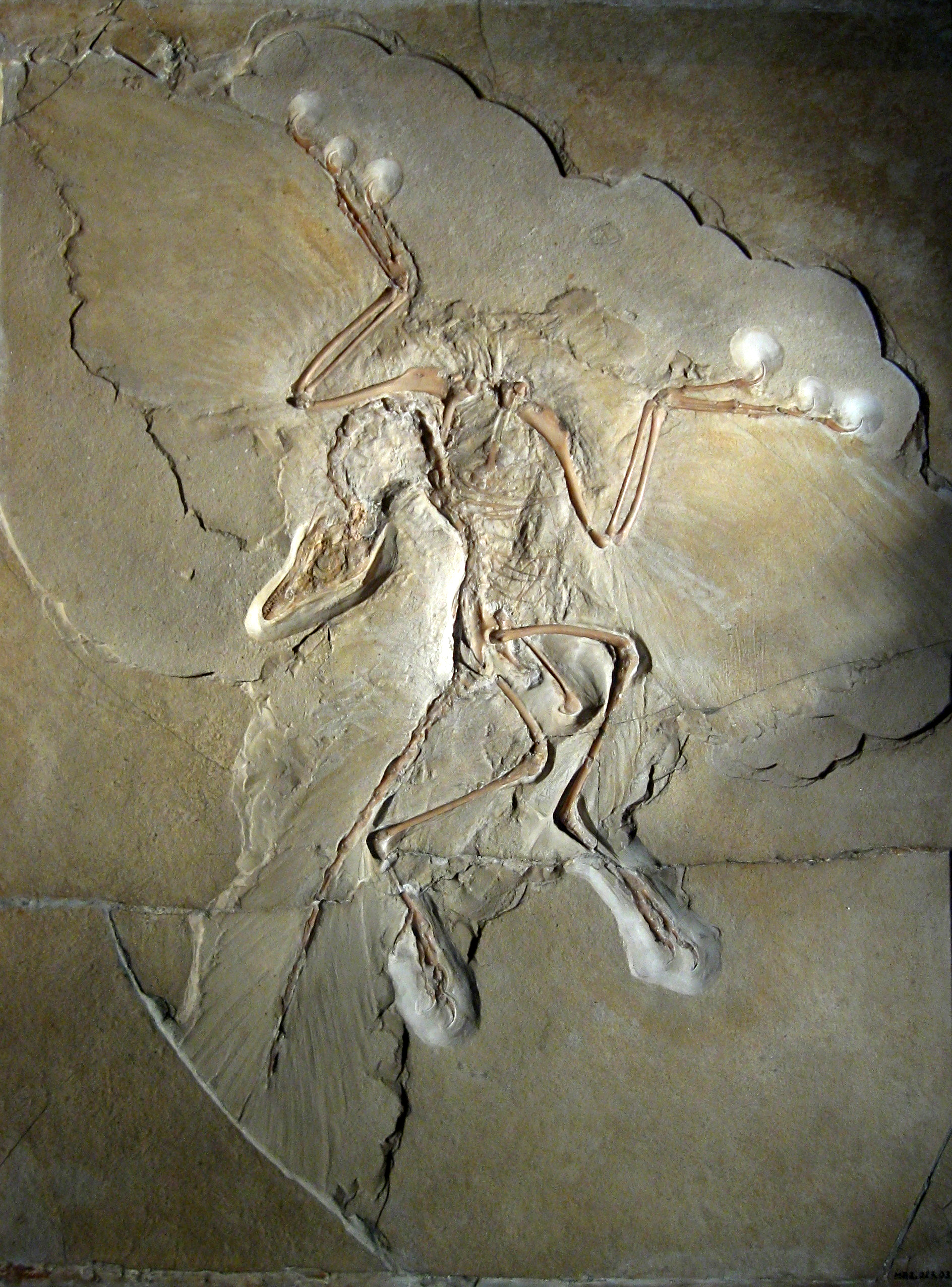
What did survive is closer than most people realise. Birds are theropod dinosaurs, and T. rex sits on the branch leading toward them, closer to a chicken than to Allosaurus. When Mary Schweitzer's team extracted protein sequences from T. rex bone in 2007 and compared them with living animals, the best matches were birds and crocodilians. The Berlin Archaeopteryx, feathers pressed into Solnhofen limestone, is one landmark of that story, along with four winged hunters like Microraptor. The tyrant's lineage did not end. It shrank, kept the wishbone and flew off.
The Survivor's Verdict
There is a useful irony in putting T. rex on a site about Triops. When the tyrant lizard king was striding through the swamps of Montana, Triops was already there, hatching in exactly the kind of temporary pool those floodplains produced, and it had been hatching in them since the Triassic. The giant needed a continent, a food supply and a stable climate, and when any of that failed it had nowhere left to go. The little crustacean needed a puddle and a hard shell of dormant eggs, and it is still with us, having walked straight through five mass extinctions. Size wins the moment. Tolerance wins the epoch.